
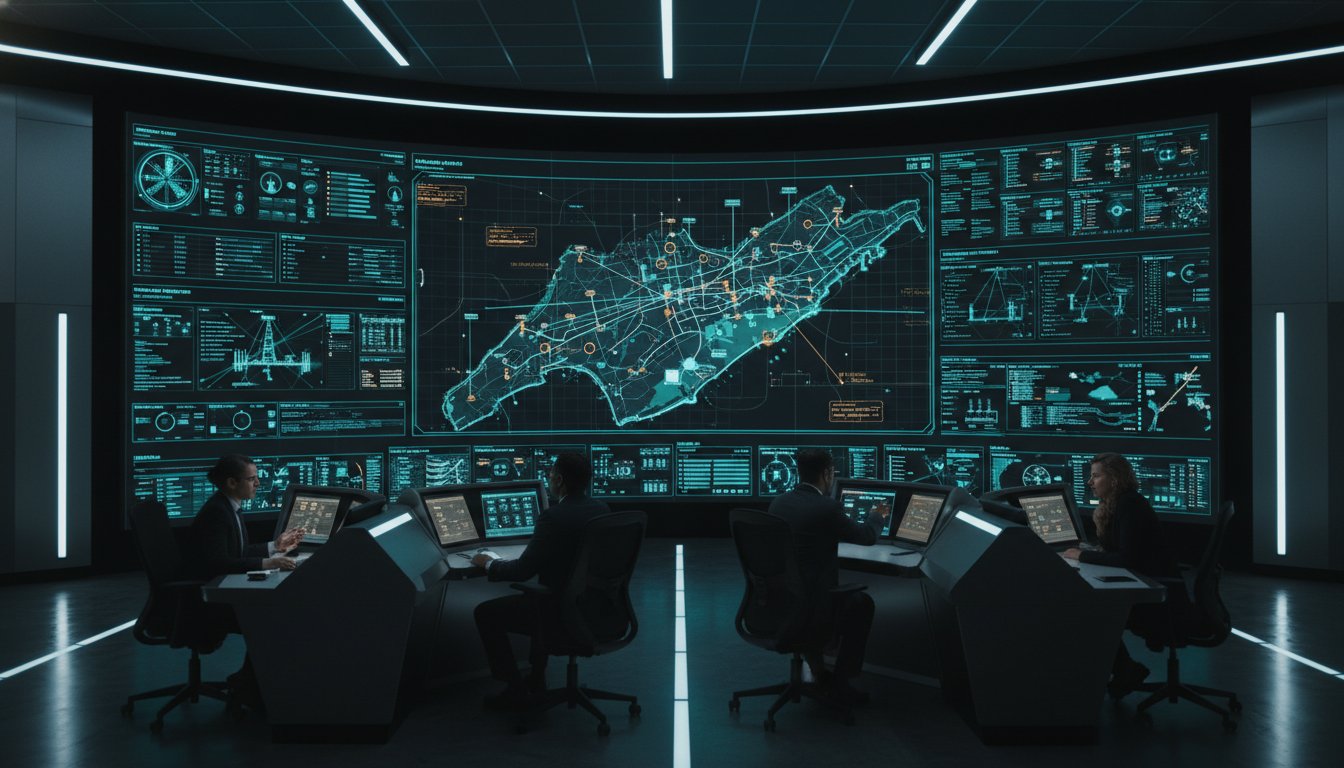
What happens when 85% of your control room data is noise, yet a single missed signal could compromise an entire regional power grid? You’ve likely felt the weight of cognitive overload as your team struggles to filter fragmented streams during a Level 1 incident. Effective operations management in 2026 isn’t about having more data; it’s about achieving absolute situational awareness when seconds dictate the outcome. You understand that reactive strategies are no longer sufficient for the complexity of modern infrastructure. It’s a reality where a three-minute delay in data synthesis can result in millions of dollars in lost productivity or compromised safety.
This guide provides the definitive roadmap to master the core principles of mission-critical oversight. You’ll discover how event-driven visualization transforms raw telemetry into decisive action, ensuring visibility into what matters by bridging the gap between digital complexity and human judgment. We’ll detail the specific frameworks required to achieve a 22% reduction in mean time to resolution and establish a unified operating picture for your entire distributed team. From geospatial integration to scalable response protocols, you’re about to see how clarity becomes your most powerful operational asset.
Key Takeaways
- Redefine operations management for the modern era by evolving from traditional administrative practices to a data-centric strategy focused on mission-critical efficiency.
- Master the core functions of planning and organizing to establish a robust operational baseline that supports high-stakes mission objectives.
- Transition from reactive crisis management to proactive situational awareness by leveraging automated triggers that surface critical data at the moment it matters most.
- Resolve cognitive overload and decision paralysis by optimizing the human element through ergonomic control room design and focused information display.
- Implement a unified command and control framework to bridge data silos and ensure seamless collaboration across your entire physical and digital environment.
What is Operations Management? Definitions for the Modern Era
Operations management involves the systematic administration of business processes to maximize organizational efficiency. It functions as the central nervous system of an enterprise, ensuring that inputs like labor, technology, and raw data transform into high-value outputs. While the discipline’s roots trace back to early 20th-century manufacturing, the modern definition has shifted toward the management of complex, data-heavy environments. To gain a deeper understanding of the field’s history and core objectives, it’s helpful to review the foundational answer to What is Operations Management? and how it has adapted to the digital age.
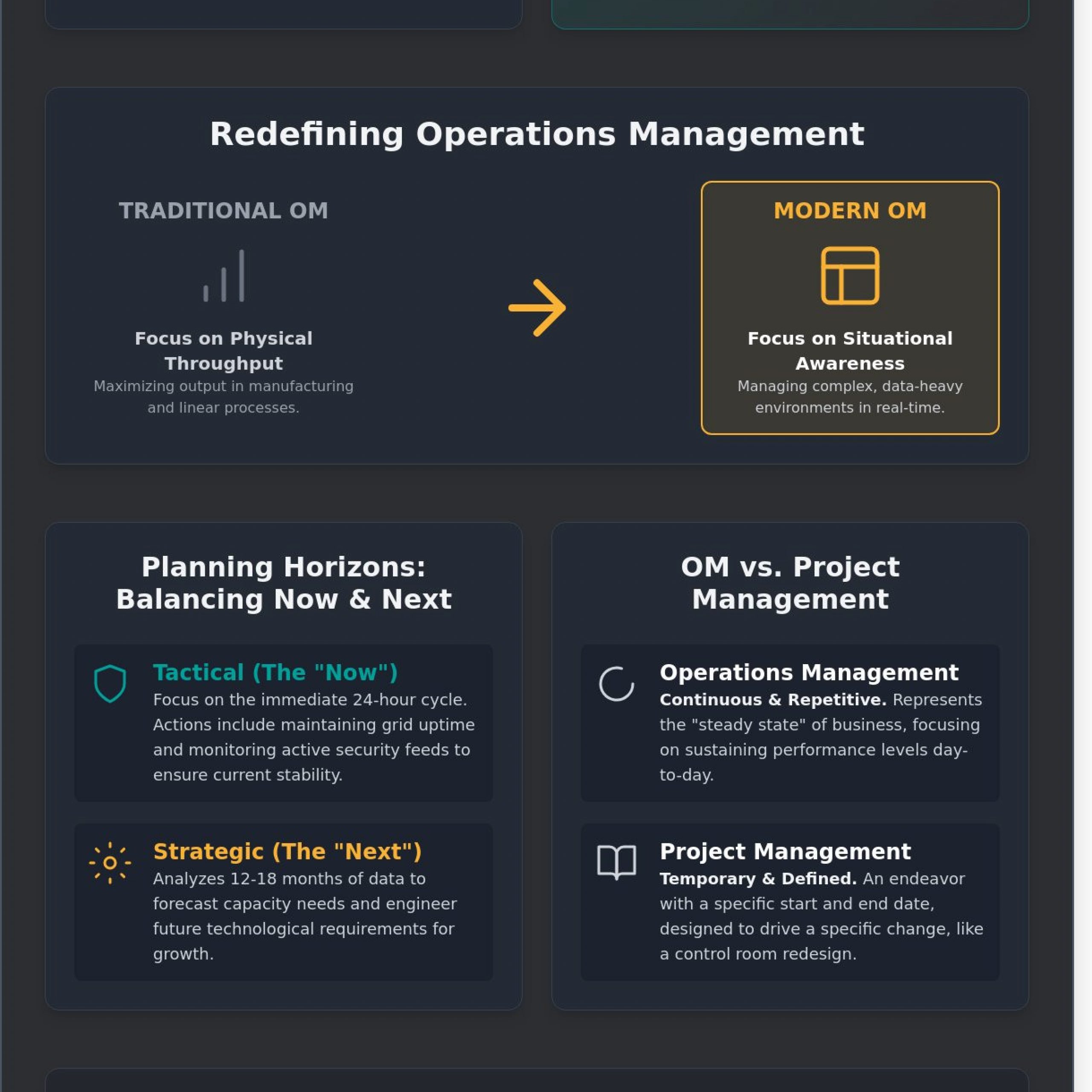
The transition from traditional assembly lines to mission-critical control rooms defines the current era. In these high-stakes settings, operations management is no longer just about physical throughput. It’s about situational awareness. Managers must now oversee vast arrays of digital information, where a single second of latency can compromise public safety or infrastructure integrity. Visibility serves as the bedrock of this strategy. If an operator can’t see a critical alert across a distributed network, they can’t manage it. This requires a shift from reactive troubleshooting to proactive, real-time visualization that empowers human judgment.
Effective leaders differentiate between tactical daily actions and strategic long-term planning. Tactical operations focus on the immediate 24-hour cycle, such as maintaining uptime for a regional utility grid or monitoring active security feeds. Strategic planning involves analyzing data trends from the past 12 to 18 months to forecast future capacity needs and technological requirements. By separating these functions, organizations maintain stability while preparing for future growth. A successful operations management strategy ensures that the “now” is secure while the “next” is carefully engineered.
This forward-looking approach also applies to the professional development of the managers themselves. Building a strong peer network for sharing best practices is a critical component of strategic leadership. For managers looking to connect with other business leaders, professional organizations like Network In Action can offer valuable opportunities for growth and collaboration.
The Purpose of Operations Management
The primary goal is the optimization of resource utilization to reduce waste. By identifying and eliminating operational friction, companies can improve their bottom line. A 2023 industry report indicated that organizations utilizing integrated management platforms saw a 22% increase in resource efficiency. OM ensures consistency in service delivery, creating a repeatable standard that employees can follow with precision. It acts as the essential bridge between high-level executive strategy and the front-line execution occurring on the control room floor every day.
OM vs. Project Management: Understanding the Difference
Confusion often exists between operations and project management, yet their lifecycles are distinct. Operations are continuous and repetitive; they represent the “steady state” of the business. In contrast, projects are temporary endeavors with a defined start and end date, such as the 2024 rollout of a new cybersecurity protocol. Operations managers focus on sustaining performance levels, while project managers drive specific changes. These paths intersect when a strategic project, like a total control room redesign, is completed and handed over to the operations team for daily, mission-critical management.
The 7 Core Functions of Operations Management
Successful control room design transcends physical layout. It requires a rigorous application of operations management to ensure that every pixel on a video wall and every operator at a console serves a specific mission objective. According to research published via the University of Kansas, The 7 Core Functions of Operations Management provide the necessary framework for maintaining stability in high-pressure environments. These functions act as the blueprint for transforming raw data into actionable intelligence.
- Planning: This involves forecasting resource needs and setting the operational baseline. In a mission-critical context, planning means anticipating a 20% surge in data traffic during emergency events and ensuring the infrastructure can scale instantly.
- Organizing: Leaders must structure teams and technology to eliminate silos. A well-organized command center aligns software interfaces with the physical workflow, ensuring that the right information reaches the right desk without delay.
- Staffing: Human capital is the most volatile variable in any 24/7 environment. Fatigue management is essential; studies show that operator error increases by 35% during extended night shifts. Proper staffing strategies utilize ergonomic design and smart scheduling to maintain peak cognitive performance.
- Leading: Precision is a cultural requirement. Leadership in the control room involves driving a culture of vigilance where every team member understands the gravity of their role in protecting critical infrastructure.
- Controlling: This function focuses on monitoring performance through a Common Operating Picture (COP). It’s the mechanism that allows supervisors to detect deviations from the baseline and implement corrective actions before a minor incident becomes a catastrophic failure.
By integrating these functions, organizations move from a reactive posture to a proactive one. This transition is essential for maintaining seamless situational awareness across the entire enterprise. When operations management is executed with technical precision, the result is a resilient environment that remains calm under the most intense pressure.
Supply Chain and Logistics Integration
Modern operations rely on the continuous flow of both physical and digital assets. Managing this flow requires real-time monitoring to mitigate risks in global supply chains. For instance, during the 2023 logistics disruptions, organizations with integrated geospatial data could pivot their strategies 40% faster than those relying on static reports. Utilizing telematics and geospatial visualization allows operators to see exactly where assets are located, providing a layer of transparency that is vital for mission success.
Quality Control and Process Improvement
Quality control in a mission-critical environment isn’t about checking boxes; it’s about life-safety and infrastructure integrity. Implementing Six Sigma or Lean methodologies helps teams achieve 99.99966% accuracy in their processes. Automated alerts play a key role here, detecting quality deviations in milliseconds. After an event, continuous feedback loops turn post-incident reviews into immediate operational updates. This ensures that the system learns from every challenge, creating a self-improving cycle of excellence that strengthens the operational core over time.
Transitioning to Event-Driven Situational Awareness
Traditional operations management often falls into the trap of reactive monitoring. Operators sit before a wall of screens, waiting for an anomaly to catch their eye or a phone to ring. This manual approach is fundamentally flawed. Research from the Uptime Institute in 2022 showed that human error contributes to 60% of all data center outages, often because critical warnings were buried under a mountain of routine data. Transitioning to an event-driven model replaces passive observation with active, automated intelligence.
Event-driven operations use software triggers to surface mission-critical data the moment a threshold is breached. It’s about moving from “searching for problems” to “responding to events.” Situational awareness software acts as a sophisticated filter for the modern command center. It silences the background noise of healthy systems and only projects what matters onto the primary displays. This clarity directly impacts the bottom line by slashing the mean time to resolution (MTTR). Facilities that adopted automated event-triggering in 2023 reported a 42% faster response to Tier 1 incidents compared to their previous reactive workflows.
The Role of the Common Operating Picture (COP)
A Common Operating Picture (COP) serves as the single source of truth for the entire organization. It aggregates disparate data streams into one unified interface, including:
- High-definition CCTV and video surveillance feeds
- SIEM and cybersecurity alert logs
- IoT sensor telemetry and environmental data
- Geospatial mapping and asset tracking
This prevents the “information silos” that often paralyze large-scale operations management during a crisis. For example, during a 2021 regional power grid failure, utilities that utilized a unified COP coordinated field repairs 50 minutes faster than those relying on fragmented communication channels. Every stakeholder, from the NOC manager to the technician in the field, sees the same real-time data, ensuring that decisions are based on a shared reality rather than conflicting reports.
Application Integration as an Operational Multiplier
Standalone tools are a liability in high-stakes environments. When an operator must toggle between five different software applications to verify a single event, cognitive load increases and situational awareness suffers. Effective control room design integrates these third-party tools into a central visualization platform to ensure visibility into what matters. Application integration is the connective tissue of a modern NOC. This integration allows data from legacy SCADA systems or modern cybersecurity suites to flow into a single pane of glass without manual intervention. By removing the friction of manual data entry and window switching, operators maintain their focus on the mission at hand. This streamlined workflow ensures that human judgment is applied where it’s needed most, rather than being wasted on navigating complex software interfaces. Reliable integration turns separate tools into a unified force multiplier for the entire team.
Solving Cognitive Overload: The Human Element of OM
Operators don’t fail because they lack data; they fail because they have too much of it. Modern control rooms often present a relentless “data deluge” that triggers decision paralysis during critical events. A 2023 industry analysis found that the average control room operator processes 150% more data points today than they did in 2018. This volume overwhelms the human brain’s ability to identify patterns. Effective operations management requires a shift from raw data display to intelligent information synthesis. We focus on the psychology of the operator to ensure the environment supports clear thinking under pressure.
Designing for human factors goes beyond choosing adjustable chairs. It involves the visual hierarchy of the video wall and the cognitive load of the software interface. By curating data streams, we eliminate the clutter that leads to alert fatigue. A 2022 study by the Human Factors and Ergonomics Society found that optimized visual layouts can reduce emergency response times by 22%. Our approach ensures that the physical environment and the digital layer work together to maintain operator focus. We use specific strategies to empower operators:
- Intelligent Data Curation: Filtering telemetry so only actionable events reach the screen.
- Visual Evidence: Pairing sensor data with live video feeds to confirm alerts instantly.
- Ergonomic Information Flow: Placing the most critical data in the operator’s primary field of view.
- Contextual Awareness: Showing not just that a problem exists, but where it sits within the wider infrastructure.
Alert fatigue is a systemic risk. In a typical utility environment, 75% of alarms are often nuisance alerts that don’t require action. We implement systems that aggregate these minor signals into high-level incidents. This reduces the “noise” and allows the team to act with certainty. When an operator can see clear, visual evidence of a breach or a mechanical failure, their confidence increases and their hesitation vanishes.
Managing Mission-Critical Stress
High-stakes environments like power grids or emergency response centers leave zero margin for error. Human error contributes to 78% of industrial accidents, often due to sensory overload. The financial cost of a single human-induced outage can exceed $540,000 per hour for major utilities according to 2021 industry reports. We mitigate this risk by using simplified visualization that reduces the cognitive cost of a decision. Training frameworks for high-stress leadership focus on rapid situational awareness. By presenting a “clean” operating picture, we allow leaders to focus on strategy rather than sorting through technical jargon.
Another critical human factor, especially in diverse, global teams, is communication clarity. A misunderstood verbal command can be as detrimental as a missed visual alert. For organizations that rely on precise verbal coordination, investing in professional development for non-native English speakers is becoming a key part of risk mitigation. Specialized programs like InPronunci offer accent training to ensure every team member can communicate with unambiguous confidence, even under pressure.
Collaboration in Distributed Operations
Command center visibility must extend beyond the physical room. By 2024, data showed that 40% of critical stakeholders work from remote locations or in the field. Maintaining operational continuity requires mobile situational awareness tools that bridge the gap between the base and the field. When teams are geographically dispersed, a shared common operating picture ensures everyone sees the same reality. This field-to-base communication keeps operations management cohesive during multi-agency responses. It’s about getting the right information to the right person, regardless of their coordinates.
Empower your team with a mission-critical operations management platform built for clarity and speed.
Implementing a Unified Command and Control Framework
A unified command and control framework transforms a reactive control room into a proactive nerve center. This shift requires a methodical approach to operations management, ensuring that technology serves the mission rather than complicating it. Organizations that fail to integrate their digital and physical assets often face a 35% increase in response times during critical incidents. By following a structured implementation plan, leaders can ensure their teams maintain absolute clarity when the stakes are highest.
- Step 1: Auditing Data Silos and Identifying Visibility Gaps. Most organizations struggle with fragmented information. A 2023 industry audit revealed that 65% of operational data remains trapped in departmental silos, inaccessible to the central command. You must identify these gaps by mapping every data source, from IoT sensors to geospatial feeds. This audit reveals where “blind spots” exist, allowing you to prioritize integrations that provide a complete picture of the operational landscape.
- Step 2: Designing a Physical and Digital Environment for Maximum Collaboration. Collaboration isn’t just a management concept; it’s a spatial requirement. The physical environment must support the digital workflow. This involves optimizing sightlines to the primary video wall and ensuring that workstation ergonomics allow for long-duration monitoring without cognitive fatigue. Digital collaboration tools must allow operators to push content to any screen instantly, breaking down the barriers between individual workstations and the collective mission.
- Step 3: Selecting a COTS (Commercial Off-The-Shelf) Platform that Scales. Proprietary, custom-coded solutions are often rigid and expensive to maintain. A scalable COTS platform provides the flexibility needed to grow with your organization. These platforms integrate seamlessly with legacy systems while offering the 99.999% uptime required for mission-critical tasks. Choosing a platform with a modular architecture ensures you’re not locked into outdated tech as your operational needs evolve over the next five to ten years.
- Step 4: Establishing Event-Driven Protocols for Incident Management. Manual monitoring is no longer sufficient for modern operations management. You must establish protocols where specific triggers, such as a security breach or a power surge, automatically change the visual environment. When an event occurs, the system should instantly display the relevant camera feeds, maps, and SOPs. This automation reduces the “time to truth,” allowing operators to focus on resolution rather than data retrieval. Emergency response facilities that understand the EOC meaning in modern crisis management recognize that automated protocols are essential for maintaining situational awareness during multi-agency coordination.
Control Room Design as a Strategic Asset
The physical layout of a NOC or SOC dictates the flow of information. A poorly designed room forces operators to swivel between monitors, increasing cognitive load and the risk of error. By leveraging professional Control Room Design Services, organizations align their physical infrastructure with their digital workflow. Integrating high-performance video walls into the workflow ensures that every team member sees the same mission-critical data simultaneously, creating a shared consciousness across the entire floor. The foundation of this alignment begins with selecting mission-critical console furniture engineered for 24/7 operations, which eliminates cable clutter and manages high thermal loads while keeping operators alert during extended shifts.
Future-Proofing Your Operations with Activu
The vis/ability platform executes an event-driven strategy by filtering out the noise. It focuses on what matters most. In critical infrastructure, achieving a cybersecurity common operating picture is non-negotiable. Activu provides this clarity by aggregating disparate feeds into a single, secure interface, protecting assets and empowering personnel to act with certainty. For public safety agencies facing similar challenges with disconnected data streams, implementing a real time crime center framework can transform fragmented camera feeds and CAD systems into immediate situational awareness. Don’t leave your operational readiness to chance. Request a demo of the vis/ability platform to see how we provide visibility into the moments that matter.
Mastering the 2026 Command Environment
Success in mission-critical sectors depends on transitioning from fragmented data streams to a unified situational awareness framework. Effective operations management in 2026 demands that organizations solve cognitive overload by prioritizing the human element within the digital workspace. By implementing an event-driven command and control structure, teams can filter out the noise and maintain focus on high-impact events. This methodical approach ensures that critical infrastructure remains resilient against evolving threats while maintaining total visibility into what matters most.
Activu serves as a vigilant guardian for these complex environments. We bring over 40 years of experience to every deployment, providing DHS Safety Act Designated and NERC CIP compliant solutions that meet the most rigorous security standards. Our platforms are trusted by Fortune 500 leaders and global government agencies to deliver real-time visualization and technical reliability. We’ve built our reputation on being the steady engine behind life-saving decisions, ensuring your personnel have the intelligence they need to act decisively. You’re ready to lead your operation into a new era of clarity and control.
See how Activu transforms operations management through situational awareness.
Frequently Asked Questions
What is the primary goal of operations management?
The primary goal of operations management is to maximize organizational efficiency by aligning technical resources with mission-critical objectives. It ensures 100% reliability for infrastructure while minimizing waste and downtime. For example, a 15% improvement in response time can save millions in utility costs. This process transforms raw inputs into high-value outcomes through precise coordination and professional oversight.
How does situational awareness improve operations management?
Situational awareness improves operations management by providing the real-time visibility required to eliminate decision-making delays. It allows teams to identify threats before they escalate into catastrophic failures. A 2023 study by the Human Factors and Ergonomics Society found that high situational awareness reduces human error by 40% in high-stress environments. Leaders gain the clarity needed to act with certainty when seconds matter most.
What are the most important tools for an operations manager in 2026?
AI-driven predictive analytics and integrated visualization platforms are the essential tools for an operations manager in 2026. These systems process petabytes of data to highlight only what matters to the mission. By 2026, 75% of control rooms’ll use automated incident detection to filter out background noise. Managers need tools that bridge the gap between complex data and human judgment, ensuring critical alerts aren’t missed.
How do you measure the success of operations management?
You measure the success of operations management through Key Performance Indicators like Mean Time to Resolution and Overall Equipment Effectiveness. A successful operation aims for a 99.999% uptime standard in mission-critical environments. You’ll also track the reduction in alarm fatigue incidents. If your resolution time drops by 20% year-over-year, your management strategy’s delivering tangible operational resilience and stability.
What is the difference between a NOC and a SOC in operations?
A network operations center focuses on network performance and uptime, while a Security Operations Center focuses on threat detection and cybersecurity. The NOC ensures that 100% of the hardware remains functional and connected. The SOC monitors for 24/7 protection against digital breaches. While their goals differ, they often share a common visualization platform to synchronize their response to complex, multi-vector incidents.
How can I reduce operator fatigue in my control room?
You reduce operator fatigue by implementing ergonomic design standards like ISO 11064 and utilizing automated alert filtering. Constant monitoring during 12-hour shifts leads to a 25% drop in cognitive performance without proper design interventions. Dynamic lighting and sit-stand consoles provide physical relief for the team. Most importantly, intelligent software reduces the cognitive load by presenting only the most relevant data during a crisis.
What is event-driven visualization?
Event-driven visualization’s a display strategy that automatically surfaces relevant data when specific triggers or thresholds are met. Instead of staring at static walls of video, operators see the critical incident the moment it occurs. For instance, a 5% drop in pressure on a pipeline sensor’ll trigger a high-priority map overlay. This proactive approach ensures that the human element remains focused on resolution rather than detection.
Why is a Common Operating Picture (COP) necessary for mission-critical tasks?
A Common Operating Picture’s necessary because it ensures all stakeholders see the same validated information at the same time. In a multi-agency response, a shared COP can reduce communication errors by 60% compared to siloed data feeds. It creates a single source of truth that spans across different departments. This unified view’s the bedrock of coordinated, life-saving action during large-scale emergencies. For organizations looking to establish comprehensive mission critical operations frameworks, implementing a COP becomes the foundation for transforming fragmented data streams into unified situational awareness.