
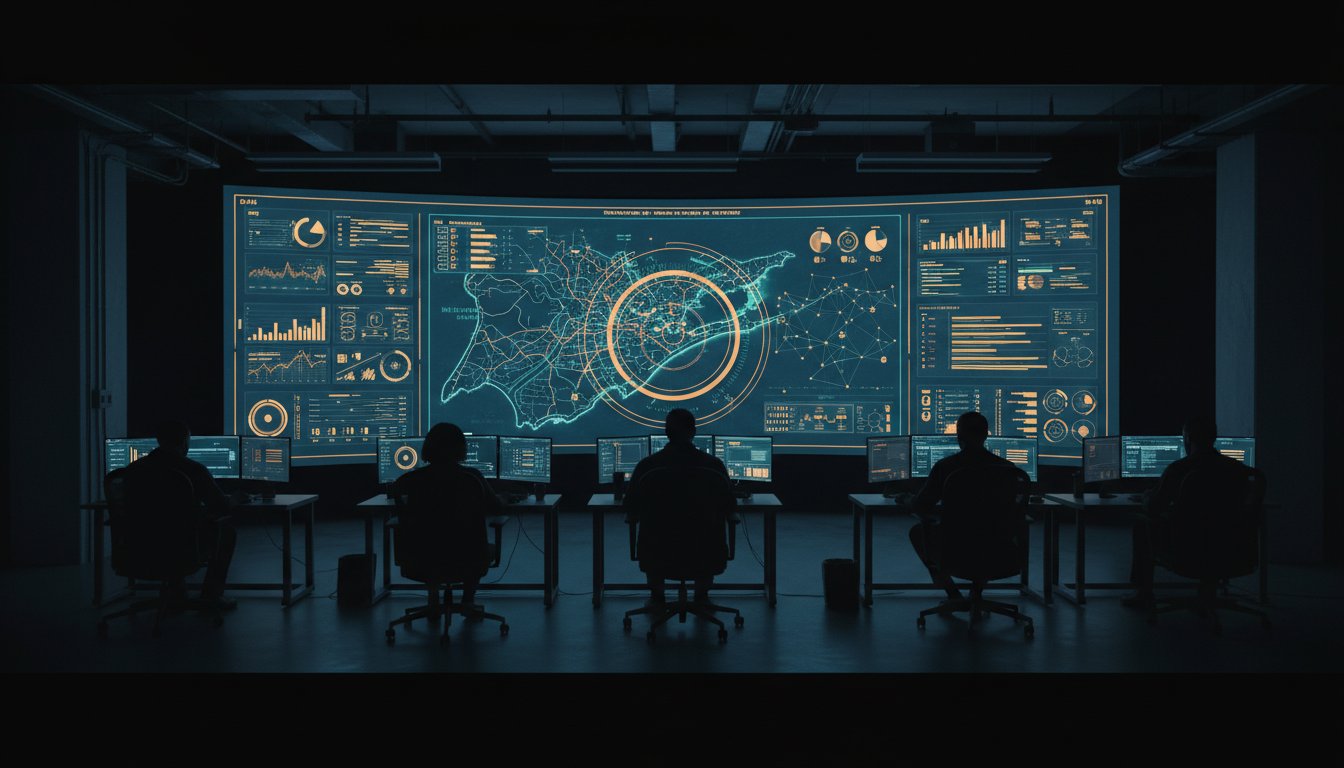
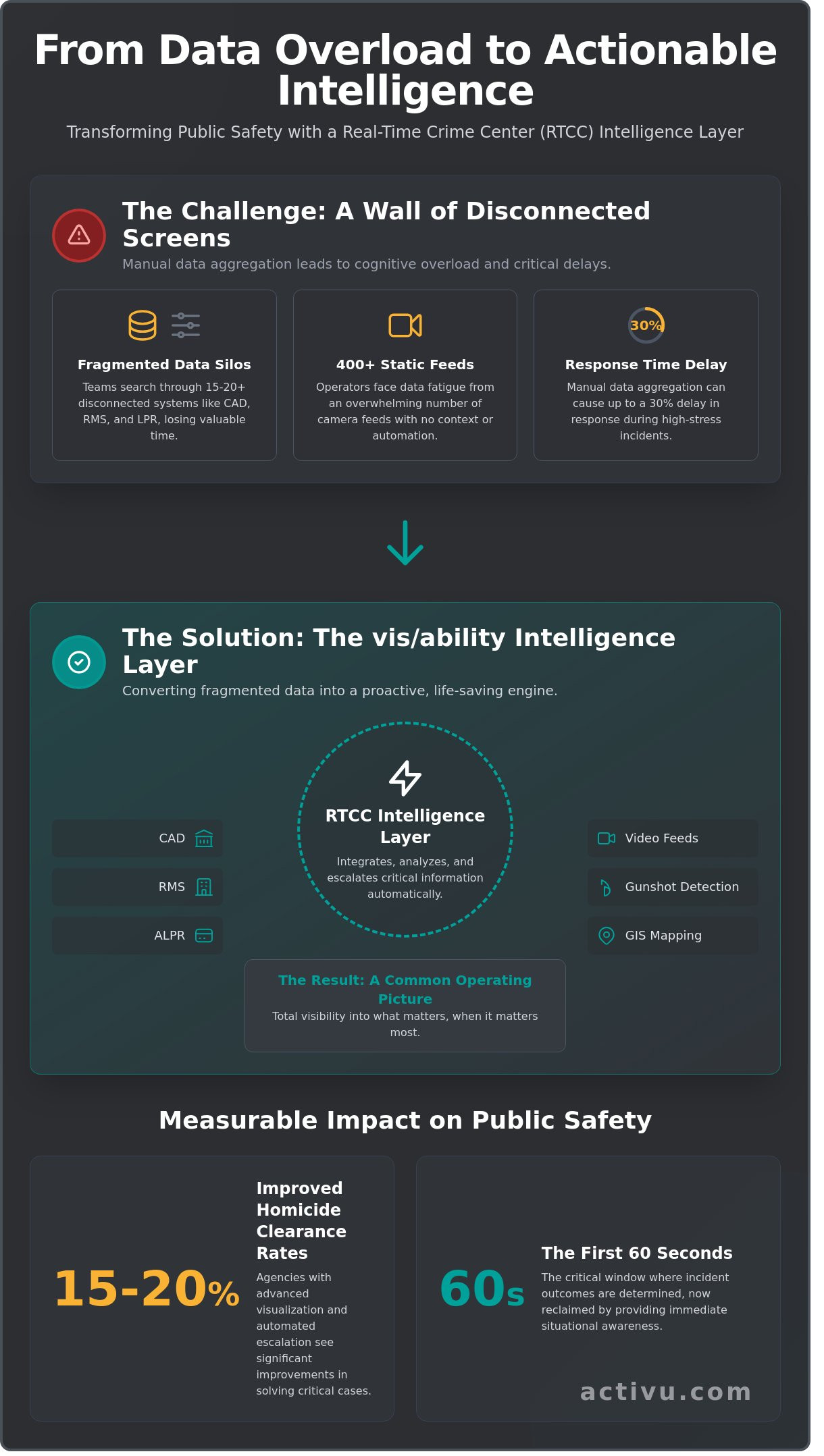
In critical incidents, the first 60 seconds determine the outcome; yet many agencies lose that vital window searching through disconnected data silos. Operations teams often struggle with 400 or more static camera feeds that don’t communicate with CAD or LPR systems, hindering the effectiveness of a real time crime center. This manual aggregation creates a gap where critical information stays hidden, often leading to a 30 percent delay in response times during high stress events. Most control rooms already have the screens. What they’re missing is the layer that decides what goes on them, and escalates automatically when something needs attention.
You understand that raw data is a liability when it overwhelms the person behind the desk. This guide details how to transform these fragments into immediate situational awareness to protect your officers and your community. We will examine the mission-critical frameworks and vis/ability intelligence layer that convert a wall of video into a proactive, life saving engine.
Key Takeaways
- Identify the critical operational gaps that prevent public safety agencies from transitioning from reactive patrolling to proactive, data-driven intelligence.
- Learn to integrate fragmented data sources like CAD, RMS, and ALPR into a cohesive real time crime center to enhance officer safety and community protection.
- Solve the challenge of cognitive overload by moving beyond a simple “wall of screens” to an intelligence layer that surfaces only what matters most.
- Establish a Common Operating Picture that automates incident escalation, ensuring your team maintains situational awareness when every second counts.
- Discover the essential design factors for mission-critical reliability, focusing on ergonomic efficiency and seamless system integration for 24/7 operations.
The Evolution of Public Safety: Why Modern Policing Requires a Real-Time Crime Center
Public safety agencies are moving away from reactive patrolling toward a proactive, data-driven intelligence model. This shift is a response to the increasing complexity of urban environments and the massive volume of data generated by modern infrastructure. A real time crime center (RTCC) serves as the centralized technological hub where this data is transformed into actionable intelligence. It isn’t just a room full of monitors; it’s a sophisticated operational layer that integrates license plate readers, gunshot detection sensors, and city-wide video feeds into a single pane of glass.
Most control rooms already have the screens. What they’re missing is the layer that decides what goes on them; it escalates automatically when something needs attention. Without this intelligence layer, operators often suffer from data fatigue, missing critical incidents hidden within fragmented systems. By centralizing these feeds, RTCCs have demonstrated a measurable impact on public safety. For instance, agencies utilizing advanced visualization and automated escalation have seen homicide clearance rates improve by as much as 15 to 20 percent. These centers reduce emergency response times by providing dispatchers with precise geographic data before the first officer even arrives on the scene.
From Dispatch to Intelligence-Led Policing
Traditional dispatch models often fail to provide full situational awareness because they rely on verbal descriptions that can be subjective or incomplete. In high-stakes tactical situations, real-time data is the primary tool for de-escalation. When supervisors can see a live feed of an encounter, they can provide immediate guidance, ensuring officers have the right resources to resolve conflicts without force. The term “mission-critical” no longer applies only to rare, large-scale disasters. It now defines daily law enforcement operations where every second of visibility can prevent a tragedy.
The National Trend Toward Centralized Operations
The growth of RTCCs across major metropolitan areas is accelerating. As of 2024, over 80 percent of large police departments in the United States have invested in centralized operations centers. This expansion is fueled by federal grants and funding initiatives designed to modernize public safety hubs. These environments require seamless inter-agency collaboration to manage complex threats that cross jurisdictional lines. Modern agencies are increasingly looking toward operational industries to understand how to manage these high-pressure, mission-critical sectors effectively.
- Fragmented Systems: RTCCs break down silos between disparate software platforms.
- Automatic Escalation: Systems now flag anomalies, such as a vehicle on a watch list, without manual searching.
- Resource Optimization: Data allows commanders to deploy units to high-risk areas before crimes occur.
The goal is to provide total visibility into what matters. By bridging the gap between raw data and human judgment, a real time crime center empowers personnel to act with absolute certainty. This technological foundation ensures that when a critical decision is required, the necessary information is already surfaced, clear, and ready for action.
Defining the RTCC: Core Components and Data Ecosystems
The modern real time crime center operates at the intersection of massive data ingestion and immediate tactical response. Agencies often struggle with how to manage multiple data feeds dispatch center operations generate every second. A standard department might juggle 15 to 20 disparate software platforms, from Computer-Aided Dispatch (CAD) to Records Management Systems (RMS). When these systems remain siloed, the intelligence gap widens. Effective RTCCs bridge this gap by unifying CAD event data with historical RMS records to provide context that a single 911 call cannot offer.
Sensors like Automated License Plate Recognition (ALPR) and acoustic gunshot detection systems, such as SoundThinking, add layers of automated alerts. These tools identify a stolen vehicle or a discharged firearm within 60 seconds of the event. To be useful, this data must live within a Geographic Information System (GIS) mapping layer. GIS transforms abstract coordinates into a visual common operating picture, allowing commanders to see the proximity of units to an active threat. High-definition video feeds require robust, scalable data pipes to ensure zero-latency transmission. Most control rooms already have the screens. What they’re missing is the layer that decides what goes on them, and escalates automatically when something needs attention.
The Technological Backbone of Public Safety
A Video Management System (VMS) serves as the central nervous system for visual intelligence. It aggregates thousands of city-owned and private partner cameras into a single interface. Integrating body-worn camera feeds directly into the RTCC provides a first-person view of field operations, which is vital for officer safety during high-risk warrants. This level of public safety solutions ensures that supervisors see exactly what the officer sees. By 2025, over 80 percent of large agencies expect to have full real-time streaming capabilities from the field to the command center.
Converging Physical and Cyber Situational Awareness
Operational integrity depends on the health of the digital infrastructure. A real time crime center cannot function if its network is compromised or its servers fail. Monitoring the health of these systems is a mission-critical task. Visualizing network threats alongside physical crime data allows IT and operations to move in lockstep. Maintaining NERC CIP and CJIS compliance isn’t just a legal hurdle; it’s a security requirement that protects sensitive evidentiary data. Agencies that proactively address these control room situational awareness problems gain a significant tactical advantage by ensuring their intelligence layer remains unbreakable. Similar to how a network operations center monitors IT infrastructure for anomalies, RTCCs must maintain constant vigilance over both digital and physical security systems.
Beyond the Video Wall: Overcoming Cognitive Overload
A modern real time crime center often faces a paradox: the more data sources it integrates, the less clear the operational picture becomes. Agencies frequently invest in massive video walls, assuming that more pixels equate to better security. This “Wall of Screens” approach fails because it ignores the limitations of human perception. When an operator is tasked with monitoring 50 or 100 simultaneous video feeds, they aren’t conducting surveillance; they’re managing a distraction. This creates a significant gap between possessing raw data and having actionable intelligence.
Fragmented systems require operators to manually pivot between CAD data, LPR alerts, and live video. This manual process is slow and prone to error, leading to missed incidents during high-stress shifts. Most control rooms already have the screens. What they’re missing is the layer that decides what goes on them, and escalates automatically when something needs attention.
The Science of Operator Fatigue in Control Rooms
Cognitive overload is a biological reality in public safety environments. Research in human factors indicates that after just 20 minutes of monitoring video screens, an operator’s ability to detect a specific event drops by over 90%. In high-volume dispatch centers, alarm fatigue becomes a liability. When a real time crime center receives hundreds of alerts per shift, the human brain begins to categorize these signals as background noise. This leads to a 45% increase in missed critical events during peak operational hours. Without an intelligent filter, the technology intended to provide clarity becomes a source of exhaustion. This challenge mirrors the operational difficulties faced in a network operations center managing mission-critical infrastructure, where manual monitoring of disparate systems creates dangerous gaps in awareness.
Event-Driven Visualization: A Proactive Model
Moving away from manual screen switching is essential for maintaining situational awareness. A proactive model uses event-driven visualization to surface critical data only when a specific trigger occurs. This transition shifts the focus from reactive monitoring to proactive intervention. Using vis/ability, the system acts as a digital curator that ignores the routine and highlights the exceptional.
When a gunshot detection sensor or a stolen vehicle alert triggers, the relevant cameras and geospatial data automatically populate the video wall. This ensures the right information reaches the right person at the exact moment it matters most. By automating the escalation process, agencies can reduce response times by an average of 30%. This model empowers people to act with greater certainty, turning the video wall into a tool for decision-making rather than a source of fatigue.
Designing for Impact: Critical Success Factors for RTCC Implementation
Building an effective real time crime center requires a shift from hardware-centric thinking to operational strategy. Many agencies fall into the trap of installing impressive video walls before they’ve addressed the underlying data silos. When information is trapped in fragmented systems, operators struggle to maintain a common operating picture. This leads to cognitive fatigue and increased response times as staff try to figure out how to manage multiple data feeds dispatch center environments often produce. Most control rooms already have the screens. What they’re missing is the layer that decides what goes on them, and escalates automatically when something needs attention.
A mission-critical operation demands an exhaustive gap analysis before any equipment is purchased. This analysis uncovers why operators miss incidents video wall displays often overlook and identifies the technical bottlenecks in the current workflow. Designing for 24/7 reliability means prioritizing ergonomic efficiency and system resilience. Professional control room design services provide the foundation for this environment, ensuring that the physical space supports the high-stress demands of public safety intelligence. Without this groundwork, even the most expensive hardware becomes a distraction rather than a tool. The physical workspace must include mission-critical console furniture engineered to eliminate cable clutter and manage high thermal loads while keeping operators alert during extended shifts.
Planning for Seamless Integration
Proprietary silos are the enemy of speed. Open-architecture systems provide the flexibility needed to bridge the gap between legacy radio systems and modern digital data streams. This integration is essential for solving control room situational awareness problems. By using an intelligence layer like visability, agencies can aggregate disparate feeds into a cohesive view. This approach ensures that when a critical event occurs, the system automatically surfaces the most relevant data. It provides the EOC common operating picture solutions that modern policing requires, rather than requiring an operator to hunt through dozens of menus during a crisis.
Extending Visibility to the Field
The impact of a real time crime center extends far beyond the walls of the command center. Mobile visibility tools allow field officers to access the same intelligence as analysts, creating a unified tactical environment. Real-time situational awareness has been shown to improve officer safety and can reduce incident resolution times by as much as 15 to 20 percent. Secure, encrypted data transmission ensures that this intelligence reaches distributed teams without compromise. This connectivity turns raw data into a decisive advantage for those on the front lines, allowing for proactive intervention instead of reactive clean-up. The effectiveness of this extended visibility depends on properly designed workstations that support 24/7 operations, which is why selecting appropriate console furniture for control room environments becomes a critical factor in maintaining operational readiness.
The vis/ability Advantage: Transforming Data into Actionable Intelligence
Operational silos create a dangerous lag in response times. When a real time crime center relies on manual monitoring, operators face classic control room situational awareness problems. They’re forced to toggle between CAD, License Plate Recognition (LPR), and disparate CCTV feeds. This friction causes delays when seconds are the only currency that matters. Most control rooms already have the screens. What they’re missing is the layer that decides what goes on them, and escalates automatically when something needs attention. Activu’s vis/ability platform serves as that layer, acting as the central brain of the RTCC. It processes incoming signals from thousands of IoT devices and legacy databases, interpreting data based on predefined operational protocols to ensure no critical event goes unnoticed.
Visibility Into What Matters
Operational chaos often stems from too much data rather than too little. In a high-stakes emergency, a 20% increase in incoming alerts can paralyze a dispatch center. The vis/ability platform solves this by aggregating complex data into a single, unified view. It filters out the noise to ensure operators focus on mission-critical events. By automating the Common Operating Picture (COP), the platform ensures that the right information reaches the right person at the right time. This is how to manage multiple data feeds dispatch center teams can actually use. You can explore the full capabilities of the vis/ability platform page to see how it streamlines these workflows into a cohesive, actionable interface.
Ready for the Next Mission
Public safety technology doesn’t stand still. An RTCC must scale as community needs and sensor networks evolve. Event-driven intelligence allows the system to react to specific triggers, such as a gunshot detection or a perimeter breach, without human intervention. This proactive stance is essential for maintaining a Cybersecurity Common Operating Picture. It ensures the RTCC remains resilient against digital threats while managing physical security. If you’re wondering why operators miss incidents video wall displays often fail because they lack this automated intelligence layer. Activu provides EOC common operating picture solutions that future-proof your investment against the next generation of threats. Whether it’s a 15% increase in network latency or a sudden spike in 911 call volume, the system adapts. To begin the transition from reactive monitoring to proactive intelligence, Contact Activu to design your RTCC.
Advancing Your Agency’s Operational Intelligence
Modern policing requires more than just a wall of monitors. Fragmented data feeds and siloed systems often lead to cognitive overload, causing operators to miss critical incidents during high-stress shifts. Most control rooms already have the screens. What they’re missing is the layer that decides what goes on them, and escalates automatically when something needs attention. This intelligence layer is what defines a high-performing real time crime center.
Since 1983, Activu has built mission critical operations centers that meet rigorous DHS and Military-grade security standards. By bridging the gap between raw data and human judgment, the vis/ability platform provides seamless integration with your existing CAD, VMS, and ALPR systems. This architecture solves common situational awareness problems by filtering the noise and highlighting only what requires immediate action. Your team deserves a common operating picture that eliminates the guesswork often found in traditional dispatch environments. You can move beyond simply watching video to actively managing outcomes with a platform built for absolute reliability. We’re ready to help you secure your community with greater precision.
Request a Demo of the vis/ability Platform for Your RTCC
Frequently Asked Questions
What is the primary purpose of a Real-Time Crime Center?
A real time crime center serves as the central hub for mission-critical intelligence, providing field units with immediate, actionable data to prevent or respond to criminal activity. Most control rooms already have the screens. What they’re missing is the layer that decides what goes on them, and escalates automatically when something needs attention. This intelligence layer transforms raw data into a common operating picture, ensuring responders arrive at a scene with full context.
How does an RTCC improve officer safety during a call?
An RTCC improves officer safety by delivering live video feeds and suspect descriptions before a patrol car arrives on scene. Data from the 2023 FBI LEOKA report shows that tactical awareness reduces the risk of ambush by providing visibility into hidden threats. This proactive visibility ensures that officers don’t walk into unknown hazards; the center monitors 360 degrees of the incident perimeter in real time to identify secondary threats.
What are the essential technology components of an RTCC?
The essential components include a Video Management System (VMS), Computer-Aided Dispatch (CAD) integration, Automated License Plate Recognition (ALPR), and gunshot detection sensors. The core of these systems is the visualization layer that aggregates these disparate feeds. Without this intelligence layer, operators face a gap of fragmented data. Modern centers utilize AI-driven analytics to filter 1,000 or more camera feeds into a single, manageable view for the analyst.
Can an RTCC integrate with existing legacy police systems?
Modern RTCC platforms integrate with legacy police systems through open architecture and specialized APIs. This connectivity bridges the gap between 20 year old records management systems and modern geospatial mapping. By unifying siloed data, the center ensures that historical incident reports and real-time alerts appear on the same interface. This approach preserves existing hardware investments while adding the necessary intelligence layer to drive faster, more informed decisions.
How do Real-Time Crime Centers handle data privacy and CJIS compliance?
A real time crime center maintains CJIS compliance through end-to-end encryption, multi-factor authentication, and strict access controls. Every data query is logged with a 100% audit trail to ensure accountability and protect civil liberties. Agencies typically implement 30 day or 60 day data retention policies to balance investigative needs with community privacy standards. These protocols ensure that sensitive criminal justice information remains secure and accessible only to authorized personnel.
What is the difference between a dispatch center and an RTCC?
A dispatch center focuses on call intake and resource routing, while a real time crime center provides the tactical intelligence needed during the active response. Dispatchers manage the “who” and “where,” but the RTCC handles the “what” and “how” by analyzing live video and historical data. This distinction allows dispatchers to focus on communication while RTCC analysts provide the critical situational awareness that prevents incidents from escalating into larger crises.
How many operators are typically needed for an RTCC?
Staffing levels vary by jurisdiction size, but a mid-sized city serving 250,000 residents typically requires 3 to 5 operators per shift. Automated escalation software allows these small teams to monitor thousands of sensors effectively. By utilizing vis/ability, a single analyst can manage the equivalent of 10 traditional workstations. This efficiency ensures that even with limited personnel, the agency maintains 24/7 visibility into high-priority zones and critical infrastructure.
How does event-driven visualization reduce operator fatigue?
Event-driven visualization reduces fatigue by only displaying video feeds and data when a specific trigger, such as a 911 call or gunshot, occurs. Operators no longer have to stare at 50 static monitors waiting for an incident. Instead, the system promotes the most relevant information to the video wall automatically. This targeted focus prevents cognitive overload and ensures that analysts remain sharp for the specific moments that require human judgment and rapid response.