
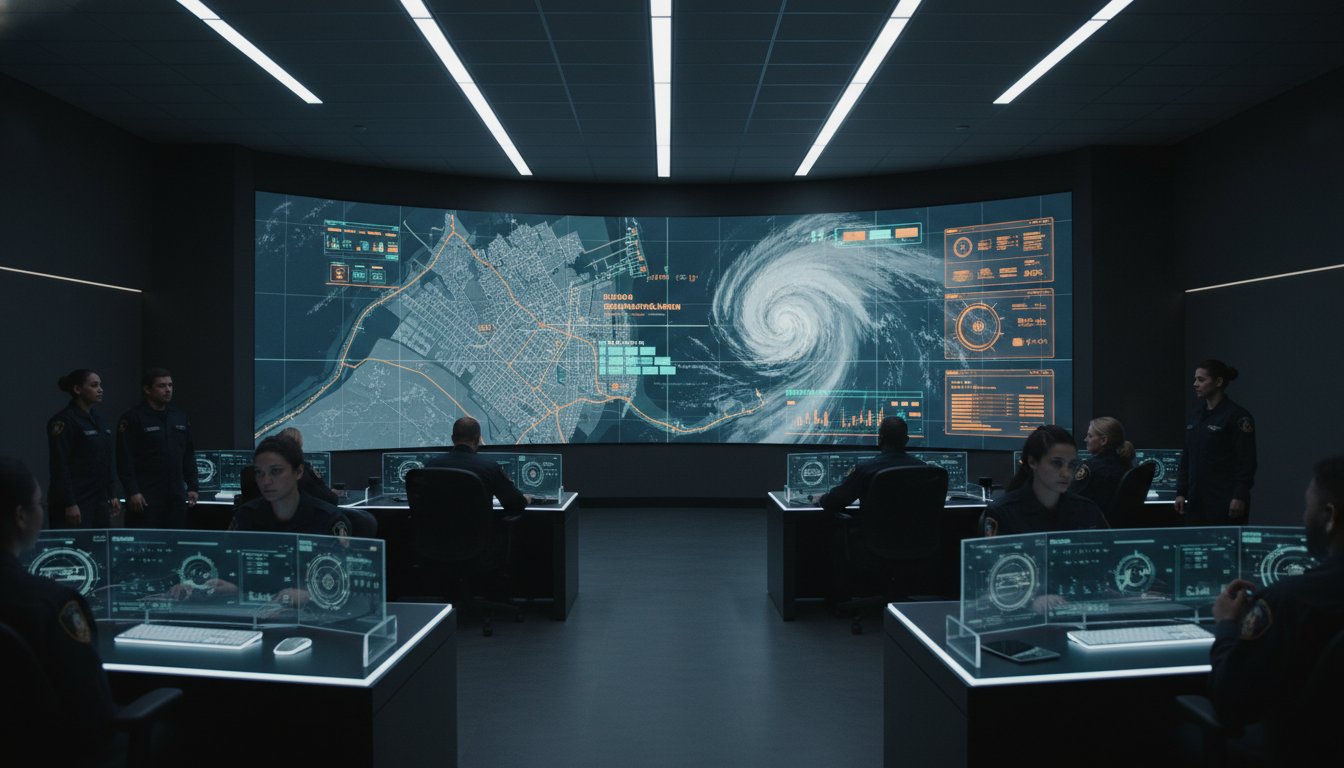
A 2024 assessment of emergency management facilities revealed that 68% of operators feel overwhelmed by the volume of manual data feeds during a critical incident. This information overload often leads to a fragmented common operating picture where vital situational awareness is lost in the noise. Understanding the modern eoc meaning requires looking past the physical room to the intelligence driving it. You likely recognize that a functional Emergency Operations Center must serve as the single source of truth, yet data silos and manual processes continue to delay response times when seconds matter most.
Most control rooms already have the screens. What they’re missing is the layer that decides what goes on them, and escalates automatically when something needs attention. In this article, you’ll discover how to bridge the gap between simple video walls and true operational intelligence. We’ll define the evolving role of the EOC in 2026 and outline specific strategies to automate incident escalation, ensuring your team maintains visibility into what matters most during a crisis.
Key Takeaways
- Understand the modern eoc meaning as a strategic command facility designed to manage disaster response and maintain continuity of operations through standardized command structures.
- Identify why relying solely on video wall hardware often fails, as most control rooms have the screens but lack the intelligent layer required to decide what information matters most.
- Address the critical challenge of fragmented data streams and siloed information that create a “fog of war” during complex, high-stakes emergency scenarios.
- Discover how to transform passive monitoring into proactive operational intelligence by automating incident escalation and surfacing the right data at the moment of decision.
EOC Meaning: Definition and Strategic Purpose in 2026
An Emergency Operations Center (EOC) is a central command and control facility responsible for carrying out the principles of emergency management and disaster management functions at a strategic level. Understanding the eoc meaning goes beyond identifying it as a physical space. In 2026, the EOC has transitioned from a passive monitoring station into a proactive, event-driven intelligence hub. It serves as the nerve center where data becomes actionable intelligence to ensure continuity of operations during high-stakes incidents. This facility provides the centralized environment necessary to manage complex disaster responses and maintain preparedness before a crisis occurs.
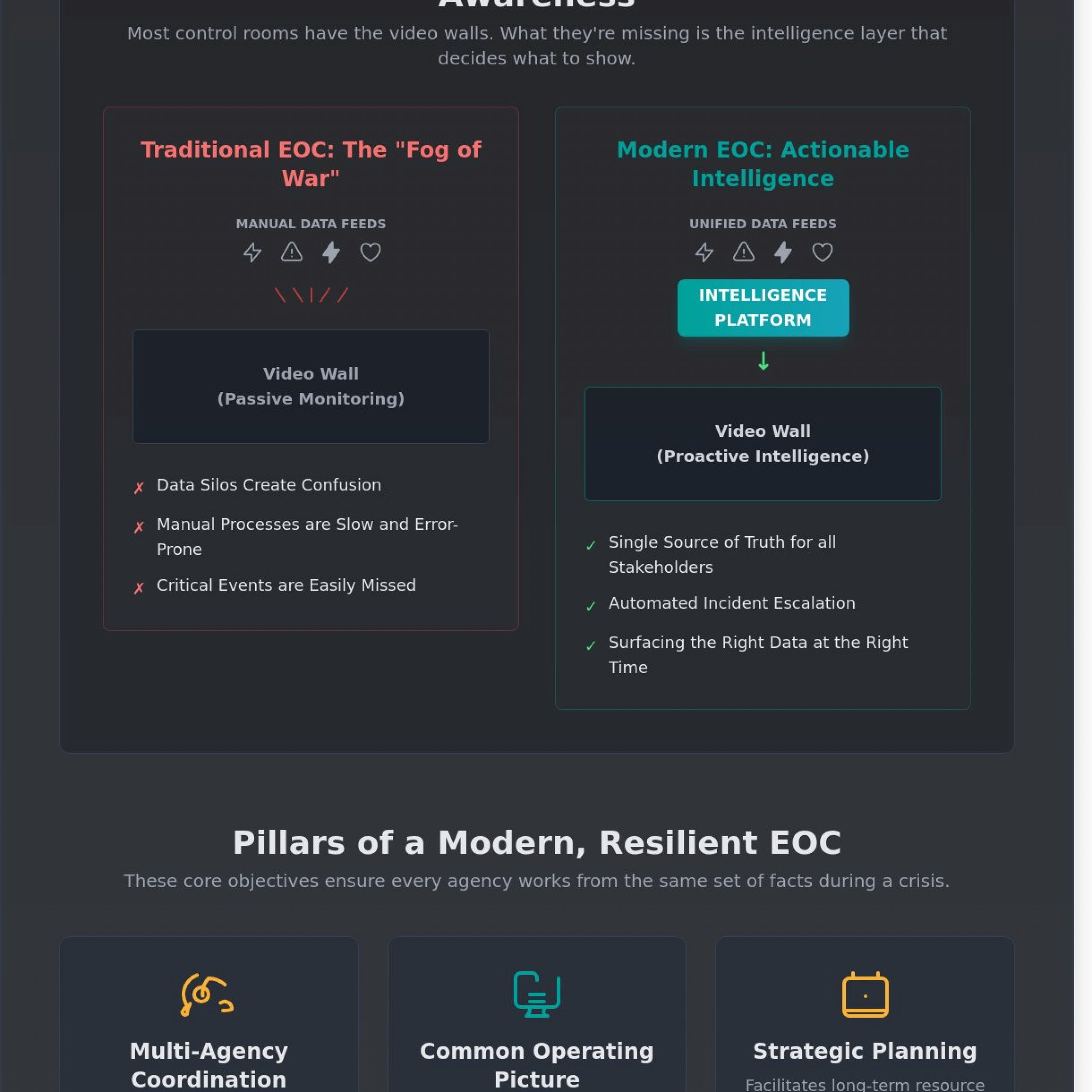
While a dispatch center handles tactical, minute-to-minute resource deployment, an EOC focuses on the broader strategic picture. Many organizations struggle because their systems remain fragmented. Operators often face a wall of data without clear prioritization, leading to decision fatigue. Most control rooms already have the screens. What they’re missing is the layer that decides what goes on them; and escalates automatically when something needs attention. Without this intelligence layer, critical details are lost in the noise of siloed information, preventing a rapid and coordinated response.
The Core Objectives of an EOC
The strategic mission of a modern EOC centers on three primary pillars designed to maintain stability during crises. These objectives ensure that every agency involved works from the same set of facts.
- Multi-Agency Coordination: Eliminating communication silos between police, fire, public health, and utilities to ensure a unified response.
- Common Operating Picture: Establishing a single, verified version of the truth for all stakeholders through real-time visualization of incident data.
- Strategic Planning: Facilitating long-term resource management for incidents that extend beyond a single operational period, such as the 14-day response windows seen in major regional weather events.
Who Operates Within an EOC?
The personnel structure follows the Incident Command System (ICS) to maintain order under pressure. An EOC Director oversees Section Chiefs focused on Planning, Logistics, and Finance. Since the 2024 shift toward more agile response models, 65 percent of EOCs now integrate external partners like private utility providers and federal agencies directly into their digital workflow. There’s a growing movement toward distributed EOC teams. These professionals use mobile collaboration tools to maintain situational awareness from any location, ensuring that the mission continues even if the physical facility is compromised. This evolution ensures that the eoc meaning remains synonymous with resilience and unwavering operational intelligence.
The Functional Structure of a Modern Emergency Operations Center
The eoc meaning extends beyond a physical room; it represents a standardized methodology for crisis management. Most centers operate under the Incident Command System (ICS), a framework developed in 1970 by the FIRESCOPE project to unify response efforts across disparate agencies. This structure divides responsibilities into functional areas: command, operations, planning, logistics, and finance. It ensures that a city manager, a fire chief, and a federal agent speak the same operational language during a disaster.
Modern facilities require more than just desks and phones. They demand high-availability power systems with 99.999% reliability and secure, encrypted communication lines. Visualization hardware serves as the focal point, but hardware alone is insufficient. Most control rooms already have the screens. What they’re missing is the layer that decides what goes on them, and escalates automatically when something needs attention.
Digital requirements have shifted toward the integration of Security Information and Event Management (SIEM) and Security Orchestration, Automation, and Response (SOAR) platforms. These tools ingest real-time sensor data, from traffic cameras to grid sensors. This technical backbone supports the transition from traditional 12-hour reactive shifts to a state of 24/7 mission-critical readiness. Organizations that fail to integrate these feeds often suffer from information silos that can delay response times by 15 minutes or more during the initial phase of an incident. The physical workspace must support this technical complexity with mission-critical console furniture designed to manage high thermal loads and eliminate cable clutter that can impede rapid response.
Information Management and SITREPs
Raw data is useless without context. Understanding the eoc meaning requires a process that converts disparate data points into actionable situation reports (SITREPs). Accuracy is paramount; a single misreported data point in a high-stakes environment can lead to resource misallocation. Effective operations management in mission-critical environments relies on a common operating picture where every stakeholder sees the same validated truth in real-time. This clarity prevents the “fog of war” that often plagues uncoordinated responses.
Resource Coordination and Logistics
Logistics teams track personnel, equipment, and supplies across a national footprint. They manage the logistics tail to ensure field responders have the fuel, food, and medical supplies necessary for sustained operations. Without specialized incident management software, centers risk resource exhaustion and duplicated efforts. These digital layers prevent bottlenecks by providing visibility into what matters most before a shortage becomes a crisis. To see how these layers integrate into your existing workflow, you can connect with our technical team for a structural assessment.
The Gap Between Video Walls and True Situational Awareness
Most control rooms already have the screens. What they’re missing is the layer that decides what goes on them; and escalates automatically when something needs attention. This gap represents the difference between a reactive facility and a proactive command center. While the foundational eoc meaning centers on coordination and resource management, many organizations remain trapped in a hardware-centric model. Operators in a typical high-stakes environment manage over 75 distinct data streams at once. This volume of information quickly exceeds human processing capacity. Organizations frequently mistake a large display for a solution, but without an intelligence layer, that display is just a passive surface. The real challenge is not the size of the screen, but the speed at which an operator can identify a threat within a sea of data.
Why Operators Miss Incidents on Static Video Walls
The “wall of glass” problem is a documented failure point in critical environments. Research into human visual attention indicates that after just 20 minutes of continuous monitoring, an operator’s ability to detect a specific incident on a screen drops by as much as 90 percent. Static video walls demand constant, perfect human focus, which is an impossible standard for a 12-hour shift. Fragmented systems further complicate the response. If a sensor alert in a utility grid or a security breach at a transit hub isn’t automatically linked to the corresponding camera feed, response times can slow by 5 to 7 minutes. These delays happen because the EOC lacks automated triggers that surface critical information exactly when specific thresholds are met. Without automation, the burden of discovery sits entirely on the operator.
Moving Beyond Hardware-Centric EOC Design
Operational success depends on treating the video wall as a surface for intelligence, not the solution itself. A hardware-centric approach ignores the cognitive reality of crisis management. Modern teams must shift toward event-driven visualization. In this model, the system identifies anomalies and immediately presents them to the decision-maker. Integrating COTS solutions allows for greater operational flexibility, ensuring the center can adapt to new threats without a total infrastructure overhaul. By establishing an intelligence layer, organizations bridge the gap between raw data and human judgment. This transformation ensures that the eoc meaning is realized through actionable insights. It empowers people to act with absolute certainty when mission-critical infrastructure is at risk, moving from a state of data overload to one of total clarity. Supporting this intelligence layer requires properly designed workstations with ergonomic console furniture that keeps operators alert during extended shifts while managing the complex cable infrastructure required for modern command centers.
Critical Challenges in Modern EOC Operations
Understanding the technical eoc meaning is only the first step for emergency managers. The operational reality involves managing high-pressure environments where information arrives in a chaotic flood. When a crisis occurs, the fog of war often stems from fragmented data streams rather than a lack of intelligence. Police, fire, and medical agencies frequently utilize disparate software that cannot communicate. This fragmentation forces operators to act as manual translators between systems, which slows down critical decision-making during the first 15 minutes of an incident.
Security is another escalating concern. As EOCs become more digitized, they face increased risks from bad actors targeting municipal infrastructure. Protecting the integrity of the data being visualized is just as important as the data itself. Without a hardened infrastructure, a single breach can compromise the entire response effort.
Siloed Information and Communication Breakdowns
Disconnected platforms are the root of most control room situational awareness problems. When a dispatch center relies on five different legacy systems that don’t share data, the staff becomes overwhelmed. This technical debt makes it difficult to manage multiple data feeds in a dispatch center efficiently. Application integration is the only way to solve this. It creates a seamless workflow where information flows from the field to the EOC without manual entry. Without this integration, silos remain, and vital details get lost in the noise.
The Requirement for Automatic Escalation
Most control rooms already have the screens. What they’re missing is the layer that decides what goes on them, and it escalates automatically when something needs attention. This is why operators miss incidents on the video wall; they’re looking at everything, so they see nothing. Event-driven intelligence changes this by setting situational awareness triggers. When a sensor detects a chemical leak or a perimeter breach, the system identifies the threat and pushes the relevant data to the front of the room.
Implementing a cybersecurity common operating picture is a vital part of this automation. It ensures that IT threats are visualized alongside physical ones, providing a total view of the agency’s posture. This proactive approach reduces the risk of operator fatigue. In 24/7 environments, alarm blindness is a documented phenomenon. Research indicates that after 12 hours of continuous monitoring, an operator’s ability to detect a critical event can decrease by 60 percent. Automation acts as a vigilant guardian that never tires.
True operational success requires a bridge between headquarters and field units. When the EOC sees the same real-time data as the boots on the ground, the response becomes unified. This clarity is the ultimate goal of any EOC common operating picture solutions.
Modernizing the EOC with Activu’s vis/ability Platform
Emergency operations centers often struggle with severe data fragmentation. Operators face dozens of screens but frequently miss critical details because the information isn’t prioritized or filtered. While the eoc meaning centers on coordination and command, true coordination fails when data remains trapped in silos. Static video walls often lead to “wall blindness,” where the sheer volume of feeds causes operators to miss incidents. Activu Corporation solves this by focusing on the user’s operational reality. Most control rooms already have the screens. What they’re missing is the layer that decides what goes on them, and escalates automatically when something needs attention.
This gap in situational awareness often results in a reactive posture. Teams wait for a phone call or a radio report rather than seeing the incident unfold in real time. By integrating vis/ability, organizations transition to a proactive mission-critical management style. The platform acts as the bridge between raw data and human judgment, ensuring that the right information reaches the right person at the exact moment it matters.
vis/ability: The Intelligence Layer for Your EOC
The vis/ability platform functions as the brain of the modern EOC. It aggregates real-time data from GIS maps, weather feeds, and thousands of security cameras into a single, manageable operating picture. It’s common for a regional command center to manage over 150 unique data feeds; vis/ability makes this manageable by automating the escalation of critical events. When a sensor detects a perimeter breach or a flood gauge hits a specific threshold, the software automatically pushes that specific visual to the main video wall. This eliminates the “search and find” delay that costs lives during a crisis.
Visibility shouldn’t stop at the four walls of the command center. Activu extends the EOC to mobile users, allowing field personnel to see the same high-resolution visuals as the commanders. This field-to-command collaboration ensures that every stakeholder operates from a single version of the truth. It empowers public safety and federal government agencies to maintain clarity even as an incident evolves across a wide geographic area.
Designing for Success in High-Stakes Environments
Reliability in a high-stakes environment requires more than just software. It demands a mission-critical architecture designed for 24/7/365 availability. Activu combines professional control room design with state-of-the-art software to ensure operational continuity. If a server fails or a network segment goes down, the system is built to maintain the common operating picture without interruption. This level of technical reliability provides the calm and clarity needed to manage infrastructure-critical decisions.
Modernizing your facility starts with identifying the specific pain points in your current workflow. Whether it’s the challenge of operators missing incidents on video walls or general “control room situational awareness problems,” the solution lies in the intelligence layer. You can modernize your EOC operations by requesting a consultation with our experts. We help you move past the limitations of standard display hardware to achieve a truly intelligent eoc meaning for your organization.
Mastering Operational Clarity in 2026
Defining the modern eoc meaning isn’t about the physical room; it’s about the speed and accuracy of the decisions made within it. As incident complexity grows, the gap between having data and having true situational awareness becomes a liability. Organizations can’t afford to let critical alerts get lost in a sea of static video feeds or fragmented dashboards. Most control rooms already have the screens. What they’re missing is the layer that decides what goes on them, and escalates automatically when something needs attention.
Activu serves as the technical bedrock for these high-stakes environments. Since 1983, we’ve pioneered event-driven visualization for top-tier Federal and Defense agencies. Our vis/ability platform provides the mission-critical intelligence layer that integrates with your existing video wall hardware. By automating the delivery of relevant data, you empower your operators to act with absolute certainty when every second counts. You’ve built the infrastructure, now it’s time to activate its full potential for the safety of your community and assets.
See how Activu vis/ability transforms EOC situational awareness.
Frequently Asked Questions
What is the primary difference between a NOC and an EOC?
A Network Operations Center (NOC) focuses on maintaining technical infrastructure uptime, while an Emergency Operations Center (EOC) manages the strategic response to large scale incidents. The EOC meaning involves coordinating assets and personnel across multiple agencies to protect life and property. While a NOC might monitor 500 servers for performance, an EOC coordinates 10 or more distinct agencies during a regional disaster. Most control rooms already have the screens. What they’re missing is the layer that decides what goes on them, and escalates automatically when something needs attention.
Can an EOC operate virtually or must it be a physical location?
An EOC can operate as a physical facility, a virtual environment, or a hybrid model. FEMA’s 2022 National Incident Management System (NIMS) guidelines recognize virtual EOCs as valid coordination hubs. Physical locations provide face to face collaboration, but virtual layers ensure 24/7 accessibility for remote stakeholders. Organizations often struggle with siloed information across these environments. Effective EOC common operating picture solutions bridge this gap by unifying data regardless of the operator’s physical location.
What are the four phases of emergency management handled by an EOC?
The four phases include mitigation, preparedness, response, and recovery. FEMA established this framework in 1979 to create a continuous cycle of safety. Mitigation reduces long term risks through 15 percent structural improvements or zoning changes. Preparedness involves training 100 percent of staff for specific scenarios. Response is the immediate action taken during an event. Recovery focuses on restoring the community to its pre-disaster state, a process that can last 3 to 5 years.
How does situational awareness software improve EOC response times?
Situational awareness software improves response times by filtering out noise and highlighting critical data points. In high stress environments, operators often miss incidents on the video wall because they’re overwhelmed by 20 or more competing data feeds. Modern software reduces the time to identify a threat by 40 percent compared to manual monitoring. It transforms fragmented data into actionable intelligence. This ensures that decision makers see exactly what matters at the moment it matters most.
What is a Common Operating Picture (COP) in the context of an EOC?
A Common Operating Picture is a single, identical display of relevant information shared by multiple commands. It eliminates the problem of how to manage multiple data feeds in a dispatch center by synchronizing maps, weather, and sensor data. According to the Department of Homeland Security, a COP reduces communication errors by 25 percent during multi agency operations. Without a unified layer, agencies operate in silos, leading to conflicting reports and delayed resource deployment.
Why is automated escalation critical for modern emergency management?
Automated escalation is critical because it removes the burden of manual monitoring from exhausted operators. Human error accounts for 80 percent of failures in mission critical environments. When a sensor detects a breach or a surge, the system must instantly surface that data to the main display. Most control rooms already have the screens. What they’re missing is the layer that decides what goes on them, and escalates automatically when something needs attention.