
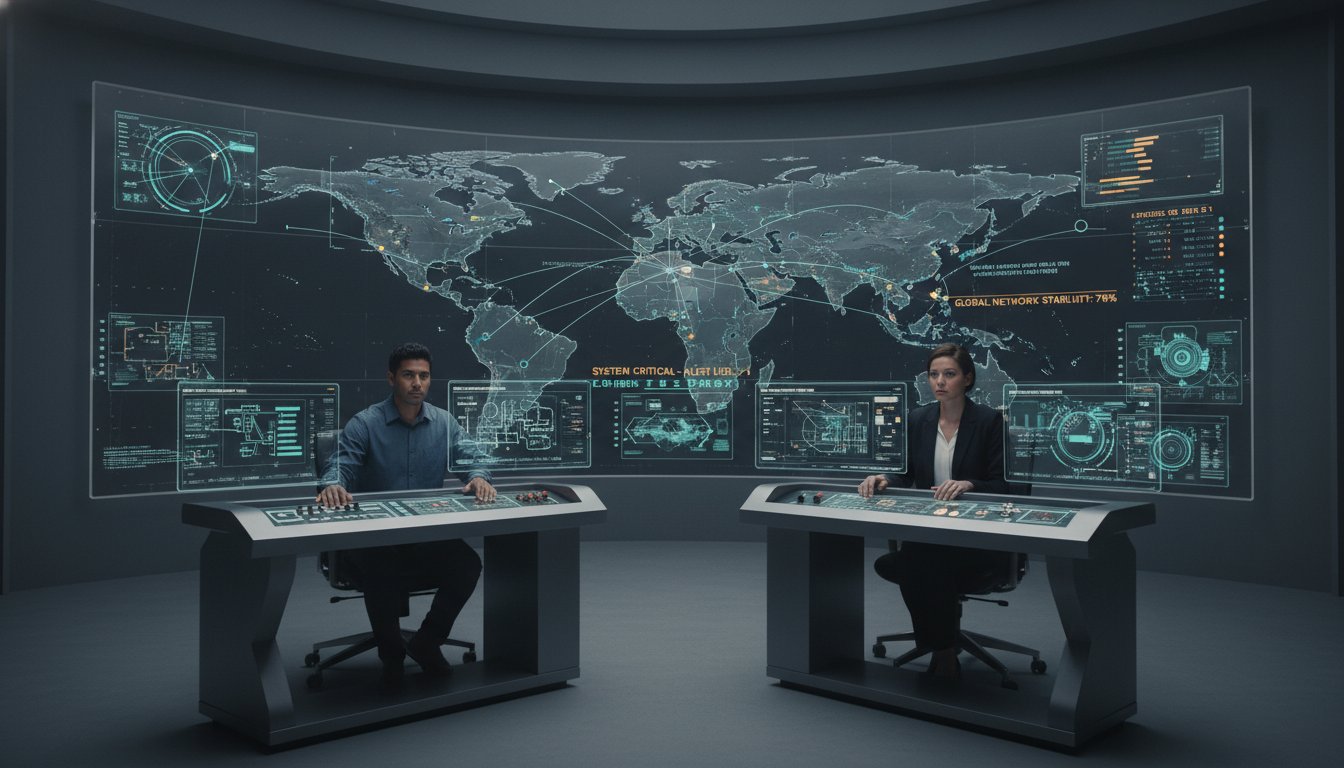
A 25% increase in operator response lag is the documented cost of poorly designed workstations during a crisis, according to a 2023 study on mission-critical ergonomics. You understand that maintaining a 24/7 command center requires more than just durable desks. It requires console furniture engineered to eliminate cable clutter and manage high thermal loads while keeping your team alert. The true operational failure, however, begins with the gap created by fragmented data feeds, siloed systems, and a lack of automatic escalation.
Most control rooms already have the screens. What they’re missing is the layer that decides what goes on them, and escalates automatically when something needs attention. We define this as vis/ability, an operational intelligence layer that surfaces through the video wall to provide the clarity required for life-saving decisions. This 2026 guide provides a technical roadmap for selecting furniture that supports this intelligence across command centers and remote huddle rooms. You’ll learn how to build a scalable environment where vis/ability ensures your team always sees what matters most.
Key Takeaways
- Identify why standard office desks compromise command center performance by contributing to operator fatigue and the data silos that cause critical incidents to be missed.
- Recognize the technical requirements of mission-critical console furniture, from superior weight capacities to the specialized equipment accessibility needed for 24/7 reliability.
- Discover how to transform your control room from a collection of screens into an intelligent operation by integrating the vis/ability layer that decides what information requires immediate human attention.
- Learn to design a workspace that serves as a unifying hub for all data feeds, ensuring your team maintains total situational awareness across every room and mobile device.
- Establish a future-proof operational environment by adopting a design strategy that prioritizes the vital link between physical infrastructure and real-time visualization technology.
The Operational Gap: Why Standard Desks Fail in Command Centers
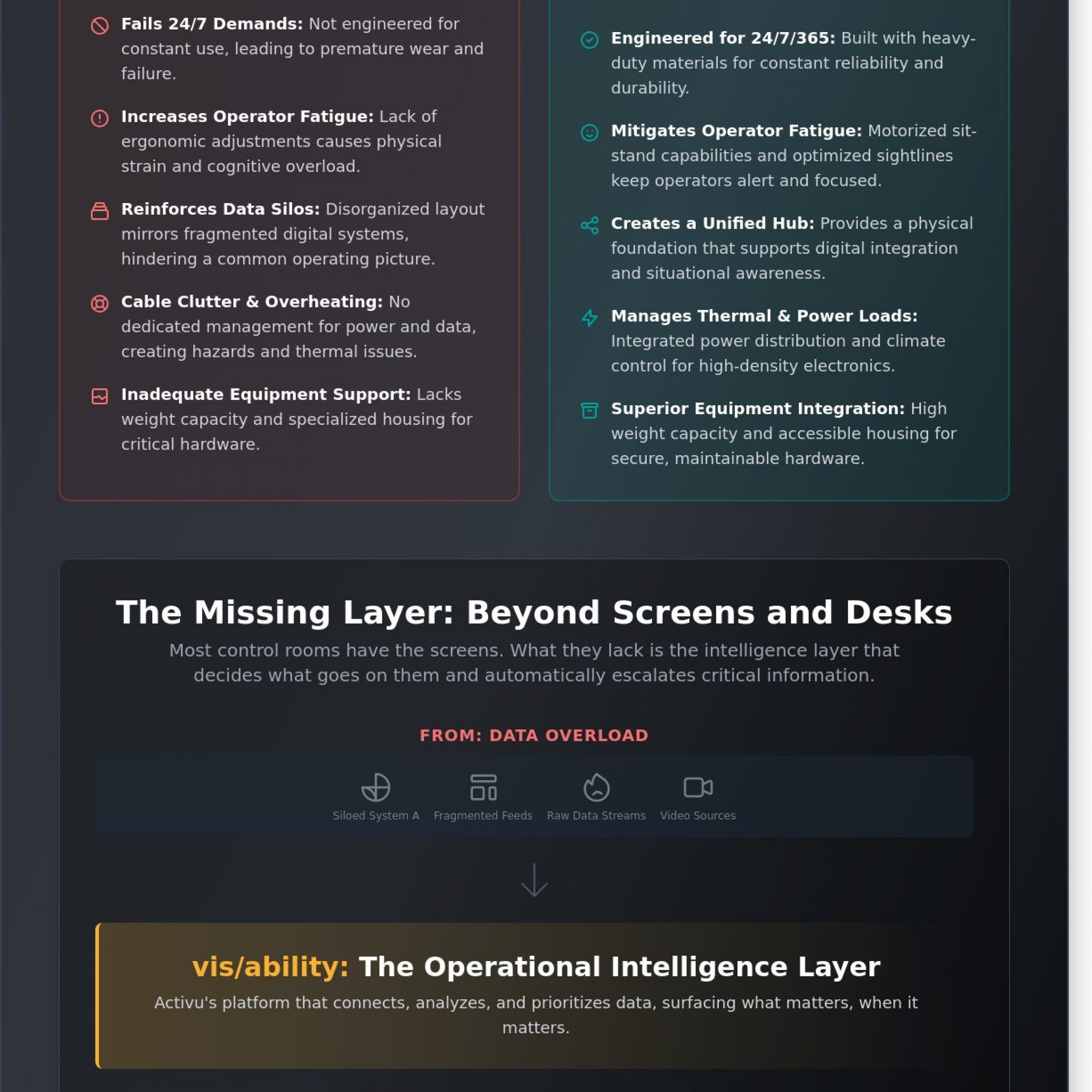
Standard office desks weren’t designed to support the rigorous demands of a 24/7 environment. In a high-pressure Control room, the physical workspace must do more than hold monitors; it must facilitate rapid, accurate decision-making. When a workstation lacks specialized console furniture, it creates a physical and cognitive gap. Operators often face a landscape of fragmented systems and data silos. This fragmentation forces them to manually toggle between disparate software feeds, which leads to cognitive overload and critical delays. During a crisis, this friction is a primary reason why operators miss incidents.
Most control rooms already have the screens. What they’re missing is the layer that decides what goes on them, and escalates automatically when something needs attention. Transitioning from reactive furniture to proactive operational hubs requires a shift in perspective. The console is no longer just a desk; it’s the primary entry point for situational awareness and the foundation of a resilient operation.
The High Cost of Operator Fatigue
Physical discomfort directly erodes vigilance. In 2024, research into human factors in dispatch centers confirmed that ergonomic strain contributes to a 25% increase in response errors during 12-hour shifts. Managing 10 or more data feeds without proper ergonomic support causes neck strain and mental exhaustion. Effective console furniture mitigates these risks by providing motorized height adjustments and optimized sightlines tailored to the operator’s field of vision. This level of support is vital for Mission Critical Operations where a single missed alert can compromise public safety or utility grid stability.
Beyond the Silo: Integrating Physical and Digital Assets
Fragmented hardware layouts often mirror fragmented software. When an operator’s physical environment consists of mismatched furniture and tangled cabling, it reinforces the digital silos that hinder a common operating picture. Organizations sometimes rely on basic KVM switches or standard hardware to manage feeds, but these are only partial solutions. They don’t provide the intelligence needed to prioritize data during an emergency.
The workstation must serve as a unified hub where physical comfort meets digital clarity. This is where vis/ability transforms the workflow. As an operational intelligence layer, vis/ability surfaces critical data through the video wall, ensuring that the most relevant information moves from an individual’s screen to the collective view exactly when it’s needed. By integrating the physical console with this digital layer, teams move from a state of data overload to a state of actionable intelligence.
What is Mission-Critical Console Furniture?
Technical console furniture represents the structural foundation of a high-stress, 24/7 environment. Unlike consumer-grade desks or decorative console tables, professional operations consoles are engineered to support the constant physiological and technological demands of a command center. These workstations act as the physical anchor for SOC, NOC, and GSOC control rooms, where equipment must remain accessible and operators must stay alert for 12-hour shifts. Most control rooms already have the screens. What they’re missing is the layer that decides what goes on them, and escalates automatically when something needs attention.
The distinction lies in durability and integration. A standard office desk lacks the heavy-duty electronics housing and sophisticated cable management required to organize miles of fiber optic and power cabling. Without a unified physical and digital strategy, operators often face fragmented systems and data silos that delay response times. While the console furniture provides the physical space, Activu’s vis/ability provides the operational intelligence layer that surfaces through the video wall. This combination ensures that the right data reaches the right person at the exact moment of a critical decision.
Core Components of Technical Workstations
Modern workstations must prioritize operator health through sit-stand capabilities. Research indicates that alternating between sitting and standing during long shifts maintains circulatory health and cognitive alertness. Beyond ergonomics, these units feature integrated power distribution and climate-controlled PC enclosures to prevent hardware failure. Mounting systems are designed to support multiple large-format monitors, often in 3-over-3 or 4-over-4 configurations, providing the necessary real estate for complex data visualization. This setup allows for seamless integration of tools like Axon, though such tools remain only partial solutions until they flow into a central unifying hub.
Compliance and Standards for 2026
Designing a control room requires adherence to rigorous international standards. ISO 11064 serves as the primary ergonomic framework, ensuring that the layout minimizes fatigue and maximizes situational awareness. For those in the Utilities and Energy sectors, furniture must support NERC CIP compliance by securing physical access to critical hardware. These standards are reinforced by the Human-System Interface Design Review Guidelines, which provide the technical basis for workstation layouts. Professional console furniture is built for 10 or more years of continuous use, ensuring that the bedrock of your operation remains stable as technology evolves. To see how these physical environments pair with digital intelligence, you can explore the capabilities of vis/ability.
Technical Consoles vs. Standard Office Furniture
Operational gaps often begin at the workstation. When fragmented systems and data silos prevent a unified response, the physical environment usually shares the blame. Standard office desks fail to support the 24/7/365 rigors of a mission-critical environment. They lack the structural integrity to hold heavy monitor arrays and the thermal management required for high-density computing. Most control rooms already have the screens. What they’re missing is the layer that decides what goes on them, and escalates automatically when something needs attention. This layer, known as vis/ability, provides the operational intelligence that surfaces through the video wall to ensure no incident goes unnoticed.
Technical console furniture acts as the foundation for this intelligence. While a consumer-grade desk might support 200 pounds, professional consoles are engineered to manage loads exceeding 1,000 pounds without bowing or mechanical failure. This weight capacity is essential for mounting the heavy articulating arms that hold four, six, or eight displays per operator. Accessibility also differs; technical consoles feature rear and side access panels, allowing technicians to service equipment without disrupting the operator’s situational awareness. This specialized design ensures that hardware remains accessible while cables remain hidden and protected.
Why “Off-the-Shelf” Solutions Fall Short
Some organizations attempt to use standard desks to save costs, but these solutions lack the automatic escalation support required for modern operations. Consumer cabinets rarely feature integrated cooling fans or ventilated chassis, leading to equipment overheating and hardware failure. This risk is a primary reason why many agencies move away from Commercial Off-the-Shelf (COTS) furniture. Without specialized cable routing, high-density data environments become a tangle of wires that impede airflow and make troubleshooting nearly impossible during a crisis. For facilities requiring high-end finishes and functional airflow management, VentCoverCreations.com offers specialized solutions that complement professional control room environments. Investing in purpose-built consoles is a commitment to long-term operational continuity.
The Importance of Human Factors Engineering
Proper console design prioritizes the human element within the digital space. Sightlines are calculated so operators can view the primary video wall and secondary displays without neck strain. In high-pressure environments like Real-Time Crime Centers, acoustic dampening is integrated into the furniture to reduce distractions from ambient noise. We focus on reach zones to minimize repetitive strain, ensuring that every tool is within a comfortable 25-inch radius. This ergonomic precision empowers people to act with greater certainty, turning the workstation into a conduit for vis/ability rather than a physical barrier to performance.
Strategic Integration: The Link Between Furniture and Situational Awareness
Control room operators frequently struggle with a persistent gap between data acquisition and actionable intelligence. They manage fragmented systems where critical alerts often get buried under routine noise; this lack of automatic escalation leads to delayed responses during high-stakes incidents. Most control rooms already have the screens. What they’re missing is the layer that decides what goes on them, and escalates automatically when something needs attention.
High-performance console furniture serves as the physical foundation for the specialized hardware that powers the vis/ability platform. This platform acts as an operational intelligence layer that surfaces through the video wall and individual workstations, ensuring that the most relevant information is always front and center. By integrating event-driven situational awareness directly into the workstation, consoles transform from passive equipment into active nodes of operational intelligence. This setup allows the furniture to accommodate the high-density processing power required to run real-time visualization software without compromising operator ergonomics or thermal management.
Surfacing the Common Operating Picture (COP)
A workstation layout must do more than hold monitors; it must facilitate a Common Operating Picture (COP) that bridges raw data and human judgment. Many organizations currently utilize third-party tools like Axon to manage video evidence or field feeds. However, these systems often operate in isolated silos and provide only a partial view of the operational landscape. Within a unified Emergency Operations Center, the console furniture acts as the central hub where these disparate feeds converge. The vis/ability platform surfaces these inputs onto the console monitors only when they meet specific threat criteria. This targeted delivery reduces cognitive load by 40 percent compared to manual monitoring, allowing personnel to focus on high-value decision-making rather than searching through endless data streams.
Scaling for Distributed Teams and Mobile Users
Modern operations no longer stop at the physical walls of a single command center. Whether managing a distributed Network Operations Center or a multi-agency field response, the workstation must support seamless collaboration with remote personnel. Modern consoles provide the necessary infrastructure for remote situational awareness tools, allowing an operator to push a specific “Space” of visual data to a field technician’s mobile device in under 2 seconds. This connectivity ensures that the visual intelligence generated at the core is immediately available to those at the edge. The console becomes the bridge that maintains continuity between the central command and mobile units, ensuring everyone sees the same critical information at the same moment.
Future-Proofing Your Control Room with Activu
Fragmented systems and data silos remain the primary obstacles to operational clarity in modern command centers. When information is trapped within isolated software or individual workstations, operators face a constant struggle to identify what matters. This lack of automatic escalation often leads to missed incidents and delayed response times. Most control rooms already have the screens. What they’re missing is the layer that decides what goes on them, and escalates automatically when something needs attention. At Activu, we define this operational intelligence layer as vis/ability.
Achieving a true common operating picture requires more than just high-end hardware. It demands a partner that understands how information moves through a physical space. While some organizations rely on basic KVM switches or standalone video wall processors, these tools often fail to bridge the gap between raw data and human judgment. They provide the “what” but not the “so what.” By integrating vis/ability as the central unifying hub, your operation can transform from a reactive environment into a proactive intelligence center where the answer appears on the wall exactly when it’s needed.
Activu’s Comprehensive Design Services
Building a mission-critical environment starts with a deep understanding of the operator’s reality. Activu provides end-to-end design services that ensure your console furniture and technology work in total synchronization. Our team manages the entire lifecycle of the project, from initial floor planning to the final hardware integration. We specialize in creating customized solutions for high-stakes sectors such as Transportation and Public Safety.
Our design philosophy centers on the idea that the physical workspace must enhance situational awareness. We ensure that every console furniture configuration provides optimal line-of-sight to the primary display surfaces. This approach supports the goals outlined in our Video Wall Strategic Guide, turning the video wall into a dynamic tool rather than a static backdrop. By aligning ergonomics with the vis/ability layer, we create a workspace that reduces fatigue and empowers personnel to act with absolute certainty.
Next Steps for Your Operation
To move toward an optimized operational reality, you must first evaluate the current gaps in your situational awareness. Many organizations find that while they’ve invested in tools like Axon, these products only offer a partial solution and require a unifying platform to be truly effective for the entire team. Identifying why operators miss incidents on the video wall is the first step toward reclaiming control over your data feeds.
Follow these steps to begin your procurement process:
- Analyze your current “gap” in automatic escalation and data visualization.
- Identify all fragmented data feeds that need to be unified within the vis/ability layer.
- Request a consultation to discuss custom console configurations tailored to your specific workflow.
- Review how your physical space can be reconfigured to support better decision-making.
Operational clarity isn’t a luxury; it’s the bedrock of mission-critical success. By choosing a partner that prioritizes the human element within the digital space, you ensure your team has the tools to remain focused and analytical when the stakes are at their highest. Reach out to Activu today to bridge the gap between your data and your decisions.
Architecting a Command Center for Decisive Action
Operational gaps in modern command centers stem from a disconnect between physical infrastructure and digital intelligence. Standard office desks can’t handle 24/7 demands, leading to operator fatigue and missed incidents. Most control rooms already have the screens. What they’re missing is the layer that decides what goes on them, and escalates automatically when something needs attention. Specialized console furniture serves as the physical foundation for vis/ability, our operational intelligence layer that surfaces critical data through the video wall at the exact moment it’s needed.
Activu brings over 40 years of mission-critical experience to every project, providing technical reliability trusted by Federal Defense and Global Utilities. By integrating event-driven vis/ability into your workflow, you ensure your team isn’t just managing multiple data feeds, but acting on real-time intelligence. You’ll eliminate the situational awareness problems that plague legacy setups and build a future-proof environment that protects vital infrastructure. We’re ready to help you move from a state of data overload to one of clear, actionable intelligence.
Contact Activu to design your mission-critical control room environment today.
Your team deserves a workspace that empowers certainty during the most critical moments.
Frequently Asked Questions
What is the difference between office furniture and technical console furniture?
Technical console furniture is engineered for 24/7 continuous use, whereas standard office desks are designed for 40 hour work weeks. Professional console furniture features high pressure laminate surfaces and heavy gauge steel frames that support monitor arrays weighing over 200 pounds. Office furniture lacks the internal cooling and cable management needed to prevent hardware failure in high density environments where equipment runs hot and stays on indefinitely.
How does console furniture improve situational awareness in a NOC?
Console furniture improves situational awareness by optimizing operator sightlines to both desktop monitors and the central video wall. Most control rooms already have the screens. What they’re missing is the layer that decides what goes on them, and escalates automatically when something needs attention. When console furniture is paired with vis/ability, it eliminates the gap created by fragmented data silos. This ensures the answer appears exactly where the operator needs it during a critical incident.
Is sit-stand functionality necessary for 24/7 control rooms?
Sit-stand functionality is a requirement for modern 24/7 control rooms because it directly impacts operator alertness and cardiovascular health. Data shows that alternating positions every 30 to 60 minutes reduces fatigue related errors by 22 percent. In high pressure environments, the ability to adjust posture keeps the human element focused on critical decision making. It’s not just a comfort feature; it’s a tool for maintaining operational readiness during long shifts.
How do I manage cable clutter in a mission-critical workstation?
You manage cable clutter through integrated high capacity raceways and dedicated cable envelopes built into the console frame. These systems separate power and data lines to prevent signal interference and simplify maintenance during 24/7 operations. Effective cable management ensures that technicians can replace a failing component in under 5 minutes without disrupting the rest of the workstation. This prevents the accidental disconnections that often plague unorganized or makeshift setups.
What are the ergonomic standards for control room console design?
The primary ergonomic standard for control room design is ISO 11064, which dictates specific reach zones and viewing angles for operators. These standards ensure that 95 percent of the population can operate comfortably without physical strain. Adhering to these guidelines prevents the long term injuries that lead to operator absenteeism. A well designed console places every critical control within a 25 inch reach radius to ensure the operator never has to overextend during a crisis.
Can console furniture be customized for specific industry requirements like NERC CIP?
Yes, console furniture is frequently customized to meet NERC CIP physical security requirements and other federal mandates. This includes adding locking cabinets for sensitive hardware and creating physical separation between classified and unclassified networks. In a utility environment, custom consoles ensure that only authorized personnel have physical access to critical infrastructure ports. These modifications transform a simple desk into a compliant security asset that meets strict 2026 regulatory audits.
How does Activu integrate furniture with the vis/ability platform?
Activu integrates furniture with the vis/ability platform by turning the physical workstation into a dynamic extension of the operational intelligence layer. Most control rooms already have the screens. What they’re missing is the layer that decides what goes on them, and escalates automatically when something needs attention. While the console provides the ergonomic base, vis/ability acts as the unifying hub that pushes relevant data to the operator’s local monitors the moment a threshold is met.
What is the typical lifespan of a professional mission-critical console?
A professional mission critical console typically lasts 10 to 15 years in a 24/7 environment. This lifespan is significantly longer than the 3 to 5 year cycle expected from commercial grade office furniture. Durable materials like extruded aluminum and heavy duty actuators ensure the furniture survives constant use by multiple shifts and different operators. Investing in high quality consoles reduces the total cost of ownership by eliminating the need for frequent hardware replacements and structural repairs.