
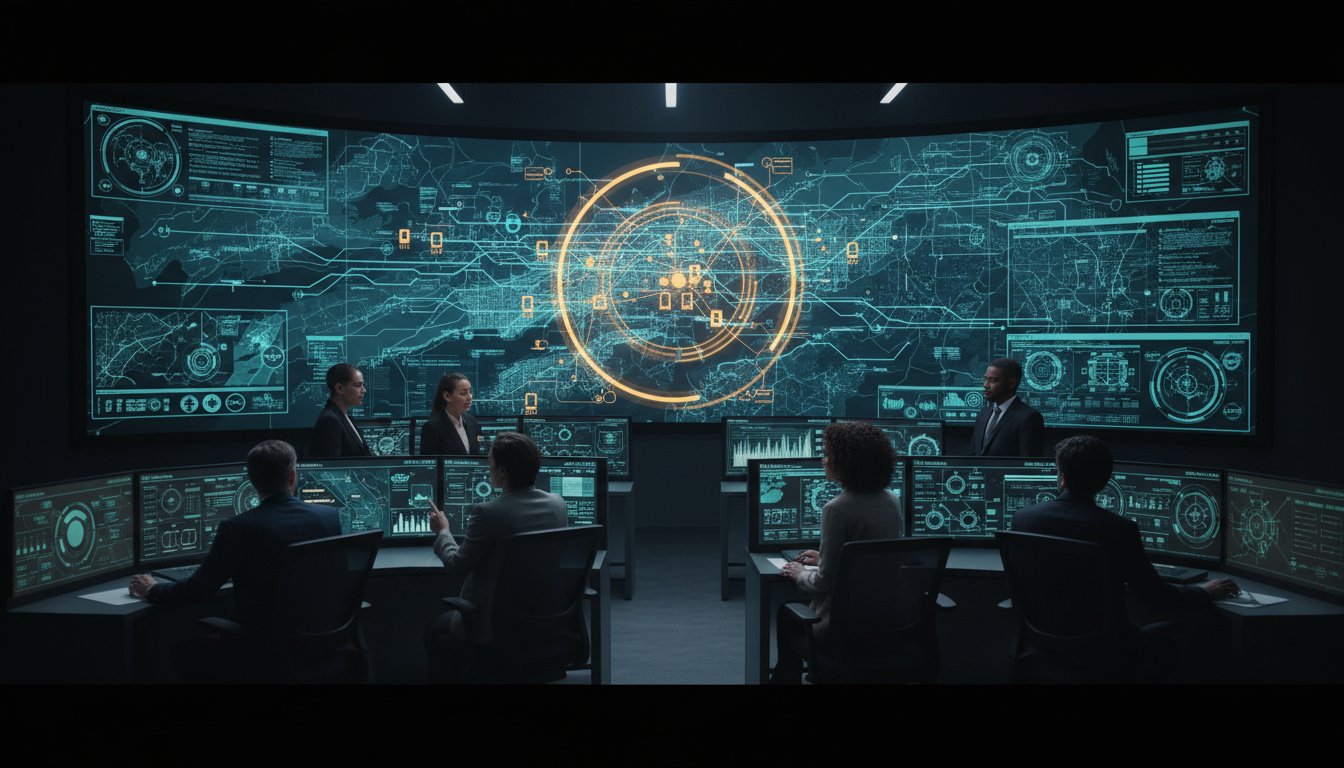
What if the sheer volume of data entering your command center is actually making your team less effective during a crisis? In high-pressure, mission critical environments, more information often leads to more noise, not more clarity. You likely deal with fragmented systems and information silos that prevent a fast response when every second counts. It’s a reality where operator fatigue is common, especially when monitoring dozens of disconnected feeds. Most control rooms already have the screens. What they’re missing is the layer that decides what goes on them, and escalates automatically when something needs attention.
We agree that your team shouldn’t spend their time hunting for answers across disparate monitors while mean time to resolution (MTTR) climbs. This is vital since human error accounts for 42% of unplanned downtime in critical infrastructure, according to industry benchmarks. This guide demonstrates how to bridge the gap between raw data and actionable intelligence to eliminate blind spots. We detail the principles of operational resilience and the specific strategies used to ensure visibility stays high even when systems face peak demand.
Key Takeaways
- Define the threshold where operational failure threatens safety or infrastructure, establishing why mission critical systems require a higher standard of technical reliability than standard business operations.
- Identify the architectural pillars of redundancy and interoperability that allow disparate systems to communicate in real-time without a single point of failure.
- Close the “Visibility Gap” by moving beyond a wall of screens to an intelligent layer that decides what information reaches the operator and escalates automatically when attention is required.
- Master the principles of Situational Awareness to detect critical signals amidst data overload, transforming raw information into decisive, life-saving action.
- Evaluate the long-term ROI of specialized visualization platforms compared to generic tools to ensure your command center remains resilient against evolving threats.
Defining Mission Critical: Why Failure is Not an Option
A mission-critical system is any equipment, process, or procedure whose failure halts business operations entirely. It’s not just about losing money. It’s about the collapse of services that keep society functioning. While business-critical issues might result in revenue loss or a dip in share price, a mission critical failure involves direct threats to life, public safety, or national infrastructure. There’s no room for downtime when the stakes are measured in lives saved or megawatts delivered.
Reliability in these environments isn’t a goal; it’s the baseline. Systems must maintain 24/7 availability with zero-latency data processing. Historically, this meant relying on mechanical fail-safes and physical redundancies. Since the digital shift accelerated in the late 1990s, the focus has moved from hardware durability to digital situational awareness. We’ve traded manual levers for complex data streams that require instant human interpretation. This evolution has made the human-machine interface the most vulnerable point in any operation.
Mission-Critical Industries and Their Unique Demands
Public safety agencies operate under the highest pressure. Real-time crime centers and emergency dispatch units require immediate access to video feeds and sensor data. A five-second delay in data transmission can change the outcome of a high-speed pursuit or a medical emergency. These teams don’t need more data; they need the right data at the moment of decision.
In the energy sector, maintaining grid stability is a legal mandate. Operators must ensure NERC CIP compliance to protect against physical and cyber threats. A failure here, similar to the 2003 Northeast blackout that affected 55 million people across eight states, demonstrates why visibility is the ultimate priority. Grid operators require a common operating picture that transcends individual silos to prevent cascading failures.
Defense and federal agencies face different but equally high stakes. In federal government and defense command centers, visualization tools don’t just show data; they provide the tactical edge. When thousands of data points converge during a conflict, the ability to filter the noise is a strategic necessity. Success depends on the speed at which intelligence is converted into action.
The Consequences of Operational Blind Spots
Fragmented data streams are the primary enemy of the modern operator. When information is siloed across different monitors and software platforms, it creates a “fog of war” in civilian operations. Decisions get delayed. During a critical incident, a 60-second lag in identifying a breach or a system failure can lead to catastrophic results. Most control rooms already have the screens. What they’re missing is the layer that decides what goes on them, and escalates automatically when something needs attention.
Without this automated intelligence, operators are forced to hunt for problems rather than solve them. This reactive stance leaves organizations vulnerable to incidents that were visible in the data but hidden by the sheer volume of noise. True resilience comes from removing these blind spots and ensuring that the most vital information finds the person who needs to see it.
The Pillars of Modern Mission-Critical Architecture
Resilience in a mission critical environment isn’t a byproduct of high-end hardware; it’s a deliberate architectural choice. Organizations must build systems that withstand both technical failures and the cognitive overload that occurs during a crisis. True resilience requires a foundation built on four distinct pillars that ensure continuous operation and total visibility into what matters most.
- Redundancy: Eliminating single points of failure requires dual-homed network paths and geographically dispersed server clusters. In 2023, data center outages cost enterprises an average of $5,600 per minute, highlighting why redundant failover is mandatory for 99.999% uptime.
- Interoperability: Information silos kill response times. When a Video Management System (VMS) cannot talk to Computer-Aided Dispatch (CAD) or Geographic Information Systems (GIS), operators often waste 30% of their time manually correlating data. Disparate systems must communicate in real-time to create a cohesive operational picture.
- Scalability: A system that works during routine monitoring might collapse during a 500% surge in data during a major incident. Scalable architecture allows for fluid resource allocation, ensuring processing power expands alongside the emergency without performance degradation.
- Security: Protecting the infrastructure is as vital as the data it carries. Implementing a Cybersecurity Common Operating Picture allows teams to monitor their own defensive posture and network health. This proactive stance aligns with the standards for Critical Infrastructure Security and Resilience, ensuring the control room remains a fortress rather than a vulnerability.
Hardware vs. Software Layers in the Control Room
Legacy control rooms rely on proprietary hardware switchers and rigid console furniture that lack the agility needed for modern threats. While high-performance video walls provide the canvas, software-defined visualization now provides the intelligence. Moving the logic to the software layer removes the limitations of physical cables and ports, allowing information to flow where it’s needed most. The vis/ability platform serves as this integration layer, turning static displays into dynamic assets. Most control rooms already have the screens; what they’re missing is the layer that decides what goes on them and escalates automatically when something needs attention.
Resilience Through Application Integration
Fragmented systems force operators to toggle between dozens of tabs, which is a primary reason why operators miss incidents on the video wall during peak stress. Consolidating legacy applications into a unified dashboard reduces this cognitive load and eliminates the “swivel-chair” effect. Using Secure Reliable Transport (SRT) ensures low-latency video feeds even over unpredictable, low-bandwidth networks. Application integration is the bridge between siloed data and collective intelligence. This approach is vital for public safety agencies where every second saved translates to lives protected and infrastructure preserved.
The Visibility Gap: Why Your Video Wall is Not Enough
Many organizations operate under the assumption that increasing the number of screens in a command center directly improves situational awareness. This is a fundamental misunderstanding of mission critical operations. A 2021 study by the Human Factors and Ergonomics Society indicates that operator performance can degrade by 10% for every additional screen beyond the fourth display. This phenomenon creates the Visibility Gap; a state where data is abundant, yet actionable context is non-existent.
In 24/7 environments, operator fatigue and cognitive overload are constant threats. When a facility relies on manual monitoring, it remains vulnerable to human error during high-stress periods. If incident volume spikes, the ability to discern a critical threat from background noise vanishes. Manual processes don’t scale. They fail precisely when they’re needed most, leaving teams reactive rather than proactive.
Bridging the Gap Between Screens and Intelligence
Most control rooms already have the screens. What they’re missing is the layer that decides what goes on them, and escalates automatically when something needs attention. Transitioning from passive monitoring to event-driven visualization is essential for modern resilience. Standard COTS solutions frequently fall short because they lack intelligent escalation features. These generic tools treat a routine server ping and a catastrophic hardware failure with the same visual weight. Without automated intelligence, the video wall becomes a decorative background rather than a tactical asset in a mission critical environment.
Managing Multiple Data Feeds in a Dispatch Center
Dispatch centers today manage a relentless influx of information from social media, weather updates, traffic sensors, and complex IoT networks. Aggregating these feeds into a single view is only the first step. To maintain clarity, operators must use incident management software to filter the noise and focus on high-priority alerts. This software acts as a gatekeeper, ensuring that only relevant data reaches the decision-makers.
A unified operating picture is the ultimate goal for cross-departmental collaboration. When every stakeholder sees the same real-time data, departments stop working in silos. This level of integration has been shown to improve response coordination by 25% in municipal emergency operations. It provides the steady reassurance that every critical decision is backed by comprehensive, filtered intelligence. By focusing on the operational reality rather than the hardware, teams can finally bridge the gap between simple data and true intelligence.
Achieving Situational Awareness in Mission-Critical Operations
In high-stakes environments, situational awareness (SA) is the foundation of effective operations management. It’s more than just seeing data; it’s the continuous process of perceiving, comprehending, and projecting information to ensure mission success. Without a structured approach to SA, operators risk falling into the trap of “data richness, information poverty,” where critical signals are lost in a sea of noise. In mission critical environments, the cost of missing a single alert can range from infrastructure failure to the loss of life.
- Perception: This initial stage involves detecting relevant signals amidst the noise. In a typical dispatch center, operators might monitor 15 different software feeds simultaneously. The goal is to isolate the 2% of data that actually requires human intervention.
- Comprehension: Once a signal is detected, the system must help the operator understand its significance. A sensor alert isn’t just a number; it’s a potential breach or a failing component that threatens the integrity of the operation.
- Projection: Superior SA allows teams to move from reactive to proactive. By analyzing current trends, operators can anticipate future states, such as predicting a power grid overload 12 minutes before it occurs.
- Action: The final step is executing a coordinated response based on a Common Operating Picture (COP). This ensures that every team member acts on the same intelligence, eliminating fragmented efforts.
The Role of the Common Operating Picture (COP)
A COP ensures every stakeholder, from the commander in the SOC to the technician in the field, sees the same data at the same time. This synchronization eliminates the silos that lead to control room situational awareness problems. By extending the COP to the field via mobile vis/ability tools, teams maintain visibility regardless of their physical location. For example, during the 2023 regional emergency response to the Canadian wildfires, multi-agency coordination relied on a COP to manage over 500 active resource deployments. This unified view prevents the confusion that occurs when different agencies use incompatible data sets or outdated spreadsheets.
Event-Driven Intelligence and Automatic Escalation
Most control rooms already have the screens. What they’re missing is the layer that decides what goes on them, and escalates automatically when something needs attention. This is where event-driven intelligence transforms mission critical workflows. By setting specific triggers, organizations can automate video wall layout changes based on incoming alerts. If a security breach occurs at a remote substation, the system immediately surfaces the relevant CCTV feeds and geospatial data. This process reduces the Mean Time to Awareness (MTA) by as much as 60%, as operators don’t have to manually search for information. Event-driven visualization is the catalyst for proactive incident management. It ensures that the most vital information is always front and center when seconds matter most.
Build a more resilient operation with a unified common operating picture. Speak with an Activu expert today.
Building a Future-Proof Mission-Critical Environment
Resilience in a mission critical environment isn’t a byproduct of more screens; it’s the result of how intelligence flows through them. Organizations often fall into the trap of investing in generic visualization tools that treat every data point with equal weight. This creates a state of data saturation where operators struggle to distinguish a routine alert from a catastrophic failure. Specialized platforms provide a long-term ROI by reducing cognitive load and accelerating the time between detection and resolution.
Most control rooms already have the screens. What they’re missing is the layer that decides what goes on them, and escalates automatically when something needs attention. This operational layer transforms a passive video wall into a proactive asset. When planning a refresh, prioritize software flexibility over hardware specs. Hardware will age, but a flexible software architecture allows your operation to adapt as new data sources and cybersecurity threats emerge.
Evaluating Mission-Critical Technology Partners
Choosing a partner requires looking beyond basic specifications. A vendor’s history of 99.999% uptime and their ability to integrate with legacy 24/7 systems are non-negotiable. You need a partner with a deep understanding of transportation and public safety sectors, where every second of downtime has real-world consequences. When evaluating solutions for your network operations center, use this checklist during your evaluation:
- Integration Depth: Can the platform ingest GIS data, VMS feeds, and IoT sensors into a single pane of glass?
- Cybersecurity Posture: Does the solution meet SOC2 or FIPS 140-2 standards to protect sensitive infrastructure data?
- Automated Escalation: Does the system trigger visual changes based on external events without human intervention?
Some organizations settle for what they call “industry standard” solutions. In reality, this is often a euphemism for outdated legacy systems that lack the agility of modern IP-based visualization. Engaging with Activu’s control room design services early in the planning phase ensures your environment is built for the workflows of 2025, not 2010.
Next Steps: From Strategy to Implementation
Moving forward requires a clear-eyed look at your current operational gaps. Conduct an analysis of your NOC or EOC to identify why operators miss incidents or where data silos slow down response times. Many centers find that while they are data-rich, they remain intelligence-poor because their information isn’t contextualized. Transitioning to an intelligence-ready posture starts with seeing only what matters, when it matters. Request a tailored demo of the vis/ability platform to see how automated situational awareness can stabilize your mission critical operations. Contact Us today for a professional consultation.
Achieve Absolute Clarity in High-Stakes Environments
Operational resilience requires more than just high-resolution displays; it demands a shift to automated intelligence. Most control rooms already have the screens. What they’re missing is the layer that decides what goes on them, and escalates automatically when something needs attention. Without this proactive layer, operators remain trapped in fragmented data silos, often missing the very incidents they’re paid to prevent. This visibility gap creates unnecessary risk in mission critical environments where every second dictates the outcome.
Since 1983, Activu has served as the technical bedrock for the US Military and Global Fortune 500 companies. Our event-driven intelligence platform transforms how teams process information, reducing Mean Time to Action by up to 50%. By bridging the gap between raw data and human judgment, we ensure your team sees what matters most at the exact moment it matters. You can move past the limitations of legacy systems and build a future-proof operation that stays steady under pressure.
See how vis/ability transforms mission-critical operations
Frequently Asked Questions
What is the difference between mission critical and business critical?
Mission critical operations are those where a failure results in catastrophic consequences for life safety, national security, or essential infrastructure. These environments typically require 99.999% uptime, allowing for only 5.26 minutes of downtime per year. Business critical functions, while important for revenue, can often tolerate 99.9% availability. Organizations must distinguish between the two to prioritize resources, as mission-critical systems demand higher levels of redundancy and immediate situational awareness to prevent total system collapse.
How do mission-critical systems ensure 99.999% uptime?
Achieving “five nines” of availability requires N+1 or 2N hardware redundancy across every layer of the architecture, including power, cooling, and networking. This infrastructure ensures that if one component fails, another takes over without a millisecond of interruption. Most control rooms already have the screens. What they’re missing is the layer that decides what goes on them, and escalates automatically when something needs attention. Adding this intelligent software layer prevents the human delays that often compromise technical uptime.
What are the main causes of failure in mission-critical environments?
Human error and fragmented information are the primary drivers of system failure, with the Uptime Institute reporting that human factors cause 70% of all data center outages. When operators work within siloed systems, they lack a unified view of the environment. This visibility gap leads to missed cues and delayed responses. A mission critical operation fails not because the hardware breaks, but because the right information didn’t reach the right person at the 12th hour.
How does situational awareness software improve response times?
Situational awareness software reduces response times by automating the delivery of relevant data to the common operating picture. In a typical manual environment, detecting an incident and gathering data can take 15 minutes or longer. By using automated triggers, this window shrinks to under 30 seconds. Most control rooms already have the screens. What they’re missing is the layer that decides what goes on them, and escalates automatically when something needs attention, ensuring zero time is wasted.
Can I integrate my existing video wall with new mission-critical software?
Yes, you can integrate existing display hardware with advanced software platforms like vis/ability. Many agencies struggle with why operators miss incidents video wall displays because the hardware is treated as a static wallpaper rather than a dynamic tool. Our software is hardware-agnostic, meaning it sits on top of your current processors to transform them into an intelligent decision support system. This approach maximizes your previous 2022 or 2023 capital investments while modernizing your operational capabilities.
What role does cybersecurity play in a mission-critical common operating picture?
Cybersecurity ensures the integrity and availability of the data feeds that populate your common operating picture. With cyberattacks on critical infrastructure increasing by 140% between 2022 and 2023, protecting these visual streams is a necessity. Systems must utilize AES-256 encryption and multi-factor authentication to prevent unauthorized access. Without robust security, the very data you rely on for life-saving decisions could be manipulated or disabled, turning your command center into a liability during a crisis.
How do I manage operator fatigue in a high-density data environment?
Managing operator fatigue requires moving away from the “wall of glass” approach where every feed is displayed simultaneously. When an operator is forced to monitor 50 different data streams, cognitive overload is inevitable. How to manage multiple data feeds dispatch center challenges is solved through exception-based reporting. By only surfacing data when it deviates from a set baseline, the software reduces visual noise and allows the operator to focus on the 5% of information that actually requires human judgment. Proper mission-critical console furniture also plays a vital role in reducing physical strain and maintaining alertness during extended shifts.
What is the most important component of a mission-critical control room?
The most important component is the intelligence layer that bridges raw data and human action. While high-resolution displays and ergonomic consoles are necessary, they’re secondary to the software that provides visibility into what matters. A mission critical environment depends on the ability to see a problem before it becomes a catastrophe. This requires a platform that can ingest disparate data sources and present a single, verified version of the truth to every stakeholder in the room simultaneously.