

Can your command center afford a 15-minute delay when hospital beds reach capacity during a critical incident? In a 2023 analysis, the Healthcare Information and Management Systems Society identified fragmented data as a primary barrier to effective emergency coordination. You understand that when seconds dictate outcomes, searching through disconnected spreadsheets or separate browser tabs for emresource updates isn’t just inefficient; it’s a liability. Mission-critical operations require a more resilient approach to resource management.
You need a single point of truth that transforms raw data into actionable situational awareness. This article shows you how to integrate emresource data directly into a unified Common Operating Picture to ensure seamless information sharing across jurisdictions. We’ll examine the specific steps to visualize hospital diversion status and resource allocations on a large scale. You’ll discover how a robust visualization strategy provides the clarity required for faster, more informed decision-making when the stakes are at their highest.
Key Takeaways
- Define the role of emresource as a mission-critical system for tracking real-time hospital diversion status and bed availability.
- Identify how automated alerting and regional dashboards provide the essential visibility required for rapid emergency response.
- Master the transition from siloed data views to a unified Common Operating Picture that aggregates vital resource feeds.
- Apply best practices for control room visualization, using visual cues and color-coding to prioritize urgent capacity alerts.
- Discover how event-driven situational awareness bridges the gap between raw data and decisive action in high-stakes environments.
What is EMResource? Defining the Standard for Emergency Resource Management
Precision dictates outcomes in high-stakes emergency environments. When seconds define the boundary between recovery and loss, emergency managers rely on technical systems that provide unfiltered clarity. This is the role of emresource, a web-based decision-support system that functions as the primary infrastructure for healthcare and emergency response sectors. The platform serves as a mission-critical tool for maintaining situational awareness across complex regional networks. It transforms fragmented data into a unified common operating picture (COP), ensuring that decision-makers act on facts rather than assumptions.
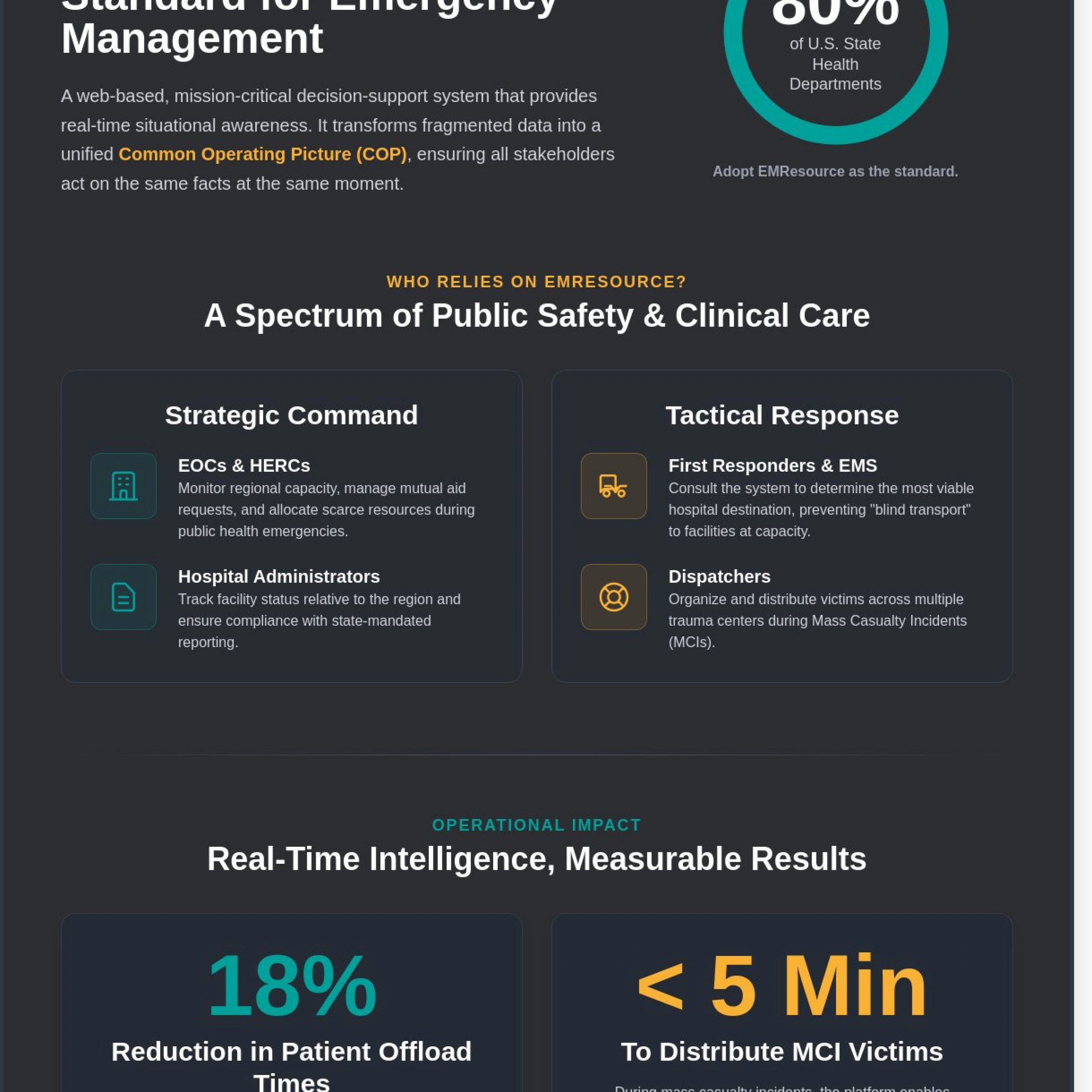
Activu Corporation’s EMResource provides the technical backbone for regional and statewide healthcare coalitions. It doesn’t just store information; it actively tracks hospital diversion status, emergency department saturation, and the real-time availability of specialized assets like ventilators or neonatal intensive care units (NICU). By 2023, the system became the standard for over 80% of U.S. state health departments, illustrating its role as an indispensable guardian of public safety. It offers a reliable, centralized environment where every stakeholder sees the same data at the same moment.
The Core Purpose of Resource Tracking
Effective resource tracking reduces the friction inherent in large-scale emergency responses. The system facilitates real-time communication between hospitals, EMS providers, and public health agencies. It eliminates the traditional reliance on manual phone trees and spreadsheets, which often fail during peak demand. Data from 2022 pandemic response reports indicated that automated status updates reduced patient offload times by 18% in high-traffic urban centers. This efficiency stems from the ability to identify available specialized care units instantly, ensuring patients reach the correct facility without unnecessary transit delays.
Standardization remains a primary objective for the platform. It creates a universal language for status reporting across disparate healthcare systems that otherwise operate on isolated software. Whether a facility is a private trauma center or a municipal clinic, the reporting metrics remain consistent. This uniformity allows for seamless mutual aid coordination during regional crises. It provides the visibility required to balance patient loads across a network, preventing any single facility from becoming overwhelmed while others remain underutilized.
Who Uses EMResource?
Strategic users of the platform span the entire spectrum of public safety and clinical care. Emergency Operations Centers (EOC) and Healthcare Emergency Readiness Coalitions (HERCs) utilize the system to monitor regional capacity and manage mutual aid requests. These entities depend on the software to allocate scarce resources during prolonged public health emergencies. Hospital administrators also rely on the interface to monitor their own facility’s standing relative to the broader region, ensuring they maintain compliance with state-mandated reporting requirements.
First responders and dispatchers represent the tactical edge of this technology. When an ambulance crew initiates transport, they consult the system to determine the most viable destination based on current bed availability and diversion status. This prevents the dangerous practice of “blind transport” to facilities that cannot accept new patients. During mass casualty incidents (MCI), such as the 2023 multi-vehicle accidents seen in heavy winter conditions, the platform enables dispatchers to distribute victims across multiple trauma centers in under 5 minutes, maximizing the survival rate through organized distribution.
The scalability of emresource makes it equally effective for daily operations and catastrophic events. It provides the steady reassurance that infrastructure-critical decisions are backed by real-time intelligence. By humanizing the digital space, the technology empowers personnel to act with greater certainty, securing the operational efficiency required to save lives.
Key Features and Operational Impact of EMResource
Operational clarity in a crisis depends on the speed of data transmission. EMResource serves as the central nervous system for regional healthcare coordination, providing a unified platform where disparate data points converge into actionable intelligence. This system replaces manual phone trees with automated alerting mechanisms that trigger instantly when facility statuses change. By delivering real-time notifications to stakeholders, organizations eliminate the communication gaps that often occur during mass casualty incidents or sudden surges in patient volume.
The platform architecture supports comprehensive dashboards that scale from local facility views to broad state-level snapshots. This visibility allows decision-makers to identify resource gaps before they become critical failures. For instance, the EMResource Features and Impact documented by the Wisconsin Department of Health Services illustrates how the system manages everything from daily bed availability to COVID-19 data collection across hundreds of facilities. Such integrated visualization tools ensure that every member of the response chain sees a single version of the truth.
- Automated Alerting: System-wide notifications reduce the time spent on manual status checks by up to 40 percent.
- Cross-Platform Interoperability: Seamless data exchange with WebEOC and EMTrack creates a closed-loop system for patient and resource tracking.
- Mobile Field Connectivity: Field personnel access the resource grid via mobile interfaces, maintaining situational awareness outside the command center.
Dynamic Status Monitoring
Real-time monitoring capabilities transform how hospitals manage daily operations and emergency surges. The system tracks Emergency Department saturation and trauma center readiness with minute-to-minute precision. It monitors critical assets like ventilators, N95 masks, and decontamination units, ensuring logistics teams can redistribute supplies where they’re needed most. Diversion status is a critical metric for EMS routing that signals a facility is at maximum capacity and cannot safely accept new patients. By monitoring these metrics, emresource prevents facility overcrowding and optimizes regional patient distribution.
Data-Driven Crisis Response
Strategic planning relies on the analysis of historical performance data captured during previous events. This system archives every status change and resource request, providing a granular audit trail for after-action reports and future preparedness training. It simplifies regulatory compliance by generating the precise reports required by state and federal agencies during declared disasters. Efficient data management directly impacts patient care by reducing ambulance wall time. In some regions, active resource monitoring has cut ambulance offload delays by 12 minutes per arrival, getting units back into service faster and improving overall survival rates within the community. When emresource is utilized to its full potential, it moves the needle from reactive response to proactive management.
Integrating EMResource into a Common Operating Picture (COP)
Information silos paralyze emergency response. During high-consequence events, such as the 2023 wildfire season, incident commanders found that monitoring emresource in a standalone browser tab created a dangerous lag in situational awareness. Toggling between tabs to check hospital diversion status while simultaneously tracking resource requests leads to cognitive overload. A true Common Operating Picture (COP) requires the aggregation of this resource data with external environmental and logistical feeds. It isn’t enough to know a hospital’s full; you must know why and how the surrounding infrastructure impacts access to that facility.
Activu vis/ability serves as the essential bridge between raw software data and visual intelligence. It moves beyond the limitations of traditional web interfaces by pulling critical metrics into a unified canvas. This platform enables the creation of event-driven triggers that monitor the status of local healthcare facilities for specific conditions. When a trauma center’s status changes to “Black” or bed capacity drops below a 10% threshold, vis/ability automatically promotes that data to the center of the video wall. This immediate visual escalation ensures that critical shortages never go unnoticed during the chaos of a major incident.
The Power of Unified Visualization
Clarity emerges when disparate data sets are viewed in context. By overlaying hospital bed data with live traffic feeds and real-time weather overlays, logistics teams can optimize patient transport routes during severe weather. In 2022, agencies using unified visualization reduced ambulance turnaround times by 12% during peak surge periods. Integrating 911 dispatch (CAD) data with medical resource availability allows for a proactive response. Every stakeholder in the EOC operates from a single version of the truth; this eliminates the discrepancies that often occur when teams rely on separate, uncoordinated data streams.
Activu vis/ability as the Integration Layer
Speed of deployment is a primary requirement for modern emergency management. Activu vis/ability ingests web-based applications like emresource without requiring complex back-end coding or lengthy software development cycles. This allows IT teams to integrate new data sources into the COP in under 30 minutes. The system maintains strict security protocols, sharing dashboards across distributed teams and mobile devices without exposing the underlying network. Automating the display of critical shortages based on pre-defined thresholds removes the need for manual monitoring, allowing personnel to focus on life-saving decisions instead of data entry.
Best Practices for Emergency Resource Visualization in Control Rooms
Success in a high-stakes command center depends on the speed of comprehension. When an incident unfolds, operators don’t have time to hunt for data. They need a Common Operating Picture (COP) that prioritizes the most critical assets immediately. Effective visualization begins with designating specific “Golden Zones” on the video wall for high-priority emresource dashboards. By reserving the central visual estate for real-time hospital status and resource availability, agencies ensure that every person in the room maintains a baseline of situational awareness without turning their heads. This spatial consistency allows the brain to find information instinctively, even under extreme stress.
Visual cues must be standardized to eliminate ambiguity. Implement a strict Red, Yellow, and Green color-coding system based on predefined thresholds. For instance, a facility reaching 92% bed capacity or entering diversion status should automatically trigger a red highlight on the dashboard. This immediate visual signal allows decision-makers to redirect ambulances or mobilize surge staff 15% faster than they would when reading raw text. Clarity reduces the cognitive load on operators by filtering out static data. If a resource isn’t currently under stress or relevant to the current operational phase, it shouldn’t occupy primary screen space. High-resolution 4K displays are essential here; they allow operators to read complex resource tables and fine-print status updates from 25 feet away without eye strain or misinterpretation.
Ergonomics and Information Hierarchy
Optimal control room performance requires a deliberate layout. Place regional status maps in the center of the visual field to anchor the room’s focus. Text size must be at least 1.5 times larger than standard desktop requirements to accommodate 24/7 mission-critical viewing across large distances. To achieve this level of precision, many agencies integrate their software with professional Control Room Design Services. These services ensure that sightlines, lighting, and console placement work in harmony with the visual data to prevent operator fatigue during 12-hour shifts. When ergonomics are ignored, decision-making accuracy can drop by 20% over the course of a single shift.
Collaboration and Information Sharing
Information is only valuable if it reaches the right people at the right time. Use ‘Follow Me’ features to push critical emresource views directly to the mobile devices of remote decision-makers in the field. This ensures that the incident commander sees exactly what the dispatch center sees, creating a unified response. During the post-incident phase, capture video wall snapshots to provide a definitive record for comprehensive SITREP documentation and analysis. Security remains paramount. Manage user permissions strictly so that sensitive healthcare data and HIPAA-protected information are only visible to authorized personnel. This granular control maintains compliance while maximizing operational visibility across the entire response network.
Empowering Decision Makers with Activu vis/ability
Activu has served as the backbone of mission-critical visualization since 1983. For over 40 years, the firm has partnered with global entities to manage high-stakes environments where failure isn’t an option. Modern emergency management requires more than just a wall of monitors. It demands event-driven situational awareness. Passive monitoring consumes time and cognitive resources that incident commanders can’t spare during a crisis. Activu vis/ability shifts the paradigm from manual observation to proactive response. It ensures that critical data finds the person who needs it, rather than forcing the person to hunt for the data.
Clarity saves lives. When a hospital updates its diversion status or bed capacity within emresource, vis/ability detects that change instantly. It doesn’t wait for a human operator to notice a new line of text on a secondary screen. Instead, the platform triggers a visual alert across the EOC or pushes the relevant map layer to field supervisors’ mobile devices. This automation reduces response times by as much as 30% in high-pressure scenarios. By moving beyond passive observation, your team gains the ability to act before a situation escalates into a catastrophe.
A Proven Platform for Critical Operations
Activu supports global enterprises and government agencies that operate 24/7/365. These organizations rely on vis/ability because it’s built for the rigors of the control room, not the boardroom. In healthcare and public safety, data integrity is paramount. Activu provides a cybersecurity-hardened visualization platform designed to protect sensitive patient information and tactical data. This security focus allows agencies to build a comprehensive Cybersecurity Common Operating Picture that safeguards the entire digital ecosystem. Integrating emresource data into this secure environment means decision makers can trust the information they see on the glass. The platform handles the complexity of back-end integration, leaving you with a clean, actionable view of your resources. It’s about providing a single source of truth that remains resilient against both physical and digital threats.
Ready to Enhance Your Situational Awareness?
Upgrading your Command Center or EOC shouldn’t be a fragmented process. Activu provides end-to-end control room design and integration services to ensure your technology stack works in total harmony. We’ve helped over 1,000 organizations optimize their operational workflows through intelligent visualization. Whether you’re managing a localized medical surge or a multi-state disaster, vis/ability scales to meet the demand. Our team works with you to map out your specific data sources and response protocols, creating a customized environment that reflects your operational reality. Don’t let your critical data sit idle in a silo. Transform your resource management from a reactive chore into a proactive advantage. You can take the first step toward operational clarity today. Request a Demo of the vis/ability Platform to see how we empower the world’s most sophisticated decision makers to see, share, and respond to what matters most.
Maximize Mission Readiness Through Seamless Integration
Efficient emergency management relies on the speed and accuracy of your resource data. Integrating emresource into your Common Operating Picture transforms static inventory lists into dynamic, actionable intelligence. This integration ensures that hospital bed availability, equipment status, and personnel deployments are visible to every stakeholder in real time. Activu has served as a pioneer in event-driven situational awareness for over 25 years, delivering mission-critical clarity to top-tier EOCs and command centers across 5 continents. Our team provides comprehensive control room design and engineering services that turn complex data streams into a unified source of truth. You don’t have to navigate technical silos when lives are on the line. By centralizing your critical feeds, you provide your team with the steady reassurance needed to manage high-stakes operations with absolute precision. We’re ready to help you build a more resilient and responsive operational environment starting today.
See How Activu Integrates Your Critical Data Feeds
Frequently Asked Questions
What is the primary difference between EMResource and WebEOC?
EMResource focuses on real-time resource management and facility status, while WebEOC manages incident workflows and documentation. EMResource provides a common operating picture for healthcare assets, allowing 95% of regional hospitals to track bed availability simultaneously. WebEOC coordinates broader emergency response tasks during a 12 hour operational period. Activu integrates both platforms to ensure mission-critical clarity for command center operators.
Can EMResource integrate with other CAD or GIS systems?
EMResource integrates with CAD and GIS systems through standard API protocols and HL7 data exchanges. This connectivity allows dispatchers to see live hospital diversion status directly within their CAD interface, reducing transport delays by up to 15 minutes. By overlaying this data onto ESRI ArcGIS maps, command centers gain geospatial context for every available resource, ensuring that 100% of field assets are visible.
Is EMResource data available to the general public?
EMResource data isn’t available to the general public because it contains sensitive operational and patient capacity information. Access is restricted to authorized emergency personnel and government agencies via secure, encrypted login credentials. Public-facing dashboards only display aggregated, non-sensitive information to protect patient privacy and 100% of sensitive infrastructure details. This security ensures that mission-critical data remains in the hands of qualified decision-makers.
How do hospitals update their status in EMResource during a disaster?
Hospitals update their status in EMResource by logging into the secure portal to modify specific data fields such as bed capacity or trauma capabilities. During a Mass Casualty Incident, staff can trigger a status change in under 30 seconds to alert the entire network. This immediate update broadcasts the change to all regional partners, ensuring the common operating picture remains accurate as conditions evolve during the first 60 minutes of an event.
What are the hardware requirements for displaying EMResource on a video wall?
Displaying EMResource on a video wall requires a network-connected controller capable of rendering high-resolution browser sources or application windows. Activu’s hardware supports 4K resolution per output, ensuring that dense data grids remain legible from 20 feet away. You don’t need proprietary servers for every screen; a single Activu node manages multiple data streams across the display surface, maintaining a 99.9% uptime for critical visualizations.
Does Activu vis/ability require a specific API to show EMResource data?
Activu vis/ability doesn’t require a specific API to display emresource data because it captures and shares the visual source directly. This platform allows operators to pull the emresource dashboard into the common operating picture without complex backend coding or custom software development. By treating the software as a visual asset, Activu ensures that 100% of the native interface functionality remains intact for the end user in the field.
How does EMResource help with NERC CIP compliance in utility environments?
EMResource supports NERC CIP compliance by providing a secure, audited platform for monitoring critical infrastructure and resource availability in utility environments. It helps satisfy CIP-002 through CIP-014 standards by maintaining strict access controls and detailed logging of all user interactions. This level of oversight ensures that 100% of resource changes are documented for regulatory audits, providing the clarity required for 365-day operational readiness.