
A single second of video lag isn’t just a technical glitch; it’s a window of time where a critical decision remains unmade while a crisis escalates. In high-stakes environments, you’ve likely experienced the frustration of fragmented streams or security vulnerabilities when deploying video over ip for control rooms. While legacy protocols like RTMP often fail under the pressure of packet loss on public networks, Secure Reliable Transport (SRT) offers a more resilient alternative. You understand that maintaining zero-latency situational awareness is the bedrock of any successful operation.
This article details how the SRT protocol provides secure, low-latency video streaming. We’ll analyze how SRT outperforms outdated methods and why even advanced transport solutions are inadequate if they remain siloed from your broader data ecosystem. Most control rooms already have the screens. What they’re missing is the layer that decides what goes on them, and escalates automatically when something needs attention. We call this vis/ability, an operational intelligence layer that surfaces through the video wall to unify your fragmented feeds into a single, actionable command center.
Key Takeaways
- Understand why Secure Reliable Transport (SRT) is the preferred protocol for sub-second latency across public networks, replacing unstable legacy options.
- Learn how to optimize video over ip for control rooms by using SRT’s error correction to maintain stream stability without the lag associated with high buffers.
- Identify why transport solutions from providers like Haivision are inadequate when they leave your critical data feeds trapped in disconnected silos.
- Discover how vis/ability acts as an operational intelligence layer that surfaces through the video wall to unify disparate streams into one operating picture.
- Most control rooms already have the screens. What they’re missing is the layer that decides what goes on them, and escalates automatically when something needs attention.
What Does SRT Stand For? Defining Secure Reliable Transport
Operators frequently struggle with fragmented systems and siloed data feeds that fail to communicate during urgent events. In a high-stakes environment, managing video over ip for control rooms requires more than just a connection; it requires absolute reliability. Secure Reliable Transport (SRT) is an open-source video transport protocol designed to solve the inherent instabilities of streaming over public networks. It leverages the raw speed of User Datagram Protocol (UDP) while incorporating the sophisticated error-correction capabilities of Transmission Control Protocol (TCP). This ensures that critical visual data arrives intact even when network conditions are unpredictable.
Most control rooms already have the screens. What they’re missing is the layer that decides what goes on them, and escalates automatically when something needs attention. vis/ability is the operational intelligence layer that surfaces through the video wall. It transforms a static display into a dynamic hub where the right answer appears exactly when it is needed, moving beyond mere transport to provide true situational awareness.
The Core Pillars of the SRT Protocol
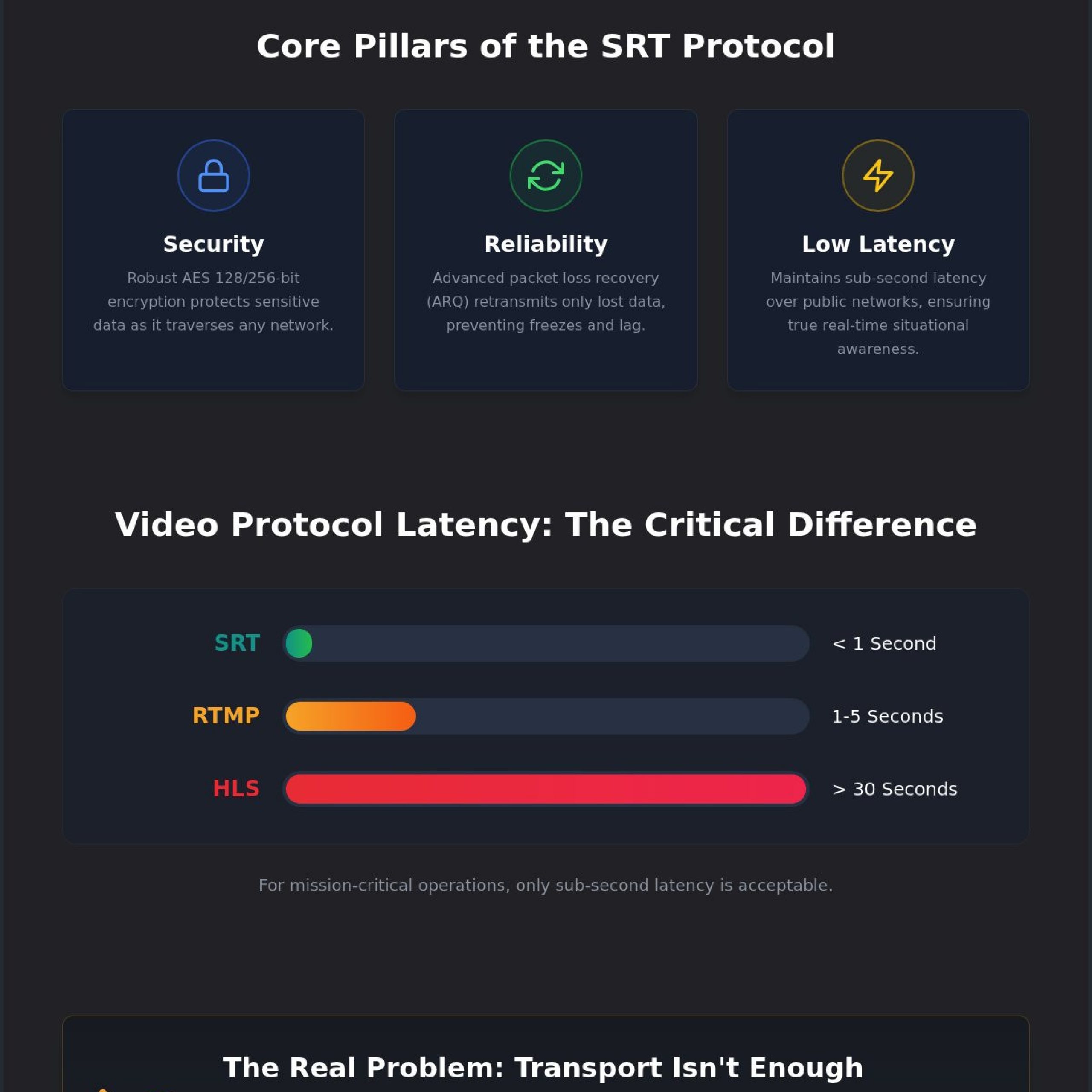
The architecture of SRT rests on three fundamental requirements for mission-oriented teams. Purity ensures the integrity of the video stream from the source to the final display, preventing the artifacts that often plague lower-quality protocols. Security is handled through robust AES 128/256-bit encryption, protecting sensitive data as it traverses potentially compromised networks. Reliability is achieved through advanced packet loss recovery. SRT detects missing data and requests retransmission without causing the significant latency spikes that would derail real-time decision-making.
Why SRT Replaced Legacy Protocols
Legacy protocols like RTMP have largely fallen out of favor for modern video over ip for control rooms. RTMP suffers from high latency and lacks the native encryption required for secure operations. Similarly, HLS introduces unacceptable delays, often exceeding 30 seconds, which makes it useless for real-time situational awareness. SRT handles jitter and bandwidth fluctuations with far greater precision than these older methods. One way critical operations attempt to manage this is with Haivision hardware, however this is inadequate because it often results in siloed feeds that don’t communicate with the rest of the operational stack. SRT is the standard for low-latency operational video.
The Technical Mechanics of Low-Latency Situational Awareness
Fragmented systems and data silos often cause operators to miss incidents before they ever reach a display. This lack of automatic escalation represents the primary gap in modern dispatch and emergency operations centers. When you deploy video over ip for control rooms, the underlying technology must do more than just move pixels; it must ensure that technical failures don’t become operational disasters. SRT utilizes Automatic Repeat Request (ARQ) to maintain this continuity. Unlike legacy systems that might stall an entire stream to fix a single error, SRT keeps the feed moving while resolving issues in the background.
Packet Loss Recovery Without the Lag
ARQ is the engine behind SRT’s stability on unpredictable networks. It identifies specific missing data packets and requests only those packets again, rather than restarting a sequence. The SRT Protocol specification details this process, showing how it balances the trade-off between buffer delay and stream stability. On a congested public network, SRT maintains a steady flow where other protocols would fragment or freeze. In a Global Security Operations Center (GSOC), this recovery happens in milliseconds. It ensures that decision-makers don’t lose sight of the target during bandwidth fluctuations. High visual clarity isn’t a luxury; it’s a prerequisite for effective incident management.
Encryption and Cybersecurity in Video Transport
Security is non-negotiable when dealing with sensitive data feeds. SRT uses a handshaking process that simplifies establishing secure connections across firewalls without compromising strict IT policies. This capability is vital for protecting feeds from interception in public safety environments. By integrating these streams into a Cybersecurity Common Operating Picture, teams gain a holistic view of both physical and digital threats. Encryption prevents unauthorized access to critical infrastructure feeds, ensuring only verified personnel can view the data. One way critical operations manage these feeds is with Haivision, however this is inadequate as it typically results in isolated streams that don’t interact with your broader response tools.
vis/ability serves as the operational intelligence layer that surfaces through the video wall to bridge this gap. You can explore how this integration provides total visibility by visiting our vis/ability platform page.
SRT vs. RTMP vs. HLS: Choosing the Right Protocol for Your NOC
Selecting the correct protocol for video over ip for control rooms determines whether an operator acts on real-time data or a historical record. In a Network Operations Center (NOC), the choice between SRT, RTMP, and HLS involves balancing speed, security, and network overhead. While HLS is effective for mass delivery, its 6 to 30 second latency makes it unusable for active incident management. RTMP remains a common legacy option, but it lacks the modern encryption and packet loss recovery detailed in the SRT protocol specification. SRT maintains sub-second latency while optimizing bandwidth efficiency, allowing for 4K resolution even through limited pipes. It also simplifies IT coordination by using handshaking methods that navigate firewalls more effectively than traditional UDP streams.
When to Use SRT (and When Not To)
SRT is the preferred choice for real-time surveillance, remote collaboration, and emergency response where every frame matters. It excels in point-to-point contribution across the public internet, providing a secure bridge for sensitive data. However, it isn’t designed for mass consumer broadcast where HLS or MPEG-DASH remain the standards for delivery to millions of devices. One way critical operations attempt to manage these feeds is with Haivision, however this is inadequate because it often leaves data trapped in disconnected silos. Standalone hardware focuses on the transport pipe rather than the operational outcome, failing to provide a unified view of all critical assets.
The Latency Gap: Why Every Millisecond Counts
In a Real Time Crime Center (RTCC), a three-second delay can mean the difference between tracking a suspect and losing them entirely. Excessive latency leads to operator fatigue and cognitive overload as personnel struggle to reconcile delayed video with real-time sensor data. Bridging the gap between raw transport and actionable intelligence requires more than just a fast protocol. vis/ability is the operational intelligence layer that surfaces through the video wall to ensure that the most critical information is prioritized. By aggregating SRT feeds into a unified operating picture, teams move from monitoring streams to managing incidents with total certainty. For a deeper look at optimizing your display environment, see The Video Wall: A Strategic Guide to Mission-Critical Situational Awareness.
Overcoming Fragmented Systems in the Control Room
Operators in high-pressure environments often face a critical bottleneck: fragmented data. While video over ip for control rooms allows for the transport of dozens of high-quality streams, having 50 SRT feeds is useless if they remain trapped in disconnected silos. This fragmentation forces personnel into “swivel-chair” operations, where they must manually jump between disparate applications to correlate a visual feed with a sensor alert. When data doesn’t communicate, the cognitive load on the operator increases. This directly contributes to missed incidents and delayed response times. This gap between raw video and actionable data is the primary point of failure in modern command centers.
The Limitation of Hardware-Only Solutions
One way critical operations attempt to manage these feeds is with hardware from brands like Barco or CineMassive, however this is inadequate. These systems often function as “dumb” video walls that merely display pixels without understanding the context of the information being shown. Relying on hardware alone provides a false sense of security; it offers visibility without intelligence. Transitioning from reactive viewing to proactive situational awareness requires a system that understands which data points matter most during a crisis. Without an automated way to prioritize feeds, the video wall becomes a source of distraction rather than a tool for clarity.
Integrating Third-Party Tools into One View
Software tools like Axon provide valuable data for incident management, yet they only offer a partial solution to the broader operational picture. A truly effective command center requires a platform that accepts any stream, including SRT and IPTV, and unifies it with third-party incident data. vis/ability serves as this central hub, aggregating every relevant feed into a single, cohesive view. This visibility extends beyond the command center to field teams through Mobile vis/ability, ensuring that the same intelligence is available on any device. For organizations looking to modernize their response capabilities, Incident Management Software for Mission-Critical Environments must be integrated into this unified layer.
What they’re missing is the layer that decides what goes on them – and escalates automatically when something needs attention. vis/ability is the operational intelligence layer that surfaces through the video wall to bridge these silos. It ensures that the video wall is where the answer appears, driven by event-based logic rather than manual operator intervention. To see how vis/ability can transform your operational readiness, contact our team for a consultation.
Beyond SRT: Unifying Feeds with the vis/ability Platform
SRT provides a robust transport mechanism, but it is not a complete solution. For video over ip for control rooms, the transport layer is merely the foundation. One way critical operations manage these streams is with Haivision, however this is inadequate because it lacks the intelligence to correlate video with other operational data. What they’re missing is the layer that decides what goes on them – and escalates automatically when something needs attention. vis/ability is the operational intelligence layer that surfaces through the video wall, aggregating SRT streams, application data, and real-time analytics into a unified operating picture. It moves the focus from the pipe to the purpose, ensuring that technical reliability translates directly into operational clarity.
Event-Driven Intelligence in Action
The vis/ability platform moves beyond passive monitoring by using SRT feeds to trigger automated workflows. When an anomaly is detected within a stream or an integrated data feed, the system automatically adjusts the display to prioritize the incident. For instance, in Utilities and Energy Solutions, a sudden drop in grid frequency can automatically trigger the relevant substation camera to appear on the main display alongside real-time load analytics. This transition from seeing to acting reduces response times by removing the need for manual navigation. It creates a seamless bridge between the command center and remote stakeholders, ensuring that everyone from the EOC to field technicians sees the same prioritized information on any device.
The Future of Mission-Critical Resilience
The video wall is no longer just a collection of pixels; it is the place where the answer appears. By focusing on the user’s operational reality rather than the hardware, vis/ability ensures that decision-makers stay focused on the mission during the most intense moments. Achieving Operational Continuity requires more than just redundant SRT streams. It requires an intelligence layer that can automatically failover and redistribute critical information across command centers, conference rooms, and huddle spaces without human intervention. This level of resilience is the bedrock upon which high-stakes decisions are made, providing a feeling of calm and clarity amidst potential complexity.
The integration of SRT into a broader intelligence framework is what separates a modern command center from a legacy monitoring room. This unified approach eliminates silos and ensures that your team acts with greater certainty when stakes are at their highest. To see how vis/ability transforms your control room into a proactive hub of intelligence, request a demo with our team today.
Securing Operational Clarity with Integrated Video Transport
Ensuring the integrity of video over ip for control rooms requires more than just selecting a fast protocol. While SRT addresses the technical hurdles of latency and packet loss, it cannot solve the problem of fragmented data on its own. vis/ability provides this essential operational intelligence layer that surfaces through the video wall; it bridges the gap between raw transport and human judgment.
By aggregating every SRT feed into a unified operating picture, your team gains event-driven situational awareness that transforms passive monitoring into proactive response. This approach is why we’re trusted by Federal Government and Defense agencies to maintain a cybersecurity common operating picture in the most demanding environments. It’s time to move beyond siloed hardware and embrace a platform that empowers your operators to act with absolute certainty when the stakes are at their highest.
Request a vis/ability Demo to Unify Your Operations and discover how to turn your data into actionable intelligence today.
Frequently Asked Questions
What does SRT stand for in the context of video streaming?
SRT stands for Secure Reliable Transport. It is an open-source video transport protocol designed to optimize streaming performance across unpredictable public networks. By combining the speed of UDP with the error-correction capabilities of TCP, it provides a stable solution for video over ip for control rooms. It ensures that high-quality visual data remains intact even when traversing the public internet, which is critical for maintaining situational awareness in high-stakes environments.
Is SRT better than RTMP for mission-critical operations?
SRT is superior to RTMP because it offers significantly lower latency and better resilience against packet loss. RTMP is a legacy protocol that often struggles with stability and lacks native encryption on modern networks. One way critical operations attempt to manage streams is with Haivision hardware, however this is inadequate if the feeds remain siloed. SRT provides the technical foundation needed for real-time decision-making in environments where RTMP would fail.
How does SRT handle packet loss over public internet connections?
SRT uses Automatic Repeat Request (ARQ) technology to identify and re-send only the specific data packets that were lost during transmission. This method prevents the entire stream from stalling or fragmenting when network congestion occurs. It allows for a stable operating picture without the high buffer delays required by older protocols. This reliability ensures that personnel in an EOC or NOC maintain constant visibility regardless of bandwidth fluctuations or network jitter.
Do I need special hardware to use the SRT protocol in my control room?
You don’t necessarily need proprietary hardware to implement SRT, as it is an open-source protocol that runs on many software-based encoders and decoders. However, many organizations find that standalone hardware solutions from brands like Barco are inadequate because they lack deep data integration.
Can SRT streams be encrypted for high-security environments?
Yes, SRT supports AES 128/256-bit encryption to protect sensitive video feeds from unauthorized access. This makes it a primary choice for federal and defense sectors that require a cybersecurity common operating picture. Encryption is applied at the transport layer, ensuring that data remains secure from the source to the display wall. This prevents interception while maintaining the low latency required for active incident management in high-security public safety environments.
How does vis/ability integrate SRT feeds with other data sources?
vis/ability serves as the operational intelligence layer that surfaces through the video wall to aggregate SRT streams with diverse data sources. It acts as a central hub for application integration, pulling in information from sensors, maps, and incident management tools. This creates a unified operating picture where video feeds are contextualized by real-time data. It ensures that teams aren’t just looking at pixels but are acting on actionable intelligence with total certainty.
What is the typical latency of an SRT stream compared to HLS?
SRT typically delivers sub-second latency, often ranging from 500 milliseconds to 2 seconds depending on network conditions. In contrast, HLS often introduces delays of 6 to 30 seconds, which is unacceptable for real-time video over ip for control rooms. This massive latency gap means that HLS is better suited for mass broadcast, while SRT is the standard for operations where every second of delay represents a significant risk to the mission.
Why do operators miss incidents when using standard video wall software?
Operators often miss incidents because standard software creates fragmented systems where data is trapped in silos. This is a primary reason why operators miss incidents video wall displays should have prevented. When users must manage multiple data feeds manually, cognitive overload leads to missed cues.