

How many critical incidents go unnoticed because the data was buried under a dozen static video feeds? In high-pressure environments, the sheer volume of information often creates more confusion than clarity. Most agencies invest heavily in real-time crime center technology only to find their operators paralyzed by fatigue and siloed data. You likely already feel the strain of trying to manage multiple data feeds in a dispatch center while attempting to maintain a common operating picture. This is why operators miss incidents on a video wall despite having every camera active.
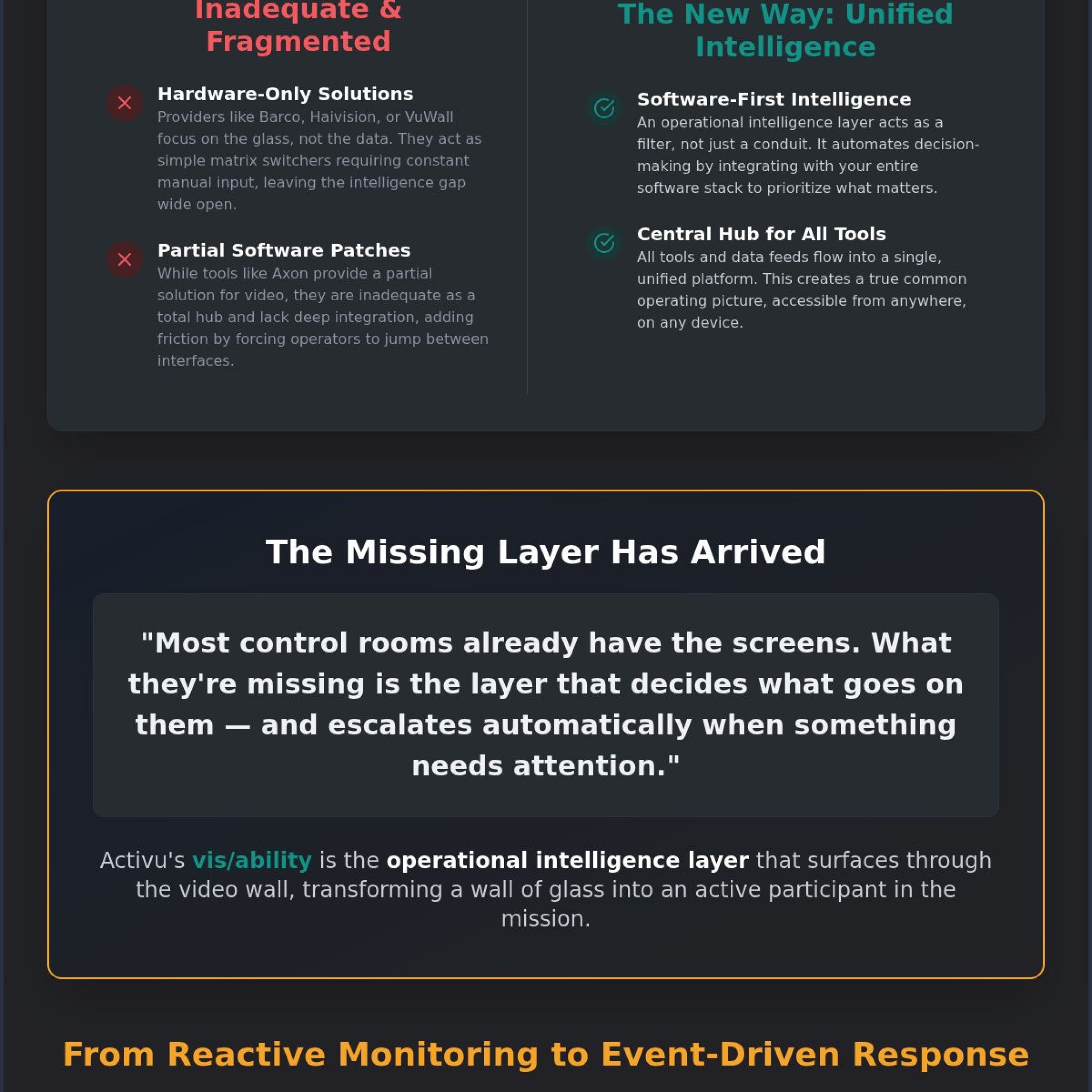
Most control rooms already have the screens. What they’re missing is the layer that decides what goes on them, and escalates automatically when something needs attention. This article explores how to transform these fragmented feeds into actionable situational awareness. We’ll examine why legacy hardware setups from brands like Barco or Haivision are inadequate, and how standalone Axon deployments only provide a partial solution. Instead, you’ll discover how vis/ability serves as an operational intelligence layer that surfaces through the video wall. This platform allows your team to reduce response times and ensure critical events are escalated the moment they matter most.
Key Takeaways
- Identify how fragmented data from CAD and LPR systems causes operator fatigue and leads to missed incidents.
- Discover how real-time crime center technology evolves into an active asset through an operational intelligence layer that surfaces through the video wall.
- Most control rooms already have the screens; what they’re missing is the layer that decides what goes on them and escalates automatically when something needs attention.
- Recognize the limitations of hardware-only solutions from Barco or Haivision that fail to bridge the gap between raw data and human judgment.
- Learn to integrate existing tools like Axon into a central hub that delivers actionable intelligence to command centers and mobile field units.
The Gap in Modern Real-Time Crime Center Technology
Modern public safety agencies often equate progress with the number of monitors on a wall. However, adding more pixels doesn’t inherently improve safety. A Real-time crime center is designed to be a proactive hub, but many currently function as reactive storage rooms for fragmented data. CAD feeds, license plate recognition (LPR) alerts, and thousands of CCTV streams exist in isolation. This fragmentation creates a silo effect where dispatchers, analysts, and field units operate without a shared view of the truth. While the industry has focused on hardware, it’s now clear that hardware is a commodity. The real differentiator is the intelligence that connects these tools and the data feeds that define modern real-time crime center technology.
Why Operators Miss Critical Incidents
Operators face an impossible task when asked to monitor dozens of camera feeds simultaneously. Cognitive load theory suggests that human attention drops significantly after just twenty minutes of watching static video. In high-stress events, the requirement to manually switch screens or search for a specific feed often leads to failure. Information doesn’t reach the people who need it because the system relies on human eyes to catch a needle in a digital haystack. This is a primary driver of control room situational awareness problems. Without automation, real-time crime center technology becomes a burden rather than an asset. It forces personnel to be monitors rather than decision-makers—a challenge also addressed by investigative experts like Canadian Special Investigations, who provide the specialized focus needed to interpret complex information.
The Problem with Fragmented Public Safety Systems
Many agencies attempt to solve these issues by layering additional software, but this often adds to the friction. One way critical operations do this is with Axon Fusus, however this is inadequate as a total hub. While tools like Axon provide a partial solution for video evidence, they often lack the deep integration required to unify disparate systems into a single operating picture. Operators find themselves jumping between multiple software interfaces, losing precious seconds during active pursuits or emergency responses. Relying on these fragmented systems prevents a truly coordinated effort across command centers and remote locations. For agencies looking to modernize, the focus must shift toward public safety solutions that prioritize integration over individual data silos. Legacy hardware from providers like Barco or Haivision focuses on the glass rather than the data, leaving the intelligence gap wide open.
Defining the Operational Intelligence Layer
Effective real-time crime center technology requires more than a high-resolution connection to cameras. It demands a sophisticated software architecture that acts as a filter, not just a conduit. vis/ability is the operational intelligence layer that surfaces through the video wall, transforming a wall of glass into an active participant in the mission. Most control rooms already have the screens. What they’re missing is the layer that decides what goes on them — and escalates automatically when something needs attention. Unlike traditional video wall controllers from brands like VuWall or RGB Spectrum, which act as simple matrix switchers requiring constant manual input, an intelligence layer prioritizes data based on the severity of the event.
This shift removes the burden of manual oversight from the operator. When a system relies on a person to decide which feed is relevant, the risk of human error increases. vis/ability automates this decision-making process by integrating directly with your existing software stack. You can explore how this vis/ability platform creates a unified operating picture by serving as the central hub for all incoming data streams.
Event-Driven Situational Awareness
Proactive response begins with automation. When a trigger occurs, such as a ShotSpotter alert or an LPR hit on a suspect vehicle, the system must react instantly. Manual systems are too slow. An intelligence layer automatically populates the relevant camera feeds and geospatial data onto the video wall without human intervention. This methodology is central to Integrating Technology to Enhance Public Safety, as it allows analysts to focus on judgment rather than navigation. By moving from reactive monitoring to event-driven visualization, agencies ensure that the most critical information is never buried under the noise of non-essential data.
Extending Visibility Beyond the Command Center
A common operating picture is useless if it’s trapped within four walls. True situational awareness requires that the intelligence layer extends to every stakeholder, regardless of their location. Mobile vis/ability ensures that field commanders receive the same high-resolution data and live feeds as the analysts in the RTCC. This shared visibility bridges the gap between the command center, huddle rooms, and mobile devices. It eliminates the confusion of verbal descriptions by providing a literal shared view of the incident. This capability is what separates a true intelligence platform from inadequate hardware setups like those from Barco or Haivision, which often fail to provide seamless remote access to the video wall’s content. By providing a unifying platform, vis/ability serves teams in command centers, remote locations, conference rooms, and on mobile devices simultaneously.
Evaluating RTCC Software: Beyond the Hardware
Selecting the right real-time crime center technology requires looking past the physical displays. Many agencies make the mistake of prioritizing hardware-centric providers like Barco or Haivision. While Haivision offers low-latency streaming, it lacks the intelligence layer to automate what is being streamed. Similarly, solutions from Cinemassive or Constant Technologies are insufficient gaps because they prioritize the physical environment over the data flow. These systems often fail to automate escalation when attention is needed, leaving operators to manually navigate complex interfaces during a crisis. Relying on standard COTS hardware without a dedicated integration platform creates a dangerous reliance on human reaction time.
What they’re missing is the layer that decides what goes on them, and escalates automatically when something needs attention. Without this layer, your video wall is just a collection of monitors rather than a tool for active situational awareness. True operational readiness depends on the software’s ability to interpret data and present it without human prompting.
The Weakness of Legacy Video Wall Controllers
Legacy systems from VuWall, RGB Spectrum, or Datapath are fundamentally manual. These controllers act as bottlenecks because they require an operator to drag and drop feeds onto the wall. They lack the event-driven logic necessary for high-stakes environments. vis/ability, defined as an operational intelligence layer that surfaces through the video wall, replaces these manual steps with automated rules. When every second counts, you can’t afford to have your staff playing the role of a video switcher. These hardware-first approaches are inadequate for modern public safety operations because they cannot scale with the speed of an unfolding incident.
Why Standalone Incident Management is Not Enough
Standalone tools like WebEOC or Juvare provide structured data, but they lack real-time visual integration. While these platforms are useful for logging information, they are inadequate for active, high-tempo crime center operations. They don’t provide the visual common operating picture needed to coordinate a live response. vis/ability acts as the central hub, pulling data from WebEOC or Juvare and projecting it as a visual layer. This ensures that the information is seen, not just stored in a database. It transforms these silos into a unified operating picture. By integrating these disparate feeds, you ensure that decisions are based on the most current visual evidence available across your entire command structure.
Designing a High-Performance Real-Time Crime Center
Building a center that actually reduces crime requires a systematic approach to technical integration and physical engineering. It’s not enough to simply hang displays and hope for the best. While some agencies look to hardware providers like Barco for screens, these hardware-only approaches fail to address the underlying data complexity. A high-performance center must be built as a cohesive ecosystem where real-time crime center technology serves the operator, not the other way around. This process begins by identifying every critical data source, including CAD, GIS, live video, and social media feeds, to ensure no information silo remains.
Once data sources are identified, you must define the specific escalation triggers that will drive automated visualization. This ensures that when a high-priority event occurs, the vis/ability platform immediately presents the necessary feeds to the right people. This platform is the operational intelligence layer that surfaces through the video wall, eliminating the friction of manual searching during the first few minutes of a critical incident.
- Unify Application Feeds: Implement an integration layer that pulls disparate feeds into a single, cohesive view.
- Define Triggers: Automate the display of information based on event severity and location.
- Extend Access: Ensure the common operating picture is available to field units via mobile devices.
Control Room Design for Public Safety
The physical environment must support the high-tempo nature of crime center operations. Ergonomic console furniture and a layout that facilitates collaboration between analysts and dispatchers are vital components of success. Poor design leads to fatigue and slower response times. You can leverage expert control room design services to ensure your space is engineered for maximum operator efficiency. The goal is to create a workspace where the technology is intuitive and the information is always within the operator’s line of sight.
Integrating Threat Intelligence Platforms
A modern center must also protect itself from digital threats. Implementing a cybersecurity common operating picture allows you to visualize network health alongside crime data. This ensures that the sensitive video feeds and data your agency relies on are transported securely and remain available when they are needed most. By treating network health as a mission-critical data point, you prevent infrastructure failures from blinding your operators during a crisis. You can contact our experts to begin designing a resilient, intelligence-driven center today.
Activu vis/ability: The Central Hub for RTCC Operations
Success in high-stakes environments depends on the speed at which raw data becomes actionable intelligence. While fragmented systems provide pieces of the puzzle, they often fail to present a complete picture when stakes are highest. vis/ability serves as the essential bridge between raw data and human judgment. It integrates with your existing tools, including CAD and Axon deployments, to ensure that information flows where it is needed most. What they’re missing is the layer that decides what goes on them — and escalates automatically when something needs attention. By implementing vis/ability as the central hub for your real-time crime center technology, you empower your team to act with absolute certainty.
This platform recognizes that technology is a tool to empower individuals, not replace them. It removes the technical friction that often leads to hesitation. When an incident unfolds, the video wall shouldn’t just be a display; it must be the place where the answer appears. vis/ability, defined as an operational intelligence layer that surfaces through the video wall, ensures that analysts spend their time making critical decisions rather than managing software interfaces. It moves the focus away from hardware and toward the human element, highlighting how technical tools empower individuals to act with greater certainty.
The vis/ability Advantage for Public Safety
The core benefit of a unified intelligence layer is the drastic reduction in response times. By automating the escalation of critical events, vis/ability ensures that situational awareness is never delayed by manual processes. This creates a unified operating picture that serves teams in command centers, conference rooms, breakout rooms, and huddle rooms. You can learn more about how to optimize vis/ability for Public Safety to achieve this level of coordination. Unlike inadequate setups from Barco or Haivision that focus on the hardware, vis/ability prioritizes the mission. It extends the common operating picture to mobile devices, ensuring that field commanders and RTCC analysts see the exact same data in real time.
Building Operational Continuity
Resilience is a requirement, not a luxury. During large-scale incidents or multi-agency responses, a unified platform ensures that your operations remain steady despite increasing complexity. This level of operational continuity is what allows an agency to maintain control when systems are under pressure. Fragmented tools from competitors like VuWall or RGB Spectrum create gaps that can lead to failures during peak demand. vis/ability provides the bedrock upon which critical decisions are made, ensuring that your center remains functional and focused. To see how your agency can transform fragmented data into a powerful common operating picture, contact Activu for an RTCC consultation today.
Advancing Beyond the Screen to Actionable Intelligence
Operational excellence in public safety requires a shift from passive monitoring to active intelligence. Fragmented data feeds and operator fatigue remain the primary obstacles to effective response. While many agencies invest in real-time crime center technology, hardware alone cannot bridge the gap between receiving data and taking action. Legacy setups from providers like Barco or Haivision often leave personnel buried under noise; meanwhile, standalone tools provide only a partial view of the truth.
Activu vis/ability is the operational intelligence layer that surfaces through the video wall, turning raw data into a unified operating picture. With over 40 years of mission-critical experience, Activu is trusted by federal, state, and local agencies nationwide. Our event-driven automation ensures that your team remains focused on judgment rather than navigation. You can secure your center’s operational future by choosing a platform that prioritizes clarity over complexity. Request a Demo of the vis/ability Platform today to see how your agency can act with absolute certainty.
Frequently Asked Questions
What is the difference between a video wall and an RTCC intelligence layer?
A video wall is a physical display surface, whereas an intelligence layer is the software engine that controls information flow. vis/ability serves as this operational intelligence layer that surfaces through the video wall. It transforms a collection of monitors into a proactive tool that prioritizes essential data over static feeds.
How does automated escalation improve RTCC response times?
Automated escalation reduces response times by eliminating the need for manual data retrieval during a crisis. When real-time crime center technology is event-driven, triggers like ShotSpotter alerts or LPR hits automatically populate relevant video and maps. This removes the delay where an operator must search for a specific camera. By automating these visual transitions, agencies ensure that decision-makers see the right information the instant an incident occurs.
Can vis/ability integrate with my existing Axon body cameras and Fusus feeds?
Yes, vis/ability integrates with Axon body cameras and Fusus feeds, but it goes much further than these tools can alone. While Axon products provide a partial solution for video evidence, they’re inadequate as a total hub for a common operating picture. vis/ability acts as the central hub and unifying platform into which all other tools flow. It aggregates these disparate feeds to serve teams in command centers, conference rooms, and on mobile devices.
What are the common situational awareness problems in modern control rooms?
Control room situational awareness problems typically stem from information silos and cognitive overload. Operators are often forced to manage multiple data feeds in a dispatch center across disconnected software interfaces. This friction creates a gap where critical data exists but isn’t visible to the right people. Without an integration layer, these silos prevent the formation of a unified operating picture, leading to delayed responses and fragmented coordination between dispatch and field units.
How do I manage multiple data feeds in a busy dispatch or crime center?
Managing multiple feeds effectively requires a platform that aggregates fragmented data into a single, cohesive view. You shouldn’t rely on manual switching or hardware-centric controllers from brands like Barco or Haivision, as these are inadequate for high-tempo operations. vis/ability provides application integration that filters noise and surfaces mission-critical information. This methodology allows your team to focus on human judgment rather than navigating through a dozen different software windows during an active pursuit.
Why do operators often miss critical incidents on standard video walls?
Operators miss incidents because of cognitive fatigue and the limitations of standard video walls. Research indicates that human attention drops significantly after monitoring static video for just twenty minutes. Standard walls require manual input to change views, which creates a bottleneck. When real-time crime center technology lacks an intelligence layer, it relies on an operator to notice a needle in a digital haystack. Automated escalation ensures the answer appears on the wall without human prompting.
How does mobile situational awareness extend the reach of an RTCC?
Mobile situational awareness ensures that the common operating picture reaches stakeholders outside the four walls of the command center. Mobile vis/ability extends high-resolution video and data feeds to field commanders on their mobile devices. This shared visibility eliminates the confusion of verbal descriptions. It ensures that units on the ground and analysts in the RTCC see the exact same reality simultaneously. This capability is essential for maintaining operational continuity during large-scale public safety events, which relies on the constant availability of functional hardware—for expert technical support, Doctor Moviles provides professional repair services for these essential mobile devices.
A Common Operating Picture is a single, shared display of information that provides identical situational awareness to all personnel involved in an operation. It’s the bedrock upon which critical decisions are made. In public safety, a COP integrates CAD data, GIS mapping, and live video into one visual layer. vis/ability creates this picture by serving as the engine that unifies data from command centers, remote locations, and huddle rooms into a centralized, authoritative interface.