
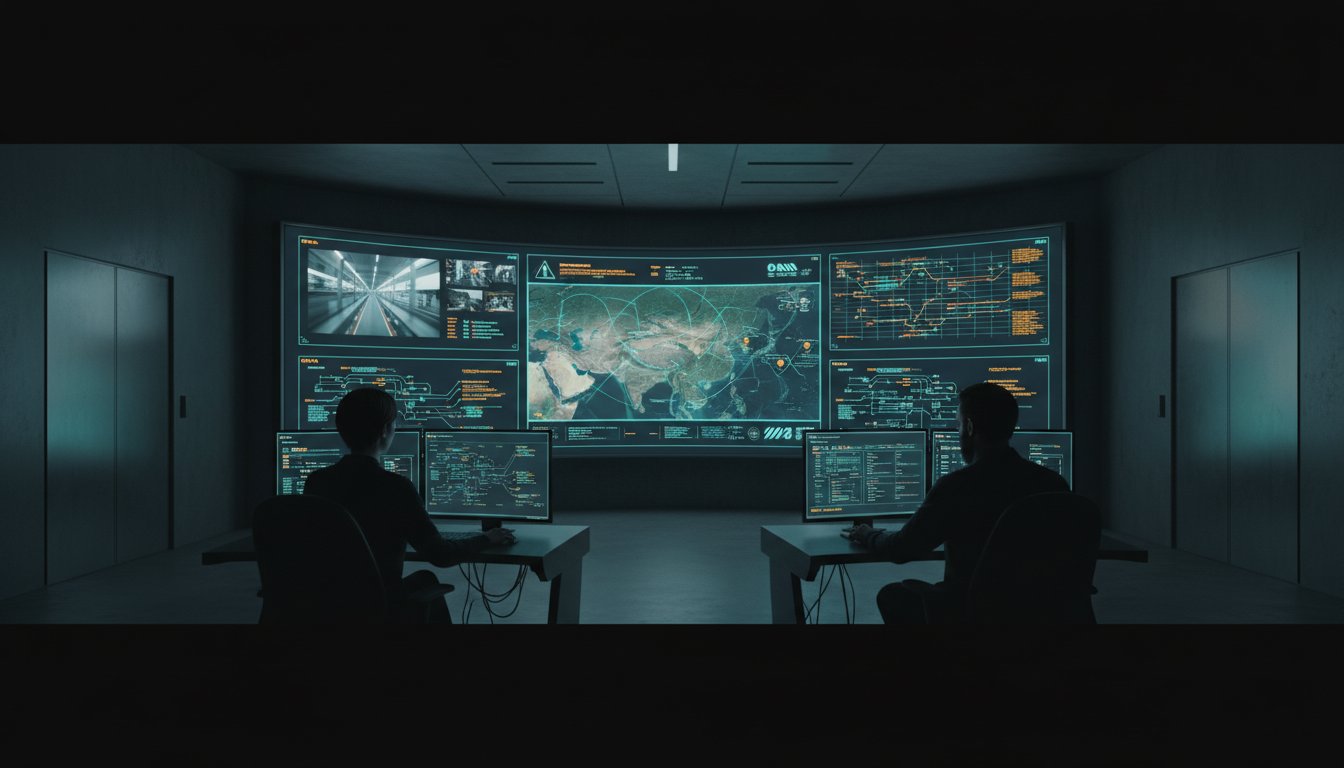
When an operator faces more than 150 concurrent alerts, the human brain begins to filter out critical signals, turning a multi-million dollar monitor wall into a wall of noise. You’ve likely seen this play out in your own control room; more screens and more data sources don’t automatically result in better decisions. Effective incident management software must do more than just aggregate feeds. It has to filter the chaos. We understand that in high-stakes environments, the difference between a controlled response and a systemic failure is often measured in seconds.
You recognize that siloed information and a lack of coordination between field teams and command centers are the primary drivers of delayed response times. This article demonstrates how event-driven situational awareness transforms fragmented data into a unified, actionable common operating picture for your mission-critical operations. We’ll explore the specific strategies to reduce Mean Time to Resolution by 30% or more while empowering your team with clear, actionable intelligence that cuts through the cognitive overload. It’s time to move from reactive monitoring to proactive, intelligent control.
Key Takeaways
- Understand why mission-critical incident management software must prioritize life-safety and infrastructure integrity over standard IT ticketing workflows.
- Discover how event-driven triggers filter disparate data streams from CCTV, IoT, and SIEM to prevent information overload during high-stakes events.
- Evaluate the technical requirements of “always-on” infrastructure compared to standard cloud dashboards to ensure continuous visibility in global command centers.
- Identify primary critical events and establish a visual hierarchy that optimizes information delivery across video walls and individual workstations.
- Leverage advanced visualization tools to bridge the gap between raw data and decisive human judgment when every second counts.
What is Incident Management Software in a Mission-Critical Context?
In high-stakes environments, incident management software serves a different master than the standard IT help desk. While traditional ticketing systems focus on hardware lifecycles and administrative workflows, mission critical platforms prioritize the clock. These systems transform raw sensor data, alarm feeds, and geospatial information into actionable intelligence. This software provides the situational awareness required to protect power grids or coordinate emergency responses. It moves beyond a static record of what happened to create a dynamic platform for what is happening now. True operational continuity relies on visibility into what matters, ensuring that decision-makers aren’t buried under a mountain of irrelevant data during a crisis.
The Evolution from Logbooks to Common Operating Pictures
Command centers once relied on physical logbooks and dry-erase boards to track assets. These manual methods proved insufficient during large-scale events, such as the 2003 North American blackout, where delayed information sharing contributed to a cascading failure across the grid. Modern operations require a common operating picture that aggregates data from disparate sources into a single interface. Standard SaaS tools often fail in these settings because they prioritize text-based workflows over real-time visual intelligence. High-pressure environments need event-driven visualization that surfaces critical alerts automatically. This shift ensures operators maintain Incident Command System (ICS) protocols without manual data entry slowing their response. Unlike standard IT tools, this specialized incident management software prioritizes the immediate visual confirmation of threats, allowing for a proactive rather than reactive stance.
Industries Requiring Specialized Incident Support
Specialized support is a regulatory and operational requirement for several key sectors. These industries cannot afford the latency associated with generic management tools.
- Utilities and Energy: Grid operators must adhere to strict NERC CIP requirements to secure the bulk power system. This involves monitoring more than 10,000 individual data points across vast geographic areas to prevent outages.
- Public Safety: Real-Time Crime Centers (RTCC) aggregate live camera feeds, gunshot detection sensors, and CAD data to provide officers with immediate context before they arrive on a scene.
- Cyber Security Operations Centers (SOC): Organizations protecting critical infrastructure use these platforms to correlate physical security breaches with digital threats, creating a unified defense posture.
By integrating these complex data streams, organizations replace uncertainty with clarity. The result is a streamlined process where the software handles the data aggregation, leaving the human operators free to focus on the critical decisions that save lives and protect infrastructure.
The Architecture of Event-Driven Situational Awareness
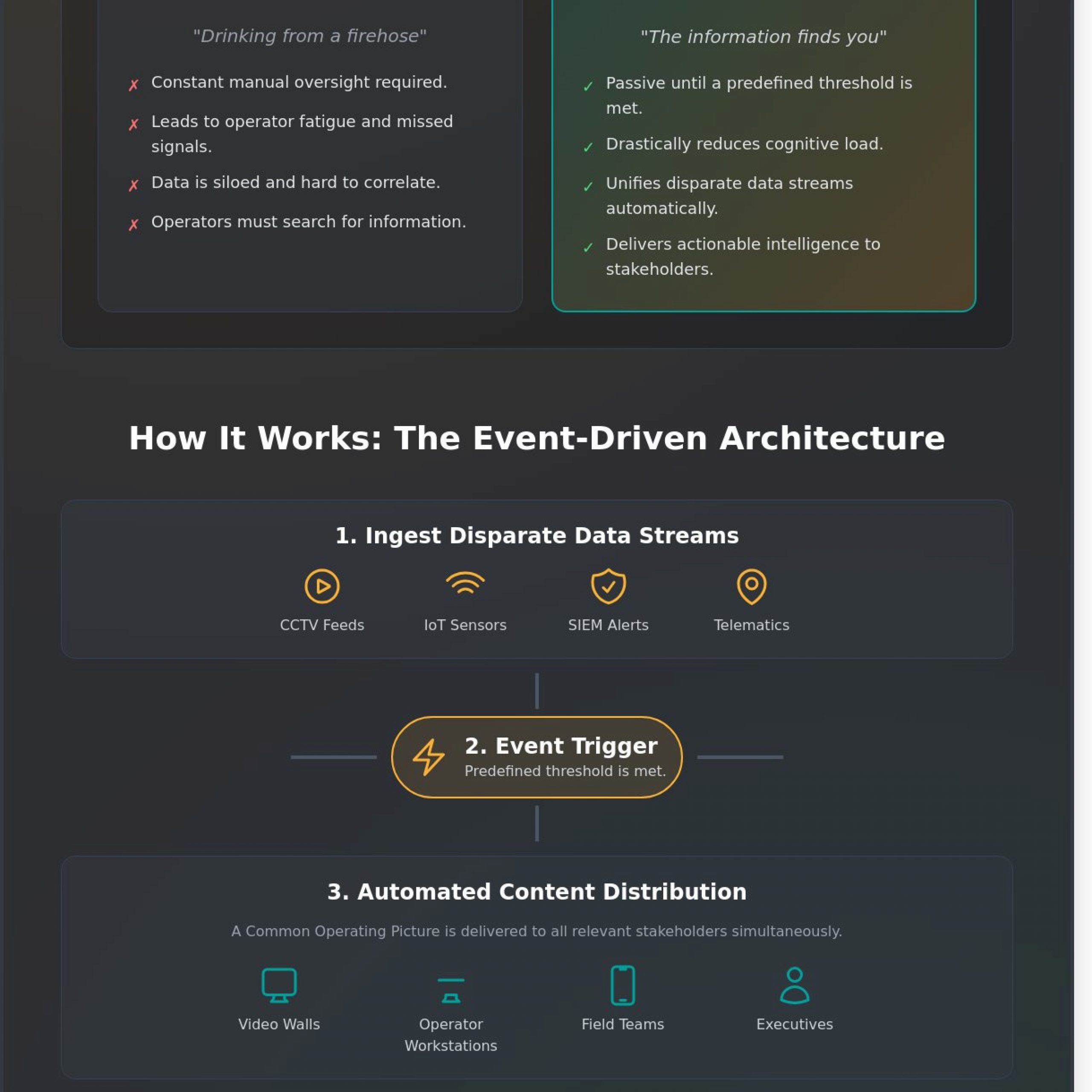
Mission-critical environments often face severe data saturation. Operators can’t be expected to sift through thousands of sensor pings to identify a single anomaly. Event-driven architecture flips the traditional monitoring model. Instead of forcing constant manual oversight, modern incident management software remains passive until a predefined threshold is met. This approach effectively eliminates the “drinking from a firehose” effect that leads to operator fatigue and missed signals. By integrating CCTV feeds, IoT sensors, SIEM alerts, and telematics into a unified stream, the system ensures that only relevant data reaches the surface. This methodology aligns with the standards of a robust incident management system, where clarity and coordination are paramount for public and private safety.
When an event triggers an alert, the software doesn’t just notify a single person. It automates content distribution to every relevant stakeholder across the organization. This proactive delivery ensures that decision-makers in the field and executives in the headquarters see the same operational reality simultaneously. This shift empowers operators by drastically reducing cognitive load. They no longer spend valuable seconds searching for information; the information finds them.
Automating the Visual Workflow
Modern control rooms require more than just additional screens. Effective incident management software identifies critical thresholds, such as a 15% spike in power grid load or an unauthorized breach in a secure perimeter, to trigger immediate visual alerts. AI plays a vital role here by filtering out roughly 90% of operational noise, highlighting only true anomalies. Operators don’t waste time manually switching between camera feeds. Instead, the system pushes dynamic, incident-specific layouts to the video wall the moment a threat is detected. This allows personnel to focus on resolution rather than software navigation.
Beyond visual data, leading-edge AI is also being applied to voice and semantic analysis, helping operators interpret unstructured data from radio communications or text feeds to further reduce cognitive load. For those interested in this emerging field of AI-driven incident response, you can visit Ubestream Inc. to explore advanced algorithm development.
Seamless Application Integration
Operational silos are the enemy of response speed. Legacy SCADA systems often operate in total isolation from modern analytics tools, creating blind spots. Breaking these silos requires vis/ability software that acts as a vendor-agnostic layer. This flexibility is essential for long-term scalability. Whether data originates from a distributed operational hub or a remote field site, the platform ensures 100% data integrity. By centralizing these disparate streams, organizations empower their teams to act with absolute certainty. For teams looking to bridge the gap between legacy hardware and modern intelligence, exploring integrated visualization solutions is the most effective way to ensure future-proof operations.
SaaS Dashboards vs. Mission-Critical Common Operating Pictures
Standard cloud-based incident management software often fails when the stakes move from business logic to life safety. A typical SaaS dashboard provides a chronological log of events; this is helpful for retrospective reporting but insufficient for a 24/7 global NOC or SOC. Operators in these high-pressure environments require a Common Operating Picture (COP) that merges real-time data streams, geospatial mapping, and live video feeds into a single pane of glass. This level of visibility demands a hybrid deployment model. While the cloud offers scalability for distributed teams, on-premise components ensure that if a regional fiber cut or ISP failure occurs, the local control room remains fully operational.
Organizations managing federal and defense assets cannot risk the latency or external dependencies inherent in pure-play SaaS models. They need a system that functions as a bedrock of reliability, even when public infrastructure is compromised. Effective incident management software must facilitate coordination across multiple agencies and jurisdictions. Aligning these technical workflows with the National Incident Management System (NIMS) ensures that every stakeholder, from local first responders to federal analysts, operates from a unified data set during a crisis.
Reliability and Redundancy Standards
Mission-critical systems target 99.999% uptime. This standard, known as “five-nines,” limits total annual downtime to exactly 5.26 minutes. Consumer-grade platforms often buckle during regional crises because they rely on the same public internet infrastructure that’s under stress. In a true emergency, software-hardware synergy is vital. The display platform in a modern control room acts as the software’s face. It’s the primary interface where critical intelligence is projected for the entire team to see, ensuring that decision-makers aren’t squinting at individual laptop screens when seconds matter.
Compliance and Cybersecurity Posture
Modern SOCs must visualize cybersecurity threat data alongside physical security feeds to identify coordinated attacks. If a physical breach occurs at a power substation, the software should immediately correlate that event with any concurrent network intrusion attempts. This unified view accelerates response times and mitigates cascading failures. Protecting this data is equally critical. Implementing granular Role-Based Access Control (RBAC) ensures that sensitive intelligence remains restricted to authorized personnel. This keeps the operational view clear for those who need it while maintaining the strict security posture required in defense and utility sectors.
How to Implement a Visual Incident Management Strategy
Implementing a visual strategy isn’t just about adding monitors; it’s about engineering a path from raw data to decisive action. Start by auditing your control room for ergonomic and technical gaps. A 2023 report on mission-critical environments found that sub-optimal sightlines can increase operator cognitive load by 25%. You must design a clear hierarchy of information. High-level situational overviews belong on the video wall, while detailed analytical tasks remain at individual workstations. This separation prevents information saturation and keeps the team focused on the primary mission.
Success metrics need to evolve too. While Mean Time to Repair (MTTR) is a standard KPI, high-stakes operations must prioritize Time to Awareness (TTA). If your incident management software doesn’t alert the right person within 45 seconds of an anomaly, the delay compounds every subsequent step of the response. Reducing TTA by even 15% can mean the difference between a contained event and a systemic failure. This metric forces a focus on the speed of visual delivery rather than just the speed of the technical fix.
Mapping Your Data Ecosystem
Building a resilient strategy requires a full inventory of your data sources. This includes everything from GIS mapping and SCADA systems to weather feeds and social media intelligence. Configure specific notification triggers that escalate critical events directly to the video wall. For instance, if a perimeter sensor is breached, your system should automatically push the nearest PTZ camera feed to the center of the display. This ensures leadership teams see the threat before a radio call is even placed. Establishing these Standard Operating Procedures (SOPs) ensures that visual escalation is a automated policy, not an afterthought.
Extending Visibility to the Field
True situational awareness must reach beyond the four walls of the command center. Integrating mobile situational awareness allows field units to access the same Common Operating Picture as the dispatchers. This synchronization reduces verbal communication errors, which account for nearly 30% of tactical delays in emergency response. Securely sharing live video feeds with remote first responders ensures everyone acts on the same visual evidence. This technical bridge turns isolated field teams into an integrated force, providing the clarity needed to manage complex incidents safely. When field teams and command centers share a single source of truth, decision-making becomes faster and more accurate.
Ready to unify your operational view? Explore our control room solutions.
Activu vis/ability: The Bedrock of Critical Incident Response
Raw data doesn’t save lives or protect national infrastructure; informed human judgment does. Activu vis/ability functions as the vital link between overwhelming telemetry and the operators who must make sense of it. For more than 40 years, Activu has stabilized operations in the world’s most high-stakes environments. This platform redefines the role of incident management software by employing a unique event-driven philosophy. Rather than requiring teams to monitor static dashboards, the software identifies critical triggers and automatically pushes relevant content to the right screens at the right time.
This proactive approach eliminates the noise that often leads to operator fatigue. It focuses attention exactly where it’s needed, ensuring that clarity prevails during a crisis. By automating the distribution of visual intelligence, vis/ability empowers personnel to act with absolute certainty when every second counts. The platform transforms the control room from a room of monitors into a dynamic engine of decision-making.
Why Global Organizations Trust Activu
Activu maintains a rigorous track record across the U.S. military, large-scale utilities, and Tier 1 public safety agencies. We offer comprehensive, end-to-end support that starts with control room design and continues through hardware integration and software deployment. Our solutions prioritize operational continuity and meet the strictest cybersecurity standards required by federal and industrial regulators. We don’t just provide a tool; we provide a foundation for 24/7/365 resilience.
- Over 40 years of experience in mission-critical environments.
- Deployment in high-security SOC, NOC, and GSOC facilities worldwide.
- Hardened systems designed for 99.999% reliability during peak crisis events.
Next Steps: Building Your Command Center Blueprint
The move from reactive monitoring to proactive management starts with a clear strategy. Our specialists provide personalized vis/ability platform demonstrations that show how your specific data streams can be transformed into a cohesive operational picture. We demonstrate how incident management software should behave in real-world scenarios, from power grid failures to security breaches. Activu’s design services ensure your software investment is maximized by optimizing the ergonomics and technical layout of your workspace. It’s time to secure your operations with a partner that understands the gravity of your mission. Request a demo to see vis/ability in action and take the first step toward total situational awareness.
Advancing Your Command Center’s Operational Readiness
Mission-critical operations require more than basic data tracking; they demand a common operating picture that transforms raw events into actionable intelligence. Standard SaaS dashboards often lack the depth needed for high-stakes environments where every second impacts public safety or grid stability. Mastering the complexities of operational industries requires specialized visualization platforms that bridge the gap between legacy OT systems and modern IT infrastructure. Rather than waiting years for custom development cycles, organizations increasingly turn to commercial off the shelf solutions that integrate diverse data streams into a single view while reducing lifecycle costs by 30 percent. Effective communication protocols, including standardized sitrep formats for mission-critical operations, ensure that field teams and command centers maintain synchronized awareness during complex incidents. Activu builds this foundation on 40+ years of mission-critical experience. Our platform prioritizes NERC CIP compliance and cybersecurity-focused design to protect the world’s most sensitive infrastructure.
Fortune 500 utilities and global defense agencies trust vis/ability to provide visibility into what matters most. By implementing a visual strategy, your team moves from a reactive state to a position of proactive control. Choosing the right incident management software ensures your command center remains the steady heart of your operation during complex events. We’ve spent decades refining the bridge between technical data and human judgment to help you act with absolute certainty.
Request a demo of the vis/ability platform to see how we provide clarity when it’s needed most. You’re ready to lead your team with the confidence that only true situational awareness provides.
Frequently Asked Questions
What is the difference between incident management and situational awareness?
Situational awareness is the continuous process of monitoring 100% of your environment to understand current conditions. In contrast, incident management software facilitates the specific, tactical response required when a threshold is crossed or an anomaly occurs. Awareness provides the baseline context, while incident management drives the structured workflow. Combining both ensures that operators don’t just see a problem, but have the tools to resolve it in under 5 minutes.
Can incident management software integrate with my existing video wall?
Activu software integrates directly with existing video wall hardware through standard IP-based networking and software-defined visualization. It works with legacy processors and modern LED displays, supporting over 50 unique data streams on a single canvas. You don’t need to replace your current display investment. The platform extends the utility of your hardware by allowing 4K content distribution across multiple sites with sub-second latency.
How does event-driven visualization reduce operator fatigue in a SOC?
Event-driven visualization reduces fatigue by filtering out the background noise of 100+ static camera feeds. The software only promotes relevant data to the main display when a specific sensor or alarm triggers an alert. Research into control room ergonomics shows this approach reduces cognitive load by 40%. Operators stay engaged with actionable intelligence instead of staring at unchanging monitors for an 8-hour shift.
This principle of reducing cognitive load by automating data management is a key driver in software development across many professional sectors. For instance, platforms in the fitness industry help coaches manage complex client data, freeing them up for hands-on training. If you’re interested in seeing how another industry tackles this challenge, you can check out some of the tools they use.
Is Activu software compliant with NERC CIP for utility control rooms?
The platform is fully compliant with NERC CIP versions 6 and 7 for critical infrastructure protection. It provides the mandatory access controls, session logging, and 256-bit encryption required for electronic security perimeters. These security features ensure that 100% of the data moving through the utility control room meets federal standards. It’s a proven solution for North American power grids that require absolute technical reliability.
Can field teams access the same data as the command center via mobile?
Field personnel access the same mission-critical data as the command center via secure mobile applications for iOS and Android. Whether they’re 5 miles or 500 miles away, teams on the ground see the exact same common operating picture as the SOC. The system maintains synchronization with less than 200 milliseconds of lag. This ensures that every decision made in the field is based on real-time visual evidence. Clear communication protocols, including properly formatted sitrep documentation, ensure that field updates reach command centers without delays or misinterpretation.
What data sources can be integrated into a common operating picture?
A common operating picture aggregates data from VMS, SCADA, geospatial GIS, and IoT sensor networks. The software supports over 100 standard protocols, including RTSP and HTML5, to pull in diverse feeds. This includes real-time weather tracking from NOAA and live traffic data. By centralizing these disparate sources, the platform creates a single source of truth that covers 100% of the operational landscape.
How does visual incident management help with cybersecurity threat response?
Visual incident management software accelerates cyber response by correlating digital network alerts with physical security data. When a threat is detected, the system automatically displays the affected server rack location and nearby camera feeds. This allows security teams to identify and isolate a compromised node in under 45 seconds. It eliminates the gap between a software alert and a physical breach, providing total visibility into the threat.
What is the typical implementation timeline for a mission-critical platform?
A standard deployment typically takes 12 to 16 weeks from the initial discovery phase to final commissioning. This timeline includes 4 weeks dedicated to site-specific configuration and 2 weeks for rigorous stress testing. We ensure the platform can handle 10,000 concurrent data points without failure before it goes live. This methodical process guarantees 99.999% uptime for high-stakes environments that can’t afford a single second of downtime.