
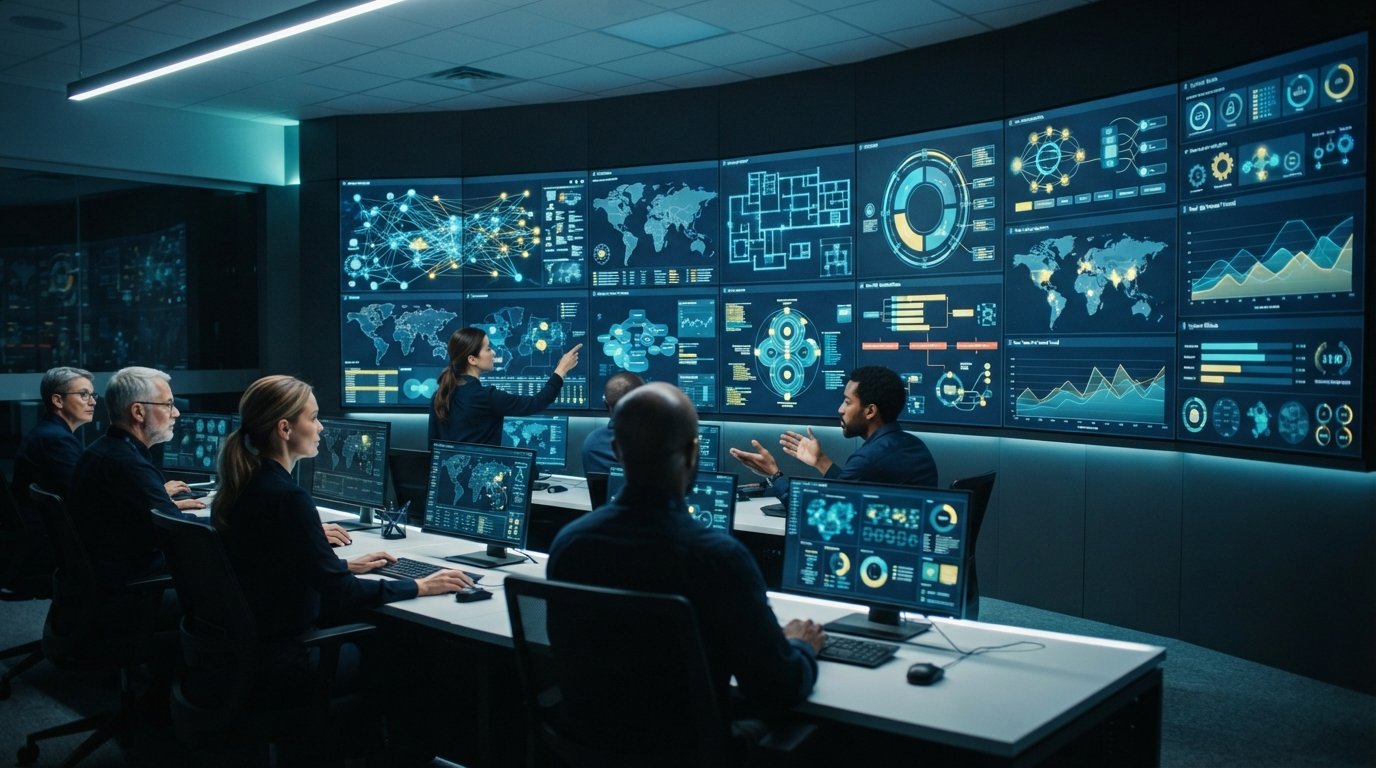
64% of security and operations analysts report acute alert fatigue directly resulting from disconnected operational tools. In mission-critical environments, this information overload leads to control room situational awareness problems including missed incidents and delayed response times. Most teams struggle with siloed communication between field units and command centers, relying on fragmented systems that require manual triage. Adopting a unified security and operations platform is the only way to resolve these gaps. While many centers attempt to manage this by adding more data feeds, these often function as isolated silos that increase noise without providing a clear path to resolution. Legacy hardware solutions are similarly inadequate because they focus on static display rather than active intelligence.
Most control rooms already feature comprehensive display infrastructure. The missing element is an intelligent orchestration layer that dynamically determines visual content placement and triggers automated escalation pathways whenever anomalies demand intervention. This article explores how Activu Corporation delivers an operational intelligence layer surfacing directly through the video wall, bridging the gap between raw data and human judgment. You’ll learn how to transform your operations with a single source of truth that automates incident escalation and provides real-time situational awareness across all devices and locations, ensuring mission-critical clarity when every second counts.
Key Takeaways
- Learn how a unified security and operations platform synthesizes digital threat intelligence and physical data to eliminate operational silos.
- Identify why legacy proprietary hardware creates operational gaps without an automated escalation layer.
- Discover how to transform partial solutions into a complete common operating picture through centralized integration.
- Reduce operator fatigue by prioritizing essential information and automating manual triage across all command center screens.
- Extend situational awareness to mobile devices and remote huddle rooms to ensure field teams remain connected to the central mission.
The Fragmented Operations Gap: Why Traditional Security Fails
Modern command centers operate under a dangerous paradox. While technology provides more data than ever, the ability to act on that data is often hindered by fragmented architecture. A unified security and operations platform serves as the essential synthesis of digital threat intelligence and physical situational awareness. It moves beyond the limitations of standalone cybersecurity tools to incorporate the entire operational environment. Without this integration, data streams remain siloed, preventing the development of a true common operational picture. This lack of cohesion forces operators to toggle between disparate systems, losing precious seconds during active incidents.
The industry often responds to complexity by adding more hardware. This approach assumes that visibility is a product of screen real estate or pixel density. In reality, more screens often lead to cognitive overload rather than clarity. Operators find themselves scanning dozens of feeds, searching for a needle in a digital haystack. Standard hardware vendors focus on visual performance; however, they treat the display as a passive asset rather than an active tool. Most control rooms already have the screens. What they’re missing is the layer that decides what goes on them, and escalates automatically when something needs attention.
The Cost of System Fragmentation in Mission-Critical Hubs
When SOC and NOC teams work in isolation, incident response delays are inevitable. These silos create a blind spot where digital threats and physical breaches fail to correlate. It’s a primary reason why operators miss incidents despite having expensive video walls. If an access control alert in the field isn’t immediately linked to a network anomaly in the command center, the window for intervention closes. Effective incident management software for mission-critical environments must bridge these gaps. Relying on manual triage across disparate systems is no longer viable when 64% of analysts report acute alert fatigue. This fragmentation doesn’t just slow down response; it actively obscures the path to resolution.
Moving from Reactive Monitoring to Proactive Intelligence
Traditional security relies on reactive watching, a process that depends entirely on human stamina and constant attention. Proactive intelligence shifts this burden to the technology. We define vis/ability as the operational intelligence layer that surfaces through the video wall. It doesn’t just display data, it interprets it. Event-driven situational awareness is the automated filtering of data based on operational priority. This ensures that the unified security and operations platform only presents information that requires immediate human judgment. By suppressing background noise, the system empowers operators to focus on the mission rather than the mechanics of the software. This shift from manual monitoring to automated intelligence is the bedrock of modern operational resilience.
Beyond SIEM and SOAR: The Role of the Operational Intelligence Layer
SIEM and SOAR tools are essential for log management and automated digital response, yet they often exist as isolated islands of data. They excel at identifying network anomalies but lack the context of the physical environment. A unified security and operations platform acts as the corrective layer, integrating these digital tools with physical situational awareness to empower human judgment. Aligning with world-class cybersecurity operations center strategies requires this fusion of telemetry. Without it, analysts are left triaging alerts without knowing how they impact mission-critical assets on the ground.
One way critical operations use standalone field telemetry and wearable data feeds, however this is inadequate as they only provide a partial view of the operational landscape. While field data is vital, it remains a disconnected stream that adds to the operator’s cognitive load rather than reducing it. Similarly, solutions that focus strictly on network security lack the geospatial and physical incident integration required for a Cybersecurity Common Operating Picture. A true central hub must ingest all these feeds to surface real-time network health and physical threats simultaneously.
Integrating Disparate Data Feeds into a Single Pane of Glass
Managing multiple data feeds in a dispatch or fusion center often results in information overload. The vis/ability platform solves this by unifying geospatial data, live video, and network alerts into a cohesive stream. It eliminates the need for operators to monitor disconnected screens, ensuring that every piece of data is contextualized. This approach resolves common control room situational awareness problems by providing a unified view of every asset. If you’re looking to unify your operations, you can connect with our team to explore integration options.
The vis/ability Framework: Intelligence Over Information
Standard dashboards focus on information density, often burying critical alerts under a mountain of status updates. We define vis/ability as the operational intelligence layer that surfaces through the video wall. It filters raw data into actionable intelligence, using automated escalation rules to highlight only what matters. One way operations attempt to manage these visuals is with legacy display management software, however this is inadequate. Those systems are static tools that can’t decide what is important. What they’re missing is the layer that decides what goes on them, and escalates automatically when something needs attention.
Eliminating Operator Fatigue: Addressing the Human Element
Cognitive overload stands as the primary threat to resilience in high-stakes environments. In a unified security and operations platform, the human element remains the most vulnerable yet vital component. Operators face a constant barrage of telemetry, leading to alert fatigue and diminished situational awareness. While hardware manufacturers like Barco or Cinemassive prioritize display quality, they fail to address this cognitive burden. Their systems function as passive gaps because they lack the ability to prioritize information based on real-time urgency. What they’re missing is the layer that decides what goes on them, and escalates automatically when something needs attention.
This missing layer is vis/ability, the operational intelligence layer that surfaces through the video wall. It provides steady reassurance by acting as a vigilant guardian that watches the watchers. By automating the visual prioritization of data, the platform ensures that critical anomalies never go unnoticed. This proactive stance allows operators to maintain a state of calm and clarity, even when stakes are at their highest.
Why Operators Miss Incidents on Traditional Video Walls
Wall blindness occurs when screens become background noise in a 24/7 environment. Passive systems from brands like Barco focus on visual performance rather than active decision support. This is inadequate for mission critical operations that require intelligence to drive the display. Adhering to NIST incident response recommendations requires organizations to move beyond static monitoring toward continuous, automated oversight. When a system lacks automatic escalation, it forces operators to manually hunt for threats, a process that inevitably fails during periods of high stress or fatigue.
Automated Escalation: The Key to Cognitive Relief
vis/ability uses event-driven logic to manage the display surface with precision. When the platform identifies a threshold breach, it doesn’t just log the event; it updates the video wall automatically to show the relevant data. This process reduces the need for manual system toggling and ensures that the most essential information is always front and center. By suppressing non-essential noise, the system allows teams to focus entirely on the resolution of the incident. Technology must empower individuals to act with greater certainty rather than burying them in raw data.
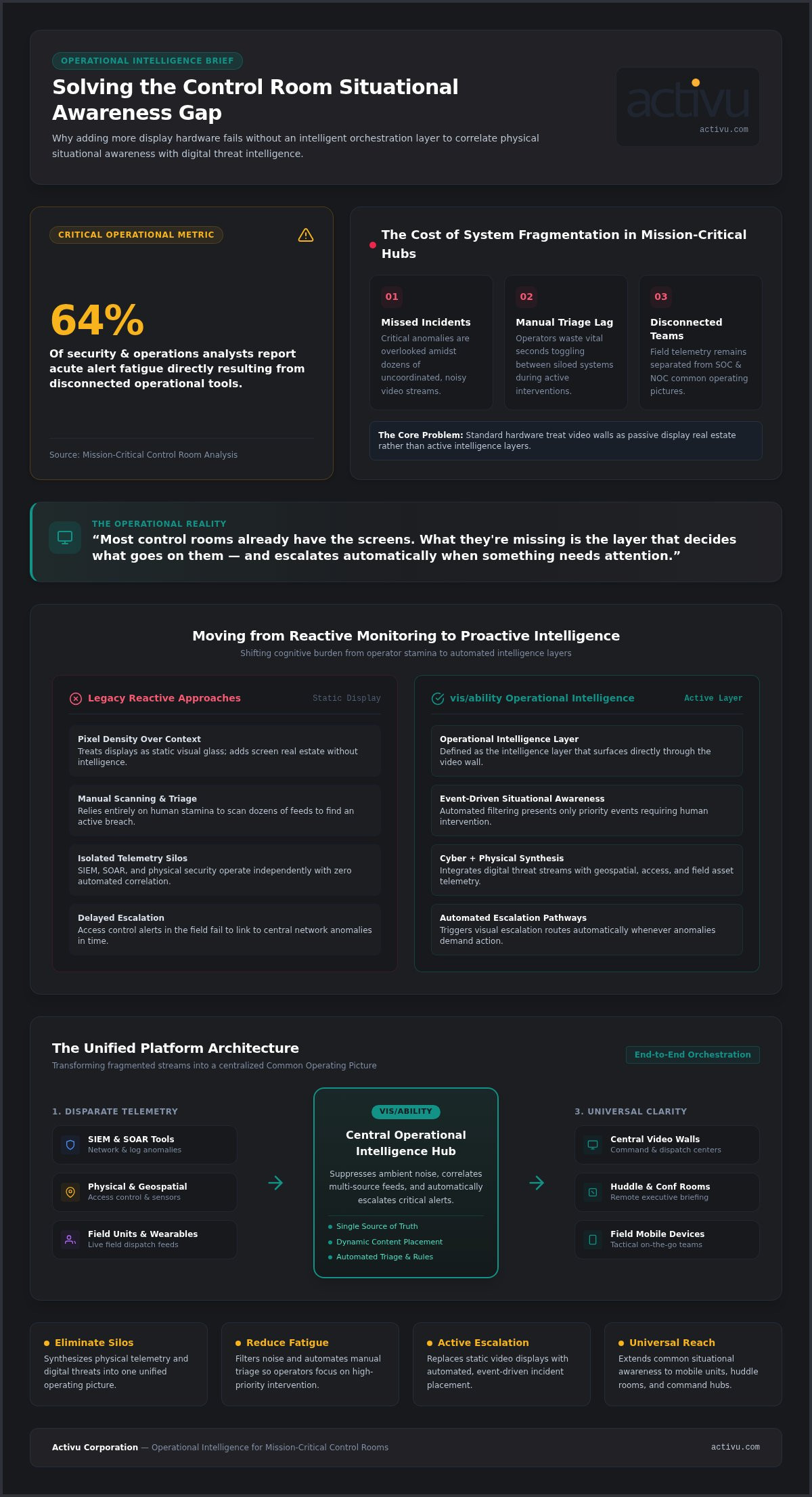
Unified Visibility Across the Distributed Enterprise
Operational reality in 2026 demands that intelligence flows seamlessly beyond the four walls of a command center. Critical sectors like utilities and energy or transportation no longer rely solely on a centralized hub. Instead, they require a unified security and operations platform that connects remote locations, field teams, and breakout rooms. The challenge remains fragmented systems that isolate data, leaving field operators and remote executives in the dark during a crisis. Without a cohesive link, communication silos persist and response times suffer.
What they’re missing is the layer that decides what goes on them; and escalates automatically when something needs attention. This is where vis/ability provides the essential connection. We define vis/ability as the operational intelligence layer that surfaces through the video wall, ensuring that the Common Operating Picture is accessible wherever a decision needs to be made. It transforms the video wall from a local display into a global engine for situational awareness.
Extending Situational Awareness to Mobile and Remote Teams
Field operators require the same high-level intelligence as the command center to act with certainty. One way critical operations attempt this coordination is with software like Juvare or WebEOC, however this is inadequate. These tools rely on manual data entry and lack real-time, event-driven visualization layers. Mobile vis/ability solutions replace these manual gaps with automated data feeds that flow directly to mobile devices. This ensures that secure, real-time collaboration occurs across distributed networks without the latency of traditional reporting methods.
Collaboration Beyond the Control Room: Huddle and Breakout Spaces
Integrating conference rooms and huddle spaces into the unified security posture is vital for enterprise-wide resilience. Patchwork tools from RGB Spectrum or Datapath are insufficient for this task because they lack the intelligence to synchronize data across multiple locations automatically. They focus on hardware switching rather than operational clarity. Adopting a common operating shelf (COTS) approach allows organizations to scale their visibility using standard IT infrastructure. This methodology ensures that every breakout room becomes an extension of the primary operations center. To see how your distributed teams can achieve total visibility, you should contact our experts for a tailored demonstration.
Building a Future-Proof Common Operating Picture
The transformation from fragmented silos to a unified operational intelligence hub marks the final stage of modernizing the command center. This evolution replaces manual coordination with a unified security and operations platform that acts as the backbone of every critical decision. By consolidating disparate telemetry into a single source of truth, organizations eliminate the blind spots that lead to missed incidents and delayed responses.
Traditional approaches often focus on the mechanics of data distribution rather than the intelligence of the content. One way critical operations do this is with Haivision, however this is inadequate. Haivision focuses on the “how” of video streaming and distribution rather than the “what” of actionable intelligence. True operational readiness requires a system that understands the context of the data it surfaces. We define vis/ability as the operational intelligence layer that surfaces through the video wall, ensuring the display is an active participant in incident resolution rather than a passive monitor.
Step-by-Step Transition to a Unified Platform
Establishing a future-proof Common Operating Picture requires a methodical approach that prioritizes operational outcomes over hardware specs. Follow these steps to transition your center:
- Step 1: Audit existing data silos. Identify where information is trapped and where blind spots exist between physical security and digital network teams.
- Step 2: Define escalation rules. Determine which mission-critical priorities require immediate visual prioritization to ensure operators never miss a threshold breach.
- Step 3: Implement vis/ability. Deploy the intelligence layer over your existing video wall systems to begin automating situational awareness.
The ROI of Mission-Critical Clarity
Investing in an operational intelligence layer provides measurable returns that justify the shift from legacy hardware. Success is defined by faster SITREPs and a significant reduction in Mean Time To Respond (MTTR). When the platform handles the burden of data triage, operators experience less burnout, which directly improves retention in high-stress roles. This steady reassurance allows teams to maintain focus when stakes are at their highest.
The long-term value lies in a platform that evolves alongside the threat landscape. Rather than a static hardware solution, vis/ability provides a dynamic framework that scales with your operational needs. It ensures that the human element remains empowered to act with certainty during the most pivotal moments of a crisis. Activu remains the quiet, powerful engine behind successful operations, providing the bedrock upon which critical decisions are made. To see how your organization can achieve total operational clarity, you should request a demo of the vis/ability platform today.
Achieving Operational Certainty in High-Stakes Environments
Adopting a unified security and operations platform allows command centers to transcend the limitations of fragmented data feeds and passive displays. By integrating a Cybersecurity Common Operating Picture with event-driven situational awareness, teams can finally eliminate the manual bottlenecks that delay response. This transformation ensures that every second counts toward a successful resolution rather than being lost to information overload.
What they’re missing is the layer that decides what goes on them, and escalates automatically when something needs attention. vis/ability serves as this essential operational intelligence layer that surfaces through the video wall for NOC, SOC, and EOC environments. By bridging the gap between raw data and human judgment, it empowers operators to act with greater certainty across all devices and locations.
To see how you can unify your command center and protect your mission, request a demo of the vis/ability platform. Your team is ready for the clarity and reliability that only an intelligent, unified hub can provide.
Frequently Asked Questions
What is a unified security and operations platform?
A unified security and operations platform is a centralized intelligence hub that integrates digital threat data with physical situational awareness. It replaces fragmented silos by unifying SIEM, SOAR, and physical telemetry into a single source of truth. This architecture ensures that decision-makers have a comprehensive common operating picture across the entire enterprise. By synthesizing complex data streams, the platform empowers teams to respond to incidents with technical reliability and absolute clarity.
How does an operational intelligence layer differ from traditional video wall software?
Traditional video wall software from brands like Barco or VuWall serves as a passive display management tool. In contrast, vis/ability is an operational intelligence layer that surfaces through the video wall to provide event-driven awareness. This intelligent layer prioritizes essential information to drive proactive incident resolution.
Can vis/ability integrate with my existing SIEM and SOAR tools?
vis/ability provides robust application integration for existing SIEM and SOAR environments. While digital tools excel at log management and automated playbooks, they often lack a visual context for the operator. The platform ingests these alerts to create a Cybersecurity Common Operating Picture. This ensures that network threats are mapped to their physical impact, allowing security teams to visualize the health of the entire infrastructure through a centralized, high-intelligence interface.
How does automated escalation reduce operator fatigue in control rooms?
Automated escalation suppresses background noise and prioritizes anomalous data based on mission-critical rules. This reduces the cognitive load on analysts who would otherwise perform manual triage across disconnected screens. By managing the display surface automatically, the platform prevents the fatigue associated with wall blindness in 24/7 environments. Technology must empower individuals to act with greater certainty, allowing operators to focus on pivotal decisions rather than navigating complex software menus or static feeds.
Why is a common operating picture (COP) essential for public safety and utilities?
Public safety and utility sectors manage high-stakes environments where siloed data can lead to catastrophic delays. A COP resolves control room situational awareness problems by providing a unified view of geospatial data and live telemetry. It ensures that command centers and field units share the same intelligence bedrock. This visibility is essential for coordinating responses across distributed assets, ensuring that every stakeholder operates from the same set of mission-critical facts during a crisis.
Does the platform support mobile devices and remote field teams?
The platform includes Mobile vis/ability to ensure that intelligence is never trapped within the command center. It extends the common operating picture to mobile devices, remote huddle rooms, and breakout spaces. This connectivity allows field teams to receive real-time updates and collaborate with the central hub. Secure, distributed access ensures that the entire enterprise remains synchronized, regardless of the physical location of individual operators or decision-makers who need to act with certainty.
How does the platform handle cybersecurity threat visualization?
Cybersecurity threat visualization is handled through a specialized common operating picture that maps digital alerts to the physical environment. The platform integrates network health data into the primary visualization layer, allowing SOC teams to monitor threats alongside physical security feeds. This unified view provides a level of visibility that standalone security tools cannot match. It ensures that analysts can identify the origin and impact of a threat with technical precision and speed.
What are the risks of using fragmented ‘patchwork’ tools in mission-critical centers?
Using patchwork tools from brands like RGB Spectrum or Datapath introduces dangerous latency into mission-critical operations. These systems are inadequate because they focus on hardware switching rather than intelligent data synthesis. They create fragmented silos that require manual intervention to share information across different teams. This lack of automatic escalation increases the risk of operators missing critical alerts, which can have severe consequences when every second counts in a high-stakes environment.