
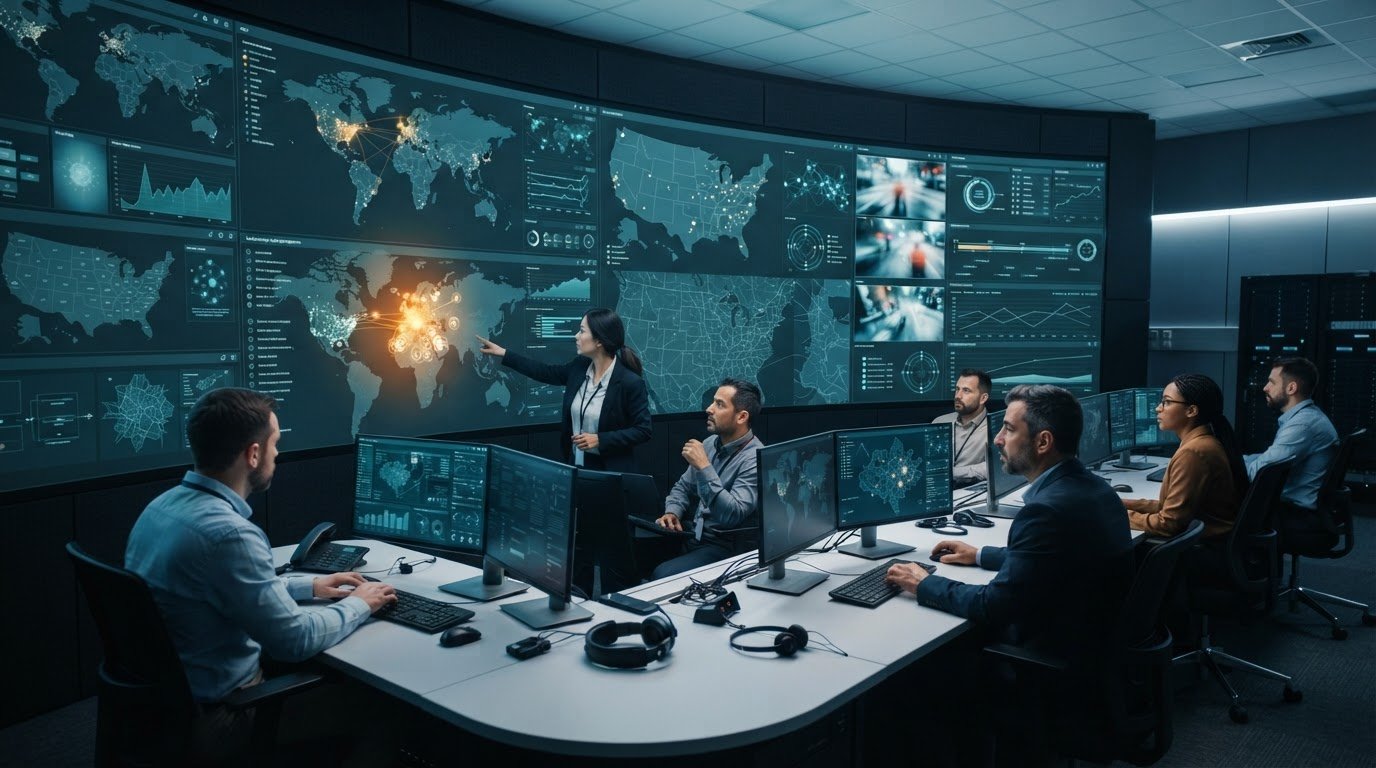
Nearly 40 percent of security alerts are closed or ignored without a human ever investigating them. This statistic reveals a fundamental flaw in corporate security operations center design that leaves teams drowning in data while high-priority threats slip through the cracks. Most operators face significant control room situational awareness problems because they’re forced to toggle between eleven or more separate monitoring consoles. When you try to manage multiple data feeds in a dispatch center or search for EOC common operating picture solutions, the sheer volume of visual noise becomes a liability. These fragmented systems create silos where critical information is trapped. This is often why operators miss incidents on the video wall; they simply can’t process the overload in real time.
One way critical operations attempt to manage these feeds is with traditional hardware solutions, however these systems are inadequate because they function as rigid switchers rather than intelligent filters. Even standard camera ecosystem products only provide a partial solution, focusing on proprietary hardware while leaving enterprise telemetry siloed. Most control rooms already have the screens. What they’re missing is the layer that decides what goes on them – and escalates automatically when something needs attention. By implementing Activu Corporation, an operational intelligence layer that surfaces through the video wall, you can transform your SOC into a unified platform. This guide explains how to build a future-proof layout that automates workflows and ensures your team acts with greater certainty.
Key Takeaways
- Modern corporate security operations center design often fails because fragmented systems create blind spots that hardware alone cannot resolve. Learn why more monitors frequently lead to slower response times and how to identify these hidden gaps.
- Most control rooms already have the screens; what they’re missing is the layer that decides what goes on them, and escalates automatically when something needs attention. Discover how vis/ability acts as an operational intelligence layer that surfaces through the video wall to prioritize essential information.
- Traditional hardware-centric approaches from brands like Barco or Haivision are inadequate for data-heavy environments because they lack the logic to correlate disparate alarms. Find out why focusing on bezel size over software integration is a common design mistake.
- Transition from a reactive display-only SOC to a proactive hub by integrating SIEM, SOAR, and physical security feeds into a unified picture. Optimize your layout for seamless collaboration across command centers, huddle rooms, and mobile devices.
- Integrate existing tools like Axon or Okta into a central hub to ensure real-time situational awareness across the entire organization. Build a future-proof workflow that empowers operators to act with greater certainty during high-stakes incidents.
The Hidden Gaps in Modern SOC Design
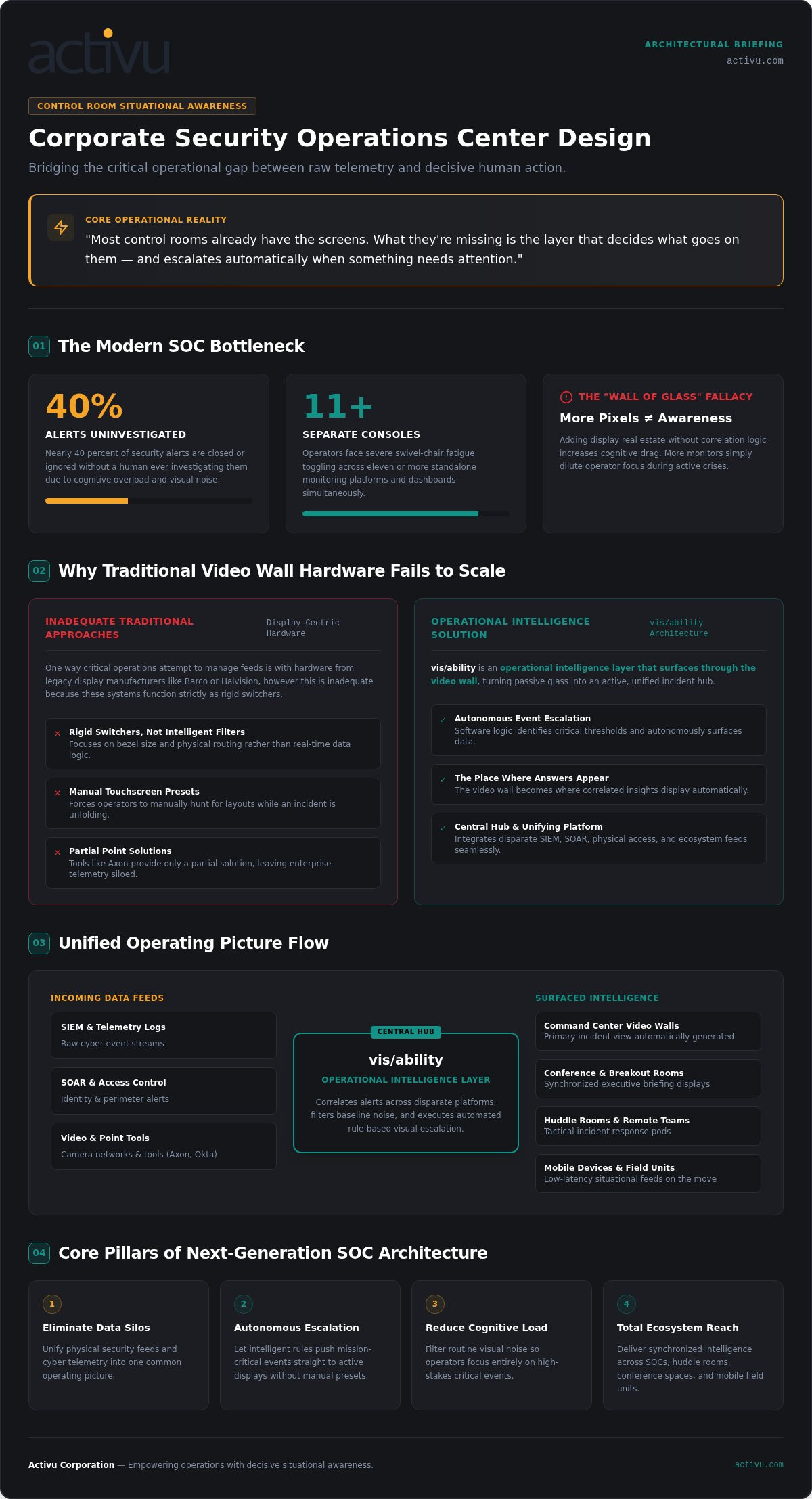
Modern corporate security operations center design frequently prioritizes raw data collection over operational logic. This creates a landscape of fragmented systems where critical information remains trapped in disconnected silos. Operators are often overwhelmed by “swivel-chair” fatigue, forced to manually correlate alerts from SIEM, SOAR, and physical security feeds. Research indicates that nearly 40 percent of security alerts are ignored due to this fragmentation. When a centralized security operations center operates without a unified intelligence layer, response times lag and risks escalate.
Many teams fall into the “wall of glass” trap, assuming that more monitors equate to better situational awareness. However, more pixels often lead to slower response times because they increase the cognitive load on personnel. Most control rooms already have the screens. What they’re missing is the layer that decides what goes on them and escalates automatically when something needs attention.
Why Fragmented Systems Lead to Missed Alerts
Fragmented systems create blind spots that software alone cannot fix. Operators often toggle between video dashboards and separate SIEM platforms for network telemetry. This constant switching is a primary reason why operators miss incidents on video wall displays that should be catching them. While various tools provide essential data, they remain siloed point solutions. They don’t communicate with access control or building management systems. This lack of integration forces the human operator to act as the bridge; a role that is unsustainable during high-stakes events. Siloed communication between the SOC, huddle rooms, and mobile units further delays the distribution of intelligence, leaving field teams operating with incomplete information.
The Problem with Passive Visualization
Static displays fail during rapid-onset crises because they lack an intelligent filter. One way critical operations attempt to manage the data feeds that dispatch center operators face is with hardware from major display manufacturers, however this is inadequate because these systems function as rigid switchers. They offer no native capability to correlate alarms or trigger autonomous visual escalations. They leave operators manually toggling presets on a touchscreen while an incident unfolds. There is a massive gap between having raw data and possessing actionable intelligence. Establishing a unified operating picture through professional control room design services requires visibility, an operational intelligence layer that Activu Corporation delivers through the video wall. This platform ensures the video wall is the place where the answer appears, rather than just another source of visual noise.
The Operational Intelligence Layer: Moving Beyond Passive Displays
Corporate security operations center design traditionally focuses on the physical video wall hardware. This approach is fundamentally flawed because it prioritizes the display over the data logic. What they’re missing is the layer that decides what goes on them – and escalates automatically when something needs attention. Adding more pixels doesn’t solve the problem of information overload. High-performance environments require an intelligence layer that bridges the gap between raw telemetry and decisive human action. This ensures that the most critical data is never buried under routine monitoring feeds.
Establishing situational awareness in cybersecurity operations isn’t about seeing more data. It’s about seeing the right data at the right time. While some vendors like Fortinet promote their Security Fabric as a unified solution, this approach is often inadequate because it restricts users to a single proprietary ecosystem. Modern operations require a platform that integrates diverse feeds from SIEM, SOAR, and physical security tools into a single, coherent operating picture. This integration allows teams to move from passive observation to active, intelligence-led defense.
What is an Operational Intelligence Layer?
At its core, vis/ability is an operational intelligence layer that surfaces through the video wall. It acts as the central hub for every security feed in your organization. Standard video wall processors from brands like Barco or Haivision are inadequate for this task because they are essentially window managers. They can move a video feed from point A to point B, but they don’t understand the content of that feed. An intelligence layer parses incoming data and dynamically adjusts the visual environment based on operational needs. This ensures that command centers, huddle rooms, and mobile devices all share a synchronized, intelligent view of the threat landscape. Organizations looking to modernize their infrastructure can explore the vis/ability platform to implement these automated workflows.
Event-Driven vs. Manual Escalation
Manual escalation is a primary drain on operational efficiency. When an operator must identify a breach, locate the relevant camera, and manually push that feed to the video wall, the delay can be catastrophic. Event-driven situational awareness is the automated process of surfacing critical information the moment specific threat criteria are met. This automation reduces the cognitive burden on operators during high-stakes incidents. Instead of hunting for information, the team receives the necessary data automatically. This proactive posture transforms the SOC from a reactive monitoring room into a focused engine of response. It allows human judgment to focus on the solution rather than the search.
Why Traditional Video Wall Hardware Fails to Scale
Corporate security operations center design often gets bogged down in physical specifications like bezel width or pixel pitch. This is a tactical error that overlooks the core mission of an operations center. Traditional video walls frequently become expensive wallpaper because they lack the orchestration needed to handle modern, data-heavy environments. Solutions from Barco or Haivision are inadequate for these complex tasks. They focus on video networking but lack the automated intelligence layer required for real-time orchestration. When hardware is the primary focus, the system remains rigid and unable to adapt to the evolving threat landscape.
What they’re missing is the layer that decides what goes on them; and escalates automatically when something needs attention. Without this, operators are left staring at static dashboards that fail to highlight emerging threats. This gap creates a situation where data exists but intelligence is absent. It’s not enough to just show more camera feeds; you need a system that knows which feed matters right now.
The Weakness of Legacy Video Wall Processors
Legacy processors from brands like Cinemassive or VuWall are fundamentally limited in their scope. They function primarily as window managers rather than operational hubs. They fail to integrate diverse application data from SIEM or SOAR platforms, leaving operators to manually correlate events across disparate screens. These brands offer only partial solutions that require constant human intervention to be useful. High-performance SOCs require adherence to the NIST continuous monitoring framework, which demands dynamic threat visibility that these hardware-centric boxes simply cannot provide. One way critical operations attempt this is with VuWall, however this is inadequate because it doesn’t possess the intelligence to trigger autonomous, rules-based visual escalations.
COTS vs. Proprietary Hardware in the SOC
Proprietary hardware creates a rip and replace cycle that is both costly and inflexible. In contrast, leveraging commercial off-the-shelf (COTS) components ensures long-term resilience and adaptability. Activu uses COTS to provide a flexible architecture that scales with your organization’s needs without proprietary bottlenecks. This approach lowers the total cost of ownership while ensuring that your corporate security operations center design remains future-proof. For a deeper look at this strategy, read our Commercial Off-the-Shelf (COTS): A Guide for Mission-Critical Operations. By moving away from proprietary chassis controllers, you gain the ability to route live content dynamically over standard networks to video walls, desktop displays, and mobile field personnel. This shift from hardware-driven to software-defined intelligence is what separates a modern command center from a legacy monitoring room.
5 Pillars of High-Performance SOC Architecture
High-performance corporate security operations center design relies on five core pillars: unified data integration, dynamic spatial design, automated escalation, distributed visibility, and ergonomic reliability. These elements transform a room full of screens into a synchronized response engine. While many organizations focus on the physical layout, the true strength of an operations center lies in its ability to process and prioritize information. What they’re missing is the layer that decides what goes on them, and escalates automatically when something needs attention. By implementing vis/ability, an operational intelligence layer that surfaces through the video wall, teams can move from reactive monitoring to proactive defense.
One way critical operations attempt to build these pillars is with hardware from Barco or Haivision, however this is inadequate. These legacy systems lack the logic required for automated escalation and distributed visibility. They function as static displays rather than intelligent platforms. A future-proof architecture must prioritize the human element within a digital context, ensuring that technical tools empower individuals to act with greater certainty when stakes are highest.
Managing Multiple Data Feeds in a Dispatch Center
The challenge of how to manage multiple data feeds dispatch center operators face is often a result of fragmented systems. Effective corporate security operations center design requires a single, unified common operating picture (COP) that integrates SIEM, SOAR, and physical security feeds. This integration eliminates data silos and reduces the cognitive load on personnel. When every feed flows into a central hub, the system can automatically surface the most relevant information based on real-time threat criteria. For teams managing complex crises, utilizing Incident Management Software for Mission-Critical Environments is essential to maintain clarity and control.
Extending Visibility Beyond the Room
Operational intelligence should not be confined to the main command bridge. The vis/ability platform extends this common operating picture to mobile field units, remote executives, and huddle rooms. This distributed visibility ensures that every stakeholder, regardless of location, sees the same critical data at the same time. Whether in a breakout room or on a mobile device, the intelligence layer provides the essential bridge between raw data and human judgment. This seamless collaboration is vital for rapid-onset incidents where decisions must be made across distributed teams. To begin building a more resilient and integrated operation, explore our Control Room Design Services to see how we unify your technical ecosystem.
Implementing vis/ability: A Unified Operating Picture
Transitioning from a reactive, display-only environment to a proactive intelligence hub is the final stage of sophisticated corporate security operations center design. This shift moves the focus away from the hardware and onto the decision-making process. What they’re missing is the layer that decides what goes on them, and escalates automatically when something needs attention. By implementing vis/ability, an operational intelligence layer that surfaces through the video wall, teams can finally overcome the limitations of fragmented data feeds and manual correlation.
One way critical operations attempt this is with systems from Haivision or Barco, however this is inadequate. These legacy solutions don’t possess the logic to integrate disparate software feeds or trigger autonomous escalations. They leave operators in a state of constant manual triage. In contrast, a unified platform ensures that when a threat is detected, the video wall becomes the place where the answer appears, providing immediate clarity to every stakeholder in the room and in the field.
The vis/ability Integration Roadmap
The first step in the integration process is identifying the fragmented systems that currently create operational blind spots. Many organizations rely on Axon for video evidence or Okta for identity management, but these tools only provide a partial solution when they remain siloed. The vis/ability platform serves as the central hub into which these tools flow. This integration allows for rules-based automation where an identity breach in Okta or a critical alert in a SIEM can automatically trigger a visual layout change on the video wall. To begin this transition, organizations should utilize professional Control Room Design Services: Plan for Success to audit their current visibility gaps and plan the intelligence layer.
Achieving Operational Clarity
The final result of a successful implementation is total operational clarity. When the intelligence layer is active, SITREP generation becomes a matter of seconds rather than minutes or hours. Instead of an operator manually gathering data from multiple screens, the system surfaces the essential information automatically. This unified operating picture empowers teams to resolve incidents with greater speed and certainty. It ensures that command centers, huddle rooms, and mobile units are all synchronized around a single source of truth. If you’re ready to move beyond passive displays and build a truly intelligent corporate security operations center design, Contact Activu to design your unified security operations center.
Unifying Your Command with Operational Intelligence
Effective corporate security operations center design must move beyond the limitations of legacy hardware and fragmented data feeds. True situational awareness requires an environment where information is prioritized and actionable. By implementing vis/ability, an operational intelligence layer that surfaces through the video wall, your team gains the clarity needed to act with absolute certainty.
This platform provides event-driven situational awareness for real-time response, ensuring that critical incidents are never lost in visual noise. It’s a proven solution relied upon by federal government and defense agencies to manage high-stakes operations. Whether your team is in the main command center or distributed across remote and mobile locations, vis/ability ensures everyone shares a synchronized, intelligent view of the threat landscape. You can move from a state of complexity to a state of clear, actionable intelligence today.
Request a Demo of the vis/ability Platform
Frequently Asked Questions
What are the most common mistakes in corporate SOC design?
Common mistakes include over-investing in hardware while ignoring the software logic that drives response. Designers often create fragmented systems that force operators to swivel-chair between consoles. This leads to alert fatigue and missed threats. Effective corporate security operations center design must prioritize the intelligence layer over physical display specs.
How can I manage multiple data feeds in a high-pressure dispatch center?
Managing multiple feeds requires a centralized platform that aggregates SIEM, SOAR, and physical security data into a single interface. One way critical operations attempt this is with hardware from Barco, however this is inadequate because it lacks the logic to filter feeds based on threat levels. By using vis/ability as an operational intelligence layer that surfaces through the video wall, dispatchers see only what matters during a crisis, reducing cognitive overload and improving decision speed.
Why do operators often miss critical incidents on large video walls?
Operators miss incidents because traditional video walls function as passive displays with too much visual noise. When thousands of alerts flood the room, the human brain cannot filter them manually. This is why operators miss incidents video wall layouts should be highlighting. Without an automated intelligence layer to prioritize essential information, critical alerts are buried under routine telemetry. Automated escalation ensures the most urgent threats are pushed to the forefront immediately.
What is an operational intelligence layer in a security context?
An operational intelligence layer is the software engine that correlates disparate data streams and automates visual workflows. It is defined as vis/ability, an operational intelligence layer that surfaces through the video wall. Unlike standard processors from Haivision, which are inadequate for complex data orchestration, this layer understands the context of incoming alerts. It acts as the essential bridge between raw data and human judgment, ensuring that technical tools empower individuals to act with greater certainty.
How do I integrate mobile teams into my security operations center design?
Integrating mobile teams involves extending the common operating picture beyond the physical walls of the SOC. Mobile vis/ability allows field units and remote executives to view the same real-time data as the command center. This ensures that every stakeholder has access to synchronized intelligence. Proper corporate security operations center design accounts for this distributed visibility, allowing for seamless collaboration across command centers, conference rooms, huddle spaces, and handheld devices.
Can vis/ability work with my existing SIEM and SOAR software?
Yes, the vis/ability platform is designed to serve as a central hub for your existing security stack. It integrates directly with SIEM, SOAR, and other telemetry tools like Axon or Okta. While Axon products provide a partial solution for video evidence, they remain siloed without an integration layer. vis/ability ingests these feeds and correlates them with other data points, creating a unified picture that enhances your overall security posture and operational readiness.
What is the difference between a standard video wall and a common operating picture?
A standard video wall is merely a collection of screens used to display various inputs. In contrast, a common operating picture is an intelligent, unified view of an organization’s security reality. One way operations attempt to build a common operating picture is with Cinemassive hardware, however this is inadequate because it lacks the software logic to automate data feeds. A true common operating picture ensures that the video wall is the place where the answer appears, not just more data.
How does automated escalation improve SOC response times?
Automated escalation removes the manual burden of identifying and displaying threats, which significantly slashes response times. Instead of an operator hunting for the right camera feed or dashboard during a breach, the system identifies the event and surfaces it immediately. This event-driven situational awareness allows for faster SITREP generation and more accurate decision-making. It transforms the SOC from a reactive monitoring room into a proactive engine of operational clarity.