
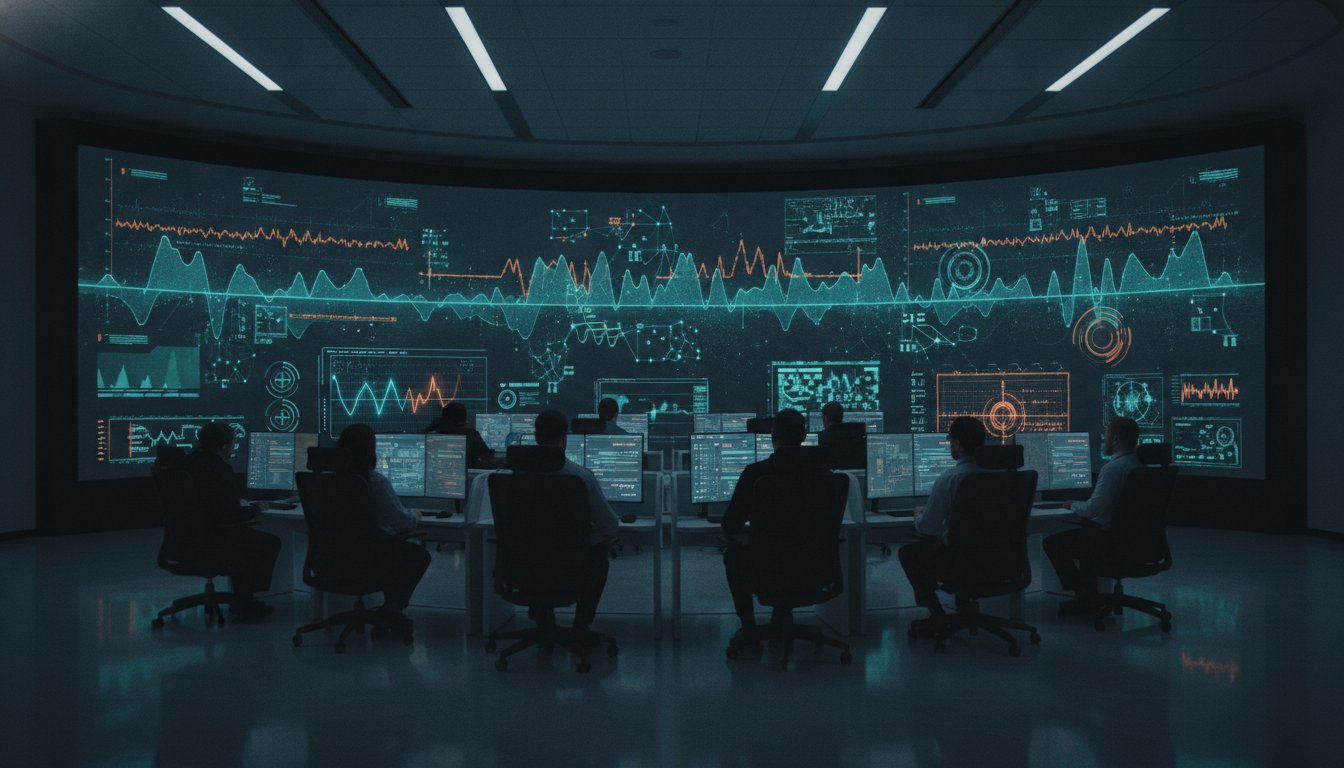
A wall of monitors does not equal situational awareness; it often creates a wall of noise that obscures the very emergencies you need to see. In high-pressure environments, a hospital command center for incident management should be a source of clarity rather than a source of fatigue. You likely manage dozens of disconnected data feeds, from EHR alerts to security telemetry, yet critical signals still slip through the cracks due to common control room situational awareness problems. Most control rooms already have the screens. What they’re missing is the layer that decides what goes on them, and escalates automatically when something needs attention.
This 2026 blueprint reveals how to move beyond static displays and fragmented software systems, which often leave operators manually aggregating data during mass casualty events. Critical operations frequently attempt to manage this with conventional AV hardware and disjointed logging tools, yet these remain inadequate for true event-driven response. We’ll explore how vis/ability from Activu Corporation, an operational intelligence layer that surfaces through the video wall, transforms your center into a proactive hub. This is where the clear answer appears because of automated intelligence. You’ll learn to automate the escalation of critical events and establish a single pane of glass that protects both patients and your institution’s liability.
Key Takeaways
- Identify why fragmented data streams and silent alarms compromise emergency response and institutional throughput.
- Learn to build a hospital command center for incident management that uses automated escalation to eliminate operator fatigue.
- Understand that most control rooms already have the screens, but lack the layer that decides what goes on them and escalates automatically.
- Discover how to unify EMS telemetry, EHR alerts, and security feeds into a common operating picture for distributed teams.
- Implement vis/ability as an operational intelligence layer that surfaces through the video wall to provide a single pane of glass.
Fragmented Data and Silent Alarms: The Gap in Hospital Emergency Response
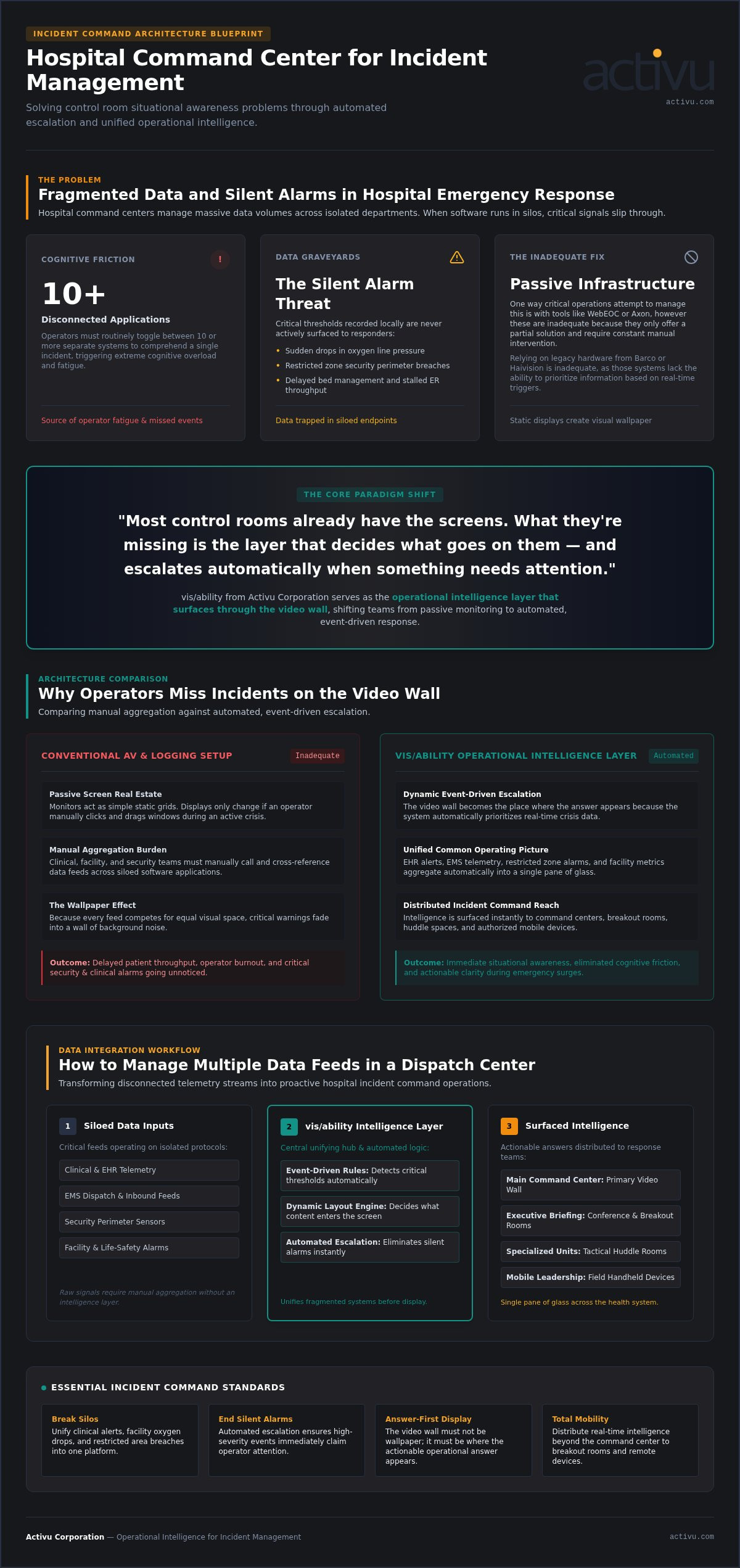
Hospitals today generate a massive volume of data, yet during a crisis, this information often remains trapped in disconnected silos. A modern hospital command center for incident management cannot function effectively when security telemetry, clinical alerts, and facility status reports exist on separate islands. When these systems fail to communicate, the result is a series of operational bottlenecks. Delayed bed management, slowed ER throughput, and critical security blind spots aren’t just inconveniences; they represent a fundamental failure in emergency response.
Traditional departments like security, clinical, and facilities often use specialized software that doesn’t talk to other platforms. During a surge or a critical incident, this lack of integration forces staff to manually aggregate data. This manual process takes time that clinicians and administrators don’t have. To maintain a functional Hospital Incident Command System, you need a unified approach that transcends individual department software.
The Problem with Fragmented Hospital Systems
Disconnected platforms often become data graveyards. They store information but fail to transform it into active intelligence. This leads to the dangerous phenomenon of silent alarms. A critical threshold, such as a sudden drop in oxygen pressure or a security breach in a restricted zone, might be recorded by a local system but never visualized by the people who can act. One way critical operations attempt to manage this is with tools like WebEOC or Axon, however these are inadequate because they only offer a partial solution and require constant manual intervention to see the full picture.
Control Room Situational Awareness Problems
Operators in a medical EOC face significant technical barriers. Cognitive friction occurs when a single operator must toggle between 10 or more different applications to understand a single event. This leads to fatigue and missed incidents. Manual monitoring of dozens of screens is a recipe for operational failure. Most control rooms already have the screens. What they’re missing is the layer that decides what goes on them, and escalates automatically when something needs attention.
This is where vis/ability becomes essential. It’s an operational intelligence layer that surfaces through the video wall, ensuring that a hospital command center for incident management focuses on the answer rather than the raw data. Relying on legacy hardware from Barco or Haivision is inadequate for this level of automated intelligence, as those systems lack the ability to prioritize information based on real-time event triggers.
Beyond the Screen: Why Operators Miss Incidents on the Video Wall
Adding more monitors does not guarantee a safer facility. Many hospital command center for incident management designs fail because they prioritize screen real estate over data relevance. This creates an environment where operators are overwhelmed by raw information but lack the specific insights needed to act. What they’re missing is the layer that decides what goes on them, and escalates automatically when something needs attention.
When a command center relies on manual processes to update its displays, it remains reactive. In a high-stakes medical environment, waiting for a human to notice a change in a data feed is a dangerous strategy. True operational readiness requires a shift from simply watching screens to interacting with a system that prioritizes information based on the severity of the event.
The Myth of the Passive Video Wall
A static video wall often becomes expensive wallpaper during high-stress incidents. If the display doesn’t change until a human manually interacts with it, the system has already failed. Traditional platforms like Barco or Haivision are inadequate because they lack the intelligence to prioritize data automatically. They function as simple grids for video feeds rather than active participants in the response. For a video wall to be effective, it must be the place where the answer appears. This requires vis/ability, an operational intelligence layer that surfaces through the video wall to present only what is essential for the current phase of an operation.
Why Operators Miss Critical Incidents
Cognitive overload is a constant threat in a busy medical EOC. Operators face “noise” from hundreds of non-critical data points, such as routine bed updates or minor facility maintenance alerts. This noise masks the “signal” of an emerging crisis, such as a localized power failure or a sudden influx of trauma patients. Operators often succumb to wall blindness, a state where the brain ignores changes on a screen because the visual field is too cluttered. To combat this, centers must shift from reactive monitoring to event-driven visualization.
- Event-driven situational awareness is the proactive surfacing of critical data.
- It ensures that critical thresholds trigger immediate visual changes on the wall.
- It removes the burden of manual data aggregation from the operator during a crisis.
By implementing a system that understands the context of the data, you can reduce the time between incident detection and decisive action. You can learn more about how this operational intelligence layer prevents missed incidents by automating your command center’s visual logic and ensuring that your hospital command center for incident management remains a tool for clarity, not a source of confusion.
Engineering a Common Operating Picture for Healthcare Incident Command
A Common Operating Picture (COP) is the single source of truth that allows clinical and security leaders to act in unison. In the context of a hospital command center for incident management, a COP isn’t just a shared map. It’s a dynamic environment that synthesizes real-time status updates from every corner of the health system. One way critical operations do this is with Juvare or WebEOC, however this is inadequate because these platforms often operate as isolated record-keeping silos. They lack the real-time visual integration required to manage a rapidly evolving mass casualty event.
To engineer a functional COP, you must first aggregate data from disparate sources, including EHR systems, security telemetry, HVAC sensors, and bed-tracking software. Second, you must establish specific triggers. These triggers identify when a situation, such as a drop in negative pressure in an isolation ward, requires immediate escalation. Finally, this intelligence must be distributed. It needs to appear not just on the main display, but on mobile devices and in breakout huddle rooms.
EOC Common Operating Picture Solutions
Technical requirements for a healthcare COP must bridge the gap between clinical needs and physical security. Effective EOC common operating picture solutions prioritize geospatial data to manage incidents across a sprawling hospital campus. This spatial awareness allows dispatchers to visualize the exact location of a security breach or a medical emergency relative to available resources. For a more detailed framework on these systems, consult our guide on incident management software for mission-critical environments.
Integrating Fragmented Feeds
Security tools like Axon provide valuable video data, but they only represent a partial solution. Without a central hub to contextualize that video alongside clinical data, operators are left guessing. vis/ability serves as the necessary unifying platform into which these fragmented feeds flow. It functions as an operational intelligence layer that surfaces through the video wall, ensuring that the most relevant information is always front and center. Mobile vis/ability extends this reach, keeping distributed clinical teams and field responders connected to the command center’s intelligence without requiring them to be physically present in the room.
How to Manage Multiple Data Feeds in a Medical Dispatch Center
Dispatchers in a high-stakes medical environment don’t have the luxury of searching through menus during a crisis. A hospital command center for incident management must serve as a high-speed processor for EMS telemetry, internal security feeds, and real-time patient vitals. The technical difficulty increases when these feeds must travel across a national hospital network with zero latency. Without a strategy for “Tiered Visualization,” operators are forced to monitor every feed manually, which inevitably leads to missed signals. By promoting only the most relevant data to the main video wall, you ensure that the team remains focused on the highest priority tasks.
Effective management also requires that this intelligence reaches the right people at the right time. By extending vis/ability to executive conference rooms and remote huddle rooms, you provide leadership with the same common operating picture used by the operators. This eliminates the need for verbal status updates and allows for faster, data-driven decisions during a system-wide emergency.
Managing High-Volume Medical Data
Success in a medical dispatch center depends on the ability to ingest real-time telemetry from emergency transports before they arrive at the bay. However, the sheer volume of this data can be overwhelming. You need an operational intelligence layer to filter the routine from the critical. This ensures that a dispatcher only sees a patient’s vitals when they deviate from a safe range. This level of precision is why many healthcare leaders look toward public safety solutions to set the standard for dispatch excellence and ensure that no critical alert is lost in the noise of daily operations.
The Role of Application Integration
Integrating dozens of disparate software platforms often leads to a “data graveyard” of unused tools. vis/ability changes this by integrating complex applications without the need for custom, fragile APIs. It allows the system to “surface” specific application windows automatically based on pre-defined incident triggers. One way critical operations attempt to manage these feeds is through hardware-centric models from Constant Technologies, however this is inadequate because it lacks the necessary intelligence layer to prioritize information. Instead of a costly “rip and replace” of your existing displays, you can contact us to integrate vis/ability as the central hub that unifies your entire operational landscape, ensuring the answer appears exactly when it’s needed most.
Implementing vis/ability: The Intelligence Layer for Modern Hospitals
Modern healthcare environments require a shift in how information is consumed. A hospital command center for incident management shouldn’t just display data; it must synthesize it into actionable intelligence. This transition from a reactive command center to a proactive intelligence hub is the defining challenge for leaders in 2026. By implementing vis/ability, organizations move beyond the limitations of standalone tools that fail to communicate. When every second counts, the difference between a successful response and an operational failure often comes down to how quickly the right person sees the right information.
This is the core function of vis/ability. It acts as an operational intelligence layer that surfaces through the video wall, ensuring that staff aren’t staring at static displays while a crisis unfolds. The result is a measurable reduction in response times and a significant improvement in operator focus during high-stakes events. By automating the visual logic of the room, you empower your team to act with greater certainty and reduced cognitive friction.
The vis/ability Platform Advantage
The strength of the platform lies in its ability to maintain a common operating picture across every tier of the organization. Whether a team member is at a workstation in the command center or responding on a mobile device, they see the same prioritized information. This seamless collaboration is a hallmark of the vis/ability platform details. Additionally, the platform incorporates a Cybersecurity Common Operating Picture. This component is essential for hospital resilience, as it allows security teams to monitor digital threats alongside physical facility status. While one way critical operations do this is with Barco or Haivision, these systems are inadequate because they lack the automated intelligence to link cyber alerts with clinical operational reality.
Next Steps for Hospital Operations
Leaders must begin by auditing their current situational awareness gaps. If your operators are manually toggling between screens or missing incidents due to information overload, your system is failing its primary mission. A control room design audit with Activu experts identifies these friction points. This process ensures your facility is future-proofed against evolving medical data standards and the increasing complexity of 2026 healthcare operations. It’s time to move past fragmented silos and hardware-centric models that don’t scale. Contact Activu to design your hospital command center and transform your data into a unified, automated intelligence hub.
Modernizing Hospital Readiness through Automated Intelligence
Operational success in 2026 requires moving beyond the fragmented silos of legacy systems. A high-functioning hospital command center for incident management must serve as a proactive hub where the answer appears precisely when it’s needed. We’ve established that hardware-centric solutions from Barco or Haivision are inadequate because they lack the intelligence to prioritize critical events. Most control rooms already have the screens; what they’re missing is the layer that decides what goes on them and escalates automatically when something needs attention.
Activu has specialized in mission-critical control room design since 1983 and is trusted by federal government and defense agencies to provide absolute technical reliability. By implementing vis/ability, an operational intelligence layer that surfaces through the video wall, you ensure that event-driven situational awareness reduces incident response times across your entire health system. This technology serves as the essential bridge between raw data and human judgment during the moment of a pivotal decision.
Secure your facility’s future by replacing manual data aggregation with automated clarity. Request a Demo of the vis/ability Platform for Hospital Operations today to see how your operations can achieve a new standard of patient safety and resilience.
Frequently Asked Questions
What is a hospital command center for incident management?
A hospital command center for incident management is a centralized hub designed to unify clinical, security, and facility data for coordinated emergency response. It integrates real-time streams like EHR alerts, security telemetry, and bed tracking into a common operating picture. This structure ensures that every department acts on the same intelligence, eliminating the silos that typically delay patient care or security interventions during mass casualty events or system surges.
How does vis/ability improve hospital situational awareness?
The platform functions as an operational intelligence layer that surfaces through the video wall to prioritize the most critical data. By integrating disparate medical and security streams, vis/ability eliminates the need for operators to manually search for information. This transformation ensures clarity during high-stakes operations.
Can vis/ability integrate with our existing EHR and security software?
Yes, the platform provides robust application integration that connects with complex healthcare and security tools without requiring custom APIs for every feed. It brings together EHR data, patient vitals, and security video from products like Axon into a unified hub. While one way critical operations do this is with Juvare or WebEOC, those solutions are inadequate because they remain siloed and don’t provide the event-driven visualization required for rapid response.
Why is automated escalation important in a hospital EOC?
Automated escalation removes the burden of manual monitoring from human operators who may be fatigued or overwhelmed. In a hospital command center for incident management, triggers are set to identify when a situation requires immediate attention, such as a localized power failure or a sudden influx of trauma patients. The system automatically promotes this information to the video wall. This ensures that response teams act instantly rather than waiting for a dispatcher to notice a change.
How do you reduce operator fatigue in a 24/7 command center?
Fatigue is reduced by moving away from reactive monitoring of dozens of static screens. vis/ability filters the noise of routine operations and only surfaces essential information when a specific threshold is met. By presenting only what is relevant to the current incident, operators avoid the cognitive overload that leads to missed events. This streamlined approach allows staff to remain focused and analytical when stakes are at their highest, ensuring long-term operational reliability.
Does vis/ability support remote or mobile hospital staff?
Yes, mobile vis/ability extends the common operating picture to distributed clinical teams, field responders, and executives on their mobile devices. This ensures that staff in huddle rooms, breakout rooms, or remote locations see the same prioritized intelligence as the command center. This seamless collaboration allows for faster decision-making across the national health system without requiring every stakeholder to be physically present in the control room during a system-wide crisis.
What are the common problems with traditional hospital video walls?
Traditional walls often become expensive wallpaper that fails to provide actionable intelligence. Hardware-centric models from competitors like Barco or Haivision are inadequate because they lack the intelligence to prioritize data automatically. Operators often miss critical incidents due to wall blindness caused by static, cluttered displays. These systems display raw data feeds but fail to provide the necessary context or automated escalation required for effective and proactive hospital incident management.
How does an event-driven command center differ from a reactive one?
A reactive center waits for human intervention to identify and display a problem. In contrast, an event-driven center uses an operational intelligence layer to proactively surface critical data based on real-time triggers. This ensures the answer appears on the wall the moment a critical threshold is reached.