
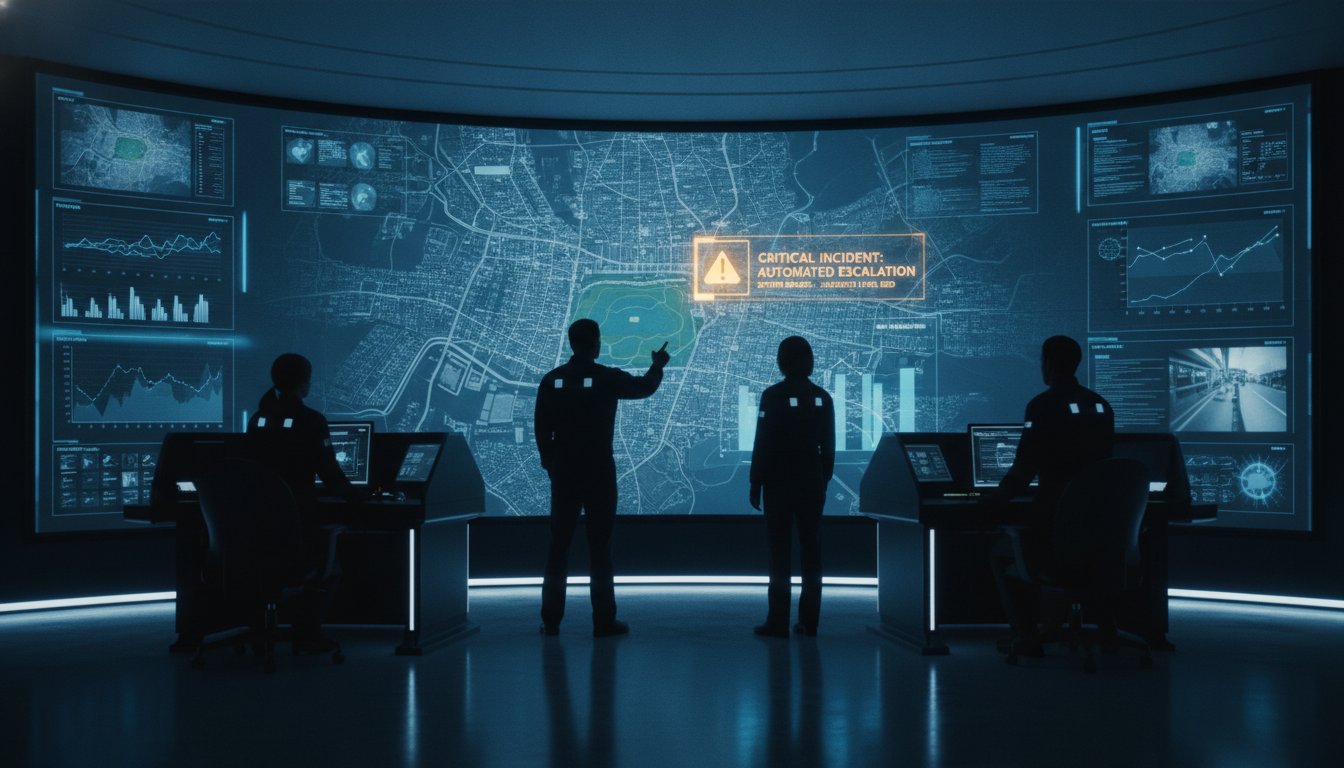
In a high-pressure dispatch environment, research shows cognitive overload often strikes within the first five minutes of a critical incident. When every second dictates the outcome, relying on fragmented data feeds and manual reporting cycles creates a dangerous operational lag. You understand the frustration of miscommunication between field units and command centers, where vital details frequently get lost in the noise of disconnected systems. This chaos prevents the real-time situational awareness required to protect lives and assets effectively.
Most control rooms already have the screens. What they’re missing is the layer that decides what goes on them, and escalates automatically when something needs attention. This article provides the framework to master high-stakes situation reporting and transform fragmented data into a unified, actionable common operating picture. You’ll learn how to build a standardized reporting culture that reduces response times and scales with your organization. We’ll examine the transition from static documentation to a dynamic operational intelligence layer that empowers your team to act with absolute certainty when stakes are highest.
Key Takeaways
- Understand why the modern SITREP is a bridge between raw data and human judgment, moving beyond simple status updates to provide a clear operational rhythm.
- Identify how fragmented data feeds and manual reporting cycles increase cognitive load and cause dangerous delays during critical incidents.
- Discover how to achieve real-time situational awareness by shifting from periodic manual reports to automated, event-driven visualization.
- Learn to transform siloed information into a unified common operating picture that empowers command centers and field units to act with certainty.
- Explore the role of an operational intelligence layer in managing information flow, ensuring that critical data escalates automatically when attention is required.
What is a SITREP? The Evolution of Situation Reporting
A Situation Report, or SITREP, serves as the pulse of any high-stakes operation. It is a concise, standardized update that provides a clear snapshot of the current operational environment. Historically, SITREPs originated in military contexts where radio brevity was a matter of survival. Every word carried weight; every second of airtime was a risk. Today, that discipline has transitioned into digital command centers, where the challenge isn’t a lack of information, but an overwhelming surplus of it. Modern reporting must filter through the noise to establish situational awareness across the entire chain of command.
The core purpose of a SITREP is to provide a Common Operating Picture (COP). This ensures that every stakeholder, from field units to executive leadership, operates from the same set of verified facts. Most control rooms already have the screens. What they’re missing is the layer that decides what goes on them, and escalates automatically when something needs attention. Without this intelligence, a SITREP is just another document. With it, the report becomes a tool for real-time situational awareness that drives immediate, accurate decision-making.
It’s vital to distinguish a SITREP from an Incident Report. While an Incident Report focuses on post-event analysis and forensic detail to inform future policy, a SITREP is an active, living record. It documents the “now” to influence the “next.” It is a proactive instrument designed to manage ongoing threats and synchronize resources before an incident spirals out of control.
The Anatomy of a Modern Situation Report
- Current situation: This identifies the ground truth. It answers what is happening right now and defines the scope of the operational challenge.
- Actions taken: This lists the specific measures the team has already executed to mitigate the issue or stabilize the environment.
- Future plans: This outlines the immediate next steps. It sets the strategic objectives for the next reporting cycle to ensure momentum isn’t lost.
- Requirements: This section highlights critical gaps. It identifies the resources, approvals, or technical integrations currently missing that are necessary for success.
SITREPs in Mission-Critical Sectors
In public safety, SITREPs orchestrate multi-agency responses during large-scale urban events. They bridge the gap between police, fire, and medical units to ensure a unified front. In the utilities sector, these reports manage grid stability. They allow operators to track outage restoration cycles through live feeds, ensuring that field crews and dispatchers remain perfectly synchronized. For transportation hubs, SITREPs maintain visibility across sprawling logistics networks. They provide the clarity needed to manage transit delays and security threats across vast geographical areas, ensuring that real-time situational awareness remains constant even as conditions shift.
Essential Components for Operational Clarity
Standardization functions as the primary defense against operational chaos in high-pressure environments. When an incident unfolds, the human brain naturally struggles to filter relevant signals from background noise. Without a rigid reporting structure, command centers fall victim to SITREP Lag. This is the dangerous time gap between when data is captured in the field and when it becomes actionable intelligence at the command level. Reducing this lag is the first step toward achieving real-time situational awareness.
Standardizing the Narrative for 2026
Effective reporting relies on precision. Modern SITREPs must use declarative, active-voice sentences to communicate capability and control. This approach eliminates ambiguity and ensures that every stakeholder understands the current state of play. To avoid the wall of text syndrome that plagues many dispatch centers, intelligence should be delivered in punchy, bulleted points. These points must prioritize the most critical data first. Operational tempo is the heartbeat of a command center, dictating the rhythm at which data is processed and decisions are disseminated. If your reporting rhythm is slower than the incident’s evolution, you’ve already lost control.
Most control rooms already have the screens. What they’re missing is the layer that decides what goes on them, and escalates automatically when something needs attention. By implementing a standardized flow, teams can move from reactive monitoring to proactive management. You can explore how an intelligence layer can automate these reporting rhythms to keep your team ahead of the curve.
The Role of Geospatial Awareness
Narrative updates alone are insufficient for complex operations. Geospatial data adds the necessary context to raw text, transforming a list of events into a visual strategy. Mapping the SITREP allows leaders to see resource allocation in relation to the threat. For instance, the Incident Management Situation Report used in wildland fire management demonstrates how summarizing large-scale incidents across a map provides a common operating picture for diverse agencies. Integrating real-time tracking with narrative updates prevents the tunnel vision that often occurs when operators focus solely on individual data feeds. This visual context is the only way to prevent miscommunication during multi-site incidents where the geographical relationship between events is just as important as the events themselves. Establishing this level of real-time situational awareness ensures that no operator misses an incident because it was buried in a siloed feed.
The Failure of Manual Reporting and the Cognitive Load Problem
Manual reporting cycles are the single greatest threat to operational efficiency. When an incident triggers, the volume of incoming data spikes instantly. Research shows that dispatchers can reach total cognitive overload within 90 seconds to five minutes of a major event. If your team is manually aggregating data from dozens of disconnected feeds, they aren’t managing the incident; they’re drowning in it. This fragmentation leads to operator fatigue, where the mental effort required to correlate siloed information causes teams to miss critical indicators. Maintaining real-time situational awareness becomes impossible when the human brain is used as the primary integration layer.
This reliance on manual processes leads to a culture of reactive reporting. Teams only generate a SITREP after a failure has occurred because the manual process is too slow to keep up with an evolving threat. This creates a massive visibility gap between the command center and mobile field units. While command may see the big picture, they can’t effectively push that intelligence to the edge, leaving field teams to operate in a vacuum without the context they need to stay safe and effective.
To ensure that field units and high-profile assets remain secure during complex incidents, you can explore Executive Protection from Stone Security Services as a specialized extension of your operational safety strategy.
Why Partial Solutions Fall Short
Organizations often deploy specialized, single-purpose tools to address specific operational needs. While these systems serve particular functions, they only provide a tactical slice of the overall operational environment. For instance, some tools focus primarily on video evidence management, while others concentrate on technical security logs. No single-purpose tool was designed to be the central hub for real-time situational awareness across an entire enterprise. Without a unifying layer to correlate these disparate data points visually, critical incidents remain hidden in the noise of individual dashboards. A security alert in one system means little if you can’t immediately see the corresponding video feed or the geospatial location of the asset involved.
Bridging the Information Gap
The solution is not more screens, but better intelligence. Most control rooms already have the screens. What they’re missing is the layer that decides what goes on them, and escalates automatically when something needs attention. This operational intelligence layer, powered by the vis/ability platform, acts as the central hub for all data streams. It bridges the gap between raw data and the video wall, ensuring that the most critical alerts are visualized instantly. Automated escalation removes the manual burden from operators, allowing them to focus on decision-making rather than data entry. This ensures that the SITREP is no longer a static document, but a living, event-driven common operating picture that scales with the organization.

Modernizing the Workflow: Toward Event-Driven SITREPs
Static reports are obsolete the moment they’re finalized. In 2026, mission-critical operations require a shift from periodic updates to continuous situational awareness. This evolution transforms the SITREP from a document into a dynamic data stream. Instead of waiting for a manual update cycle, command centers use event-driven visualization to see exactly what matters, exactly when it happens. This approach integrates physical security, logistics, and a Cybersecurity Common Operating Picture into one unified view.
Automating the Situation Report
Automation eliminates the delay inherent in manual data entry. Most control rooms already have the screens. What they’re missing is the layer that decides what goes on them, and escalates automatically when something needs attention. By establishing automated triggers based on KPIs or safety thresholds, the system generates a SITREP the moment an incident occurs. This removes the “wait and see” period that often precedes a crisis. When a threshold is crossed, the intelligence layer identifies the relevant data and pushes it to the video wall and mobile devices simultaneously. This ensures that real-time situational awareness isn’t just a goal; it’s a constant state of operation.
Digital threats now move faster than physical ones. A modern SITREP that ignores the network is incomplete. Integrating a Cybersecurity Common Operating Picture ensures that IT and OT threats are visualized alongside physical security feeds. This unified approach prevents a scenario where a network outage is mistaken for a hardware failure, or where a cyber-attack masks a physical breach. By correlating these streams, the operational intelligence layer provides the clarity needed to defend the entire enterprise. This level of real-time situational awareness is the bedrock of resilient operations.
Extending Visibility to the Field
For organizations managing security risks in Latin America or other high-stakes regions, you can read more about Tactical Troop’s specialized operational support.
Command centers don’t exist in a vacuum. To be effective, the common operating picture must reach the edge of the operation. Utilizing Mobile vis/ability closes the loop between ground teams and command staff. It allows field units to contribute to and consume the live SITREP from any location. This capability is vital for huddle rooms and distributed teams tasked with a nationwide response. Maintaining Operational Continuity depends on this seamless flow of information between the hub and the remote units.
When everyone shares the same visual context, miscommunication disappears and response times drop. This visibility ensures that field units aren’t just following orders, but are acting with the same intelligence as the command center. You can see the vis/ability platform in action to understand how this integration empowers your entire team to respond with greater certainty.
Implementing an Intelligence Layer with vis/ability
Operational success in 2026 depends on the transition from manual data aggregation to automated intelligence. While previous sections identified the risks of cognitive overload and fragmented feeds, the solution lies in a unified technology stack. The vis/ability platform serves as the central hub for all operational data, creating a single point of truth for the entire organization. It moves your team beyond the limitations of tactical tools that only provide partial visibility. By integrating every stream into one interface, you achieve the real-time situational awareness necessary to manage complex, overlapping threats.
The vis/ability Advantage
Most control rooms already have the screens. What they’re missing is the layer that decides what goes on them, and escalates automatically when something needs attention. This operational intelligence layer transforms raw feeds into a cohesive narrative. It aggregates video streams, geospatial data, and technical logs into a Common Operating Picture that is accessible from the command center to the field. This integration empowers operators to act with absolute certainty during critical moments. By removing the need to toggle between siloed applications, the platform builds a resilient framework for Incident Management. It ensures that when a threshold is met, the system prioritizes the most vital information, reducing the mental burden on your staff and accelerating response times.
Effective reporting also requires a physical environment optimized for information flow. Professional Control Room Design Services provide the foundation for these reporting cycles. A well-designed room ensures that the visual intelligence layer is visible and actionable for every stakeholder in the room. This synergy between software and physical design eliminates the information silos that lead to operational lag. It allows for a seamless transition from daily monitoring to emergency response without changing workflows.
Next Steps for Strategic Readiness
Achieving a proactive operational posture begins with an audit of your current command center reporting gaps. Identify where data is siloed and where manual reporting cycles cause delays. Strategic readiness requires integrating these existing tools into a unified operating intelligence layer that scales as your mission evolves. Don’t let your team operate in the dark with fragmented systems that provide only a tactical slice of the environment. Transition to a model where real-time situational awareness is the bedrock of every decision. Contact Activu today for a mission-critical visualization demo to see how the vis/ability platform can transform your operations from reactive to proactive.
Secure Your Operational Future with Event-Driven Intelligence
The modern SITREP has evolved from a static radio update into a dynamic data stream that bridges the gap between raw information and decisive action. By moving away from manual reporting cycles and fragmented feeds, your team can eliminate the cognitive overload that causes dangerous delays. Standardization and geospatial context are no longer optional; they’re the primary tools for maintaining a common operating picture across distributed units.
Most control rooms already have the screens. What they’re missing is the layer that decides what goes on them, and escalates automatically when something needs attention. Activu brings over 40 years of control room design expertise to this challenge. Our platform provides event-driven automation that is trusted by Federal Government and Defense agencies to reduce operator fatigue and ensure real-time situational awareness. This intelligence layer ensures your command center remains focused and analytical when stakes are at their highest.
It’s time to transform your fragmented data into a unified engine of operational success. Request a Demo of the vis/ability Operational Intelligence Layer to see how we can empower your team to act with greater certainty. You have the tools; we provide the clarity to use them effectively.
Frequently Asked Questions
What is the primary purpose of a SITREP in a control room?
The primary purpose is to establish a verified baseline of ground truth that synchronizes all stakeholders. It ensures that decision-makers operate from the same set of facts to reduce miscommunication. By providing a concise snapshot of the environment, a SITREP enables real-time situational awareness across distributed teams. This clarity is essential for resource allocation and strategic planning during rapidly evolving incidents where ambiguity can lead to operational failure.
How often should a Situation Report be updated during a crisis?
Update frequency is determined by the operational tempo of the specific incident. In high-intensity crises, reports might be updated every few minutes or as significant milestones are achieved. Standardizing this rhythm ensures that the command center maintains a continuous flow of intelligence. Automated systems can accelerate this process by surfacing data the moment thresholds are met, ensuring that the reporting cycle keeps pace with the speed of the actual event.
What is the difference between a SITREP and a Common Operating Picture?
A SITREP is a specific, narrative-driven report that provides a snapshot of an event at a point in time. Conversely, a Common Operating Picture is the continuous, visual environment where all data streams are integrated. While the SITREP informs the COP, the COP provides the broader geospatial and technical context. Both are necessary to achieve real-time situational awareness, but the COP serves as the living foundation upon which individual reports are built.
Can SITREPs be automated in a modern EOC or NOC?
Modern Emergency Operations Centers and Network Operations Centers can automate SITREPs using event-driven visualization tools. By setting specific triggers for KPIs or safety thresholds, the system can generate and escalate reports automatically. This shift from periodic manual entry to continuous data streams ensures that critical information is never missed. Automation allows operators to focus on high-level decision-making rather than the repetitive task of manual data aggregation during a crisis.
Why do manual SITREPs often fail in high-stakes environments?
Manual reports often fail because they rely on the human brain as the primary integration layer. During a crisis, operators experience cognitive overload within minutes, leading to missed details and reporting errors. Manual cycles also create a visibility gap, as the report is often obsolete by the time it is finalized. This lag prevents the command center from acting on the most current data, resulting in a reactive rather than proactive operational posture.
What information is most critical to include in an operational SITREP?
An effective SITREP must include four core components: the current situation, actions taken, future plans, and resource requirements. This structure provides a complete view of the operational lifecycle. Identifying what is happening right now is critical, but outlining the immediate next steps and identifying resource gaps is what makes the report actionable. Without these components, a report provides history rather than intelligence, failing to support the needs of a mission-oriented team.
How does vis/ability improve the effectiveness of situation reporting?
The vis/ability platform functions as the operational intelligence layer that transforms fragmented data into a unified narrative. Most control rooms already have the screens. What they’re missing is the layer that decides what goes on them; and escalates automatically when something needs attention. By acting as a central hub for all feeds, vis/ability ensures that the most critical alerts reach the right person on any device, significantly reducing the burden on human operators.
What is operational lag and how does it affect SITREP accuracy?
Operational lag is the time delay between a field event occurring and the command center becoming aware of it. This gap directly undermines SITREP accuracy by providing decision-makers with outdated information. In high-stakes environments, even a few minutes of lag can result in misaligned resource allocation. Reducing this lag requires an automated intelligence layer that captures and visualizes data in real time, ensuring that the ground truth remains current and actionable.