
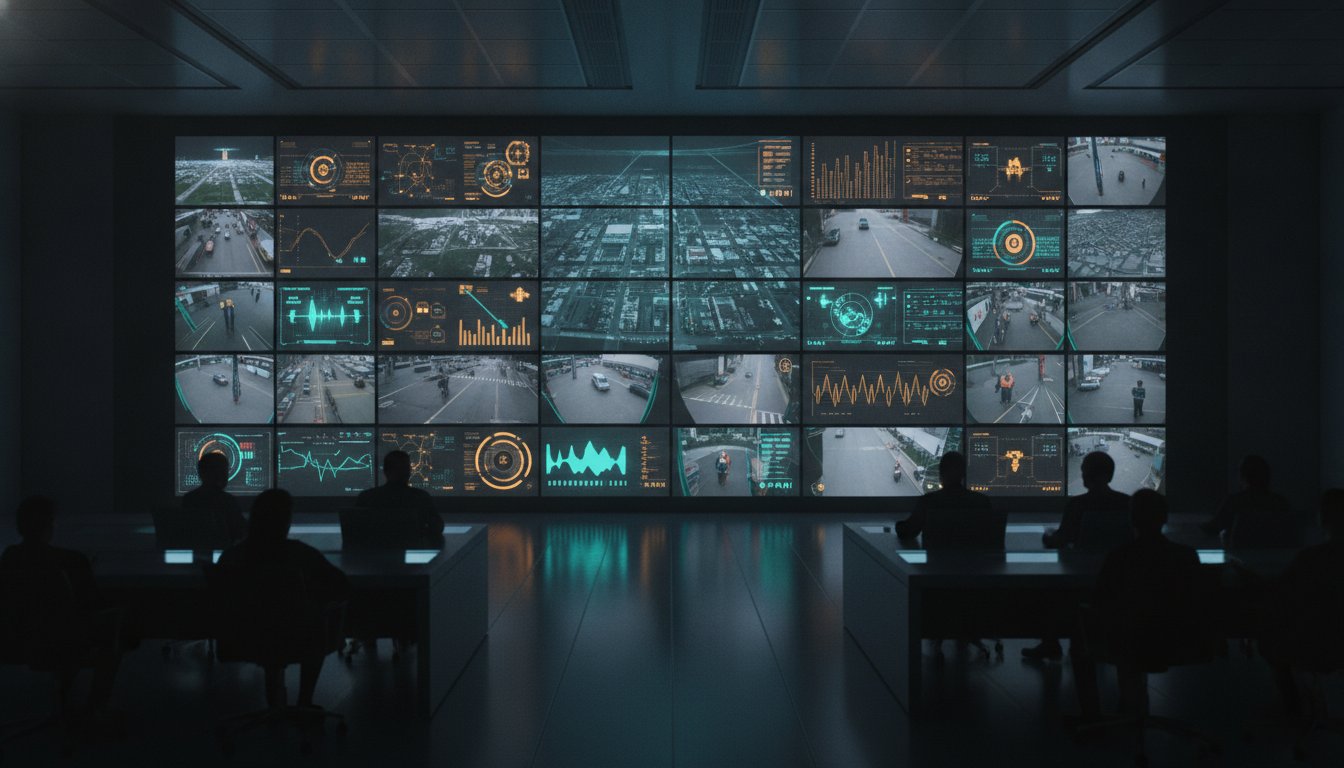
A three-second lag in a mission-critical environment isn’t just a technical annoyance; it’s a dangerous gap in your operational command. When operators rely on fragmented feeds, even a minor delay in low latency video streaming can lead to missed incidents and compromised safety. You likely recognize the frustration of managing data silos where information from multiple, unintegrated sources provides only a partial view, leaving your team to piece together a fractured common operating picture under extreme pressure.
Most control rooms already have the screens. What they’re missing is the layer that decides what goes on them, and escalates automatically when something needs attention. This article demonstrates how to eliminate visual latency and unify your disparate data streams into a single, cohesive intelligence hub. We’ll explore the shift from passive monitoring to event-driven situational awareness, ensuring your command center and mobile units operate with absolute synchronicity. By the end, you’ll understand how an operational intelligence layer transforms raw data into the decisive clarity required for faster, more effective incident response.
Key Takeaways
- Understand why sub-second, low latency video streaming is the essential requirement for glass-to-glass intelligence in mission-critical operations.
- Identify the technical protocols, including SRT and H.265, that maintain visual clarity while managing the bandwidth of high-bitrate feeds.
- Address the problem of fragmented data silos by recognizing that tools like Axon only provide a partial view of the operational landscape.
- Most control rooms already have the screens; what they’re missing is the layer that decides what goes on them and escalates automatically when something needs attention.
- Learn how the vis/ability platform acts as the central hub to unify all operational tools into a single, common operating picture.
The Strategic Role of Low Latency Video Streaming in Mission-Critical Operations
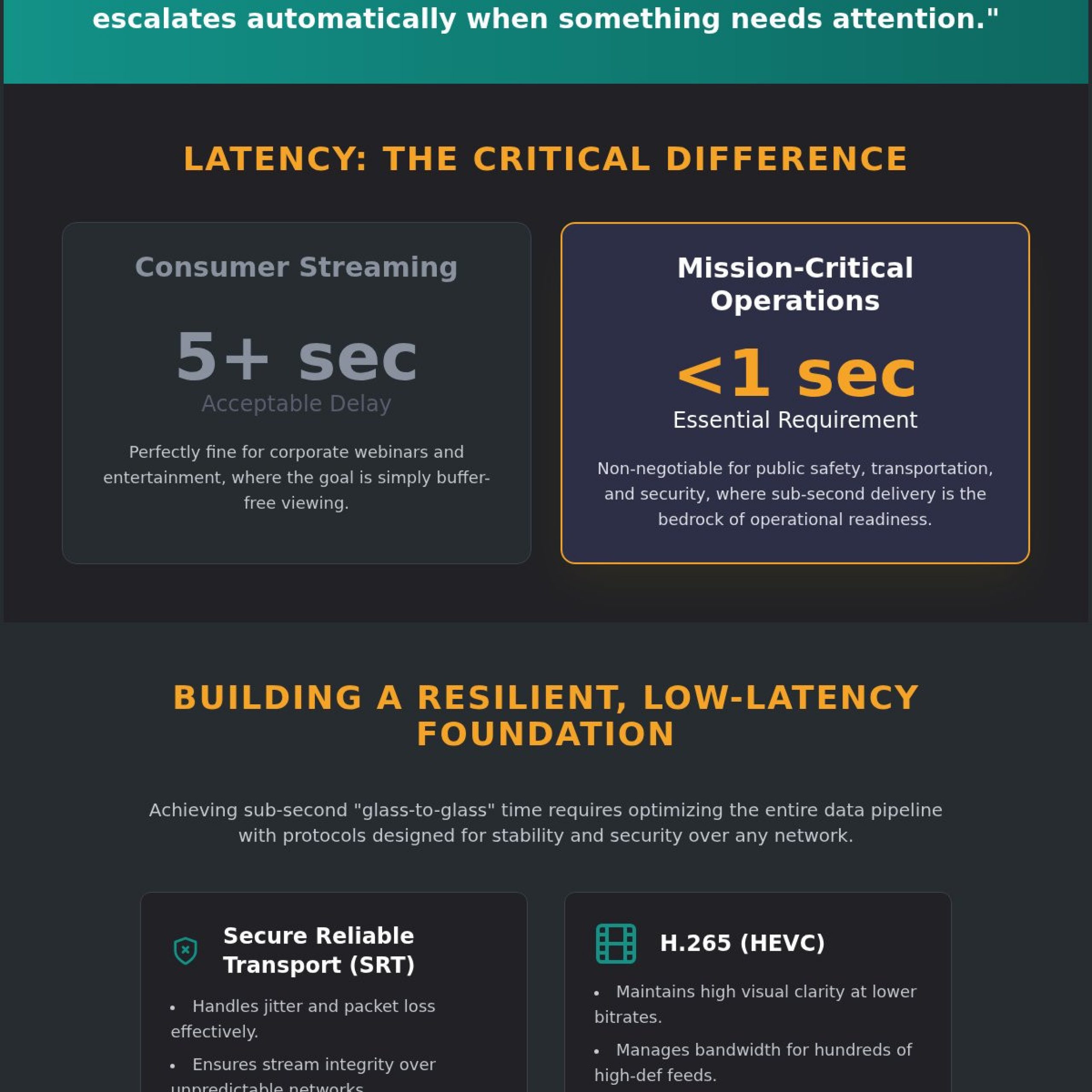
Low latency video streaming represents the critical interval between data capture and visual display, commonly referred to as glass-to-glass time. In a mission-critical environment, this metric determines the boundary between a proactive response and a reactive failure. While consumer streaming focuses on buffer-free entertainment, operational environments demand sub-second delivery to maintain situational awareness. For agencies focused on public safety, the speed at which visual intelligence reaches an operator is the bedrock of operational readiness.
The requirements of a Network Operations Center (NOC) are far more rigorous than those of standard commercial applications. In these high-stakes settings, technology serves as the essential bridge between raw data and human judgment. Decisions must be made in the moment of a pivotal event, requiring a platform that ensures clarity and precision when stakes are at their highest. Most control rooms already have the screens. What they’re missing is the layer that decides what goes on them, and escalates automatically when something needs attention.
Operational Latency vs. Consumer Delay
While a five-second delay might be acceptable for a standard corporate webinar, high-stakes live and hybrid environments require the same level of technical precision found in mission-critical settings. To see how these solutions are implemented in professional event production, learn more about Straight Street Event Services.
A five-second delay is perfectly acceptable for a corporate webinar, yet it’s catastrophic for a transportation management center monitoring high-speed transit corridors. Visual lag directly degrades the speed and accuracy of human intervention, creating a dangerous disconnect between the reality on the ground and the image on the video wall. Operational latency is the bridge between an event and an effective response. When a delay occurs, the operator isn’t just seeing a late image; they’re working with stale data that no longer reflects the current threat environment.
The Anatomy of Glass-to-Glass Time
Achieving true real-time visibility requires optimizing every stage of the digital pipeline. This process begins with capture and moves through encoding, transmission, decoding, and final display. Common standards like the Real-Time Streaming Protocol (RTSP) provide the foundation for managing these feeds, but each stage of the pipeline introduces the potential for “stale data” to enter the common operating picture. If the transmission phase isn’t optimized for low latency video streaming, the resulting visual intelligence becomes unreliable. Technical reliability is non-negotiable because the intelligence layer must empower individuals to act with absolute certainty, regardless of the complexity of the incoming data streams.
Technical Standards for Achieving Low Latency in Control Rooms
Maintaining a high-definition common operating picture requires more than just high-speed internet. Standard commercial hardware often fails under the pressure of hundreds of simultaneous high-bitrate feeds. To achieve true low latency video streaming, organizations must implement specific technical protocols that prioritize stability and security. Relying on basic COTS hardware without specialized integration creates bottlenecks that can freeze a video wall during an emergency. Traditional hardware setups often lack the processing power to decode multiple high-resolution streams simultaneously, leading to dropped frames and increased latency. This operational intelligence layer ensures that technical standards translate directly into tactical advantages.
Secure Reliable Transport (SRT) and Network Resilience
The Secure Reliable Transport (SRT) protocol has become a vital component for ensuring situational awareness in mission-critical contexts. Unlike older protocols, SRT is designed to handle jitter and packet loss over unpredictable networks. This makes it essential for distributed teams and mobile users who need reliable access to the common operating picture from the field. Whether communicating over public internet or private fiber, SRT provides the encryption necessary to maintain a robust cybersecurity common operating picture without sacrificing speed. It acts as a shield against the packet drops that typically plague long-distance data transmission, ensuring that the visual intelligence remains fluid and actionable regardless of network conditions.
HEVC and Bitrate Optimization
High-Efficiency Video Coding (H.265 or HEVC) is the standard for maintaining visual clarity while minimizing bandwidth consumption. It allows command centers to ingest 4K resolution feeds without saturating the local network. This balance is critical when operators must distinguish fine details in a crowded visual field while demanding zero-lag transmission. In the utilities and energy sectors, encoding efficiency serves as a strategic variable that allows for real-time monitoring across vast, geographically dispersed infrastructure. Modern video wall systems must leverage these standards to ensure that every pixel contributes to actionable intelligence rather than network congestion. By integrating these protocols into a unified platform, agencies can transform a collection of disparate feeds into a reliable stream of visual intelligence. Discover how to optimize your environment with our control room design services.
Overcoming Control Room Situational Awareness Problems
Operators in high-stakes environments often face a deluge of information that obscures rather than clarifies. This fragmented system problem occurs when siloed data feeds compete for limited attention, forcing individuals to manually correlate disparate streams during a crisis. While organizations may utilize specialized tools like Axon, these platforms often provide only a partial solution. They lack the unifying architecture required to synthesize a complete common operating picture. Without a central hub, critical incidents are easily missed because the relevant data is buried within a secondary application or delayed by network congestion.
Relying on standard video walls without this intelligence layer often results in a collection of passive displays rather than an active operational tool. When visual feeds are inconsistent or laggy, the resulting disconnect prevents the video wall from serving as a reliable bedrock for decision-making.
The Danger of Siloed Data Feeds
Disparate Video Management Systems (VMS), Computer-Aided Dispatch (CAD), and IoT sensor streams frequently create blind spots during critical incidents. Legacy systems often fail to aggregate real-time video with application-specific data, leaving gaps in the narrative of an unfolding event. This fragmentation is particularly dangerous when low latency video streaming is not maintained across all platforms, as visual lag can lead to mismatched data points. To bridge these gaps, agencies require Incident Management Software for Mission-Critical Environments that treats every feed as a piece of a larger, unified puzzle.
Visual inconsistency also accelerates operator fatigue. When feeds are laggy or out of sync, the cognitive load required to process information increases significantly. This mental drain reduces the speed and accuracy of human intervention precisely when it’s needed most. The technology must act as the essential bridge between raw data and human judgment, ensuring that operators can remain focused and analytical when stakes are at their highest.
EOC Common Operating Picture Solutions
True situational awareness requires a unified view that extends seamlessly from the command center to the field. Every team member must see the same prioritized information simultaneously to ensure coordinated action. Achieving this state requires event-driven visualization, which shifts operations from a reactive posture to a proactive one. By utilizing an operational intelligence layer, organizations can ensure that low latency video streaming reaches every stakeholder, whether they’re in the Emergency Operations Center (EOC) or on a mobile device. For field operations requiring custom aerial data, incorporating engineering solutions from DAO 無人機系統設計 ensures that the capture hardware is optimized for these demanding environments. This approach ensures that technical tools empower individuals to act with greater certainty, transforming the video wall into a dynamic engine of operational success.
Practical Guidance: How to Manage Multiple Data Feeds in a Dispatch Center
Managing hundreds of simultaneous high-bitrate feeds in a modern dispatch center is an immense technical and psychological challenge. When every camera and sensor is streaming data, the sheer volume can overwhelm even the most seasoned operator. The risk isn’t just network congestion; it’s the cognitive overload that occurs when a video wall becomes static wallpaper rather than an active tool. Operators miss critical incidents when they’re forced to scan rows of irrelevant footage instead of focusing on the specific event that requires intervention. This passive approach to monitoring creates a dangerous environment where the most important visual intelligence is hidden in plain sight.
This operational intelligence layer acts as a vital filter for the data deluge, ensuring that low latency video streaming is directed only to the individuals who need it at that exact moment. By transforming the video wall into a dynamic asset, organizations can ensure that their technical tools empower individuals to act with greater certainty when stakes are at their highest.
Prioritizing Essential Information
To maintain situational awareness, systems must distinguish the “signal” from the “noise” during a crisis. This is achieved through event-driven triggers that automatically escalate relevant feeds to the primary display. Instead of an operator manually searching for a camera, the system presents the visual intelligence based on CAD alerts, geospatial triggers, or IoT sensor data. Automated escalation preserves operator focus by removing the need for manual navigation during high-stress scenarios. This proactive strategy reduces the time spent searching for data, allowing the team to focus entirely on the moment of a pivotal decision. Identifying these triggers is a core part of effective control room design services.
Optimizing for Distributed Collaboration
Operational continuity depends on the ability to share real-time data across the entire organization. This includes ensuring low latency video streaming is accessible in huddle rooms and on mobile devices for personnel in the field. Managing bandwidth constraints for remote users is vital; the platform must optimize the stream to maintain clarity without causing lag that compromises the common operating picture. Every stakeholder, regardless of their location, must see the same prioritized information to ensure coordinated action. This unified approach eliminates the data silos that typically occur between the command center and mobile units. Explore how to unify your operation with our vis/ability platform for event-driven awareness.
Vis/ability: The Unifying Layer for Real-Time Operational Intelligence
vis/ability stands as the definitive central hub into which all other operational tools flow. While traditional systems focus on the transmission pipe or the display hardware, this platform provides the intelligence between them. It’s the unifying platform that makes other tools useful for the entire team; whether they’re in a command center, a huddle room, or on mobile devices. By aggregating data and video streams into a single operational intelligence layer, vis/ability ensures that technical reliability translates into clear, actionable judgment. This approach transforms low latency video streaming from a simple performance metric into a strategic asset for mission-critical environments.
The Intelligence Layer for Decision-Making
This is the core value of the vis/ability platform. It empowers individuals to act with greater certainty by providing the right context at the right moment. Instead of overwhelming operators with every available feed, the system prioritizes the essential information. This ensures that visual intelligence is not just fast, but relevant to the current mission. By aligning technical tools with human judgment, you create a more resilient operation. For a deeper look into these strategies, consult our Mission Critical Operations: A Comprehensive Guide.
Future-Proofing Your Common Operating Picture
As the volume of IoT sensors and high-resolution video feeds grows, scalability becomes a non-negotiable requirement. A modern common operating picture must integrate more than just visual data; it must incorporate cybersecurity intelligence to provide a total view of organizational risk. vis/ability manages this complexity by acting as the foundational engine for event-driven situational awareness. It seamlessly handles the growth of data while maintaining the integrity of low latency video streaming across all endpoints. This future-proof architecture ensures that your command center remains a source of calm and clarity, even as the digital landscape becomes more complex. Technology should be a silent partner that empowers your team to act decisively. To see how this unifying layer can transform your operation, schedule a vis/ability platform demo today.
Establishing Real-Time Operational Clarity
Achieving absolute situational awareness requires more than just high-speed hardware; it demands a strategic alignment between technical protocols and human judgment. We’ve explored how low latency video streaming serves as the foundation for this clarity, ensuring that operators aren’t sidelined by stale data or fragmented silos. By moving beyond static video walls, command centers can transform passive monitoring into a proactive, event-driven response that identifies threats before they escalate.
Activu Corporation brings over 40 years of mission-critical expertise to this challenge, providing the bedrock upon which federal agencies and global utility providers make their most vital decisions. Our vis/ability platform serves as the unifying intelligence layer that empowers your team to act with unwavering certainty when stakes are at their highest.
Take the next step in future-proofing your common operating picture. Request a demo of the vis/ability platform to unify your operational intelligence. We look forward to helping you achieve a new standard of operational readiness and safety.
Frequently Asked Questions
How does video bitrate affect situational awareness in a control room?
Video bitrate directly impacts the clarity of visual intelligence and the speed at which it’s delivered. While high bitrates provide the fine detail necessary for identifying threats, they can also saturate network bandwidth and introduce significant lag. Effective situational awareness requires a balance where bitrate is optimized to ensure low latency video streaming without sacrificing the essential fidelity required for precise human judgment during a crisis.
What is the best protocol for low latency video streaming in a NOC?
Secure Reliable Transport (SRT) is a superior protocol for achieving low latency video streaming in Network Operations Centers. Unlike legacy protocols, SRT manages jitter and packet loss while maintaining high-security encryption. This ensures that visual data remains fluid and reliable even when transmitted over unpredictable public networks or complex private infrastructures, providing the technical reliability required for mission-critical oversight.
Why do operators miss critical incidents on high-resolution video walls?
Operators often miss incidents because high-resolution video walls are frequently treated as passive wallpaper rather than active operational tools. When a wall displays too much irrelevant information, the resulting cognitive overload makes it difficult to distinguish the signal from the noise. Without an intelligence layer to prioritize feeds, the human element becomes overwhelmed by the sheer volume of data, leading to delayed responses during high-stakes events.
How can I manage hundreds of data feeds in a dispatch center without overloading operators?
Managing a high volume of feeds requires a shift toward event-driven situational awareness. By using automated triggers, you can ensure that only the most relevant data is displayed, significantly reducing the mental burden on dispatchers and preserving their focus for critical decisions.
What is the difference between low latency and ultra-low latency for mission-critical apps?
The distinction between low latency and ultra-low latency is measured in glass-to-glass time. While standard low latency might be acceptable for general monitoring, mission-critical applications often require ultra-low latency, which is typically sub-second. This near-instantaneous delivery is vital when operators must coordinate real-time responses to rapidly evolving threats where every millisecond counts toward a successful outcome and operational safety.
Can vis/ability integrate with existing tools like Axon or SIEM platforms?
Yes, vis/ability is designed to act as the central hub for all operational tools. While platforms like Axon or SIEM tools provide valuable data, they often offer only a partial view of the total environment. vis/ability unifies these fragmented streams into a single common operating picture, ensuring that data from disparate sources is synthesized into actionable intelligence for the entire team across all locations.
How does HEVC encoding improve remote situational awareness for mobile users?
HEVC (H.265) encoding provides superior compression, allowing high-resolution video to be transmitted over constrained networks. This is particularly beneficial for mobile users who rely on cellular data to maintain situational awareness in the field. By reducing bandwidth requirements without compromising visual clarity, HEVC ensures that remote personnel receive the same high-quality intelligence as those inside the command center, maintaining operational continuity.
What are the most common situational awareness problems in an EOC?
The most frequent challenges in an Emergency Operations Center involve fragmented systems and siloed data. When information is trapped in separate applications, it creates blind spots that hinder a coordinated response. Overcoming these problems requires a unifying platform that aggregates VMS, CAD, and IoT feeds into a cohesive display, allowing stakeholders to act with greater certainty based on a shared reality during urgent operations.