
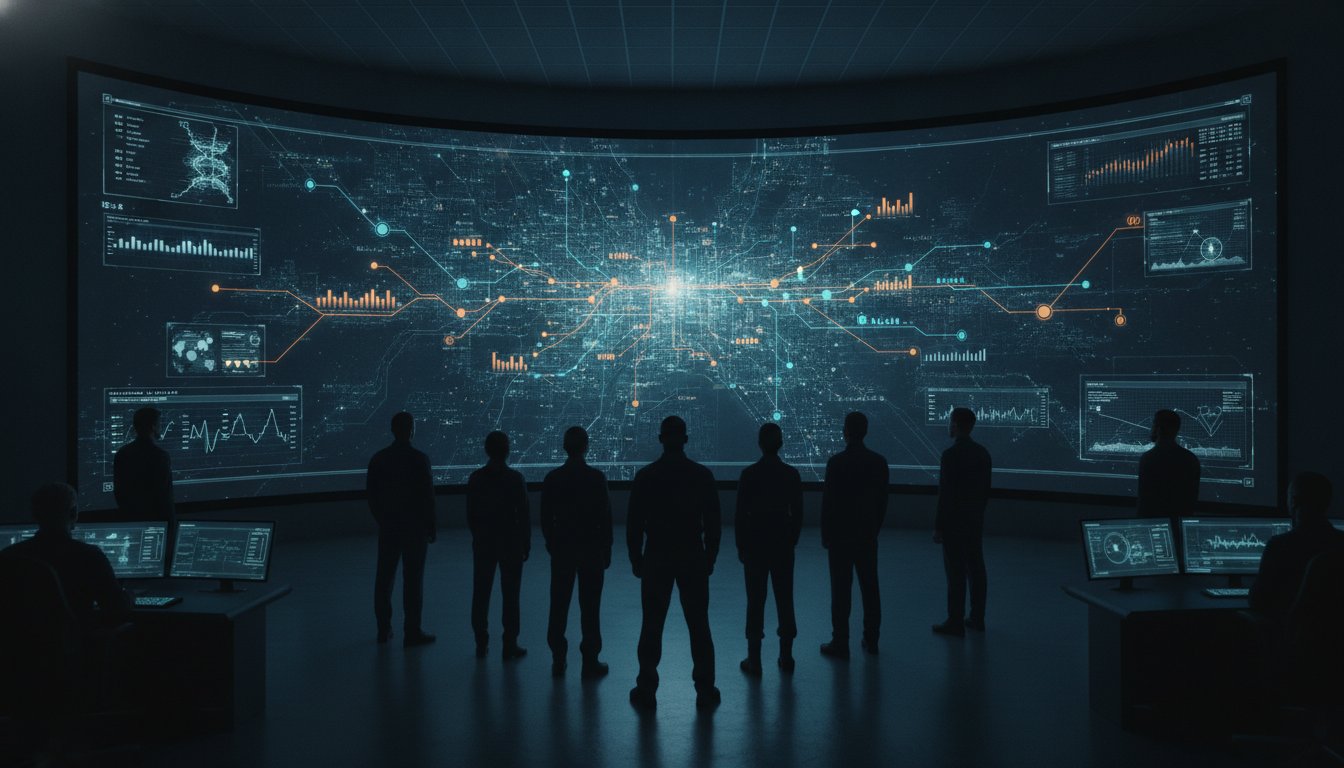
The primary bottleneck in a command center during a critical incident is the cognitive load on your operators. When a video wall controller only functions as a display tool, it fails to address the fragmented systems that force professionals to manually interpret unprioritized feeds. You likely recognize the fatigue that sets in when teams must hunt for relevant data across disconnected platforms while every second counts. This lack of geospatial oversight and situational awareness often results in information silos that delay decisive action.
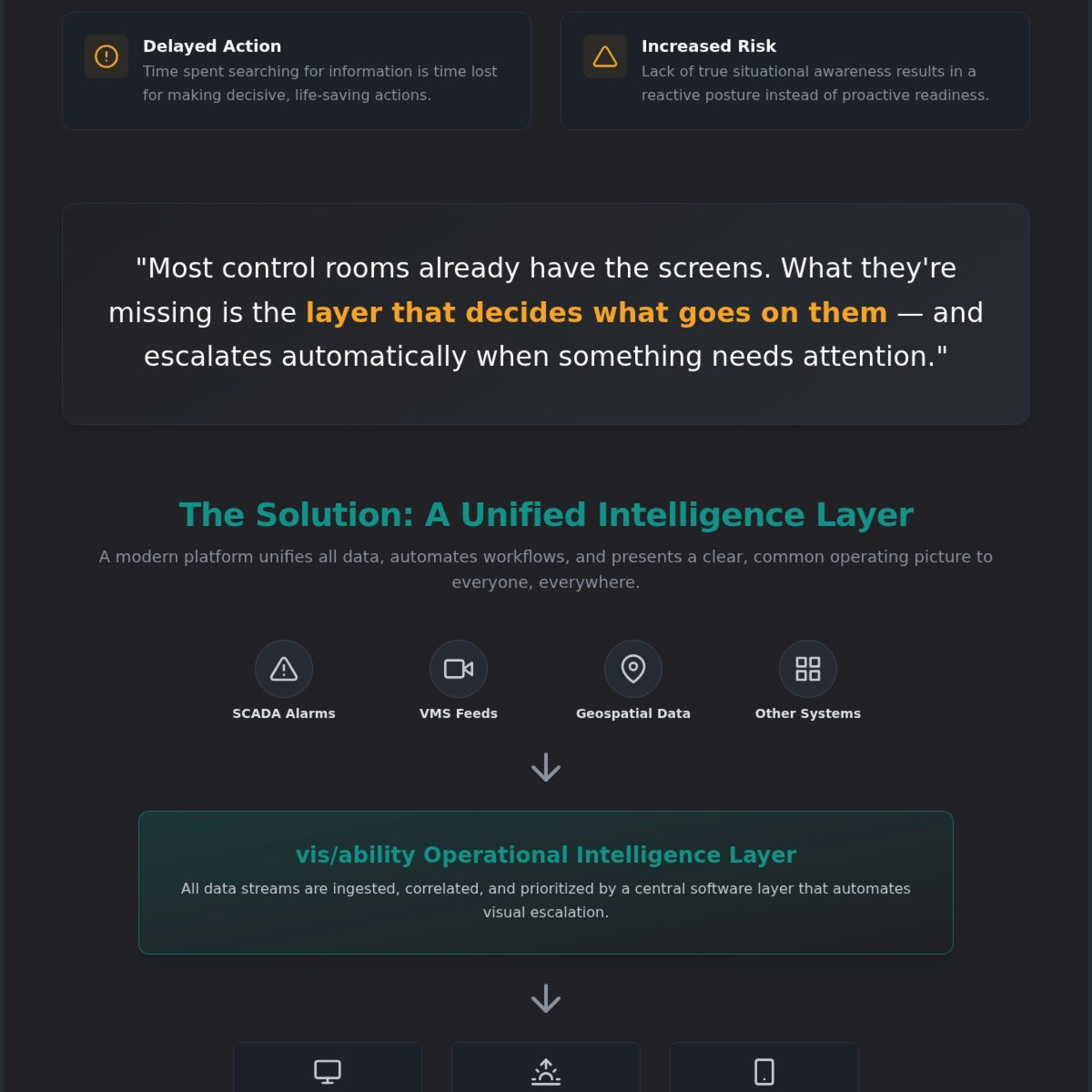
Modern operations require a solution that serves as the bedrock for operational readiness and technical integration. Most control rooms already have the screens. What they’re missing is the layer that decides what goes on them, and escalates automatically when something needs attention.
This article explains how the right technology transforms raw data into a unified common operating picture. You’ll learn how an operational intelligence layer eliminates latency and bridges the gap between the NOC and field units. We’ll explore the path toward seamless collaboration and how to future-proof your infrastructure against evolving data streams, ensuring your team maintains clarity when stakes are at their highest.
Key Takeaways
- Shift your perspective from simple display management to an operational intelligence layer that unifies fragmented data streams into a single source of truth.
- Learn why a modern video wall controller is the essential bridge between raw incoming data and the pivotal human decisions required in high-stakes environments.
- Address the cognitive load that causes operators to miss incidents by implementing event-driven automation and prioritized feed escalation.
- Bridge the communication gap between the command center and mobile field units to ensure every team member acts on the same common operating picture.
- Identify the technical non-negotiables for 24/7 resilience, from high-resolution processing to future-proof scalability for growing data requirements.
Beyond the Hardware Box: Defining the Modern Video Wall Controller
Mission-critical operations demand more than just large-scale displays. While a basic video wall might satisfy the requirements of a lobby or retail space, command environments require a sophisticated brain to manage extreme complexity. A modern video wall controller serves as that brain. It doesn’t merely split signals; it orchestrates a high-pressure flow of information. The primary objective is situational awareness. This means moving beyond static screen mirroring and toward a dynamic environment where data drives the visual output. In these settings, the technology acts as the essential bridge between raw data and human judgment.
The Role of the Controller in the NOC and SOC
In a Network Operations Center (NOC) or Security Operations Center (SOC), the environment is defined by a constant influx of disparate data. Operators must simultaneously monitor SCADA systems, Video Management Software (VMS), and real-time geospatial data. A dedicated controller aggregates these feeds into a single, cohesive view. For federal and defense agencies, 24/7 reliability isn’t a feature; it’s a requirement for operational readiness. These high-stakes environments rely on SOC and NOC Solutions that ensure no single point of failure disrupts the common operating picture. The goal is to provide a feeling of calm and clarity amidst potential complexity, allowing leaders to act with greater certainty.
From Matrix Switchers to Intelligent Processors
Traditional hardware matrix switchers are limited by fixed inputs and rigid architecture. They lack the flexibility needed for modern, scalable operations. Software-defined controllers have replaced these legacy systems, offering a future-proof way to manage evolving data streams. While many organizations utilize Commercial Off-the-Shelf (COTS) hardware to reduce costs, this hardware alone is insufficient. Most control rooms already have the screens. What they’re missing is the layer that decides what goes on them, and escalates automatically when something needs attention. Without this intelligence layer, COTS hardware remains a collection of disconnected parts rather than a unified tool for decision-making. By transforming signal processing into data intelligence, the video wall controller becomes the bedrock upon which critical decisions are made. It ensures that the core message of operational efficiency is never lost in unnecessary technical complexity.
Architecture and Processing: How Data Flows Through the Command Center
Data flows through a command center like blood through a nervous system. If the architecture is flawed, the entire operation becomes sluggish and unresponsive. A high-performance video wall controller must ingest a massive variety of inputs, from 4K IP camera streams to complex browser-based dashboards. Managing these high-bitrate streams requires a sophisticated understanding of network performance. Without the right transport protocols, such as SRT or HEVC, the big picture arrives with unacceptable lag. This latency is more than a technical nuisance; it is a direct risk to operational readiness during a crisis. When seconds define the outcome of an emergency response, the journey from data source to visual output must be instantaneous and reliable.
This transition from a simple signal processor to a comprehensive operational intelligence layer is what separates a modern hub from a legacy environment. It ensures that the most critical information is always front and center, reducing the cognitive load on your team.
Hardware-Accelerated Decoding and Rendering
High-performance GPUs are the engine room of modern data visualization. They handle the heavy lifting of decoding high-density visual data in real-time. This processing power ensures frame-accurate synchronization across dozens of displays, preventing the visual tearing that distracts operators. Efficient bandwidth management is equally critical. You need a system that prioritizes essential data to prevent network bottlenecks when every second counts. These technical foundations are what allow for real-world applications in mission-critical operations, where information must be both high-resolution and immediate. A robust video wall controller manages these resources dynamically, ensuring that the visual performance remains steady even as data streams multiply.
Application Integration vs. Simple Screen Scraping
Relying on simple screen scraping or video feeds often leaves operators blind to the underlying data. Partial solutions, often limited in scope, typically only offer a slice of the operating picture. They require a unifying hub to become truly effective for the entire team. The vis/ability platform serves as this central hub, moving beyond passive viewing. It integrates applications natively, allowing operators to interact with data directly from the video wall or their mobile devices. This approach eliminates the information silos that cause operator fatigue and fragmented decision-making. By choosing a system designed for public safety and high-stakes response, you ensure that your team isn’t just watching a screen, but actively managing an incident with full situational awareness. To see how this integration can transform your operations, you can contact our design team for a tailored consultation.
The Cognitive Gap: Why Standard Controllers Fail in High-Stakes Operations
High-stakes environments often suffer from an abundance of data but a scarcity of insight. When a video wall controller is treated as a simple hardware box, it contributes to this problem by overwhelming operators with unprioritized feeds. Cognitive overload occurs when essential information is buried under a mountain of noise. This is exactly why operators miss incidents. It’s not a failure of vigilance; it’s a failure of system design. Without this intelligence, a wall of displays is just a collection of pixels rather than a tool for decision-making.
Fragmented Systems and the Information Silo Problem
Standalone tools create a disjointed view of operational reality. When your VMS, SCADA, and geospatial data remain in separate silos, your team must manually correlate information during a crisis. This manual process causes significant delays in response times. Fragmented systems prevent a unified common operating picture, leaving operators to guess which feed is most relevant at any given moment. For a deeper look at overcoming these visual hurdles, see The Video Wall: A Strategic Guide. True situational awareness requires a hub that breaks these silos and presents data in a context that’s immediately actionable for the entire team.
Event-Driven vs. Always-On Monitoring
The traditional model of staring at screens for hours is fundamentally inefficient. Human attention spans are naturally limited, and monitoring dozens of static feeds leads to rapid operator fatigue. Modern mission-critical operations must shift to an event-driven visualization model. This approach ensures that the video wall controller only highlights information when specific thresholds are met or incidents occur. Automated feed escalation directs the team’s focus exactly where it’s needed most. By reducing visual noise, you empower your operators to act with greater certainty. This proactive nature is the bedrock of operational readiness in any defense or federal environment. It moves the operation from a reactive state to a position of total control, ensuring that critical data is never lost in the complexity of the digital landscape.
Critical Evaluation Framework: Selecting a Controller for 24/7 Resilience
Selecting a video wall controller for a mission-critical environment is a strategic decision that impacts the long-term operational readiness of your team. Price should never be the primary metric when national infrastructure or public safety is at stake. A resilient system must be vendor-agnostic, ensuring you aren’t locked into proprietary hardware that limits future upgrades. Cybersecurity is another non-negotiable factor. Your controller must act as a hardened defense layer, protecting the integrity of your data streams from external threats. This intelligence layer ensures that your investment remains scalable as your operational requirements expand and new data sources emerge.
Operational Continuity and Redundancy Protocols
Uptime is the only acceptable standard for 24/7 operations. Failover protocols must be instantaneous to prevent any loss of situational awareness during a crisis. Software-defined architectures provide a distinct advantage here, allowing for robust disaster recovery that hardware-centric systems cannot match. By decoupling the intelligence layer from the physical components, you ensure that the common operating picture remains accessible even if a specific hardware node fails. For a deeper analysis of how to leverage standard equipment in high-stakes settings, review our Commercial Off-the-Shelf (COTS) Guide. This approach provides the flexibility to replace or upgrade components without overhauling the entire system.
Collaborative Extension: Beyond the Video Wall
Situational awareness shouldn’t stop at the command center door. A modern common operating picture must extend to huddle rooms and the mobile devices used by field units. This collaborative extension ensures that remote stakeholders see the exact same data as the operators in the NOC. Without this synchronization, field teams act on outdated or incomplete information, creating dangerous gaps in response. Our Federal Government and Defense Solutions highlight how these extensions empower distributed teams to act with total certainty. If you’re ready to secure your operation with a resilient intelligence layer, contact our experts today to discuss your specific requirements.
Transforming Displays into Intelligence with the vis/ability Platform
Raw data remains a liability until it is processed into actionable intelligence. While the physical components of a video wall controller provide the necessary infrastructure, the software layer determines the speed and accuracy of your team’s response. Fragmented feeds and siloed applications create a chaotic environment where critical details are easily overlooked. The vis/ability platform serves as this essential operational intelligence layer. It acts as the bedrock of situational awareness, ensuring that your command center functions as a unified engine of decision-making rather than a collection of disconnected monitors.
The vis/ability Operational Intelligence Layer
A true common operating picture requires the seamless aggregation of real-time data from every corner of your organization. The vis/ability Platform Overview demonstrates how this hub unifies disparate tools, from cybersecurity dashboards to geospatial oversight. Event-driven automation shifts the paradigm from reactive monitoring to proactive incident management. When a specific threshold is met, the system automatically surfaces the relevant data to the entire team. This capability extends beyond the command center walls. Mobile vis/ability ensures that field units and remote stakeholders act on the same synchronized intelligence as the NOC. By providing this field-to-command synchronization, the platform eliminates the information gaps that typically hinder large-scale operations.
Designing for the Moment of Pivotal Decision
Technology must empower the human element to act with greater certainty when stakes are at their highest. Activu’s design services focus on optimizing both hardware and software for high-pressure human action. We recognize that a video wall controller is the essential bridge between digital complexity and human judgment. Our methodical approach begins by identifying your specific operational challenges and concludes with a definitive statement on clarity and safety. We ensure that your operators aren’t just viewing video feeds; they are interacting with prioritized intelligence designed for the moment of a pivotal decision. This results in faster incident response times and absolute technical reliability. To begin transforming your fragmented data into a unified operating picture, Contact Activu for a Control Room Design Consultation and ensure your team has the bedrock they need for successful operations.
Securing Operational Readiness Through Intelligent Visualization
Operational success in high-stakes environments depends on the seamless integration of fragmented data into a single common operating picture. A modern video wall controller must do more than display signals; it acts as the strategic hub that empowers human judgment at the moment of a pivotal decision. This operational intelligence layer eliminates the information silos and cognitive load that cause delayed response times, ensuring your team remains focused and analytical when every second counts.
With over 40 years of expertise in mission-critical visualization, Activu is trusted by federal agencies, global utilities, and transportation hubs to provide absolute technical reliability. Our solutions serve as the bedrock upon which critical decisions are made, providing calm and clarity amidst potential complexity. You can request a demo of the vis/ability platform to unify your command center operations and ensure your team acts with total certainty. Take the first step toward a more resilient and collaborative future today.
Frequently Asked Questions
What is the difference between a video wall controller and a matrix switcher?
A video wall controller is an intelligent processor that aggregates, scales, and manages multiple data sources, while a matrix switcher simply routes signals from inputs to outputs. While a switcher provides basic connectivity, a controller serves as the operational intelligence layer.
Can a video wall controller handle multiple 4K data streams simultaneously?
Yes, a high-performance video wall controller manages multiple 4K data streams simultaneously by utilizing hardware-accelerated decoding. This ensures that high-density visual information is rendered without latency or dropped frames. Managing these bitrates requires robust network architecture and low-latency transport protocols. This processing capability is essential for maintaining a clear common operating picture during high-stakes incidents where detail and timing are critical for human decision-making.
How does a software-defined controller improve situational awareness?
Software-defined controllers improve situational awareness by decoupling the intelligence layer from specific hardware constraints. This allows for event-driven automation, where the system automatically highlights essential information based on real-time data triggers. This shift from passive monitoring to proactive incident management reduces operator fatigue. It ensures that the most relevant feeds are prioritized, creating a unified operating picture that adapts to the evolving needs of the command center.
What are the hardware requirements for mission-critical video processing?
Mission-critical video processing requires high-performance GPUs, redundant power supplies, and high-bandwidth network interfaces. These components must support 24/7 operation with instantaneous failover protocols to prevent any loss of visibility. The hardware serves as the bedrock for the software intelligence layer. Reliability is paramount in federal and defense environments, where technical failure is not an option. Professional design services ensure that every component is optimized for maximum operational efficiency.
How do you integrate mobile field teams into a video wall system?
Mobile field teams are integrated through specialized tools like mobile vis/ability, which extend the common operating picture to smartphones and tablets. This synchronization ensures that field units see the exact same data as operators in the command center. It bridges the communication gap and eliminates information silos. By providing real-time visibility to distributed teams, organizations can coordinate responses with greater certainty and improve overall incident response times.
Why do operators miss critical incidents on standard video walls?
Operators miss critical incidents primarily due to cognitive overload caused by monitoring too many unprioritized feeds. When a system lacks an intelligence layer to filter and escalate data, the human element becomes overwhelmed by visual noise. Standard walls often present fragmented information that requires manual interpretation. Using event-driven situational awareness allows the system to focus attention where it is needed most, significantly reducing the risk of human error during a crisis.
Is it possible to integrate third-party applications like Axon into the controller?
You can integrate third-party applications like Axon, but these tools often provide only a partial solution. They require a unifying platform to create a full common operating picture for the entire team. The vis/ability platform acts as the central hub into which these disparate tools flow. This integration ensures that data from various sources is correlated and presented in a way that supports decisive action rather than creating further fragmented silos.
What role does cybersecurity play in control room visualization?
Cybersecurity provides the foundation for trust in a mission-critical environment. A specialized cybersecurity common operating picture allows organizations to visualize their security posture and network health in real-time. The video wall controller must act as a hardened defense layer, protecting sensitive data streams from unauthorized access. This visibility helps security operations centers monitor threats and coordinate incident responses through a centralized, secure interface that ensures absolute technical reliability.