

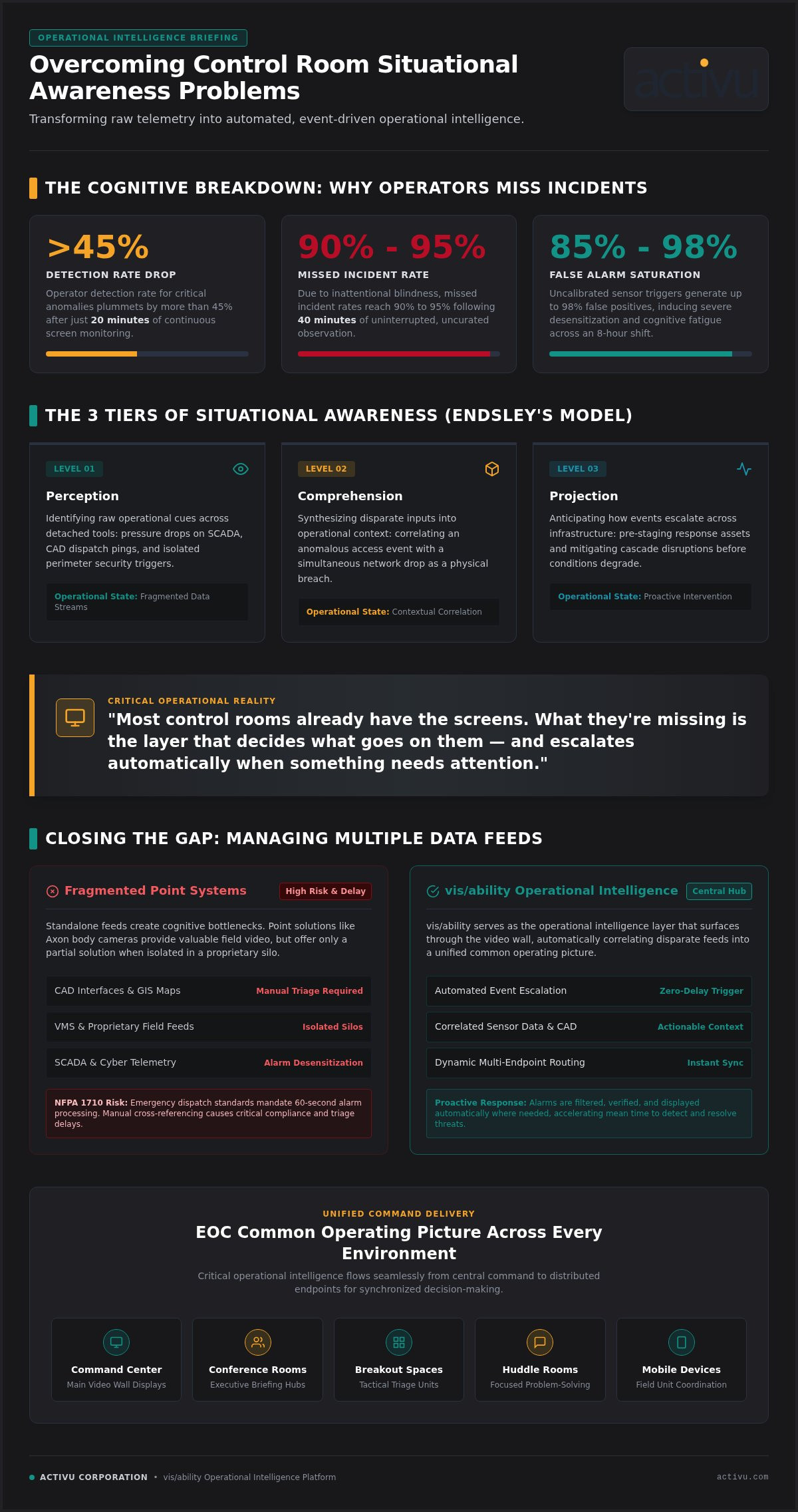
Human-factors research reveals that after just 20 minutes of continuous screen monitoring, an operator’s detection rate for critical anomalies drops by more than 45%. Operations leaders witness this breakdown every day. Dispatchers and supervisors face relentless cognitive strain as they toggle between isolated CAD interfaces, GIS maps, and sensor feeds. When critical events occur, manual triage across disconnected tools delays response times and splinters communication between command hubs and field units. Unlocking the tangible benefits of situational awareness requires confronting these fragmented data streams before fatigue compromises the mission.
You already know that simply adding more static monitors doesn’t solve control room situational awareness problems or eliminate operational blind spots. Discover how advanced situational awareness accelerates incident response, eliminates data silos, and empowers proactive operational decision-making. We examine how shifting from passive visual monitoring to automated, event-driven intelligence establishes an actionable common operating picture across command hubs, breakout rooms, and mobile units.
Key Takeaways
- Shift from passive visual monitoring to proactive operational comprehension, giving teams the foresight needed to anticipate critical developments.
- Capture the operational benefits of situational awareness to accelerate incident triage times and eliminate communication silos between dispatchers, command staff, and field units.
- Understand why conventional display matrices and fragmented point tools induce operator fatigue, increase false-alarm desensitization, and obscure urgent threats.
- Consolidate disparate systems like CAD, VMS, GIS, and cyber telemetry into an actionable common operating picture compliant with modern response standards.
- Leverage an intelligent operational layer that automatically routes critical incidents across command hubs, breakout spaces, and mobile endpoints for immediate resolution.
Defining Situational Awareness: Beyond Passive Monitoring in Operations
Situational awareness in modern operations represents far more than staring at camera feeds or scrolling through alert queues. True awareness demands real-time comprehension of current operational variables combined with the ability to project how an event will develop minutes or hours down the line. Control room situational awareness problems rarely stem from an absence of data. Instead, operations hubs struggle because operators face an uncurated flood of information that masks developing crises behind routine noise.
Passive monitoring forces personnel to manually cross-reference telemetry across multiple detached applications. Active situational awareness inverts that dynamic by contextualizing and correlating signals automatically. Raw data streams only deliver value when they translate into clear operational context. Without that intelligence layer, vast sensor arrays merely create cognitive bottlenecks during critical incidents. Realizing the full benefits of situational awareness means shifting your operational posture from retroactive troubleshooting to proactive intervention.
The Three Levels of Situational Awareness in Control Rooms
Decades of human-factors research structure operational understanding through Endsley’s situational awareness framework, which breaks down into three distinct operational thresholds:
- Level 1 Perception: Identifying fundamental operational cues, such as sudden pressure drops on a SCADA interface, CAD dispatch pings, or perimeter security alerts across isolated software tools.
- Level 2 Comprehension: Synthesizing disparate data points into immediate context, recognizing that an anomalous access event and a simultaneous network drop indicate a coordinated physical breach.
- Level 3 Projection: Anticipating how an incident will escalate across infrastructure, allowing command staff to pre-stage response assets before conditions degrade.
Cognitive Overload: Why Operators Miss Incidents on Crowded Screens
Operators frequently miss critical anomalies when workstation displays become oversaturated with dozens of unorganized browser windows and application monitors. Cognitive fatigue accelerates under sustained visual monitoring. Research indicates that after 40 minutes of uninterrupted screen observation, missed incident rates can reach 90% to 95% due to inattentional blindness. Between 85% and 98% of uncalibrated sensor triggers represent false alarms, which severely desensitizes staff over an eight-hour shift.
This dynamic reveals the root cause of why operators miss incidents video wall installations fail to curate. When a display wall acts as nothing more than a static digital canvas showing raw camera feeds, it exacerbates sensory fatigue rather than resolving it. Real operational readiness requires software that filters noise, automates escalation, and prioritizes essential elements so teams can execute timely decisions under pressure.
The Primary Benefits of Situational Awareness in High-Stakes Operations
High-tempo operations demand rapid, defensible decisions. When critical systems operate in isolation, supervisors waste precious minutes manually reconciling contradictory alerts. Capturing the measurable benefits of situational awareness transforms this dynamic, shifting control centers from delayed panic to coordinated command. By synthesizing multiple data layers into immediate intelligence, organizations mitigate systemic risk and protect personnel before disruptions multiply.
Accelerating Mean Time to Detect and Resolve Incidents
Emergency benchmarks, such as NFPA 1710 standards requiring dispatch alarm processing within 60 seconds, leave zero room for manual cross-referencing. While point solutions like Axon body cameras provide valuable field video, they offer only a partial solution when stranded in a proprietary silo. True operational awareness automatically correlates field telemetry with internal alarms to reduce mean time to detect. This automated triage lets dispatchers instantly verify emerging incidents, deploy field units rapidly, and leverage specialized incident management software to contain threats before they escalate.
Breaking Down Functional Silos Across Distributed Units
Command operations unravel when physical security teams, network engineers, and executive leadership view different operational pictures. Disparate teams operating from fragmented consoles generate conflicting assessments during a crisis. Grounding control environments in the NRC Human-System Interface Design Review Guidelines reinforces the necessity of structured, unified displays that minimize human error. Shared awareness standardizes operational visibility simultaneously across main command floors, crisis breakout rooms, and remote command staff, ensuring every stakeholder acts on identical facts.
Ensuring Regulatory Compliance and Operational Continuity
Post-incident investigations demand meticulous, timestamped records of every alert, operator action, and dispatch decision. Situational awareness platforms capture complete digital event trails, proving regulatory compliance under frameworks like FEMA NIMS. Maintaining resilience requires robust data orchestration across utility grids, transit hubs, and emergency management agencies, as detailed in established operational continuity frameworks. To modernize your facility around these resilient workflows, discuss your technical requirements with an expert team via Activu control room design services.
Why Traditional Control Room Displays Fail to Deliver True Awareness
Operations directors often assume that hanging massive display panels guarantees operational visibility. In practice, traditional screen arrays become visual wallpaper. They present a static grid of camera feeds and application windows, leaving human operators to spot deviations through sheer willpower. Solving how to manage multiple data feeds dispatch center supervisors face requires moving past simple pixel routing. Most control rooms already have the screens. What they’re missing is the layer that decides what goes on them, and escalates automatically when something needs attention.
One way critical operations try to solve this is with legacy hardware matrix switches, however this approach is inadequate because these tools route video signals without understanding the operational data inside them. Similarly, specialized field video capture tools provide reliable data acquisition, yet they offer only a partial solution when locked in their own software silo. Without an overarching intelligence platform, operators waste time manually reconfiguring monitors while incidents unfold in real time. Achieving the actual benefits of situational awareness requires dynamic orchestration rather than passive display hardware.
The Pitfalls of Fragmented Architecture and Isolated Systems
Control hubs frequently fracture under disjointed emergency management stacks. One way organizations handle communications is through isolated incident management software, however this is inadequate because tabular incident boards remain completely detached from real-time spatial and physical video feeds. Operators are forced to flip between disconnected browser tabs, radio dispatch logs, and separate sensor windows to verify an alarm. Legacy display controllers compound this friction; they function strictly as hardware-bound AV canvas managers incapable of interpreting live event telemetry.
Static Dashboards Versus Event-Driven Automation
Static workstation dashboards demand constant active scanning, a task human cognitive bandwidth cannot sustain under shift pressure. Contrast that manual upkeep with event-driven automation:
- Manual Monitoring: Operators monitor dozens of dormant feeds, searching for anomalies across uncurated camera banks while juggling secondary telemetry tabs.
- Event-Driven Escalation: Background rules engines continuously ingest API feeds from SCADA, CAD, and perimeter sensors, instantly surfacing contextual views the second a predefined threshold trips.
When an alarm activates, an event-driven setup dynamically populates the relevant surveillance angles, facility schematics, and GIS mapping directly into view. Staff members no longer guess where to look or struggle with input switchers. Modern software bridges raw telemetry and swift intervention, giving teams the decisive operational benefits of situational awareness when seconds count.
Achieving a Common Operating Picture Across Disparate Feeds
Establishing an authentic Common Operating Picture (COP) requires consolidating isolated technologies into a unified operational narrative. Regional coordination hubs searching for EOC common operating picture solutions must align with FEMA NIMS standards, ensuring operational decisions stem from verified Essential Elements of Information. Capturing the full benefits of situational awareness means transforming fragmented systems into coordinated, multi-agency action.
Step 1: Ingesting and Harmonizing Diverse Operational Feeds
Operational data lives across incompatible formats: SCADA telematics, CAD incident queues, GIS spatial layers, and live IP video streams. When operators manually copy coordinates between disconnected windows, response velocity collapses. An integrated operational intelligence layer ingests live applications, web consoles, and sensor telemetry directly, rendering them interoperable. Incorporating infrastructure telemetry using modern video wall systems eliminates manual data transcription, establishing a synchronized operational baseline across all consoles.
Step 2: Automating Content Escalation and Alarm Prioritization
Static displays force operators to conduct continuous manual triage across hundreds of dormant signals. Modern architectures replace passive monitoring with automated, event-driven rules engines. When incoming telemetry crosses predefined operational thresholds, the software instantly escalates the relevant camera feeds, access logs, and facility schematics into immediate view. Routine metrics step aside. Vital incident data displays immediately on shared screens without requiring manual operator intervention, delivering the operational benefits of situational awareness right when seconds dictate outcomes.
Step 3: Extending Unified Visibility to Distributed Stakeholders
Critical incidents rarely resolve within the four walls of a single command room. Decision-makers gather in crisis suites, breakout rooms, and mobile command vehicles. Traditional AV matrices fail here because they tether content to physical cables inside a single room. An agile software architecture replicates the common operating picture across conference rooms, huddle spaces, and field smartphones. Distributed teams share identical, real-time context, maintaining operational continuity even when key leadership operates off-site.
To eliminate information silos and accelerate multi-agency coordination across every tier of your operation, discover how to deploy the vis/ability platform across your command infrastructure.
Operationalizing Situational Awareness with Activu vis/ability
Operational readiness hinges on intelligent software orchestration rather than raw display hardware. Organizations cannot afford fragmentation when threats materialize. Activu vis/ability acts as an operational intelligence layer that surfaces through the video wall, turning disparate telemetry into purposeful action. Instead of operators hunting through disjointed tools during a crisis, the video wall becomes the physical space where the answer appears because vis/ability put it there. By continuously analyzing inputs and coordinating responses across command centers, breakout rooms, and mobile endpoints, agencies capture the tangible benefits of situational awareness without overwhelming their personnel.
The Operational Intelligence Layer Behind the Video Wall
One way critical operations route visual feeds is with video processors from RGB Spectrum, however this is inadequate because basic pixel routing lacks semantic awareness of the underlying data. Hardware-centric processors simply manage canvas layouts without understanding incident urgency. In contrast, deploying Activu vis/ability inserts intelligent decision logic between raw sensor data and operational displays.
The platform aggregates IP streams, mapping data, and application telemetry, analyzing alert severity in real time. When an anomaly triggers an escalation rule, vis/ability automatically surfaces relevant cameras, building layouts, and communication channels directly to frontline staff. Operators receive curated context at the exact moment of decision, eliminating guesswork and accelerating containment.
Tailored Solutions for Sector-Specific Control Centers
High-reliability environments face distinct operational demands that off-the-shelf software cannot meet. Purpose-built integrations empower specialized control rooms across industries:
- Critical Infrastructure: Grid operators protect regional transmission networks and streamline substation monitoring through architectures tailored for utilities and energy.
- Security and IT Operations: Analysts fuse network telemetry with physical access logs, maintaining a synchronized cybersecurity common operating picture to counter complex threats.
- Emergency Response: Dispatchers coordinate multi-agency resources with instant visual distribution across municipal operations and public safety control hubs.
To implement an integrated architecture tailored to your facility’s operational workflow, explore comprehensive control room design services.
Modernize Your Command Operations with Event-Driven Intelligence
Modern command centers cannot afford visual blind spots or fractured communication when critical incidents unfold. Capturing the full benefits of situational awareness means transforming passive screen grids into dynamic, event-driven environments that correlate complex data streams in real time. When your operations layer automatically flags urgent threats and synchronizes intelligence across workstations, crisis suites, and mobile endpoints, operators gain the continuous clarity needed to act decisively.
Activu has pioneered control room visualization technology since 1983. Trusted across federal defense agencies, major regional utilities, transit networks, and global SOCs, the patented vis/ability operational intelligence platform provides continuous 24/7 reliability where failure isn’t an option. Equip your personnel with tools that cut through operational noise, safeguard critical infrastructure, and streamline coordinated response. Schedule a Consultation with Activu Control Room Specialists to begin designing your common operating picture today.
Frequently Asked Questions
What is the primary difference between situational awareness and basic video surveillance?
Basic video surveillance simply captures and displays optical feeds without interpreting their operational significance. In contrast, situational awareness correlates video with system telemetry, access controls, and geospatial mapping to provide actionable context. It moves operators beyond passive camera monitoring by projecting how an incident could escalate. Achieving the genuine benefits of situational awareness ensures teams understand what is happening across their entire environment rather than merely watching isolated video streams.
Why do traditional video wall installations fail to create true situational awareness?
Traditional video wall installations rely on static hardware switchers that treat displays as passive digital wallpaper. These systems push raw pixels without understanding event severity or content priority, forcing personnel to manually organize application windows during high-pressure events. Without an operational intelligence layer to orchestrate and escalate live data automatically, large screen arrays actually increase visual clutter and operator distraction instead of delivering clear, actionable awareness.
How does automated event-driven escalation prevent operator cognitive overload?
Automated event-driven escalation filters out background noise by applying rule-based logic to incoming data feeds. Instead of requiring operators to scan dozens of idle dashboards continuously, the software remains dormant until an alert threshold is breached. When an anomaly occurs, the platform automatically pushes relevant camera views, system diagnostics, and site maps to the forefront. This targeted workflow removes guesswork, preserves cognitive focus, and allows operators to respond immediately.
Can situational awareness platforms integrate with existing legacy software like SCADA or CAD?
Yes, modern situational awareness platforms integrate directly with legacy systems through flexible application integration frameworks. Instead of replacing operational tools like SCADA, CAD, or physical security systems, platforms like Activu vis/ability capture and aggregate native desktop applications, web interfaces, and live IP feeds directly. This approach unifies legacy data streams into a cohesive operational environment, eliminating the need to re-architect existing field infrastructure or retrain staff on replacement software.
How do enterprise operations extend situational awareness to remote and mobile teams?
Enterprise platforms decouple operational visualizations from physical control room hardware using secure network architectures. Through tools like Mobile vis/ability, organizations stream real-time operational canvases directly to tablets, smartphones, crisis suites, and breakout conference rooms. Field units and executives receive the exact operational context visible on the central video wall. This bi-directional communication ensures distributed personnel coordinate from identical facts, speeding up containment decisions outside the central facility.
What role does a common operating picture play in cybersecurity operations centers?
A common operating picture integrates logical network telemetry with physical building security systems inside security operations centers. Cyber threats frequently coincide with physical access breaches or industrial control system anomalies. By correlating SIEM alerts, firewall activity, and facility monitoring into a unified visual layer, cyber analysts identify complex threats faster. Realizing the full benefits of situational awareness in a SOC environment bridges the divide between physical security and digital network defenses.
How does real-time situational awareness help organizations meet regulatory compliance mandates?
Real-time situational awareness platforms automate compliance by recording timestamped digital event logs throughout an incident. When agencies must demonstrate adherence to standards like FEMA NIMS or regional critical infrastructure protection guidelines, the platform provides complete auditability of every alert, display layout change, and operator decision. This synchronized historical data simplifies post-incident reporting, reduces regulatory audit exposure, and confirms that operational protocols were executed in accordance with established standards.