
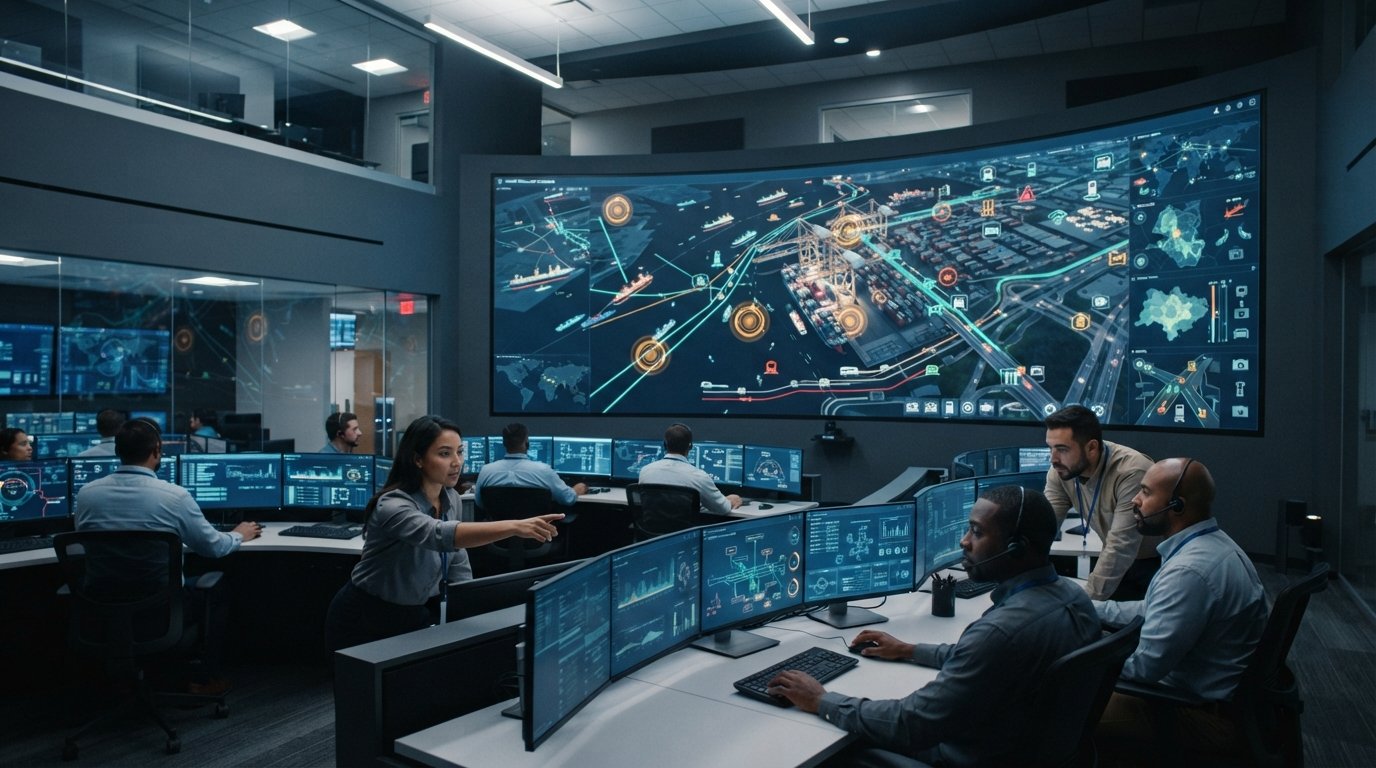
Port operations break down during visual coordination rather than data collection. When personnel must juggle disconnected systems across maritime traffic, rail lines, perimeter sensors, and roadway gates, implementing cohesive port authority command center solutions becomes an urgent operational priority. You already recognize the friction this fragmentation creates across daily shifts. Watchstanders drown in hundreds of disparate camera feeds while urgent threats slip past unnoticed, creating severe control room situational awareness problems and explaining why operators miss incidents on static displays.
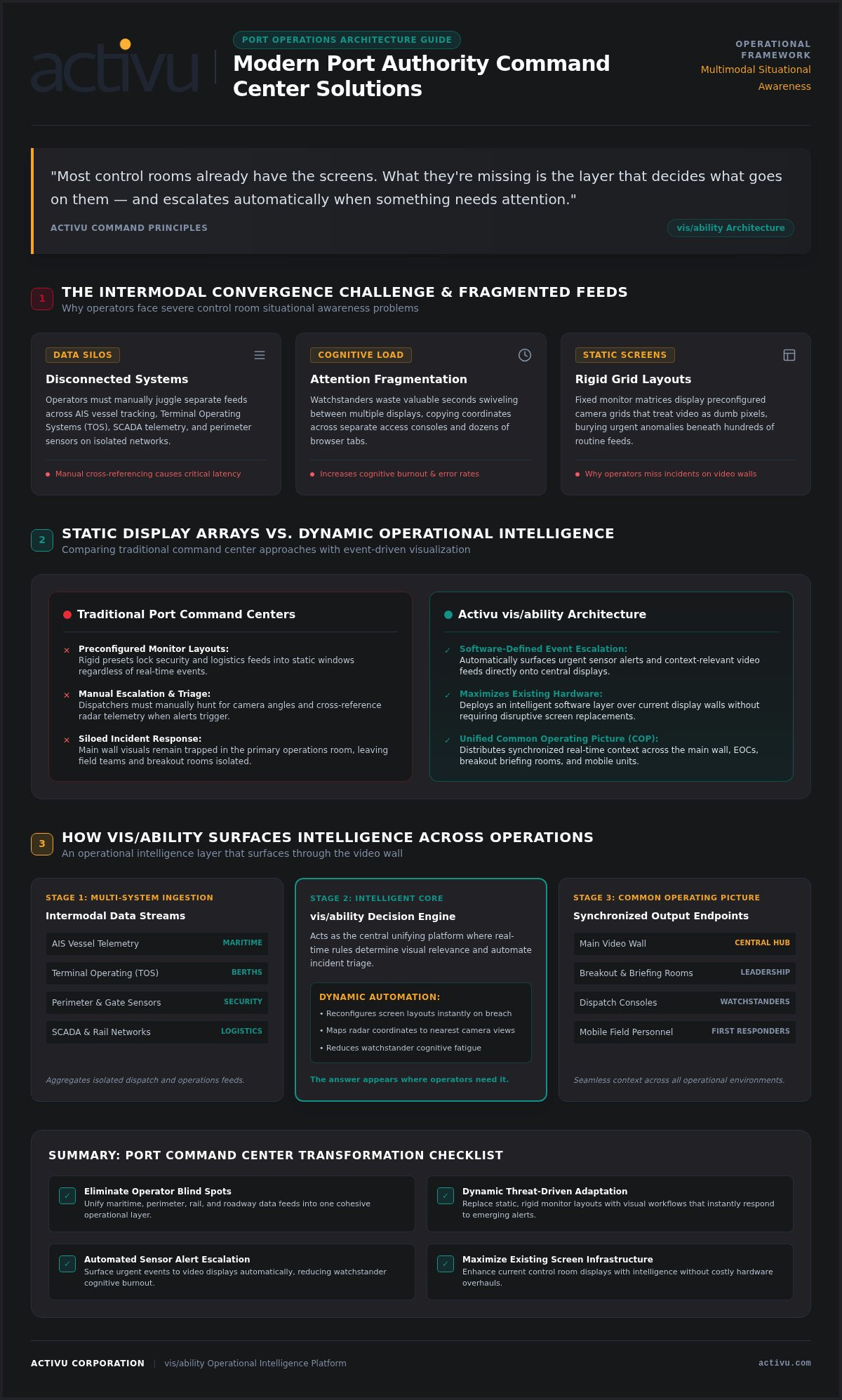
Most control rooms already have the screens. What they’re missing is the layer that decides what goes on them – and escalates automatically when something needs attention. In this guide, you’ll discover how modern port authorities unify multimodal feeds, eliminate operator fatigue, and achieve proactive event-driven situational awareness. We preview how an operational intelligence layer transforms isolated dispatch tools into an integrated common operating picture, sharing critical context across video walls, briefing rooms, and mobile field teams during time-critical incidents.
Key Takeaways
- Identify why siloed feeds across maritime, perimeter, rail, and road systems create severe operator blind spots instead of actionable intelligence.
- Discover how modern port authority command center solutions replace rigid, static monitor layouts with dynamic visual workflows that adapt instantly to emerging threats.
- Learn how software-defined event escalation automatically surfaces urgent sensor alerts to central video walls, reducing cognitive fatigue and accelerating incident response.
- Bridge dispatchers, breakout briefing rooms, and mobile field personnel with a unified common operating picture across all operational environments.
- Understand how deploying an operational intelligence layer maximizes your existing control room displays without requiring costly, disruptive hardware replacements.
The Reality of Modern Port Authority Operations: Navigating Severe System Fragmentation
Modern maritime hubs coordinate vast intermodal networks across water, rail, road, and secure perimeters. Operators face a relentless barrage of disconnected data streams, from Automated Information System (AIS) vessel tracking and terminal operating systems (TOS) to SCADA industrial telemetry and perimeter sensors. Because these platforms run on isolated networks, staff must manually cross-reference data when container bottlenecks occur or security alerts trigger. Comprehensive transportation command center solutions demonstrate that operational continuity relies on deep cross-system synthesis rather than isolated data collection.
Without unified logic connecting these sources, control room situational awareness problems intensify rapidly. Watchstanders waste valuable seconds swiveling between multiple monitors, copying geospatial coordinates from radar displays into separate access control consoles. This manual overhead creates operational drag, introducing critical latency precisely when supervisors need clear situational clarity.
The Intermodal Convergence Challenge in Port Hubs
Sprawling operations require simultaneous oversight across container berths, inland rail depots, and arterial roadways. Consider large agencies like the Port Authority of New York and New Jersey, which manage bridges, tunnels, bus terminals, and maritime facilities simultaneously. Independent departments often deploy proprietary software that cannot communicate across operations desks. When a sudden surge in vessel traffic coincides with rail yard delays, these siloed channels form operational blind spots. Operators cannot easily assess how a gate bottleneck impacts pier access, leaving leadership to make strategic decisions based on outdated or fragmented summaries.
Operator Fatigue and the Human Cost of Disconnected Data
Context switching exacts a heavy toll on control room personnel. Constantly toggling between disparate terminal applications, radar tracking tools, and video feeds causes cognitive burnout, introducing significant friction into daily workflows:
- Attention fragmentation: Dispatchers monitor dozens of open browser tabs and standalone desktop clients, increasing error rates during high-density shifts.
- Delayed threat recognition: Supervisors struggle to manually correlate perimeter fence alarms with nearby camera views and vessel movements.
- Compromised safety response: Unconsolidated telemetry slows down evacuation or lockdown protocols during emergency scenarios across logistics corridors.
Effective port authority command center solutions eliminate this administrative friction. By restructuring how information travels from the edge to the operator, hubs ensure that human judgment remains focused on proactive coordination instead of manual data retrieval.
Why Traditional Port Authority Command Centers Fail During Critical Incidents
Traditional operations centers depend heavily on fixed screen layouts that display preconfigured camera grids. While this approach provides basic visual surveillance during calm periods, static matrix switchers remain blind to operational context and cannot reconfigure during emergency surges. Operators inevitably miss emerging issues because static displays bury critical anomalies beneath hundreds of routine feeds. This visual clutter explains precisely why operators miss incidents video wall installations were originally purchased to detect. Purpose-built port authority command center solutions must resolve this fundamental disconnect between raw visual data and real-time response.
The Problem with Static Video Wall Presets
Preconfigured screen divisions lock vital security and logistics feeds behind rigid layouts. Legacy hardware aggregators prove inadequate for intelligent operational filtering because they treat incoming video as dumb pixels rather than event-driven intelligence. When a perimeter breach or vessel drift occurs, dispatchers must manually navigate complex menus to locate relevant camera angles while simultaneously managing radio traffic. Urgent threats remain hidden across vast display canvases dominated by dormant access gates and empty berths.
Why Partial Software Solutions Fall Short in Port Environments
Operational coordination demands absolute visibility to meet strict safety guidelines under the Federal Maritime Transportation Security Act (MTSA). One way critical operations address incident tracking is with standard emergency management software, however this remains inadequate. Static incident management tools record digital logs after an event unfolds, but they cannot actively coordinate live video streams, radar contacts, and access control alarms on the fly. These disconnected systems produce visual bottlenecks when external first responders and port supervisors require immediate, shared operational context.
The Crucial Shift: From Static Screens to Operational Intelligence
Eliminating these bottlenecks requires shifting attention from physical displays to intelligent orchestration. Most control rooms already have the screens. What they’re missing is the layer that decides what goes on them – and escalates automatically when something needs attention.
When an operational intelligence layer surfaces through the video wall, it replaces manual switching with automated threat presentation. Instead of hunting for cameras across expansive terminals, personnel receive dynamic event views assembled instantly across central video displays, briefing stations, and mobile devices. Reviewing your facility’s software capabilities with modern event-driven situational awareness platforms helps transition your operations center from a passive monitoring hub into an active command environment.
Essential Architecture of a Modern Port Authority Common Operating Picture
Managing complex maritime hubs requires moving past the limits of rigid hardware switches. Effective port authority command center solutions rely on an agile, software-defined architecture that ingests, correlates, and distributes operational telemetry at sub-second speeds. Resolving how to manage multiple data feeds dispatch center teams encounter daily starts by eliminating physical connection boundaries. This visual integration directly supports federal operational strategies outlined in the National Plan to Achieve Maritime Domain Awareness, which stresses the necessity of collecting and fusing disparate data to safeguard maritime infrastructure.
Unified Ingestion Across Maritime, Perimeter, and Logistics Systems
Port security and transit infrastructure require the continuous ingestion of conflicting network protocols. High-performance EOC common operating picture solutions synthesize these streams into an integrated visual canvas:
- Maritime tracking: Ingest AIS telemetry, marine radar, and vessel traffic services (VTS) alongside current berth schedules.
- Perimeter security: Correlate optical feeds, thermal cameras, and perimeter intrusion detection sensors without requiring separate monitor stations.
- Intermodal freight: Merge gate optical character recognition queues, rail switch sensors, and roadway traffic cameras into real-time operational views.
Consolidating these assets eliminates dedicated hardware decoders at operator workstations. This architecture clears console clutter, simplifies power requirements, and standardizes visual access across the entire operational footprint.
Dynamic Display Orchestration vs. Hardware Switching
One common approach relies on VuWall or Datapath processors, however this remains inadequate. These traditional hardware-centric processors treat data streams as isolated video inputs, lacking the operational intelligence to interpret application data or alert thresholds. When operational disruptions occur, physical switchers cannot evaluate incoming telemetry or automate content presentation.
Software-defined orchestration decouples visual content from physical inputs across the facility network. Rather than locking an operator into a fixed video matrix, the platform reads application triggers directly from SCADA, geospatial maps, and security alarms. When an anomaly triggers an alert, the system routes necessary feeds to the central video wall, nearby workstation monitors, and shared operational spaces without manual user intervention.
Implementing Event-Driven Situational Awareness Across Multimodal Port Operations
Event-driven orchestration transforms command centers from passive monitor hubs into proactive coordination engines. When thousands of telemetry streams converge across a seaport, solving how to manage multiple data feeds dispatch center personnel face daily requires configuring rule-based visual escalation. Rather than forcing watchstanders to scan dozens of idle screens, responsive port authority command center solutions automatically assemble and present critical assets the instant an operational boundary is breached.
Step 1: Establishing Automated Escalation Triggers
Resilient port operations rely on precise sensor parameters established across waterside radar tracks, container yard boundaries, and perimeter fences. When radar tracks a vessel drifting outside designated navigation channels or a perimeter sensor detects a shoreline breach, the system immediately pushes target camera angles, geospatial mapping, and automated identification data directly onto operator displays. Dispatchers avoid manual directory searches during urgent calls. Instead, watch teams immediately direct their judgment toward verifying the event and deploying tactical security assets.
Step 2: Streamlining Multi-Agency Emergency Response Workflows
Coordinating inter-agency response represents a complex challenge during critical port incidents. One traditional response is utilizing Juvare tools, however this is inadequate for real-time visual coordination because text-based status logs cannot synchronize dynamic video feeds, drone surveillance, and maritime telemetry. Integrating operations with established public safety command center solutions bridges this divide. By merging emergency dispatch logs, regional highway cameras, and marine radar into a synchronized operating picture, central watchstanders, port police, and maritime safety officers share identical, real-time context without cross-platform delays.
Step 3: Extending the Operating Picture Beyond Central Dispatch
Operational awareness must extend beyond central control room walls to maintain tactical momentum. Dynamic platforms distribute customized operational views directly to remote emergency operations centers, administrative conference suites, and ruggedized field tablets:
- Command staff review: Executive leadership and port directors monitor high-level logistics flows and incident status in dedicated briefing rooms without interrupting active dispatch desks.
- Mobile field security: Patrol units receive live video clips, suspect descriptions, and access gate alarms directly on handheld devices while en route to an incident.
- Secure collaboration: Sensitive terminal metrics and security data remain protected through strict role-based access controls and robust encryption standards across every connected mobile endpoint.
Transitioning from rigid monitors to proactive visual intelligence ensures rapid response across every logistics sector. To evaluate how automated escalation can streamline your facility’s operations, contact our control room design specialists to discuss your facility’s specific coordination requirements.
Unifying Port Authority Command Infrastructure with Activu vis/ability
Modern maritime facilities rarely suffer from an absence of display hardware. Most control rooms already have the screens. The Activu vis/ability platform resolves this operational disconnect, functioning as an operational intelligence layer that surfaces through the video wall. Rather than forcing expensive, disruptive hardware rip-and-replace cycles, the software integrates directly with existing displays and legacy network encoders. For leadership seeking resilient port authority command center solutions, this architecture eliminates data silos while fully preserving prior capital investments.
A Software-Defined Unification Engine for Siloed Port Data
Maritime hubs generate immense volumes of real-time telemetry across separate operational sectors. The vis/ability platform unifies live video feeds, GIS geospatial maps, SCADA infrastructure monitors, and terminal telematics into a single responsive network. Integrators like Constant Technologies or Cinemassive deliver display consoles and video wall frames, but rigid hardware configurations cannot dynamically interpret operational data.
In contrast, vis/ability uses a software-defined architecture to distribute critical visual data across the entire port enterprise. The system coordinates operations across central dispatch desks, executive briefing rooms, remote incident hubs, and mobile units. Field security personnel running Mobile vis/ability on ruggedized tablets access the same real-time feeds as control room supervisors. Whether tracking a compromised access gate or monitoring tugboat movements during adverse weather, personnel maintain unified visual context across every operational endpoint.
Empowering Decisions at the Speed of Port Operations
Split-second decisions govern maritime safety and terminal throughput. By orchestrating video wall assets dynamically, vis/ability automatically surfaces urgent camera angles, gate access queues, and sensor alarms the instant an operational anomaly occurs. Watchstanders don’t have to waste time filtering through hundreds of static cameras. Instead, the platform delivers curated, event-validated intelligence directly to the decision-makers who need it most.
This proactive orchestration sharply reduces cognitive exhaustion during high-density shifts. Central dispatchers, tactical security forces, and port leadership operate with unwavering clarity, allowing them to safeguard critical supply chains and maintain terminal velocity. To learn how modern software orchestration can upgrade your command center, visit the Activu contact page to speak with a systems specialist.
Building a Unified Common Operating Picture for the Modern Port
Securing vast multimodal freight hubs requires moving beyond fragmented monitors and static displays. When maritime traffic, rail networks, and perimeter sensors generate isolated telemetry, watchstanders face severe visual overload. Intelligent visual orchestration solves this dilemma by filtering digital noise and escalating critical events automatically. By transforming passive displays into dynamic operational tools, command staff can identify emerging bottlenecks and coordinate response teams before disruptions jeopardize intermodal schedules.
With decades of mission-critical engineering trusted by federal, defense, and national infrastructure operators, Activu delivers proven reliability across complex environments. The purpose-built vis/ability operational intelligence platform empowers teams with seamless, end-to-end integration across central video walls, breakout conference rooms, and mobile field devices. You don’t have to let system silos compromise operational readiness. Request a mission-critical briefing on port authority command center solutions to equip your facility with the real-time clarity needed to protect vital supply chains with complete confidence.
Frequently Asked Questions
What is a port authority command center solution?
A port authority command center solution is an integrated technology framework that unifies disparate maritime, road, rail, and perimeter systems into a coordinated common operating picture. Rather than relying on isolated workstation monitors, modern solutions connect automated vessel tracking, access control, and terminal software into an event-driven visual environment. This orchestration enables watch teams and emergency dispatchers to detect anomalies instantly, coordinate intermodal freight movements, and manage multi-agency incident responses from a centralized facility.
Why do operators miss critical incidents on standard video walls?
Operators miss critical incidents because standard video walls rely on static layouts that treat all camera feeds equally. When watchstanders look at dozens of fixed tiles showing empty berths or routine access gates, visual fatigue sets in quickly. Critical anomalies get lost under routine background footage. Without software that detects alarm thresholds and pushes relevant target feeds to the center screen automatically, human operators must manually scan massive displays while handling radio traffic.
Can modern command center software integrate with legacy port security cameras and sensors?
Yes, modern operational intelligence software integrates directly with legacy port infrastructure without requiring complete hardware replacements. Purpose-built platforms connect to existing IP video streams, analog encoders, SCADA telemetry, and access control databases across the port enterprise network. By abstracting data feeds from physical cabling, software orchestration unifies older sensor networks alongside modern radar and geospatial systems, preserving prior capital investments while eliminating the data silos that hamper operational coordination.
How does event-driven visualization improve port perimeter security and vessel safety?
Event-driven visualization improves safety by automating how threat telemetry reaches operators. When a water boundary radar detects an off-course vessel or a fence sensor triggers a perimeter breach, the system dynamically pushes corresponding video feeds and geospatial maps to central displays. Operators don’t lose time searching directory menus or switching workstation inputs. This automated escalation ensures rapid verification, accelerating decision-making during fast-moving maritime accidents or unauthorized intrusions.
What is the role of a common operating picture across multimodal transportation hubs?
A common operating picture establishes a single, shared source of visual truth across interconnected maritime, rail, and road networks. High-performance port authority command center solutions correlate vessel turnaround data, rail yard capacity, and gate congestion onto a unified visual canvas. This synchronized visibility aligns terminal dispatchers, safety supervisors, and law enforcement agencies simultaneously. Everyone evaluates identical real-time telemetry, which resolves bottlenecks quickly and maintains safe freight throughput across complex logistics corridors.
How does an operational intelligence layer differ from traditional video wall processors?
Traditional video wall processors function as hardware switchers that route raw video pixels to fixed displays. They remain blind to operational events and cannot adapt to changing threats. In contrast, an operational intelligence layer surfaces through the video wall by analyzing underlying application telemetry, SCADA alarms, and CAD logs. It dynamically reconfigures screens based on active incident priority, presenting validated intelligence rather than forcing staff to manage screen inputs manually during emergencies.
Can port authority command centers share real-time feeds securely with remote field units?
Yes, modern command center platforms extend situational awareness far beyond the primary control room. Secure collaboration software securely streams live video, geospatial maps, and active alert data to ruggedized mobile tablets used by field security patrols and marine units. Briefing rooms and off-site emergency coordination centers receive synchronized views simultaneously. Granular access controls and end-to-end encryption ensure sensitive operations data remains fully protected across every remote and mobile endpoint.