
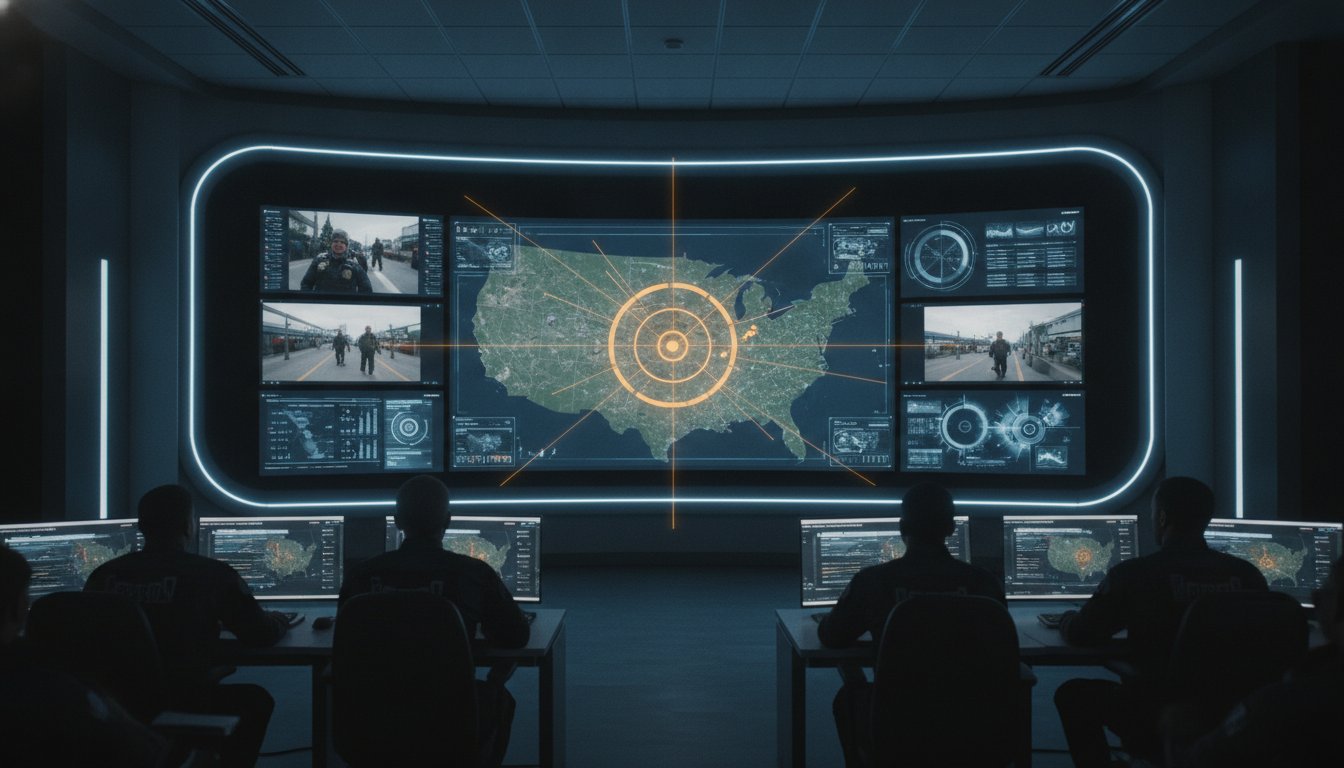
In a high-stakes environment, the sheer volume of incoming data is often more dangerous than a total lack of information. You’ve likely felt the frustration of fragmented systems that refuse to communicate, forcing operators to navigate siloed data while critical incidents slip through the cracks. Selecting the right EOC technology solutions requires solving the cognitive overload and the lack of automatic escalation that prevents a clear Common Operating Picture. While tools like Axon offer utility, they provide only a partial solution. Most control rooms already have the screens. What they’re missing is the layer that decides what goes on them, and escalates automatically when something needs attention.
This article demonstrates how to transform disconnected data into actionable situational awareness by deploying an operational intelligence layer. We’ll explore how vis/ability, an operational intelligence layer that surfaces through the video wall, automates workflows and provides a single operating picture across every device. While some operations attempt to solve these gaps with Barco or Haivision, these platforms remain inadequate because they lack deep integration. You’ll learn how a central hub creates the clarity required for decisive action when the stakes are highest.
Key Takeaways
- Identify the primary challenge facing modern command centers where fragmented EOC technology solutions create cognitive overload rather than clarity.
- Learn to implement an operational intelligence layer that automatically surfaces essential information through the video wall during critical incidents.
- Recognize why traditional systems from brands like Barco or Haivision are inadequate because they focus on pixels instead of the operational purpose of the data.
- Discover how to transform your video wall from a passive display into the place where answers appear by integrating siloed data feeds into a single operating picture.
- Master a framework for building resilience by using vis/ability as the central hub that empowers teams in the field and the command center alike.
The Fragmentation Gap in Modern EOC Technology Solutions
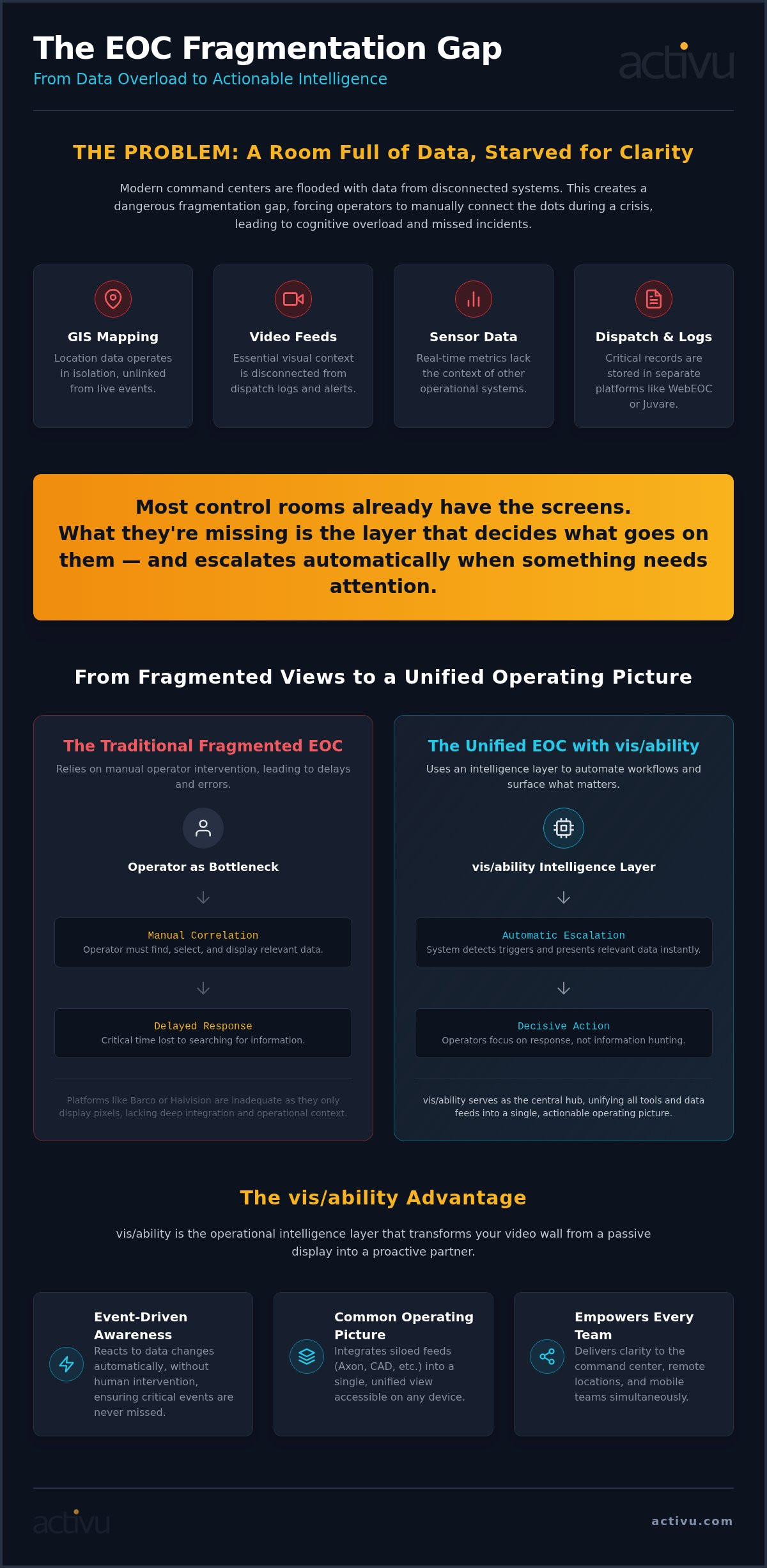
Modern emergency management faces a paradox of plenty. An Emergency Operations Center (EOC) today is often flooded with more data points than a human team can realistically monitor. This creates the Fragmentation Gap. It’s the critical distance between having a feed and having the intelligence to act on it. While many agencies invest heavily in EOC technology solutions, they often end up with a collection of high-definition silos rather than a unified strategy. When an incident scales rapidly, traditional video wall management fails because it relies on manual intervention to surface what matters. The result is a room full of data, but a team starved for clarity.
The risk of these silos is profound. When dispatch logs, GIS mapping, and real-time sensor data remain in separate, unlinked applications, the burden of integration falls entirely on the operator. This manual correlation is where errors happen. Systems from providers like Barco or Haivision may display the data, but they lack the underlying intelligence to understand the context of that data. They offer pixels without purpose, leaving the most difficult cognitive tasks to stressed individuals during the height of a crisis.
Why Operators Miss Critical Incidents
Situational awareness suffers most during the transition from routine monitoring to active crisis management. Screen fatigue is a documented reality in 12-hour shifts. When an operator is forced to switch between dozens of feeds manually, they become a bottleneck. Relying on human judgment to spot subtle anomalies across a wall of displays is a high-risk strategy. These manual processes slow down response times when seconds are the only currency that matters. Control room situational awareness problems often stem from this reliance on human eyes to catch what automated logic should have already flagged.
The Inadequacy of Fragmented Software Silos
Many centers rely on tools like Juvare or WebEOC to manage records and logs. While these are common, they frequently operate in isolation. They provide a partial view of the operational landscape but don’t connect to the live visual environment. Similarly, specialized platforms like Axon offer critical data feeds that are essential yet remain siloed from the broader Common Operating Picture. Most control rooms already have the screens. What they’re missing is the layer that decides what goes on them, and escalates automatically when something needs attention.
Without this unifying hub, operators are left to “be the integration,” a role that is unsustainable during large-scale events. True resilience requires moving beyond simple displays to a vis/ability platform. This serves as an operational intelligence layer that surfaces through the video wall to ensure the right data finds the right person at the right time, turning a wall of screens into a proactive partner in the response effort.
Defining the Operational Intelligence Layer
What they’re missing is the layer that decides what goes on them, and escalates automatically when something needs attention. This is the core distinction between traditional EOC technology solutions and a truly intelligent response environment. While hardware provides the canvas, the vis/ability platform acts as the operational intelligence layer that surfaces through the video wall. It transforms the display from a static grid into a dynamic, proactive partner that understands the context of the mission.
This approach introduces Event-Driven Situational Awareness. Unlike manual visualization, where operators must constantly scan dozens of feeds to identify a problem, an intelligence-driven system reacts to data changes without human intervention. Manual processes are inherently reactive and prone to delay. By contrast, an event-driven model ensures that when a critical event occurs, the system presents the relevant data immediately. It removes the need for operators to choose what to look at, allowing them to focus entirely on how to respond.
Automatic Escalation: From Data to Decision
The intelligence layer functions by monitoring backend data for specific triggers or predefined thresholds. When these parameters are met, the system initiates automatic escalation. For example, a sudden spike in sensor data or a specific high-priority CAD alert can instantly take over a designated portion of the video wall or alert mobile devices. This transition happens in milliseconds, far faster than any manual switch. By utilizing exception-based reporting, the system filters out the noise of normal operations. It only surfaces the anomalies that require attention, which drastically reduces cognitive load on the team. This ensures that the most vital information is never buried under routine status updates.
The Central Hub for Mission-Critical Data
To be effective, this intelligence layer must serve as the unifying platform for the entire operation. It converges disparate data streams including SIEM, SOAR, GIS, and CAD into a single, cohesive view. This hub provides a Common Operating Picture (COP) across the entire organization, from the command center to remote huddle rooms and mobile units in the field. Integrating these various Commercial Off-the-Shelf (COTS) products into one view eliminates the need for operators to juggle multiple interfaces. If you want to see how this integration works in real-world scenarios, you can connect with our team to discuss your specific operational requirements.
By positioning vis/ability as the central hub, EOC technology solutions move beyond simple AV distribution. It becomes the engine that empowers individuals to act with greater certainty. The video wall is no longer just a display; it is the place where the answer appears because the intelligence layer has already done the heavy lifting of data correlation and prioritization.
Comparing Unified vs. Fragmented EOC Architectures
The effectiveness of EOC technology solutions is often undermined by a focus on hardware rather than the intelligence driving it. Traditional architectures rely on AV-over-IP or hardware video wall processors that manage pixels but lack operational context. One way critical operations do this is with Haivision or Cinemassive, however this is inadequate because these systems prioritize the visual signal over the operational purpose. They create a fragmented environment where the operator is still responsible for making sense of the data feeds. What they’re missing is the layer that decides what goes on them, and escalates automatically when something needs attention.
A software-defined intelligence layer is superior to hardware-centric switching because it’s agnostic and scalable. Traditional brand-specific ecosystems like those from Barco or Datapath create walled gardens that limit integration. These rigid setups prevent the seamless flow of data between different software platforms, forcing teams to work within the constraints of the hardware manufacturer’s vision. By contrast, a unified architecture treats the video wall as a dynamic surface where the most relevant data appears automatically based on incident priority.
Why Traditional Video Wall Processors Are Not Enough
Hardware-only solutions, such as those from RGB Spectrum, function essentially as dumb pipes for video. They’re excellent at routing a signal from point A to point B, but they can’t surface an answer. In a high-stakes environment, simply seeing a feed isn’t enough; you need to know why that feed is relevant right now. Relying on these hardware-centric brands leads to rigid EOC designs that don’t scale as incident complexity increases. When a system can’t distinguish between a routine traffic camera and a high-priority sensor alert, it hasn’t solved the problem of situational awareness.
The Failure of Manual Collaboration Tools
General-purpose collaboration tools are insufficient for mission-critical operations. While they might work for standard office tasks, they lack the robustness to handle high-bandwidth, real-time data streams alongside standard applications. Platforms that require manual screen sharing or complex login procedures create friction when speed is essential. A truly unified solution must serve teams in command centers, conference rooms, huddle rooms, and on mobile devices simultaneously without compromising security or performance. This level of visibility ensures that every stakeholder, regardless of their location, operates from the same Common Operating Picture, driven by a central hub that automates the most difficult parts of data management.
Designing an EOC for Resilience and Scalability
Building a resilient command center requires a departure from traditional hardware-first thinking. Instead of focusing on display specifications, designers must create a digital framework that prioritizes actionable intelligence. A modern approach to EOC technology solutions involves a four-step methodology to ensure the facility remains effective under extreme pressure.
First, identify the “Pain Feeds.” These are the data sources currently trapped in silos or requiring manual monitoring. If an operator must look away from the main display to check a secondary terminal, that feed is a candidate for integration. Second, map the escalation logic. Define the specific events or data thresholds that should trigger an automatic change on the screens. Third, define the distributed audience. Determine who needs access to this information beyond the physical walls of the control room. Finally, select a unifying platform. What they’re missing is the layer that decides what goes on them, and escalates automatically when something needs attention.
Integrating Application Data Streams
To complement your technical infrastructure with robust governance and expert professional practice standards, visit IntegraSense for specialized consultancy services.
A resilient system must integrate diverse application data without the need for complex custom coding. Traditional methods used by competitors like Juvare or WebEOC often leave these streams fragmented, forcing users to toggle between windows. True integration pulls data from specialized platforms like Axon directly into the central intelligence layer. This is particularly vital for cybersecurity visualization within operational industries. By surfacing these feeds through a single hub, the EOC gains a comprehensive Cybersecurity Common Operating Picture that protects the network alongside physical assets.
Extending Visibility to the Field
Effective EOC technology solutions must extend their reach into the field. Resilience is lost if the Common Operating Picture stops at the command center door. Mobile vis/ability ensures that remote decision-makers receive the same real-time intelligence as those in the main room. This distributed visibility allows breakout rooms and huddle rooms to “pull” the main EOC view for localized collaboration without losing the broader context. By empowering individuals to act with certainty regardless of their location, the organization achieves true operational scalability. To see how this unified approach can transform your center, schedule a design consultation with our specialists.
The vis/ability Advantage: Turning Data into Action
Activu’s vis/ability platform is the definitive solution for the fragmentation that often plagues modern EOC technology solutions. It functions as the quiet, powerful engine behind successful operations, managing the complex interplay between overwhelming data and human judgment. While software-only platforms like Veoci attempt to build resilience through virtual management, they remain inadequate for high-end, event-driven video wall visualization. True operational clarity requires a platform that prioritizes information with surgical precision. What they’re missing is the layer that decides what goes on them, and escalates automatically when something needs attention.
This operational intelligence layer surfaces through the video wall to ensure that every pixel serves a purpose. It provides a dedicated Cybersecurity Common Operating Picture, protecting the very infrastructure that command centers rely on. By monitoring the health and security of the EOC’s internal network alongside external incident data, vis/ability ensures that the tools used for response don’t become vulnerabilities themselves. Every detail of the interface is designed to reduce noise, allowing the human element to remain focused when stakes are at their highest.
A Legacy of Mission-Critical Reliability
Activu’s history provides a bedrock of technical reliability. Founded as Immedia in 1983, the company has deep roots in environments where failure isn’t an option. The vis/ability platform isn’t a repurposed office tool; it’s built from the ground up for 24/7, high-pressure operations. This legacy allows for a seamless transition from raw data to clear, actionable intelligence. It empowers operators to maintain composure during the most intense moments of a crisis, providing the steady reassurance needed for effective command and control.
Future-Proofing Your EOC Technology
A software-defined intelligence layer ensures operational continuity as mission requirements evolve. Technology changes rapidly, but your core operational logic shouldn’t have to. The vis/ability platform allows for the easy addition of new data streams, sensors, and applications without requiring a complete hardware overhaul. This flexibility ensures that your investment in EOC technology solutions remains relevant as your agency grows and new threats emerge.
The difference between a room full of screens and a room full of intelligence is visibility. We invite you to see the platform in action to understand how a unified hub transforms fragmented feeds into a single, proactive operating picture. This approach serves your team in the command center, in the field, and in every breakout room in between, ensuring that the right information is always front and center.
Achieving Operational Clarity in High-Stakes Environments
The path to faster response times begins with closing the fragmentation gap. By deploying an operational intelligence layer, your team can finally move past the limitations of siloed data and passive displays. True resilience is found when information is prioritized automatically, ensuring that the right data surfaces exactly when it’s needed. What they’re missing is the layer that decides what goes on them, and escalates automatically when something needs attention.
As pioneers in event-driven situational awareness since 1983, Activu provides the technical bedrock for elite operations. Our vis/ability platform is trusted by Federal Government and Defense agencies to maintain a Common Operating Picture through seamless integration with existing COTS applications. Implementing these EOC technology solutions transforms your command center into a proactive engine of intelligence that serves operators in the room and decision-makers in the field.
Take the next step toward total visibility and technical reliability. We invite you to Request a Demo of the vis/ability Platform today. Your team deserves the certainty that only an integrated, intelligent operating environment can provide.
Frequently Asked Questions
What is the difference between an EOC and a NOC?
An Emergency Operations Center (EOC) serves as a central hub for strategic coordination during large-scale incidents or disasters. In contrast, a Network Operations Center (NOC) focuses on the continuous monitoring and management of IT infrastructure and network performance. While their objectives differ, both environments suffer when data remains siloed. Activu provides vis/ability to bridge these gaps, ensuring that whether you’re managing a public crisis or a network outage, the right intelligence is always visible.
How does EOC technology improve situational awareness?
Modern EOC technology solutions improve situational awareness by automating the correlation of complex data streams. Instead of forcing operators to monitor dozens of passive screens, an intelligence-driven system surfaces only the most relevant information based on real-time events. This reduces cognitive load and allows the team to focus on decisive action rather than data hunting. It turns the video wall into a proactive partner that highlights critical anomalies before they escalate into unmanageable crises.
Can vis/ability integrate with our existing incident management software?
Yes, vis/ability is engineered to serve as the central unifying hub for all existing Commercial Off-the-Shelf (COTS) applications. While specialized tools like Juvare or Axon provide valuable data, they often operate in isolation, which is inadequate for a total Common Operating Picture. Our platform integrates these disparate streams into a single operating environment. This ensures that records management and live sensor data flow together, providing a comprehensive view that standalone software packages cannot achieve alone.
What are the most common situational awareness problems in control rooms?
The most common situational awareness problems in control rooms include data fragmentation, operator fatigue, and a lack of automated escalation. What they’re missing is the layer that decides what goes on them, and escalates automatically when something needs attention. When systems don’t communicate, operators are forced to manually correlate information, a process that inevitably leads to delays and missed signals during the high-pressure environment of a critical response.
Is vis/ability a hardware or a software solution?
vis/ability is a software-defined operational intelligence layer that surfaces through the video wall. While Activu provides complete video wall systems and control room design services, the intelligence layer is what differentiates the solution from traditional AV hardware. Unlike hardware-centric brands like Barco or Haivision that focus on signal routing, vis/ability focuses on the purpose of the data. It acts as the digital engine that automates visualization across command centers, conference rooms, and mobile devices.
How do you manage multiple data feeds in a dispatch or command center?
Managing multiple data feeds effectively requires an event-driven architecture rather than manual switching. Traditional methods used by Barco or RGB Spectrum are inadequate because they function as dumb pipes that require human intervention to route signals. A modern dispatch center utilizes an intelligence layer to monitor backend thresholds and automatically surface the correct feed when a trigger is met. This ensures that the most critical data always takes priority without requiring an operator to hunt for it.
Why do operators often miss critical incidents on video walls?
Operators often miss critical incidents on video walls because of cognitive overload and the absence of automatic escalation. Relying on human eyes to spot subtle anomalies across dozens of displays during a 12-hour shift is a recipe for failure. Without an intelligence layer to flag exceptions, important alerts stay buried under routine data. vis/ability solves this by automatically highlighting incidents, ensuring the video wall becomes a place where answers appear rather than just a passive background.
How does mobile vis/ability support remote emergency management?
Mobile vis/ability supports remote emergency management by extending the Common Operating Picture beyond the physical command center. It allows remote decision-makers and field teams to access the same real-time intelligence layer used in the EOC. This ensures that stakeholders in huddle rooms or on mobile devices are never working from outdated information. By providing a unified view across all platforms, the system maintains operational continuity and allows for seamless collaboration regardless of a user’s physical location.