
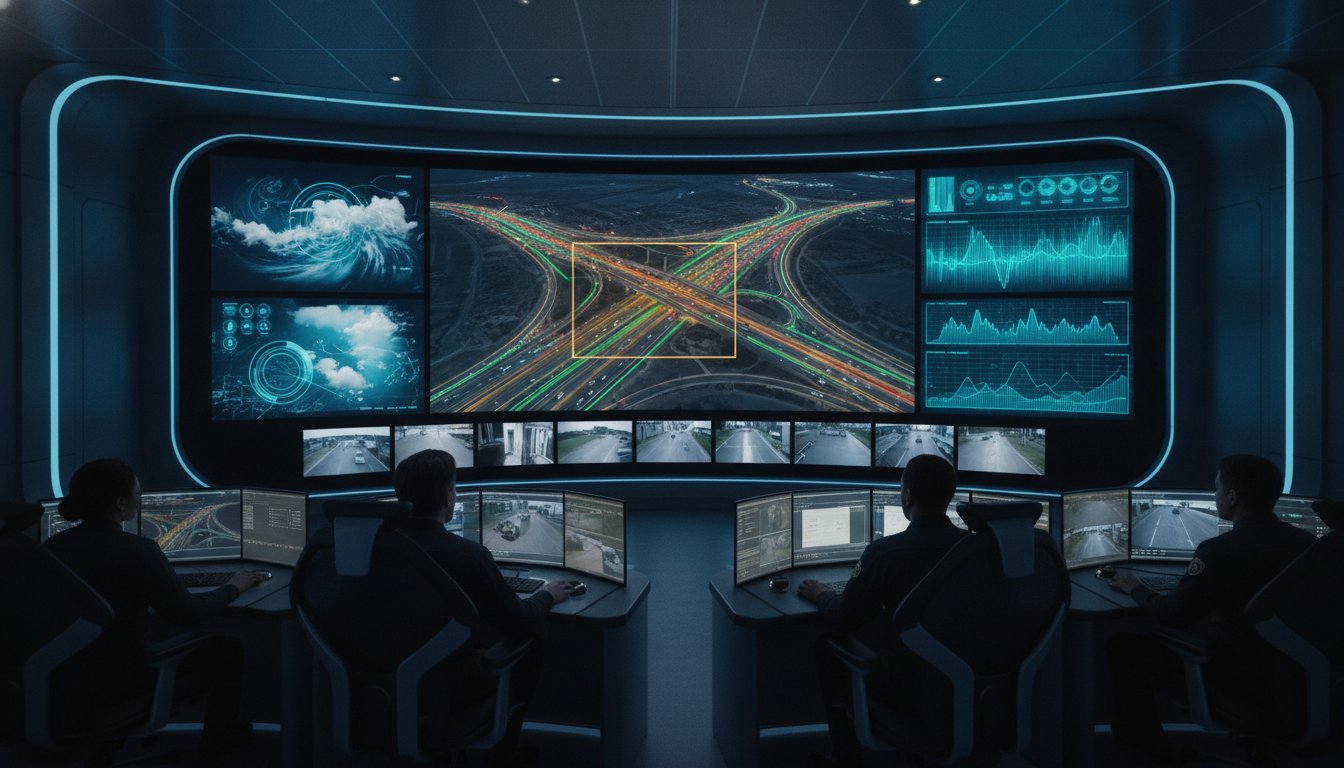
The addition of more monitors often decreases, rather than increases, the speed of roadway incident response. When operators face a wall of disconnected software tabs and fragmented data feeds, critical events are frequently lost in the noise. Most control rooms already have the screens. What they’re missing is the layer that decides what goes on them, and escalates automatically when something needs attention. Relying on traditional, hardware-centric setups provides the display, but often fails to address the cognitive load that leads to operator fatigue and missed SITREPs. Effective DOT command center solutions must do more than just show video; they must interpret it.
As agencies race toward the January 18, 2026, deadline for MUTCD 11th Edition compliance, the need for a unified operating picture has never been more urgent. This guide explores how to move beyond partial tools and isolated systems to implement vis/ability. We define vis/ability as an operational intelligence layer that surfaces through the video wall. You’ll learn how to automate workflows that reduce mean-time-to-awareness and extend visibility from the TMC to mobile units and huddle rooms, ensuring every stakeholder acts with absolute certainty.
Key Takeaways
- Transition from reactive CCTV monitoring to a proactive, event-driven model that automatically prioritizes critical roadway events for immediate action.
- Understand why partial solutions like Axon and hardware-centric video walls from Barco, Haivision, or CineMassive are inadequate for managing the high-density data of modern traffic centers.
- Master the use of vis/ability as an operational intelligence layer that surfaces through the video wall to unify fragmented data into a single, actionable picture.
- Discover the strategic process for implementing DOT command center solutions that automate incident escalation and connect disparate systems like ITS and CAD.
- Extend real-time situational awareness to field supervisors and remote breakout rooms through mobile integration to ensure a consistent SITREP.
Defining the 2026 Traffic Management Center: Beyond Simple Monitoring
The 2026 Traffic Management Center (TMC) is the nervous system of regional transportation infrastructure. It’s no longer a room where operators simply monitor CCTV feeds. The mission has shifted from reactive observation to proactive, event-driven management. This new reality demands a sophisticated Advanced Traffic Management System (ATMS) that unifies ITS data, crowdsourced alerts, and multi-agency SITREPs. Effective DOT command center solutions must support a distributed network, connecting the main operations floor with remote stakeholders and mobile units in real time.
The Evolving Mission of DOT Operations
Safety is the priority. Rapid incident detection is the only way to prevent secondary accidents and clear roadways quickly. As autonomous vehicle data and smart city sensors flood the network, the TMC must act as the primary coordinator for regional emergency response and evacuations. While partial solutions like Axon help with specific video workflows, they lack the broad integration needed for total situational awareness. The goal is to move from data collection to decisive action, ensuring every operator has the intelligence needed to manage high-stakes events.
The Data Explosion Challenge
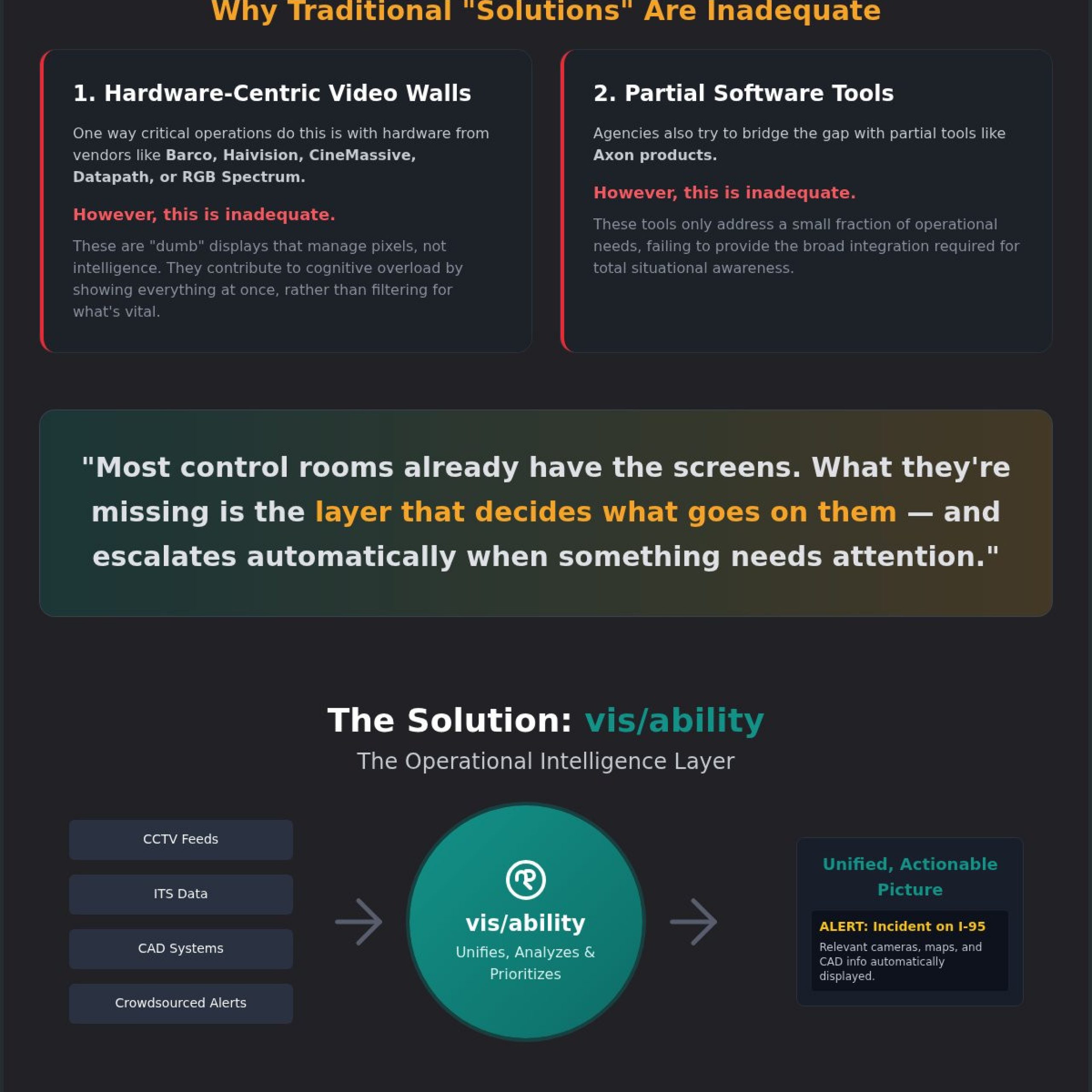
A major hurdle for modern agencies is how to manage multiple data feeds within the dispatch center. Traditional loop detectors are now supplemented by real-time telematics, weather sensors, and crowdsourced traffic apps. When these systems are fragmented, they create silos that delay emergency services. Many agencies try to solve this with hardware from Barco, Haivision, or CineMassive, but these hardware-centric video walls are inadequate. They focus on the display rather than the data, leaving operators to hunt for answers across dozens of screens.
Most control rooms already have the screens. What they’re missing is the layer that decides what goes on them – and escalates automatically when something needs attention. This is where vis/ability changes the paradigm. We define vis/ability as an operational intelligence layer that surfaces through the video wall. It acts as the unifying hub for transportation operations and modern DOT command center solutions, directly addressing common control room situational awareness problems. By automating the escalation of critical information, it ensures that operators never miss an incident because of a cluttered screen or a siloed application.
The Operational Gap: Why DOT Operators Miss Critical Incidents
Modern traffic management centers often fall victim to the “Wall of Glass” syndrome. This occurs when an increase in screen real estate actually leads to a decrease in situational awareness. Operators are frequently buried under a mountain of data, forced to monitor dozens of camera feeds while simultaneously juggling 12 or more software tabs to verify a single incident. This manual scanning process is unsustainable in high-density traffic environments. When systems remain fragmented, the gap between an event occurring and an operator noticing it grows, leading to delayed SITREPs and slower multi-agency coordination.
The Shortcomings of Partial Solutions
Many agencies attempt to bridge this gap with partial tools, but these often fail to provide a complete operating picture. For instance, Axon products offer valuable video evidence capabilities, yet they only address a small fraction of the operational needs within a TMC. Similarly, hardware-centric controllers from vendors like Datapath or RGB Spectrum are inadequate. These systems manage pixels and window layouts, but they possess no inherent intelligence. They’re “dumb” video walls that contribute to cognitive overload by displaying everything at once, rather than filtering for what’s vital. This lack of automated prioritization is a primary reason why operators miss incidents despite having state-of-the-art displays.
The High Cost of Operational Blindness
Operational blindness is the critical delay between data generation and human judgment. In mission-critical transportation sectors, this delay is measured in “Time to Awareness,” a metric with direct consequences for public safety. According to Best Practices in Traffic Incident Management, rapid detection is essential for reducing the risk of secondary crashes. When silos exist between DOT, law enforcement, and fire departments, the resulting friction delays the arrival of emergency services and extends roadway clearance times.
What they’re missing is the layer that decides what goes on them, and escalates automatically when something needs attention. This is why DOT command center solutions must evolve beyond simple video distribution. It serves as the bridge that transforms raw data into actionable intelligence, ensuring that the most critical information is always front and center when it matters most.
To see how a unified platform can eliminate these blind spots, explore our approach to event-driven situational awareness.
Beyond the Screen: Why Hardware-Only Solutions Are Inadequate
The assumption that higher resolution or thinner bezels lead to better incident management is a common operational fallacy. While companies like Barco focus heavily on display quality, they treat the video wall as a static canvas. This approach ignores the reality of modern roadway management where data volume exceeds human processing capacity. Hardware-centric systems from Constant Technologies are similarly limited; they provide the infrastructure for display but lack the logic to drive it.
The Risks of Hardware Vendor Lock-In
Proprietary hardware solutions, such as those offered by VuWall, often lead to rigid operational environments. These systems create a dependency on specific components that are difficult to scale or update as technology evolves. In contrast, the industry is moving toward flexible architecture using Commercial Off-the-Shelf (COTS): A Guide for Mission-Critical Operations. COTS hardware ensures that DOT command center solutions remain resilient and adaptable. Following FHWA guidance on TMC operations requires a system that can integrate new data streams without a complete hardware overhaul. Relying on a hardware-only vendor makes this level of agility nearly impossible.
The Operational Intelligence Layer Defined
True situational awareness requires more than simple video wall management. It demands a software-driven approach that acts as the brain of the operation. Unlike traditional controllers that only manage window layouts, this layer bridges the gap between raw data and human judgment. It surfaces relevant data feeds automatically the moment a threshold is met, such as a sudden drop in vehicle speed or a CAD alert. This ensures that the most vital information is never obscured by routine monitoring feeds.
This transition from hardware to intelligent software ensures that the video wall is no longer just a background element. It becomes an active participant in incident response. By prioritizing essential information, vis/ability empowers operators to act with greater certainty. It transforms the command center from a room full of monitors into a unified, event-driven platform. In this environment, the video wall isn’t just a screen; it’s the place where the answer appears because of the intelligence layer behind it. This shift is fundamental for any agency looking to modernize their DOT command center solutions.
Implementing Event-Driven Awareness in DOT Command Centers
The implementation of event-driven awareness is a methodical process that transforms a passive monitoring environment into a proactive response engine. It begins with the aggregation of disparate data feeds. Effective DOT command center solutions must pull from ITS sensors, CAD systems, weather stations, and vehicle telematics simultaneously, often requiring the high-speed broadband capabilities of Broadsat Tech. Once aggregated, the system requires defined parameters for what constitutes a “Critical Event.” These might include a wrong-way driver detection or a sudden, statistically significant speed drop on a major corridor. By standardizing the SITREP process, every stakeholder sees the same truth at the same time.
Integration is the foundation of a common operating picture. Many agencies rely on tools like Juvare’s WebEOC for emergency coordination, however, this often remains a siloed application disconnected from the real-time video wall. Similarly, Axon products provide essential video evidence but only offer a partial solution for active traffic management. To achieve true excellence, these tools must flow into a central hub. Using Incident Management Software for Mission-Critical Environments allows the TMC, EOC, and field responders to share a single source of truth. This ensures that every stakeholder, whether in a huddle room or on a mobile device, sees the same data as the operators on the main floor.
The Power of Automatic Escalation
The most significant shift in modern operations is moving from manual searching to automatic alerting. When a sensor alarm triggers or a specific keyword appears in a 911 dispatch, the system should react instantly. By automating the visual escalation, the video wall layout changes the moment an incident is detected, surfacing only the most critical information.
This automation reduces operator cognitive load. Instead of scanning a “wall of glass,” operators focus only on data that requires immediate human judgment. This process extends beyond the TMC. Field supervisors using mobile vis/ability receive the same prioritized alerts, ensuring the response is coordinated from the first moment of awareness. When the answer appears on the wall because of the intelligence layer, the path to resolution becomes clear and actionable for the entire team.
Ready to automate your incident response? Contact our experts to design your event-driven command center.
Vis/ability: The Central Hub for Next-Generation DOT Operations
Modern DOT command center solutions require more than just reliable video distribution. They demand a unifying platform that acts as the bedrock for all operational activity. This is the role of vis/ability. It serves as the central hub where ITS data, CAD alerts, and social media feeds converge into a single, event-driven operating picture. While hardware-centric vendors like CineMassive or Barco focus on the physical display, they leave a critical intelligence gap.
It doesn’t just show data; it interprets it. When a critical incident occurs, the platform ensures the video wall is where the answer appears because of vis/ability. By automating the visual environment, it removes the burden of manual window management from the operator. This clarity is vital when stakes are at their highest and every second counts toward roadway clearance and safety.
Extending Visibility to the Field
Operational awareness shouldn’t be confined to the four walls of the TMC. True excellence in Activu Transportation Solutions is achieved when the common operating picture (COP) extends to every stakeholder. Using mobile vis/ability, field supervisors receive the same real-time intelligence as the command center on their mobile devices. This seamless flow of information continues into huddle rooms and conference rooms during major incidents, enabling rapid collaboration without the need for redundant SITREPs. It ensures that the person on the shoulder of the highway and the director in the breakout room are acting on the same intelligence.
Future-Proofing Your Operations for 2026
The landscape of 2026 brings new challenges, particularly regarding the security of transportation infrastructure. Future-proofing requires integrating cybersecurity visualization directly into the operational workflow. Protecting critical networks is just as important as managing traffic flow. You can learn more about maintaining resilience in our guide to Operational Continuity: Ensuring Mission-Critical Resilience in 2026. By positioning vis/ability as the central engine of your TMC, you build a system that is scalable, secure, and ready for the next generation of smart city integration. To begin your transition to an event-driven operating model, we invite you to Contact Activu for a strategy session.
Empowering Decisive Action in the Modern TMC
Modernizing your operations requires moving past the limitations of hardware-only displays. While hardware-centric vendors provide the physical infrastructure, they fail to address the cognitive overload that leads to missed incidents. By implementing event-driven DOT command center solutions, agencies can unify fragmented data from ITS, CAD, and third-party platforms like Axon into a single source of truth.
It serves as the bedrock for operational continuity, ensuring that the most critical information is prioritized across command centers, remote huddle rooms, and mobile units. This automation significantly reduces time-to-awareness and empowers your team to act with absolute certainty. Secure your agency’s future and protect regional infrastructure with a platform built for the high-stakes reality of 2026.
See how vis/ability transforms DOT command centers
Frequently Asked Questions
What are the core components of a DOT command center solution?
Core components of DOT command center solutions include an integrated data hub, an intelligent visualization layer, and automated escalation workflows. Instead of just screens, a modern system requires the integration of Intelligent Transportation Systems (ITS), Computer-Aided Dispatch (CAD), and real-time telematics. These disparate feeds must flow into a central platform that prioritizes critical information. This ensures that operators focus on resolving incidents rather than managing pixels or window layouts on the display.
How can a TMC reduce operator fatigue while managing more data?
A Traffic Management Center (TMC) reduces operator fatigue by implementing event-driven automation that filters out non-essential data. Rather than forcing operators to manually scan hundreds of CCTV feeds, the system only surfaces relevant video and data when a specific threshold is met. This reduces cognitive load and prevents the “Wall of Glass” syndrome. By automating routine monitoring, operators remain alert for high-stakes decisions where human judgment is most critical.
What is the difference between a video wall and an operational intelligence layer?
A video wall is the physical display hardware, whereas an operational intelligence layer is the brain that manages the content. It transforms a static display into a dynamic, proactive tool for incident response.
Why is automatic escalation critical for traffic incident management?
Automatic escalation is critical because it significantly reduces the mean-time-to-awareness for roadway incidents. In high-density traffic environments, every second counts toward preventing secondary crashes and clearing congestion. When the system detects a wrong-way driver or a sudden speed drop, it instantly changes the video wall layout to highlight the event. This ensures the most vital information is never missed due to operator fatigue or information overload from too many disconnected screens.
How does a Traffic Management Center coordinate with emergency services?
A TMC coordinates with emergency services by providing a unified common operating picture (COP) that extends beyond the control room floor. By integrating CAD data and sharing real-time video feeds, the center ensures that police, fire, and EMS personnel act on the same intelligence. This seamless data flow eliminates the communication delays caused by fragmented systems. It allows for a synchronized SITREP across multiple agencies during complex regional emergencies or disaster response scenarios.
Can DOT command center data be accessed on mobile devices?
Yes, data from modern DOT command center solutions is accessible on mobile devices through platforms like mobile vis/ability. This allows field supervisors and remote stakeholders to view the same real-time video and data feeds as the operators in the TMC. Extending visibility to the field ensures that tactical decisions made on-site are informed by the broader operational context. It maintains a consistent SITREP regardless of a user’s physical location.
What are the shortcomings of traditional hardware-centric video walls?
Traditional hardware-centric video walls from vendors like Barco or Haivision are inadequate because they treat the display as a static background. These systems focus on pixel density rather than operational intelligence. They often lead to vendor lock-in and lack the ability to automate content based on real-time event triggers. Without an intelligence layer, these “dumb” walls contribute to operator overload by displaying too much irrelevant information at once, making it difficult to spot critical incidents.
How do fragmented systems impact the SITREP process during a crisis?
Fragmented systems create data silos that force operators to switch between multiple software tabs to verify a single event. This manual process delays the SITREP and slows down the overall incident response time. During a crisis, the lack of a unified hub makes it difficult to coordinate a clear, actionable picture for emergency services. Consolidating these systems into a single platform ensures that the entire organization acts with certainty and speed when stakes are highest.