
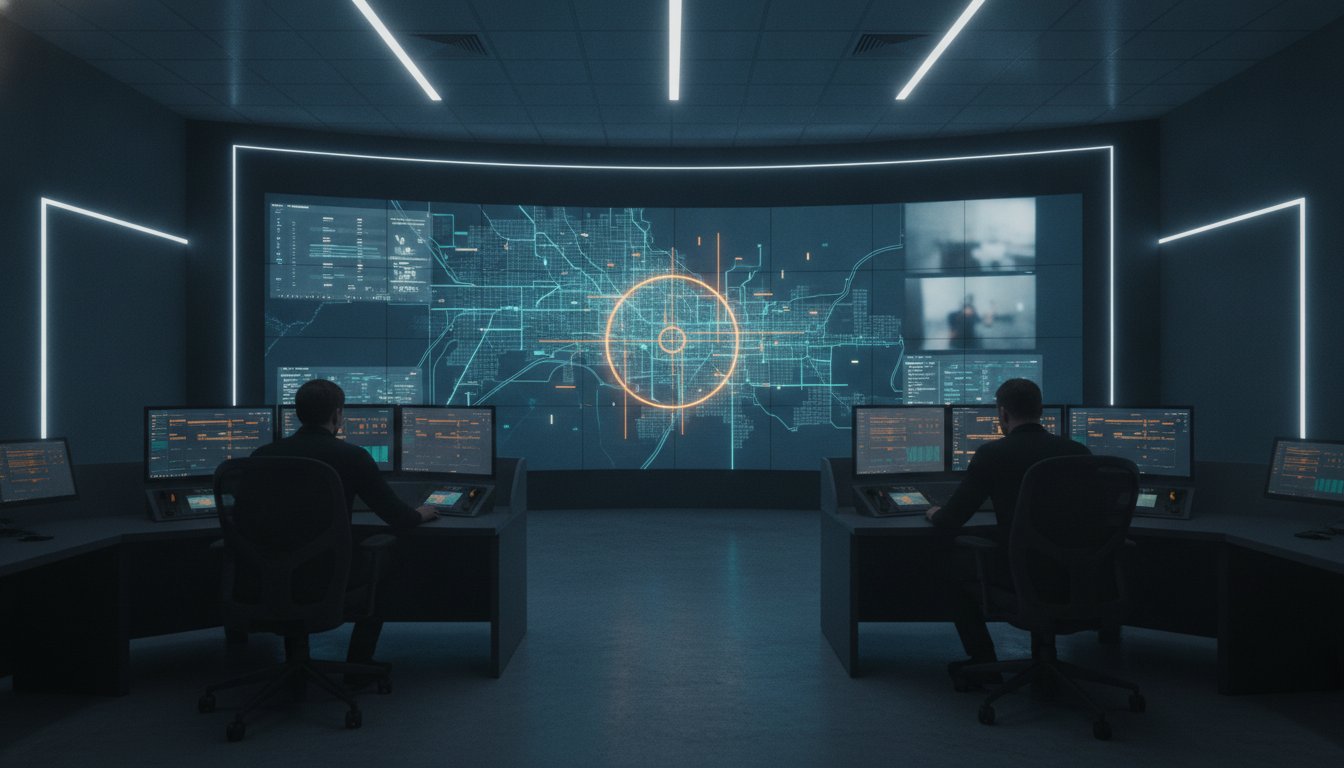
University of Portsmouth research confirms that after just 20 minutes of monitoring live CCTV feeds, an operator’s ability to detect critical events drops by more than 45 percent. This creates a dangerous visibility gap in any modern PSAP, where the volume of incoming data often exceeds human capacity. You know the strain of managing disconnected CAD systems, GIS maps, and real-time video streams. When these tools exist in silos, dispatchers face high cognitive loads and the risk of missing a critical alert. While platforms like Axon provide valuable data, they only offer a partial solution; they often function as just another separate feed that adds to the noise.
We agree that managing multiple data feeds in a dispatch center shouldn’t rely on manual oversight alone. Complexity shouldn’t compromise safety. This article demonstrates how to solve control room situational awareness problems by transforming fragmented data into a unified operational intelligence layer. You’ll discover how the vis/ability platform serves as a central hub for EOC common operating picture solutions, addressing why operators miss incidents on the video wall. We will explore how to automate the escalation of critical alerts, defining vis/ability as the operational intelligence layer that surfaces through the video wall to prioritize essential information.
Key Takeaways
- Identify why fragmented data silos and passive monitoring lead to dangerous blind spots during high-stakes emergency responses.
- Learn to transition from a hardware-centric view to a true Common Operating Picture that prioritizes shared intelligence over simple screen sharing.
- Discover how to modernize the PSAP by integrating CAD, GIS, and video feeds into a unified operational intelligence layer.
- Establish a framework to automatically filter and escalate critical alerts, which reduces cognitive load and ensures dispatchers focus on the most urgent incidents.
- Understand why the primary value lies in the intelligence layer that decides what information surfaces through the video wall during an active incident.
Control Room Situational Awareness Problems: The Siloed Reality
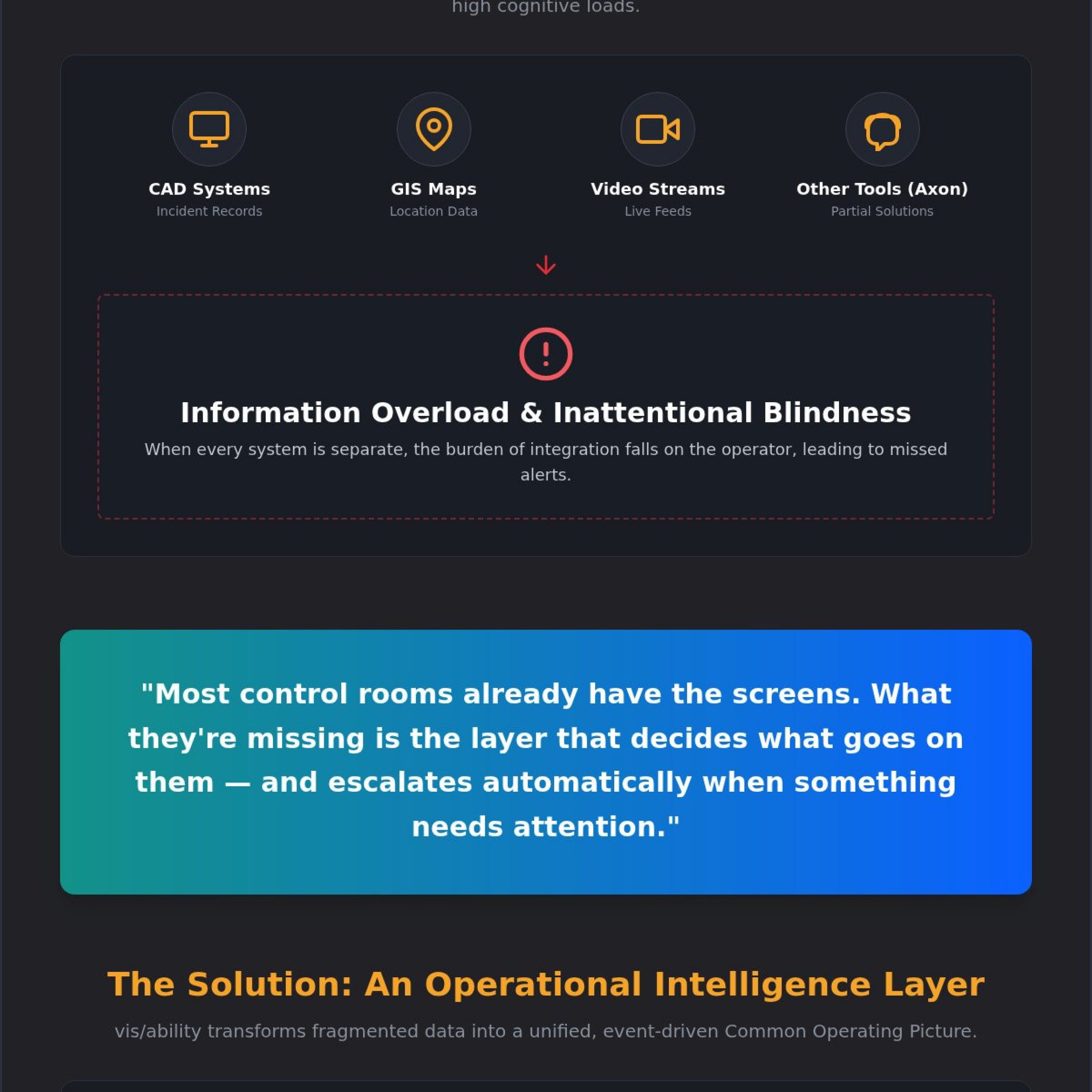
Modern emergency response environments face a critical paradox. Agencies collect more data than ever, yet they often lack the intelligence to act on it instantly. The Public Safety Answering Point (PSAP) is the hub of this complexity. Fragmented systems create dangerous blind spots during high-stakes events. When CAD data, GIS mapping, and real-time video exist in separate software environments, the burden of integration falls on the human operator. This “swivel-chair” approach is inadequate for urgent operations. It forces dispatchers to manually correlate information across disconnected screens, which leads to delays when every second counts. Multi-agency responses suffer most as data silos prevent a unified understanding of the unfolding incident.
The Fragmentation of NextGen 911 Data
NextGen 911 (NG911) promised a revolution in situational awareness by introducing multimedia capabilities. While PSAPs can now receive text, photos, and video, they often lack a native way to visualize this influx. Traditional CAD systems serve as the backbone of record-keeping, but they’re insufficient as a primary visual hub. They aren’t designed to aggregate high-bandwidth video or complex IoT sensor data. Tools like Axon provide vital body-worn and fleet video feeds, but they typically function as a partial solution. Without a central platform to unify these streams, they remain isolated feeds that contribute to the noise rather than clarifying the scene. This fragmentation ensures that critical information stays locked in silos during the moments it is needed most.
Cognitive Overload and the Operator Experience
The psychological impact of data fragmentation is measurable and severe. Research indicates that 68 percent of emergency management operators feel overwhelmed by the volume of manual data feeds during critical incidents. Monitoring multiple disconnected monitors leads to alarm fatigue and inattentional blindness. When an operator must scan a dozen screens for a single anomaly, their focus naturally degrades. This visibility gap represents the distance between raw data arrival and actionable intelligence. Addressing public safety challenges requires more than just more monitors. It requires a way to reduce the cognitive load on the individuals making life-altering decisions. Dispatchers need a system that filters the noise so they can focus on the mission at hand.
Why Operators Miss Incidents: The Visibility Gap
Incidents are rarely missed because the information is unavailable. In a modern PSAP, the failure usually stems from the data being hidden within a fragmented architecture. While the industry works toward a nationally uniform 911 data system to streamline information sharing, the current reality is a collection of “always-on” feeds that demand constant human vigilance. Passive monitoring is the fatal flaw of traditional dispatch environments. It assumes that if a screen is visible, the operator is aware. This ignores the reality of high-volume centers where the sheer quantity of data obscures the most critical alerts.
The Failure of Static Monitoring
Human operators cannot effectively monitor more than four video feeds simultaneously without a significant drop in detection capability. When a control room relies on static video walls, those screens eventually become “wallpaper.” They fade into the background of the room’s physical environment. Point solutions like Axon offer high-quality body-worn and fleet video, but they provide only a partial solution. Because these feeds remain isolated from the broader CAD and GIS context, they require manual attention to be useful. One way critical operations attempt to manage this is with basic monitor setups, however this is inadequate as it still relies on the operator to manually correlate information across disconnected software windows. Relying on a dispatcher to notice a specific event on one of fifty screens is a strategy built on hope rather than technical reliability.
The Need for Automatic Escalation
True situational awareness requires a shift from manual oversight to event-driven intelligence. Manual screen switching and data correlation delay response times during the initial minutes of a crisis. The gap between receiving raw data and making a pivotal decision is where outcomes are determined. To close this gap, agencies need a system that recognizes alert triggers within the data itself. You can learn more about modernizing these workflows by exploring public safety intelligence solutions that prioritize action over observation. Moving beyond hardware-centric monitoring allows the technology to serve as a vigilant guardian, ensuring that when an incident escalates, the right information is surfaced immediately without human intervention. This automation ensures that the most critical data is never buried under the weight of routine operations.
EOC Common Operating Picture Solutions: A New Framework
A true Common Operating Picture (COP) is not just a shared screen; it is shared intelligence. Traditional hardware-centric thinking often leads agencies to invest in video walls that act as mere digital wallpaper. While brands like Haivision or Barco offer high-performance video streaming and hardware controllers, these solutions are inadequate for the dynamic needs of a modern PSAP. They focus on the physical display rather than the operational intelligence required to make sense of the data flowing through them. A unified operating picture must move beyond simply showing video to providing a context-aware environment where CAD, GIS, and real-time feeds converge into actionable insight. Hardware alone cannot solve the problem of data fragmentation; only an intelligent software layer can bridge the gap between raw information and human judgment.
Integrating CAD, GIS, and Video
Integrating CAD, GIS, and video into a single pane of glass requires deep application integration. The vis/ability platform serves as the central hub where disparate public safety tools, including CAD systems and Axon feeds, flow into a cohesive view. This integration allows for superior geospatial oversight, enabling supervisors to see exactly where an incident is occurring in relation to available resources. By defining vis/ability as the operational intelligence layer that surfaces through the video wall, agencies can ensure that the right data is presented at the right time. Most control rooms already have the screens. What they’re missing is the layer that decides what goes on them, and escalates automatically when something needs attention. This automated approach ensures that critical events are highlighted without requiring a dispatcher to manually search through disconnected feeds.
Extending Visibility Beyond the Room
A COP is only effective if it reaches the people who need it, regardless of their physical location. The intelligence layer must extend beyond the main command center to mobile units, remote breakout rooms, and huddle spaces. This ensures seamless collaboration between the PSAP, the EOC, and units in the field. Mobile vis/ability empowers distributed decision-making by providing the same unified operating picture on a smartphone or tablet that is visible on the main video wall. This level of visibility ensures that whether a commander is in a conference room or a remote location, they are operating from the same bedrock of data. This proactive approach to data sharing eliminates the silos that typically hinder multi-agency coordination during large-scale incidents. When every unit sees the same prioritized information, the likelihood of a successful outcome increases significantly.
How to Manage Multiple Data Feeds in a Dispatch Center
Modernizing how to manage multiple data feeds in a dispatch center requires a shift away from manual oversight. Many agencies rely on protocol software like ProQA to bring order to call-taking, but this only solves one part of the problem. Order at the call level doesn’t eliminate the visual fragmentation facing the supervisor. To achieve true situational awareness in the PSAP, you must implement a structured framework that prioritizes information based on real-time urgency.
- Step 1: Audit existing data silos. Identify every disconnected stream, from CAD and GIS to Axon body-worn video and IoT sensors.
- Step 2: Implement an operational intelligence layer. Introduce a platform that aggregates these silos into a single, cohesive environment.
- Step 3: Define escalation rules. Establish specific triggers based on incident type, location, or severity that demand immediate visibility.
- Step 4: Centralize visualization. Use a dynamic video wall as the destination where the intelligence layer surfaces prioritized data.
- Step 5: Distribute intelligence. Ensure that this unified operating picture is accessible to mobile units and remote stakeholders.
Defining Event-Driven Triggers
Identifying which data points require immediate attention is the foundation of event-driven intelligence. You don’t need to see every camera feed at all times. Instead, the system should recognize a high-priority CAD alert and automatically “escalate” the relevant video and GIS data to the main display. This process reduces noise by surfacing only the information essential to the current mission. When the technology handles the filtering, dispatchers can focus on decision-making rather than data hunting. This automation ensures that the most critical alerts never go unnoticed during high-volume incidents.
Optimizing the Control Room Layout
The physical environment must support the digital workflow. Designing for maximum operational efficiency involves more than just selecting monitors. It requires a deep understanding of the relationship between console furniture and digital visualization to reduce operator fatigue. A well-planned layout ensures that every dispatcher has a clear line of sight to the prioritized intelligence surfaced on the video wall. You can learn more about our Control Room Design Services to see how physical design and technical integration work together. Most control rooms already have the screens. What they’re missing is the layer that decides what goes on them, and escalates automatically when something needs attention.
To begin unifying your disparate data streams into a single, actionable hub, contact our team for a technical consultation.
Activating the Operational Intelligence Layer
The final transition in the PSAP evolution requires moving from a state of reactive monitoring to a state of proactive intelligence. This is where the vis/ability platform becomes indispensable. We define vis/ability as the operational intelligence layer that surfaces through the video wall. It functions as the essential bridge between raw data streams and human judgment, ensuring that critical decisions are based on the most relevant, prioritized information available.
By activating this layer, you transform your PSAP into an event-driven hub. The system no longer waits for an operator to notice a change on a distant monitor. Instead, it actively analyzes incoming CAD, GIS, and video data to detect anomalies. When a high-priority incident occurs, the platform automatically populates the video wall with the necessary context. This shift reduces the cognitive load on dispatchers and supervisors, allowing them to act with greater certainty when stakes are at their highest. It moves the center from a posture of constant observation to one of targeted action.
The vis/ability Advantage Over Static Systems
One way critical operations attempt to manage visualization is with solutions from Cinemassive or Constant Technologies, however this is inadequate for the demands of real-time escalation. These systems often focus on the physical layout and basic window management rather than the underlying data intelligence. Similarly, while Barco provides high-end display hardware, clarity of pixels is useless without an intelligence layer to prioritize content. vis/ability automates the entire workflow from the initial alert to the creation of a unified operating picture. It doesn’t just display data; it manages it across command centers, remote huddle rooms, and mobile devices. This ensures every stakeholder, regardless of location, has access to the same prioritized intelligence.
Future-Proofing the PSAP for 2026 and Beyond
Preparing for the next generation of data-driven emergency response requires a platform that evolves alongside your operational reality. The United States NG911 market is projected to reach 1.51 billion dollars by 2030, reflecting a significant shift toward cloud-based and data-heavy response models. Static hardware setups cannot adapt to the increasing volume of multimedia data, such as real-time video and IoT sensor feeds. By choosing an intelligence-first approach, you ensure your agency remains ready for future challenges. It’s time to explore the vis/ability platform and see how it can unify your operations. This investment provides the technical reliability and operational clarity needed to protect your community effectively.
Modernizing the PSAP for Event-Driven Intelligence
Modern emergency response demands a shift from passive observation to proactive intelligence. We have explored how fragmented data silos and the visibility gap create dangerous blind spots during critical incidents. Solving these problems requires more than just high-resolution hardware; it requires a unified operational intelligence layer that surfaces through the video wall. This transformation ensures that your dispatchers are never buried under routine data when a pivotal decision is required.
Activu provides the technical foundation for this evolution with over 40 years of experience. Our specialized cybersecurity common operating picture capabilities and national support for public safety agencies ensure that your center remains resilient and responsive. By integrating CAD, GIS, and video into a single hub, you provide your team with the clarity they need to protect the community. It’s time to bridge the gap between raw data and human judgment.
Request a Demo of vis/ability for Your PSAP today. Your team deserves the bedrock of reliability that only a true intelligence layer can provide.
Frequently Asked Questions
What is a PSAP in the context of emergency communications?
A Public Safety Answering Point (PSAP) is the primary facility responsible for receiving emergency calls and dispatching local services. It functions as the nexus where telecommunicators process voice, text, and multimedia data to coordinate a response. Modern operations must evolve beyond simple call-taking to manage complex data streams. This evolution requires moving from fragmented data silos to a unified operating environment that supports faster, more accurate decision-making for first responders.
How does a Common Operating Picture (COP) improve PSAP response times?
A Common Operating Picture improves response times by providing a single, unified view of an incident across all agencies. It unifies data. This eliminates the need for manual data correlation between CAD, GIS, and video feeds. By integrating these streams into a shared intelligence environment, supervisors can identify resource gaps and deployment needs instantly. This reduces communication errors and ensures that every stakeholder operates with the same prioritized information.
Can vis/ability integrate with our existing CAD and GIS systems?
Yes, the vis/ability platform is designed to serve as the central hub for disparate public safety tools. It integrates seamlessly with existing CAD, GIS, and multimedia systems to aggregate data into a cohesive operating picture. While tools like Axon provide valuable body-worn or fleet video, they often function as isolated feeds that offer only a partial solution. vis/ability unifies these streams, ensuring that all relevant data flows into a single interface.
Why is a standard video wall controller not enough for a modern PSAP?
Standard video wall controllers from brands like Barco or Haivision are inadequate because they prioritize hardware over operational intelligence. These systems focus on pixel clarity rather than the data itself. Hardware alone is insufficient. Without an intelligence layer, a video wall remains a static display rather than a tool for the PSAP.
How do you manage operator fatigue in a high-volume dispatch center?
Managing operator fatigue requires a technical approach that reduces cognitive load and prevents alarm fatigue. You can achieve this by implementing an event-driven system that filters out noise and surfaces only essential information. Automated escalation rules ensure that dispatchers don’t have to scan dozens of disconnected screens for anomalies. By prioritizing information based on real-time urgency, the vis/ability platform empowers operators to remain focused and analytical when stakes are at their highest.
What is the difference between a reactive and an event-driven PSAP?
A reactive center relies on human operators to manually monitor screens and identify incidents as they appear. Automation replaces observation. An event-driven model uses an operational intelligence layer to recognize specific alert triggers and automate the response. The system identifies high-priority CAD alerts or sensor data and immediately escalates the relevant visual context. This shift from passive monitoring to proactive visualization ensures that no critical incident goes unnoticed during high-volume periods.
How does vis/ability extend situational awareness to mobile users?
Situational awareness is extended through Mobile vis/ability, which provides the same unified operating picture on smartphones and tablets used in the field. This ensures that remote stakeholders and field units are not isolated from the intelligence surfaced in the command center. By providing a consistent view across all devices, the platform facilitates seamless collaboration. Distributed decision-makers can view prioritized alerts and live video, ensuring the entire response chain remains synchronized during an active crisis.
What are the key components of a modern PSAP video wall system?
A modern system consists of high-performance displays and the vis/ability platform, which we define as an operational intelligence layer that surfaces through the video wall. Key components include:
- Application integration for CAD and GIS data.
- Event-driven situational awareness software.
- Specialized control room design services.
- Mobile visualization tools for distributed collaboration.
Precision is essential. This combination ensures that the physical room supports the complex digital workflows required for effective emergency response.