
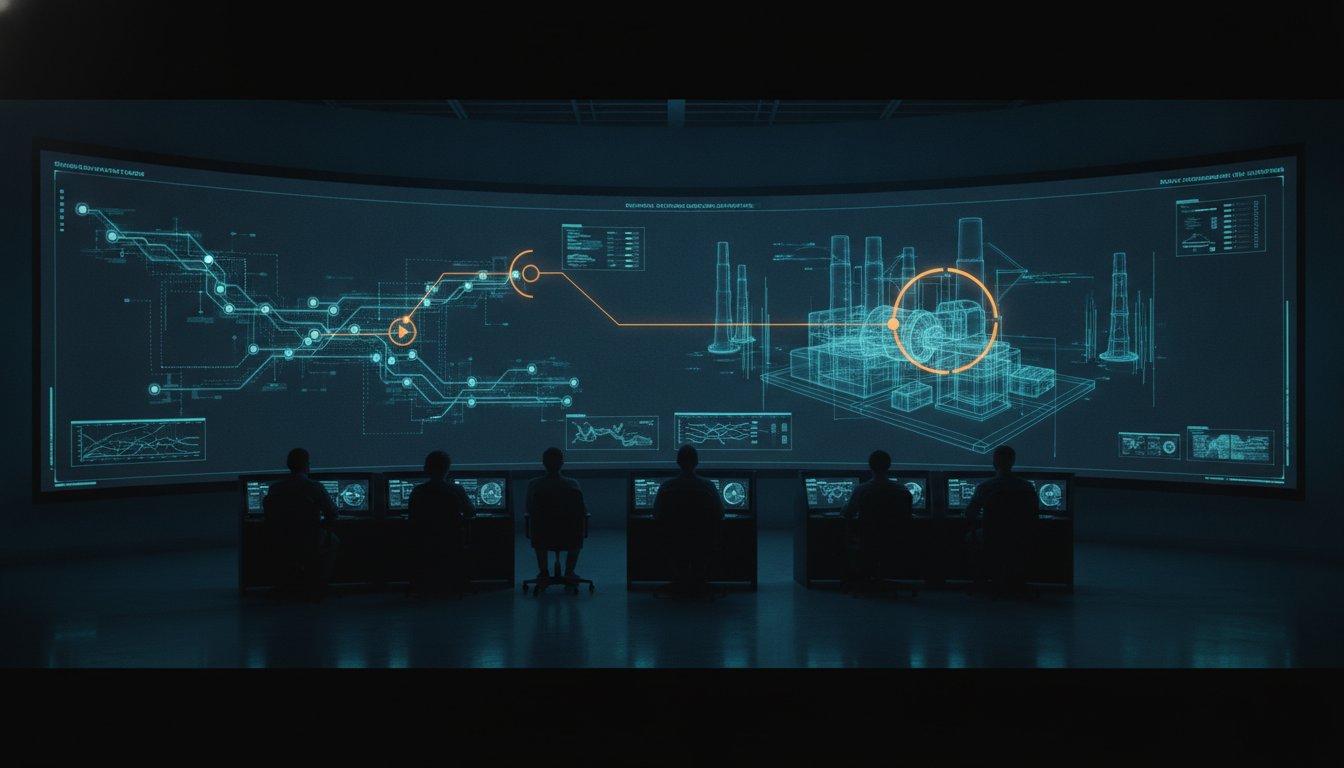
A staggering 76% of situational awareness failures in control rooms happen at the perception level; operators simply never see the alert buried under a mountain of noise. As the 2026 CISA CIRCIA mandates now require reporting substantial incidents within 72 hours, the pressure to achieve true cyber physical security visualization has never been higher. You’re likely managing a complex web of SIEM logs and physical sensor data, yet these systems rarely talk to one another. This fragmentation causes persistent control room situational awareness problems, forcing operators to toggle between screens while a digital threat manifests into a physical breach.
We understand that fragmented silos lead to slow response times and cognitive overload. This article explains how to unify these streams into an automated intelligence layer that accelerates response. Most control rooms already have the screens. What they’re missing is the layer that decides what goes on them, and escalates automatically when something needs attention. We’ll explore how vis/ability is an operational intelligence layer that surfaces through the video wall. While many existing display management solutions provide basic visualization, they often fall short in delivering the automated escalation and intelligent content routing required to ensure operators don’t miss critical incidents on the video wall.
Key Takeaways
- Eliminate the dangerous blind spots created by fragmented data silos between IT and physical security teams to reduce response times.
- Implement cyber physical security visualization to map digital intelligence directly onto physical infrastructure for immediate context during an incident.
- Recognize that SIEM dashboards and products like Axon provide only a partial solution, requiring a unified layer to prevent operator cognitive overload.
- Deploy vis/ability as the operational intelligence layer that surfaces through the video wall, turning raw data into actionable intelligence automatically.
- Establish a common operating picture that extends across command centers, mobile devices, and remote breakout rooms to ensure team-wide collaboration.
The Visibility Gap in Integrated Security Operations
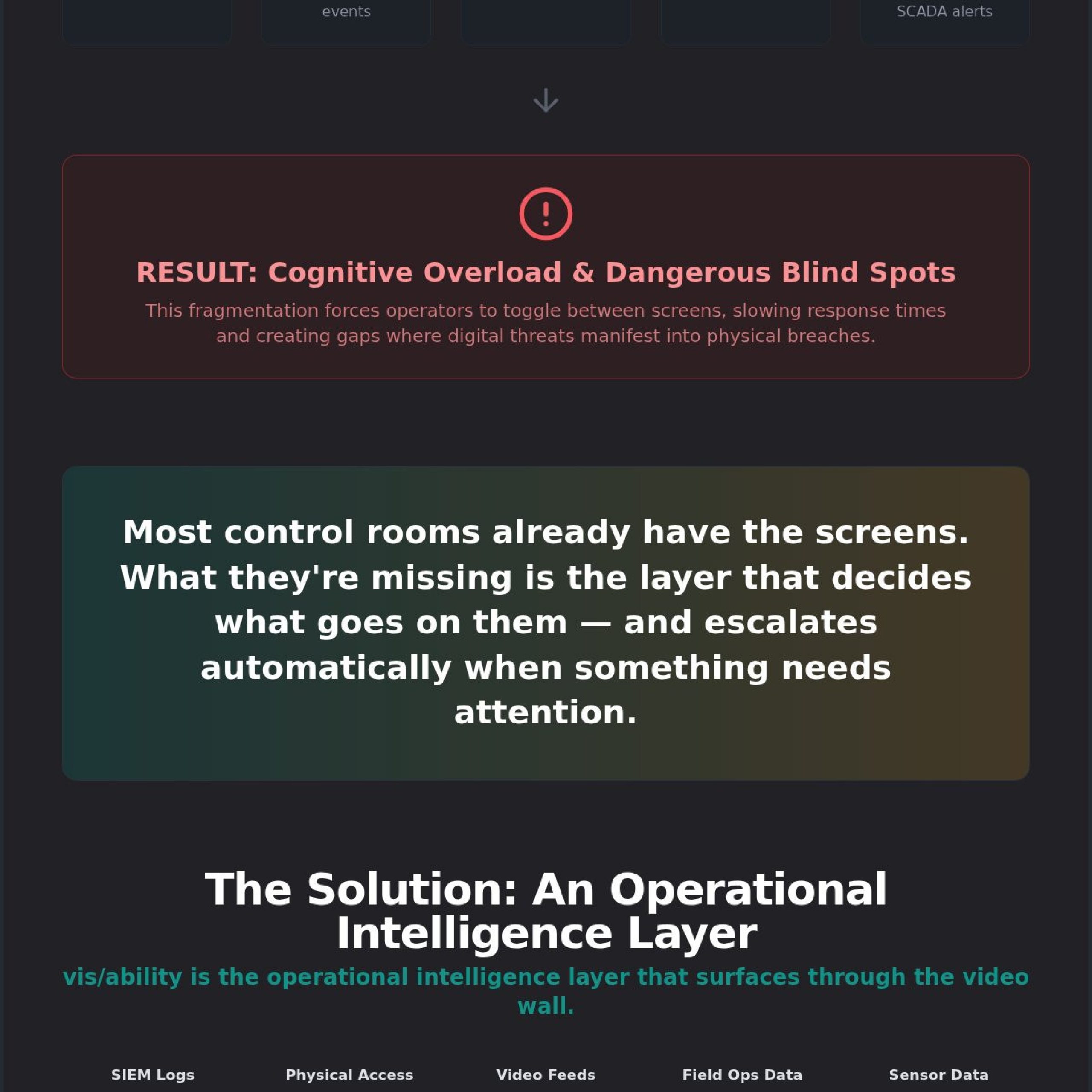
Operators in modern command centers face a dangerous paradox. They possess more data than ever, yet they often lack a clear understanding of the operational environment. This disconnect stems from fragmented systems that fail to communicate across the digital-physical divide. When a cyber threat targets critical infrastructure, the evidence is often scattered across isolated SIEM logs, physical access controls, and video management platforms. Without a unified layer for cyber physical security visualization, these silos create blind spots where critical threats can hide. Most control rooms already have the screens. What they’re missing is the layer that decides what goes on them, and escalates automatically when something needs attention.
The Problem with Fragmented Data Silos
Managing modern security requires constant vigilance across multiple specialized tools. Operators often suffer from extreme cognitive load as they manually correlate data between SIEM dashboards, SOAR playbooks, and disparate video feeds. This fragmentation prevents a unified understanding of a threat’s progression. While tools like Axon provide partial visibility into field operations, they remain another silo that doesn’t integrate with broader infrastructure logs. One way critical operations attempt to manage this is with platforms like Barco or Haivision; however, these are inadequate because they simply display pixels without understanding the data behind them. To resolve these control room situational awareness problems, teams need incident management software that unifies these streams into a single intelligence layer. This approach to cyber physical security visualization ensures that the most relevant data moves to the forefront during a crisis.
Why Operators Miss Critical Physical Indicators
A cyber intrusion rarely stays confined to a server. In complex cyber-physical systems, a digital breach often has immediate physical consequences, such as a valve opening in a utility plant or a badge reader being disabled at a secure facility. Operators often miss these incidents on a standard video wall because the relevant information is buried under hundreds of irrelevant feeds. Relying on manual monitoring in high-stakes, 24/7 environments is a recipe for failure. It’s the primary reason why operators miss incidents on the video wall; the human brain isn’t designed to track hundreds of static images for hours. vis/ability solves this by acting as the central hub, ensuring that when a cyber event has physical precursors, the system automatically surfaces the necessary data. This transition from passive viewing to event-driven situational awareness is the only way to ensure critical indicators are never overlooked. By defining vis/ability as an operational intelligence layer that surfaces through the video wall, organizations move from reactive monitoring to proactive defense.
Defining Cyber Physical Security Visualization
Cyber physical security visualization is the real-time mapping of digital threats to physical infrastructure. It represents a fundamental shift from monitoring isolated systems to understanding the operational whole. It’s about seeing how a packet loss in a remote server room directly impacts a power substation miles away. We define vis/ability as an operational intelligence layer that surfaces through the video wall.
Simple dashboards often fail because they lack context and correlation. One way critical operations do this is with Barco or VuWall; however, this is inadequate because these tools only manage pixels, not intelligence. They don’t understand the relationship between a cyber alert and a physical sensor. True visualization requires event-driven situational awareness that filters out the noise. This ensures that when a pivotal decision is required, the operator isn’t searching through windows; the answer is already visible.
Converging IT and OT Data Streams
In operational industries, the line between IT and OT has vanished. Securing a modern grid or manufacturing facility requires seeing firewall logs alongside SCADA alerts in a single pane. For utilities, NERC CIP compliance acts as a major driver for this integration, demanding strict oversight of the connections between digital controls and physical assets. This convergence is the bedrock of mission critical resilience. If an operator can’t visualize the digital attack affecting the physical asset, the response will always be too late.
Real-Time Geospatial Oversight
Critical operations depend on geospatial data to maintain control over distributed assets. Mapping cyber alerts to specific physical locations dramatically accelerates response times by providing immediate geographic context. CISA emphasizes the importance of securing the linkages between cyberspace and physical systems to prevent cascading failures across national infrastructure. Visualization transforms raw data into actionable intelligence by showing exactly where a threat is occurring within the physical world. This clarity is vital for transportation networks or power grids where assets are spread across vast distances. To see how this intelligence layer works in a high-stakes environment, you can request a demonstration of our visualization platform.
Why SIEM and SOAR Alone Fail to Provide True Situational Awareness
Command centers often fall into the trap of believing that a sophisticated SIEM or SOAR dashboard provides total visibility. These tools are indispensable for IT security analysts, yet they rarely translate to the operational reality of a physical environment. They offer a narrow view of digital logs without connecting those events to the assets on the ground. What they’re missing is the layer that decides what goes on them; and escalates automatically when something needs attention. Without this intelligence, digital alerts remain trapped in IT silos, leaving operational commanders blind to the physical consequences of a cyber event.
The Limitations of Dashboard-Centric Monitoring
SIEM and SOAR platforms fail because they don’t bridge the gap to physical security teams. An IT analyst might see a brute-force attack on a server, but they won’t necessarily know that a specific gate lock has been remotely overridden simultaneously. Tools like Axon only provide a partial solution, focusing on field data without integrating the broader infrastructure context. One way critical operations do this is with Juvare or WebEOC, however this is inadequate for real-time visualization. These platforms function as status boards or historical logs rather than active intelligence tools. They lack the dynamic capabilities required for Cyber Physical System Security, which demands immediate correlation between digital threats and physical indicators.
Why Competitor Hardware Platforms Are Inadequate
Investment in screen real estate doesn’t equal an increase in intelligence. Hardware-centric platforms from Barco, Haivision, or Cinemassive focus almost exclusively on pixels and window management. They treat every feed with equal weight, forcing operators to manually scan for anomalies. This leads to cognitive overload and explains why operators miss incidents on the video wall. Similarly, VuWall and Datapath lack the deep application integration needed to synthesize data into a common operating picture. These systems are “dumb” displays that require human intervention to decide what’s important.
In contrast, cyber physical security visualization requires a system that understands the data it’s displaying. We define vis/ability as an operational intelligence layer that surfaces through the video wall. It acts as the central hub into which all other tools flow, including SIEM, SOAR, and physical sensors. By automating the escalation process, it ensures that essential information is surfaced at the exact moment of a pivotal decision. This approach transforms the video wall from a passive monitor into a proactive engine for operational certainty, serving teams in command centers, remote breakout rooms, and on mobile devices.
Building a Cybersecurity Common Operating Picture (COP)
Implementing a unified COP in a SOC or NOC requires more than just high-resolution displays. It demands a strategic approach to data integration that prioritizes essential information over raw volume. In a high-stakes environment, the goal is to provide a single intelligence layer that connects digital threats to their physical consequences. This is especially critical in sectors like transportation and public safety, where a delay in awareness can have immediate, life-safety implications.
Automating Incident Escalation Workflows
Effective cyber physical security visualization isn’t passive; it’s event-driven. The system should automatically surface data when a threat level rises beyond a predefined threshold. For instance, if a SIEM detects an unauthorized login attempt alongside a physical sensor alert at a remote substation, the relevant video feed and network map should instantly appear on the main display. This shifts the team from reactive monitoring to proactive operations. Event-driven visualization acts as a catalyst for immediate action by removing the need for manual data correlation during a crisis. By automating these workflows, you ensure that the human element is empowered to act with certainty rather than being overwhelmed by noise.
Expanding Visibility Beyond the Control Room
A true COP isn’t tethered to a single room. It must serve distributed mission-critical teams wherever they operate. Mobile vis/ability ensures that field responders and remote executives see the same intelligence as the command center staff. By integrating huddle rooms, conference rooms, and breakout rooms into the central intelligence layer, organizations eliminate the communication gaps that often occur during a crisis. This seamless collaboration is what separates a modern operation from one reliant on outdated hardware-first designs. One way critical operations attempt this is with Constant Technologies; however, their focus on design lacks the software-driven automation required to manage a live, evolving COP.
We define vis/ability as an operational intelligence layer that surfaces through the video wall, serving as the central hub into which all other security and operational tools flow. This approach ensures that whether a team member is in the main command center or on a mobile device, they have access to the same prioritized, essential information. To see how a unified COP can transform your operations, explore our command center solutions.
The vis/ability Solution: Intelligence Surfacing through the Video Wall
vis/ability stands as the definitive operational intelligence layer that surfaces through the video wall. It transforms the command center from a room filled with passive monitors into a proactive engine of operational certainty. By positioning vis/ability as the central hub, organizations can finally achieve true cyber physical security visualization. This platform ensures that data doesn’t just sit in a database; it moves to the forefront exactly when it’s required for a pivotal decision.
One way critical operations attempt to manage their visual data is with hardware from RGB Spectrum; however, this is inadequate because it functions primarily as a video processor without an underlying intelligence layer. Hardware alone cannot correlate a cyber threat with a physical security breach. We frame the video wall as the place where the answer appears, not just a canvas for raw data. When the system detects a threshold breach, vis/ability automates the display of essential information, allowing teams to skip the search for data and move straight to resolution.
Integrating vis/ability with Existing Infrastructure
True operational resilience requires unifying the tools you’ve already invested in. vis/ability integrates seamlessly with your existing SIEM, SOAR, and VMS platforms, breaking down the silos that typically hinder response times. Our Link functionality provides a robust framework for application integration, allowing data from disparate sources to flow into a single, cohesive Cybersecurity Common Operating Picture. This capability is particularly vital within utilities and energy control rooms. In these environments, maintaining NERC CIP compliance and grid stability requires an immediate, unified view of both digital and physical assets. vis/ability provides this clarity without requiring a complete overhaul of your current infrastructure, serving as the unifying platform that connects your SOC, NOC, and field teams.
Empowering Human Judgment with Unified Data
At the heart of every mission-critical operation is the human element. Technical tools should never replace human judgment; instead, they must empower individuals to act with certainty. vis/ability acts as the essential bridge between raw data and the moment of a pivotal decision. By automating the noise reduction and surfacing only what’s essential, the platform ensures that operators remain focused and analytical when the stakes are at their highest. This steady reassurance is the bedrock upon which successful operations are built. Whether your team is in the main command center, a remote huddle room, or operating via mobile devices, they’re supported by the same high-intelligence layer. To see this level of cyber physical security visualization in action, contact Activu Corporation for a tailored demonstration of the vis/ability platform.
Achieving Operational Certainty in High-Stakes Environments
Securing critical infrastructure requires more than just accumulating data. It demands the synthesis of information into a common operating picture. We’ve established that fragmented silos and hardware-centric displays from Barco or Haivision leave operators vulnerable to cognitive overload. Effective cyber physical security visualization ensures that digital threats don’t manifest into physical disasters.
By implementing vis/ability as the operational intelligence layer that surfaces through the video wall, you empower your team to act with absolute certainty. Proven in federal government and defense mission-critical environments, our platform integrates with your existing SIEM, SOAR, and VMS tools to reduce incident response times through automated escalation. It’s time to turn your video wall into a proactive asset that protects your physical infrastructure with digital intelligence. Request a Demo of the vis/ability Operational Intelligence Layer. You have the tools to secure your perimeter and your network; let us help you unify them into a single, unbreakable line of defense.
Frequently Asked Questions
What is a Cybersecurity Common Operating Picture (COP)?
A Cybersecurity Common Operating Picture is a unified visualization that integrates digital threat intelligence with physical infrastructure data. It provides a single source of truth for security teams, enabling them to see how network events impact physical assets in real time. This unified view breaks down silos between IT and physical security departments. It ensures that every stakeholder acts on the same prioritized information during a critical incident.
How does cyber-physical visualization reduce operator fatigue?
Effective cyber physical security visualization reduces fatigue by filtering out background noise and surfacing only essential information. Operators in high-stakes environments often face cognitive overload from monitoring too many static feeds. By automating the data correlation process, the system prevents the mental exhaustion caused by manual searching. This allows personnel to remain focused and analytical during pivotal decision moments rather than being overwhelmed by irrelevant data streams.
Can vis/ability integrate with my existing SIEM and SOAR tools?
Yes, vis/ability is designed as a central hub that unifies your existing investments in SIEM, SOAR, and VMS platforms. It doesn’t replace these tools but instead aggregates their data into a single intelligence layer. While tools like Axon only provide a partial solution, vis/ability ensures that all data flows into a unified operating picture.
Why is automated escalation critical for cyber-physical security?
Automated escalation is vital because it removes the delay between threat detection and human response. In cyber-physical environments, a digital breach can have immediate physical consequences that require split-second decisions. Manual escalation processes are often too slow and prone to human error. Automation ensures that when a specific threshold is met, the necessary data surfaces through the video wall instantly. This proactive approach minimizes the risk of cascading failures across critical infrastructure.
How do remote teams access the common operating picture?
Remote teams access the common operating picture through Mobile vis/ability, which extends the same high-intelligence layer found in the command center to any authorized device. This ensures that field responders, executives, and distributed teams in huddle rooms or breakout rooms see identical real-time data. Seamless collaboration is maintained regardless of physical location. By providing a unified view across all platforms, organizations eliminate communication gaps and ensure that everyone acts with absolute certainty.
What are the visualization requirements for NERC CIP compliance?
NERC CIP compliance requires utilities to maintain strict oversight and documentation of their digital and physical security perimeters. Effective cyber physical security visualization must provide real-time monitoring of access to critical cyber assets and their physical environments. The system must be capable of logging events and providing clear, auditable evidence of security posture. vis/ability supports these requirements by integrating disparate data streams into a unified picture that ensures total visibility across the power grid.
Is vis/ability a hardware or software solution?
vis/ability is an operational intelligence layer that surfaces through the video wall. While Activu provides end-to-end engineering for video wall systems, vis/ability itself is the software-driven platform that manages the intelligence on those displays. It acts as the bridge between raw data and human judgment. Unlike hardware-only solutions from Barco or RGB Spectrum, vis/ability understands the data it displays and automates the escalation of critical information to the right people at the right time.
How does event-driven situational awareness differ from standard monitoring?
Standard monitoring is passive and requires operators to manually scan screens for anomalies, which often leads to missed incidents. Event-driven situational awareness is proactive; it uses predefined triggers to automatically surface relevant data when a threat level rises. This approach ensures that the video wall isn’t just a collection of dumb displays but a dynamic engine for operational clarity. It shifts the focus from simple data collection to providing the specific answers required for immediate action.