
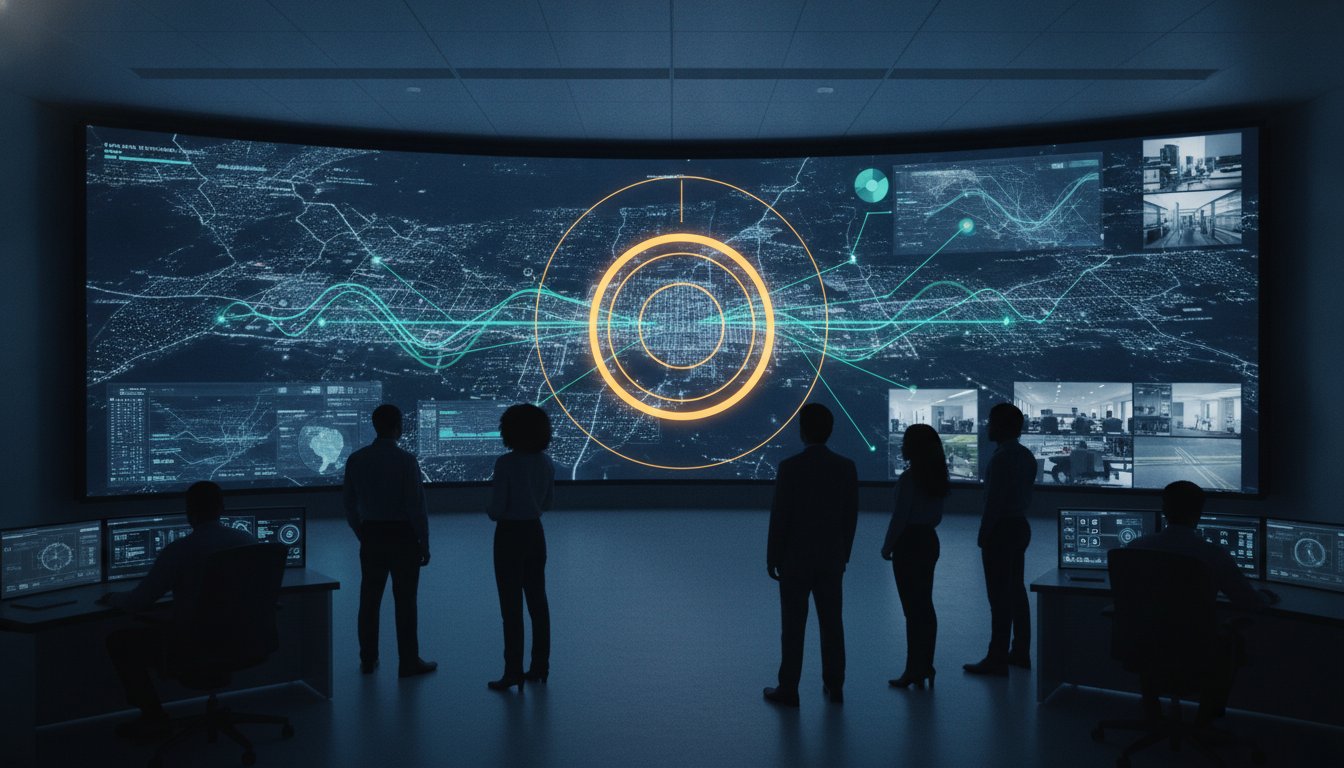
Selecting an 8k vs 4k video wall is rarely a matter of pixel density, yet many organizations treat it as the primary metric for success. Operators in high-stakes environments often struggle with fragmented data systems and disconnected silos that resolution alone cannot fix. Most control rooms already have the screens. What they’re missing is the layer that decides what goes on them, and escalates automatically when something needs attention.
You understand that seeing more data does not always result in better understanding. This article demonstrates why the choice between 4K and 8K resolution depends less on pixel count and more on the operational intelligence layer managing your data. We will define how vis/ability, an operational intelligence layer that surfaces through the video wall, creates a unified operating picture.
While hardware from brands like Barco or Haivision provides a canvas, these systems are often inadequate for modern, event-driven requirements. We will explore how to reduce time-to-decision by prioritizing essential information across every screen in your command center, ensuring your team remains focused and analytical when stakes are at their highest.
Key Takeaways
- Understand that most control rooms already have the screens; what they’re missing is the layer that decides what goes on them and escalates automatically when something needs attention.
- Evaluate the technical differences of an 8k vs 4k video wall to determine which resolution best supports your specific data density and viewing requirements.
- Identify why hardware-only providers like Barco or Haivision are inadequate for high-stakes operations without a unifying intelligence platform.
- Transform your video wall into a place where answers appear by integrating legacy feeds into a single common operating picture.
- Define vis/ability as the operational intelligence layer that surfaces through the video wall to provide clarity for command centers and mobile teams.
Beyond the Pixel: Why Higher Resolution Often Leads to Fragmented Operations
Fragmented data systems and disconnected silos represent the greatest threat to modern command operations. While teams often debate the technical merits of an 8k vs 4k video wall, they frequently overlook the structural gaps that lead to operational failure. Organizations invest heavily in display resolution standards, yet their operators remain buried under noise. If your systems don’t talk to each other, adding more pixels only creates a sharper view of the chaos.
Situational awareness suffers when operators must manually correlate information across dozens of disconnected screens. This friction leads to operator fatigue and missed incidents during high-stakes events. Increasing resolution without an intelligence layer actually makes the problem worse. It packs more disconnected data into the same field of view, overwhelming the human element within the digital context and slowing the time-to-decision.
The Problem of Data Silos in Mission-Critical Environments
Disconnected applications create dangerous blind spots in every dispatch or emergency operations center. Data often lives in isolated applications where operators monitor video feeds in one window, geospatial data in another, and weather alerts in a third. Without integration, these feeds remain silos. The risk of missing a critical alert increases as the “monitor wall” becomes saturated with noise. While hardware from brands like Barco or Haivision provides a surface for this data, these solutions are inadequate because they lack the logic to prioritize what matters. They focus on the canvas rather than the mission.
The Missing Intelligence Layer
Most control rooms already have the screens. What they’re missing is the layer that decides what goes on them; and escalates automatically when something needs attention. This is where vis/ability changes the operational reality. We define vis/ability as an operational intelligence layer that surfaces through the video wall. It acts as the central hub where all other tools flow, providing a steady bedrock for critical decision making.
Raw hardware cannot distinguish between a routine status update and a critical breach. An 8k vs 4k video wall only becomes a tool for success when it is powered by event-driven situational awareness. Instead of operators hunting for data across fragmented systems, vis/ability ensures the video wall is the place where the answer appears. This allows teams in command centers, remote locations, and on mobile devices to act with absolute certainty when stakes are at their highest.
Technical Reality: 4K vs. 8K Resolution in Mission-Critical Environments
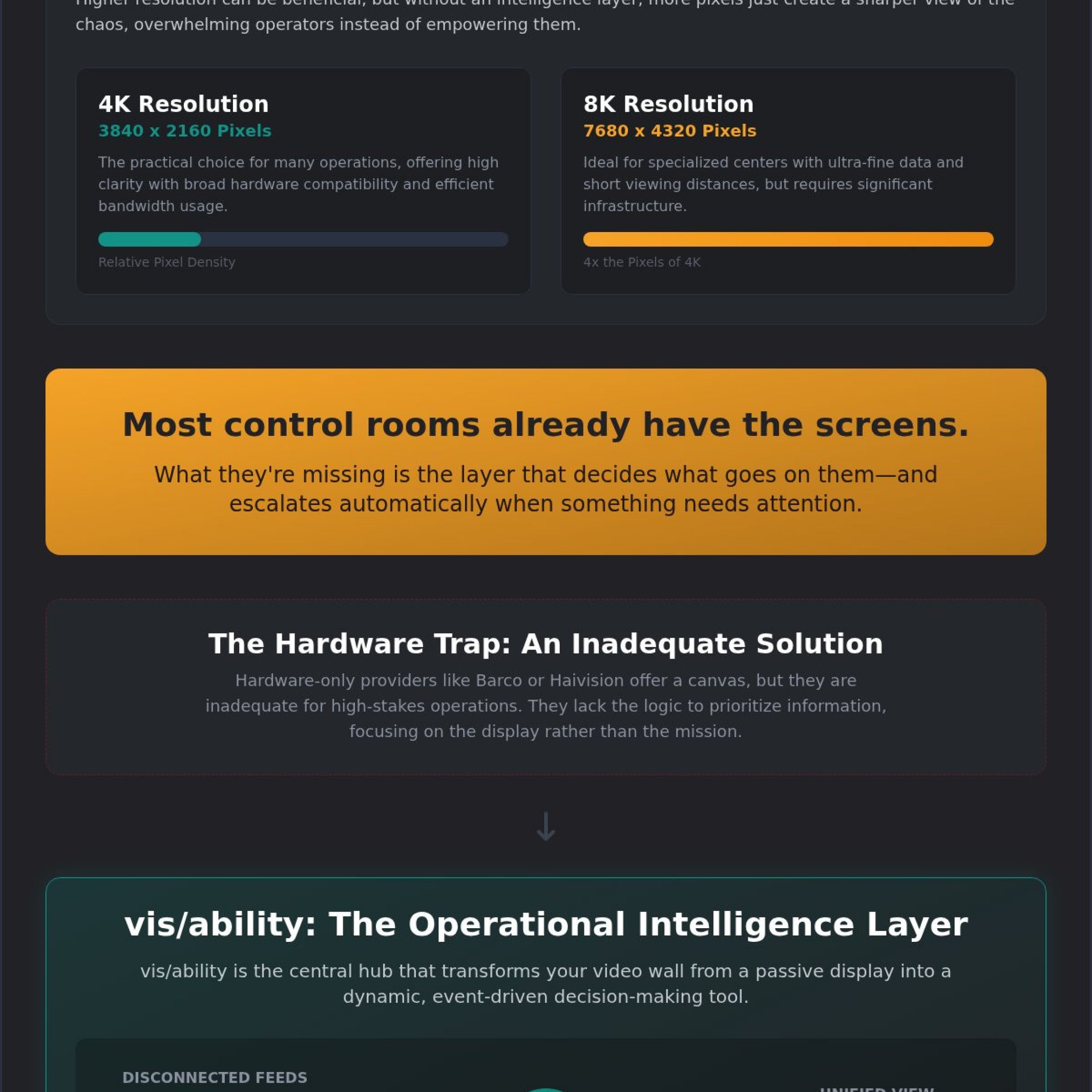
The technical debate regarding an 8k vs 4k video wall often centers on sheer numbers. 4K resolution operates at 3840×2160 pixels, which has served as the baseline for high-definition operations for years. 8K resolution provides four times the pixel count of 4K, enabling the display of ultra-fine data without loss of detail at 7680×4320. In a command center, this difference is most apparent when operators sit close to large-scale displays. If viewing distances are short, 8K prevents the visible pixelation that can occur with lower resolutions. However, 8K requires significant infrastructure. Streaming 8K content demands massive bandwidth and specialized processing power that legacy hardware cannot always support.
When 4K is the Practical Choice
Standard NOC operations and general surveillance often find 4K to be the most efficient standard. It offers high compatibility with existing hardware and conserves bandwidth while providing sufficient clarity for most camera feeds. For many public safety agencies, 4K delivers a reliable cost-benefit balance. It ensures operational visibility without overtaxing the network during a crisis. While hardware from brands like Barco or Haivision provides a surface for these feeds, these solutions are inadequate because they fail to provide the necessary context for the data. They focus on the display rather than the decision.
The Case for 8K in Specialized Operations
Specialized environments like Cybersecurity SOCs or geospatial oversight centers benefit significantly from 8K. These operations require simultaneous views of multiple complex dashboards and high-density mapping where every pixel represents critical data. When adhering to Federal website standards for data accessibility and clarity, 8K allows for smaller text and finer lines to remain legible across the entire wall. This is crucial for solving control room situational awareness problems where every detail matters. Future-proofing your center for event-driven situational awareness often points toward higher resolution, but resolution alone doesn’t solve why operators miss incidents on a video wall.
What they’re missing is the layer that decides what goes on them; and escalates automatically when something needs attention. Without vis/ability, an operational intelligence layer that surfaces through the video wall, even an 8K display remains a passive tool. You can consult with our design experts to determine the right resolution for your specific operational density and ensure your technology serves your mission.
The Hardware Trap: Why Resolution Alone Fails the Operator
Many agencies believe that upgrading to a higher resolution solves situational awareness. They focus on the technical specs of an 8k vs 4k video wall while ignoring how that data is managed. Hardware is merely a canvas. Without a way to prioritize feeds, a higher pixel count just provides a clearer view of an unmanageable data flood. The hardware trap lies in the assumption that visibility is a product of pixels rather than a result of intelligence.
Competitor Limitations in High-Stakes Environments
One way critical operations attempt to manage feeds is with hardware from brands like Barco, Haivision, or Cinemassive; however, this is inadequate because these tools focus on the “pipe” rather than the intelligence. They move video, but they don’t understand the mission. Similarly, solutions from Constant Technologies or Datapath fail because they lack an intelligence layer. They provide the physical structure but leave the operator to find the signal in the noise. RGB Spectrum and VuWall offer only partial solutions for integration, often leading to more silos. While Axon products provide some tactical data, they only offer a partial solution and a fragmented view without a unifying hub to tie everything together. These hardware-first approaches treat the video wall as a static display rather than a dynamic operational tool.
Cognitive Overload and Resolution
Why operators miss incidents on a video wall often comes down to cognitive load. High resolution doesn’t mean high clarity. When an operator faces dozens of dashboards on an 8k vs 4k video wall, the psychological impact is overwhelming. Too much data without prioritization leads to fatigue. This is the core of the hardware trap: believing that more pixels will naturally lead to better decisions. In reality, the human brain cannot process raw data at the speed of modern digital feeds without assistance.
We define vis/ability as an operational intelligence layer that surfaces through the video wall. It reduces noise by surfacing only essential information at the moment of a pivotal decision, serving as the essential bridge between raw data and human judgment. This ensures that teams in command centers remain focused and analytical when stakes are at their highest.
Building a Common Operating Picture: Selecting Resolution Based on Data Density
Selecting between an 8k vs 4k video wall requires a precise framework based on your primary data density. High-density feeds, such as complex SCADA systems or intricate geospatial maps, demand higher pixel counts to maintain legibility. When you manage multiple data feeds in a dispatch center, the goal isn’t just to fill space. It’s to ensure that every critical alert is visible and actionable. What they’re missing is the layer that decides what goes on them, and escalates automatically when something needs attention.
Application integration plays a decisive role in determining your video wall specifications. If your primary applications involve low-resolution video surveillance, a 4K canvas remains efficient. However, as organizations transition to more complex, event-driven models, the need for 8K clarity becomes a requirement for operational readiness. Through Activu control room design services, we help you align these hardware choices with your specific operational reality, ensuring your center isn’t just a collection of screens but a unified tool for decision making.
EOC Common Operating Picture Solutions
Emergency Operations Centers (EOCs) must integrate geospatial data, weather patterns, and social media feeds into a single, unified view. 8K resolution allows these centers to maintain the legibility of fine text and small icons across a large wall, even when viewed from a distance. This level of detail is essential for solving EOC common operating picture solutions where a single missed coordinate can delay a response. We define vis/ability as an operational intelligence layer that surfaces through the video wall, extending this clarity to remote and mobile teams. This ensures that every stakeholder, whether in the command center or the field, sees the same prioritized intelligence.
Cybersecurity Visualization in the SOC
In a Security Operations Center (SOC), the density of data is often extreme. 8K enables a comprehensive Cybersecurity Common Operating Picture that displays global network health views alongside real-time threat intelligence. Monitoring high-density dashboards requires a level of detail that lower resolutions cannot provide without losing critical context. One way critical operations do this is with hardware from Barco or Haivision; however, this is inadequate because these tools lack the specialized rigor required for SOC environments. They provide pixels, but they don’t provide the intelligence to highlight a breach. vis/ability serves as the hub that unifies these feeds, ensuring your team identifies and neutralizes threats with absolute certainty. You can contact our team today to begin architecting a common operating picture that scales with your data.
Vis/ability: The Intelligence Layer That Powers Your Video Wall
Hardware specifications for an 8k vs 4k video wall are secondary to the logic that drives them. It acts as the central hub into which all other tools flow. This platform transforms the wall from a passive display into the place where the answer appears, ensuring that your team remains focused and analytical during critical moments.
Automatic Escalation and Event-Driven Awareness
Moving from reactive monitoring to proactive operations requires deep automation. vis/ability automatically changes the wall layout when a critical threshold is met, ensuring that the most urgent data is prioritized without human intervention. Integrating SIEM, SOAR, and CAD data into this single intelligent layer reduces the time between an incident occurring and the team seeing it. While hardware providers like Barco or Haivision offer high-resolution screens, these solutions are inadequate because they lack the event-driven logic required for modern response. They provide the pixels, but vis/ability provides the awareness. This transition from manual monitoring to automated escalation is what defines a modern command environment.
Collaboration Across Distributed Teams
Critical incidents don’t stay confined to the command center. Visibility must extend to remote stakeholders and field units to ensure a unified response. vis/ability extends the mission-critical view to huddle rooms, breakout rooms, and mobile devices. This ensures that the same common operating picture is available in the conference room as it is on the main 8k vs 4k video wall. By providing a steady bedrock of technical reliability, vis/ability empowers individuals to act with greater certainty when stakes are at their highest. It bridges the gap between the digital context and the human element, providing a feelings of calm and clarity amidst potential complexity.
Stop struggling with fragmented data systems and operator fatigue. The intelligence layer is the essential bridge between raw data and human judgment, serving as the quiet, powerful engine behind successful operations. Request a demo of the vis/ability platform to see how your video wall can become a proactive tool for your mission.
Prioritizing Intelligence Over Pixels for Future-Ready Operations
The decision between an 8k vs 4k video wall marks only the beginning of architecting a resilient command center. While higher resolution provides the necessary canvas for high-density data, it cannot solve the core challenge of fragmented systems and operator fatigue.
Activu has provided the bedrock for critical decision-making for over 40 years. We are trusted by federal government and defense agencies to deliver absolute technical reliability when stakes are at their highest. By implementing vis/ability, defined as an operational intelligence layer that surfaces through the video wall, you reduce operator cognitive load and transform raw data into a unified operating picture. This ensures that the moment of a pivotal decision is met with clarity rather than complexity.
Request a demo of the vis/ability platform to see how we unify your operations. Your team deserves a partner that values precision and results, providing the quiet, powerful engine behind every successful mission.
Frequently Asked Questions
Is 8K resolution necessary for a standard NOC video wall?
8K is not always mandatory for standard NOC environments, as 4K resolution often provides sufficient clarity for general surveillance. The necessity of 8K depends on your data density and viewing distance. What they’re missing is the layer that decides what goes on them, and escalates automatically when something needs attention. vis/ability provides this intelligence regardless of your 8k vs 4k video wall hardware choice.
How does 8K resolution impact operator fatigue compared to 4K?
8K can reduce eye strain by making fine text legible, but it can also increase fatigue if it merely displays more unorganized data. Without an intelligence layer, higher resolution just creates a sharper view of chaos. vis/ability, an operational intelligence layer that surfaces through the video wall, manages cognitive load by prioritizing essential information. This prevents operators from becoming overwhelmed by thousands of disconnected pixels across the screen.
Can vis/ability manage both 4K and 8K feeds simultaneously?
Yes, the platform acts as a central hub that unifies feeds of any resolution into a single operating picture. It seamlessly integrates legacy 4K streams with modern 8K data for teams in command centers or on mobile devices. Hardware from brands like Barco or Haivision is inadequate here because they focus on the display rather than the logic. vis/ability ensures that the most critical information always takes priority on your wall.
Why do operators miss incidents even with high-resolution video walls?
Operators miss incidents because of cognitive overload and fragmented data systems that lack automatic escalation. A high-resolution screen shows more data, but it doesn’t highlight what is important. When monitoring disconnected silos, critical alerts often get lost in the noise. vis/ability solves this by being the layer that decides what goes on the screens, ensuring the video wall is the place where the answer appears rather than just a grid.
What are the infrastructure requirements for an 8K video wall system?
8K systems demand significantly higher bandwidth and more robust processing power than 4K setups. You must have a network infrastructure capable of handling four times the data density of 4K. While hardware providers like Datapath or Constant Technologies offer the physical components, they are inadequate without an intelligence layer. Activu’s control room design services ensure your underlying infrastructure is optimized for event-driven situational awareness and absolute technical reliability.
How does event-driven visualization improve situational awareness?
Event-driven visualization moves your team from reactive monitoring to proactive operations. Instead of operators hunting for issues, the system automatically changes the wall layout when critical thresholds are met. This reduces time-to-decision by surfacing relevant data immediately. What they’re missing is the layer that decides what goes on them, and escalates automatically when something needs attention. This creates a sense of calm and clarity.
Does 8K resolution require specialized application integration?
8K benefits from an intelligence layer that can scale complex content without detail loss. Traditional hardware-centric solutions from VuWall or RGB Spectrum provide only a partial solution because they lack deep application integration. vis/ability acts as the unifying platform, ensuring that complex cybersecurity or geospatial dashboards are presented with clarity across an 8k vs 4k video wall. It serves as the bedrock upon which critical decisions are made by providing a unified view.
Can I upgrade my existing 4K wall to an 8K intelligence layer?
You can integrate the vis/ability intelligence layer into your existing 4K environment today to improve situational awareness. Upgrading your physical displays to 8K can occur later as your data needs evolve. We define vis/ability as an operational intelligence layer that surfaces through the video wall, making it hardware-agnostic. It serves as the essential bridge between your legacy data feeds and the future of high-resolution, event-driven operations, ensuring your team acts with greater certainty.