
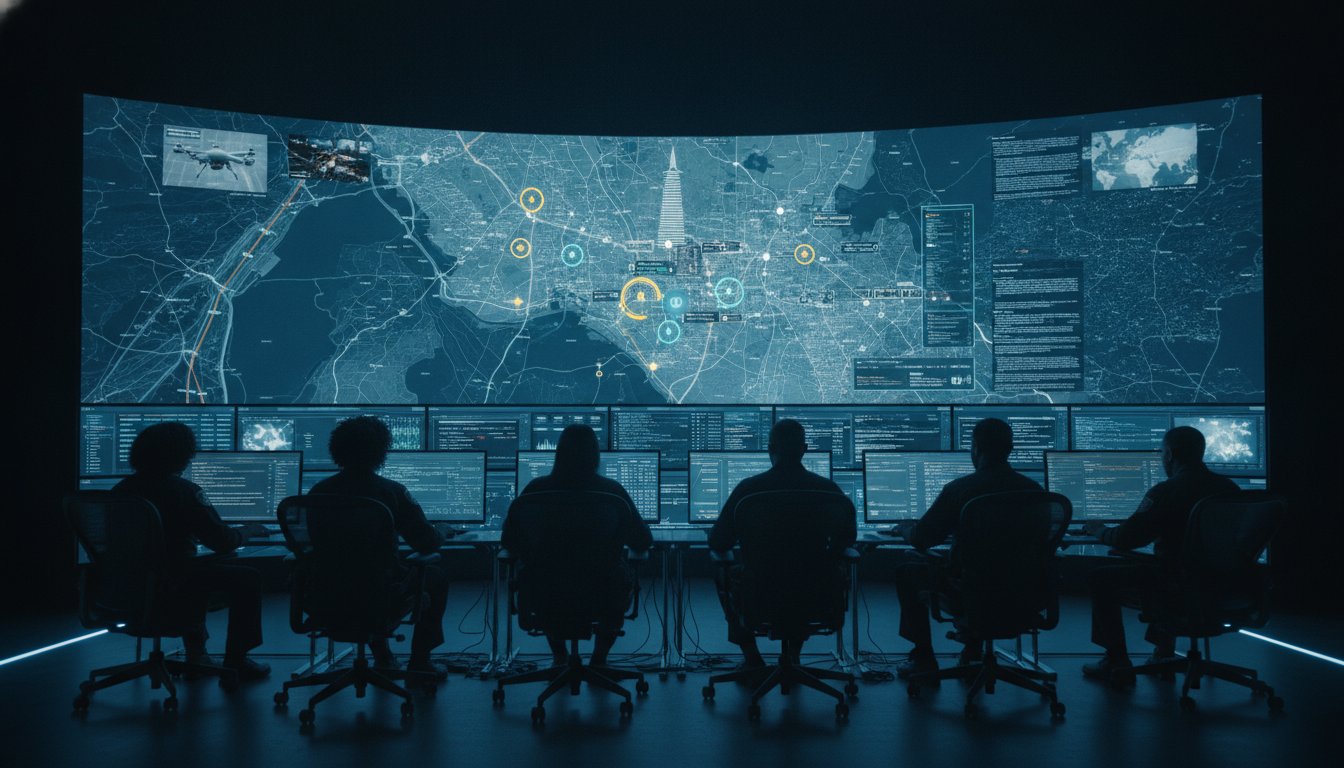
Command centers relying on disconnected screens often function as a liability rather than an asset. This fragmentation causes operator fatigue and hides critical incidents in plain sight. When your team must manually toggle between fragmented applications like Axon or disparate GIS feeds, they aren’t managing an operation; they’re struggling against information silos. These platforms offer valuable data, but they only provide a partial solution that requires a unifying force to be truly effective. Understanding the benefits of a software-defined video wall starts with recognizing that your current hardware is likely underutilized. Most control rooms already have the screens. What they’re missing is the layer that decides what goes on them, and escalates automatically when something needs attention.
We understand the pressure of maintaining absolute situational awareness when seconds dictate the outcome of a mission. This article demonstrates how the vis/ability platform serves as your operational intelligence layer, transforming static pixels into a proactive tool for rapid response. You’ll discover how a software-defined approach reduces cognitive load by automating data escalation and creating a single, unified operating picture. We’ll examine the technical shift from hardware-centric switching to a flexible, IP-based ecosystem that empowers your team to act with total certainty.
Key Takeaways
- Eliminate the risk of “hidden incidents” caused by fragmented data and the manual management of dozens of disconnected applications.
- Understand the strategic benefits of a software-defined video wall for virtualizing data orchestration and removing the limitations of physical cable-patching.
- Move beyond passive displays to an active intelligence layer that uses real-time event triggers to automate situational awareness.
- Bridge the gap between specialized tools like Axon or Milestone by creating a unified operating picture that serves the entire command team.
- Reduce operator cognitive load and accelerate decision-making by prioritizing essential information when stakes are at their highest.
The Crisis of Fragmented Data in Modern Control Rooms
Operators in modern command centers face a mounting crisis of complexity. They are often tasked with monitoring 10 to 15 different applications simultaneously, ranging from VMS and CAD to cybersecurity dashboards and weather feeds. This volume of information creates a dangerous environment where critical data is easily lost in a sea of static monitors. When information is siloed across separate workstations and proprietary hardware, the risk of a “hidden incident” increases. An operator might miss a perimeter breach because they were focused on a network alert on a different screen. This gap between an event occurring and an operator noticing it defines the cost of reactive operations.
Traditional video wall technology frequently exacerbates these issues by relying on rigid hardware-based switching. These systems create physical silos that hinder real-time collaboration. Most control rooms already have the screens. What they’re missing is the layer that decides what goes on them, and escalates automatically when something needs attention. Without this intelligence, the video wall remains a passive display rather than a strategic asset. Transitioning to a software-centric model is essential to realize the full benefits of a software-defined video wall.
Why Operators Miss Incidents on Traditional Video Walls
A “wall of noise” effect occurs when too much unprioritized data floods the room. Operators eventually become desensitized to constant visual movement, leading to missed cues during high-stakes shifts. Manual source switching further complicates response times. During a crisis, an operator shouldn’t have to navigate complex menus or physical patch panels to share a critical feed with the team. This lack of contextual awareness is a primary driver of control room situational awareness problems. When VMS data and SIEM alerts aren’t unified, the team lacks the clear, actionable intelligence required to act with certainty.
The Hidden Cost of Information Silos
Fragmented visualization directly impacts Mean Time to Resolution (MTTR). Every second spent “swivel-chairing” between disconnected tools like Axon or Milestone is a second lost in incident mitigation. These specialized tools only provide a partial view of the operational landscape. Proprietary hardware controllers also carry significant technical debt and a heavy maintenance burden. Organizations need an operational intelligence layer that prioritizes essential information over raw data. By removing these silos, the benefits of a software-defined video wall become clear; it transforms the command center into a proactive, unified environment where data flows seamlessly to those who need it most.
What is a Software-Defined Video Wall Architecture?
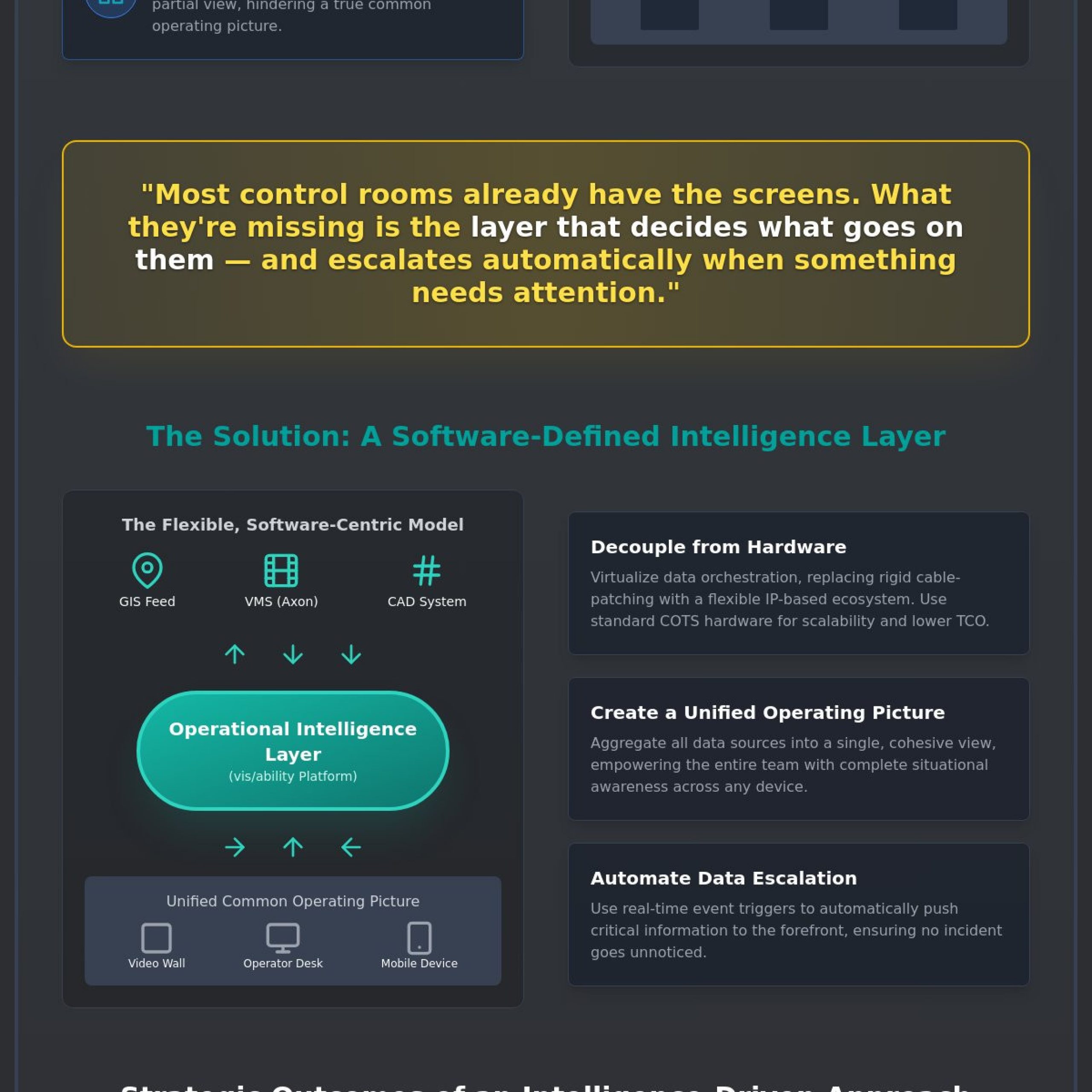
Software-defined visualization represents a fundamental shift in how command centers manage and distribute information. At its core, this architecture decouples content from specific hardware. In a traditional setup, a video feed is tethered to a specific physical port on a matrix switcher. If you want to move that feed, you often deal with complex cable-patching and proprietary configurations that limit flexibility. A software-defined approach replaces this rigidity with virtualized data orchestration. This means every stream, application, and dashboard is treated as a dynamic data source that can be routed to any display on the network without physical reconfiguration.
One of the primary benefits of a software-defined video wall is the ability to leverage Commercial Off-the-Shelf (COTS) hardware. Instead of investing in expensive, specialized processors that become obsolete within a few years, organizations can use standard enterprise servers and networking equipment. This provides a scalable foundation that grows with your operational needs. Most control rooms already have the screens. What they’re missing is the layer that decides what goes on them, and escalates automatically when something needs attention. This is the operational intelligence layer.
From Hardware Switching to Intelligence Layer
Traditional AV matrix switchers operate on a point-to-point basis, which creates significant bottlenecks during complex incidents. Software-defined systems distribute data over standard IP networks, allowing for unlimited flexibility in how information is shared across the organization. This software layer treats every application as a live asset rather than a static image. For critical infrastructure, such as utilities, this architecture supports NERC CIP compliance by providing granular control over data access and visibility. It ensures that sensitive information is only displayed when and where it is authorized, enhancing the overall security posture of the command center.
The Role of Application Integration
Tools like Axon or Milestone are vital for specific tasks, but they only provide a partial solution to the broader operational challenge. A software-defined system acts as a central hub that ingests live feeds from VMS, GIS, and cybersecurity tools into a single environment. Simply being “display agnostic” isn’t enough for high-stakes environments. The data must be interactive and contextually relevant to the mission. A common operating picture is a unified, real-time visualization of all mission-critical data. By centralizing these streams, the vis/ability platform ensures that every team member sees the same reality at the same time. You can learn more about how this integration works by exploring our operational intelligence layer.
Key Benefits of a Software-Defined Video Wall
The primary benefits of a software-defined video wall revolve around the transition from passive observation to active operational intelligence. Most control rooms already have the screens. What they’re missing is the layer that decides what goes on them, and escalates automatically when something needs attention. This intelligence layer removes the burden of constant manual monitoring from the operator. It ensures that the right information reaches the right person at the exact moment it becomes critical, rather than waiting for a human to notice an anomaly on a static display.
Beyond immediate response, these systems address long-term operational health. Intelligent information filtering reduces operator fatigue by hiding irrelevant data until it becomes necessary. This prioritization ensures that decision-makers aren’t overwhelmed by volume but are instead supported by clarity. Additionally, software-defined systems future-proof the organization. By removing reliance on proprietary, end-of-life hardware, agencies can update their capabilities through software cycles rather than expensive, disruptive hardware overhauls. This approach provides a sustainable path for maintaining technological leadership in high-stakes environments.
Event-Driven Escalation and Automation
Event-driven situational awareness changes the fundamental workflow of a NOC or SOC. Instead of operators staring at a “wall of noise,” the system remains in a state of high readiness, only changing the video wall layout when a specific trigger occurs. This might be a SIEM alert, a sensor breach, or a geospatial threshold. This shift allows teams to manage incidents by exception. For transportation hubs and public safety agencies, this means immediate visual confirmation of an incident without manual intervention, significantly reducing the gap between detection and action.
Unified Collaboration Across the Enterprise
Mission-critical operations rarely happen within the four walls of a single room. A software-defined architecture enables seamless collaboration across the entire enterprise. The vis/ability platform acts as a central hub, ensuring that a “single version of the truth” is available to commanders in the EOC, supervisors in huddle rooms, and responders on mobile devices. By providing a common operating picture that is accessible anywhere, the platform empowers individuals to act with greater certainty, regardless of their physical location. This enterprise-wide visibility is a cornerstone of modern operational readiness.
Managing Multiple Data Feeds in a Unified Operating Picture
Managing high-stakes operations requires more than just access to data; it requires the synthesis of that data into a coherent narrative. Traditional environments often force operators into “swivel-chair” management, where they must constantly jump between disconnected tools like Axon for video evidence, Milestone for security management, and Okta for identity verification. This fragmentation creates a fractured reality where critical connections between digital and physical events are easily missed. Most control rooms already have the screens. What they’re missing is the layer that decides what goes on them, and escalates automatically when something needs attention.
This is where the benefits of a software-defined video wall become most apparent. By acting as an operational intelligence layer, the system unifies these disparate feeds into a single pane of glass. Techniques like geospatial overlays allow teams to see the physical location of an incident alongside real-time event-driven dashboards. For this visualization to support real-time decision-making, the architecture must prioritize secure, low-latency streaming. This ensures that the information on the wall is a precise reflection of the current environment, providing the bedrock upon which certain action is taken. To understand how to reliably stream high-quality broadcast content into this ecosystem, check out Edge IPTV.
Integrating Fragmented Cybersecurity and Physical Security
Tools like Axon are vital for evidence and situational awareness, but they only provide a partial solution. To achieve a full common operating picture (COP), organizations must bridge the gap between cybersecurity alerts and physical site security. A software-defined layer allows you to visualize threat intelligence from your SIEM directly alongside live camera feeds and access control logs. This holistic view is essential for identifying sophisticated attacks that span both digital and physical domains. To see how this integration strengthens your defense, explore our Cybersecurity Common Operating Picture solutions.
Reducing Cognitive Load Through Layout Automation
Continuous monitoring of dozens of static feeds leads to rapid cognitive decline and operator fatigue. Software-defined systems solve this by using incident-specific layouts that only display data relevant to the current threat or mission. During normal operations, the video wall can maintain a “quiet” state, showing only high-level KPIs or a standard geospatial map. When a trigger occurs, the system automatically reconfigures the display to show the most critical assets. These automated layouts prevent operators from missing critical alerts during high-stress moments or vulnerable periods like shift changes. If you are ready to eliminate information silos in your command center, contact our team for a system assessment.
Optimizing Command Decisions with vis/ability
Achieving absolute clarity in a high-pressure environment requires a departure from traditional, reactive monitoring. The vis/ability platform serves as the essential bedrock for mission-critical situational awareness, providing the structure needed to navigate complex data landscapes. By consolidating fragmented inputs into a single, cohesive interface, vis/ability empowers individuals to act with greater certainty. This transition from a passive display to a proactive, event-driven intelligence hub ensures that decision-makers are never looking for the truth; they’re acting upon it. Most control rooms already have the screens. What they’re missing is the layer that decides what goes on them, and escalates automatically when something needs attention.
The strategic benefits of a software-defined video wall extend beyond the physical boundaries of the command center. This architecture enables a seamless flow of intelligence that supports every phase of an operation, from initial detection to final resolution. When your technology functions as a vigilant guardian, it filters out the noise and highlights the signals that require immediate human judgment. This allows your team to maintain a steady, analytical focus even when stakes are at their highest. Seeing the platform in action through a tailored demonstration reveals how this operational intelligence layer transforms raw data into a decisive advantage; for those interested in the broader evolution of high-impact visual media in public spaces, read more.
The vis/ability Operational Intelligence Layer
vis/ability unifies the entire enterprise by serving as the central hub for all operational data. Whether your team is stationed in a primary command center, collaborating in a huddle room, or responding in the field via mobile devices, everyone accesses the same real-time intelligence. The platform’s human-centric design prioritizes what matters most to the operator, reducing the mental friction of managing multiple systems. This focus on the human element ensures that technical tools empower, rather than overwhelm, the individuals responsible for critical outcomes. For a deeper analysis of these strategies, consult our Strategic Guide to Mission-Critical Situational Awareness.
Next Steps for Your Command Center
Modernizing your infrastructure is a prerequisite for maintaining operational continuity in an increasingly volatile world. Software-defined systems provide the resilience and flexibility required to adapt to new threats and evolving mission requirements without the need for constant hardware replacement. This approach ensures that your command center remains a quiet, powerful engine behind every successful operation. We invite you to take the next step in securing your operational readiness. Contact Activu today to schedule a comprehensive audit of your current video wall environment and discover how an intelligence layer can redefine your command capabilities.
Transitioning to Proactive Operational Intelligence
The evolution of the command center depends on moving past the limitations of static hardware. We’ve explored how virtualizing data orchestration removes information silos and addresses the primary causes of operator fatigue. By implementing an operational intelligence layer, organizations can ensure that critical data is never lost in a sea of monitors. One of the most significant benefits of a software-defined video wall is the ability to automate situational awareness, allowing your team to focus exclusively on high-value decision-making. Most control rooms already have the screens. What they’re missing is the layer that decides what goes on them, and escalates automatically when something needs attention.
Activu has been at the forefront of this technology since 1983, providing decades of mission-critical expertise and national coverage for end-to-end control room design. We specialize in event-driven situational awareness that transforms how teams respond to crises. It’s time to equip your operators with the clarity they need to act with total certainty. Request a vis/ability Demo to Transform Your Control Room Operations. Your mission depends on the quality of your intelligence, and we are ready to help you secure it.
Frequently Asked Questions
What is the difference between a hardware-based and a software-defined video wall?
Hardware-based walls rely on proprietary matrix switchers and physical cabling, which creates rigid silos and limits scalability. Software-defined architecture virtualizes data orchestration, allowing any source to reach any screen over a standard IP network. This shift removes the bottlenecks of physical ports and enables a flexible environment where content is decoupled from specific hardware.
Can a software-defined video wall integrate with my existing VMS and SIEM tools?
Yes, the vis/ability platform is designed to integrate with disparate VMS and SIEM tools. While specialized tools like Axon or Milestone provide essential data, they often operate as partial solutions in isolation. Our platform acts as the unifying hub that brings these feeds into a single, comprehensive common operating picture for the entire team.
How does a software-defined video wall reduce operator fatigue?
Software-defined systems reduce fatigue by automating information prioritization and filtering out noise. Instead of operators monitoring dozens of static feeds, the system uses event-driven triggers to change layouts only when an incident requires attention. One of the key benefits of a software-defined video wall is this transition to managing by exception, which significantly lowers cognitive load.
Is software-defined visualization secure enough for government or defense operations?
Software-defined visualization provides a high level of security suitable for defense and government operations. By utilizing secure IP protocols and granular access controls, the system ensures that sensitive data is only visible to authorized personnel. This architecture supports rigorous compliance standards and offers better visibility into the cybersecurity posture of the command center itself.
Do I need to replace all my existing screens to move to a software-defined system?
No, you don’t need to replace your existing displays to adopt this architecture. Most control rooms already have the screens. What they’re missing is the layer that decides what goes on them, and escalates automatically when something needs attention. We leverage your current infrastructure while adding the operational intelligence layer required for modern operations.
What happens if the software-defined controller fails during a critical incident?
The architecture is built for mission-critical resilience and high availability. Unlike traditional systems that rely on a single hardware processor, a software-defined environment uses distributed processing and redundant servers. If one node fails, the system automatically reroutes data to ensure that situational awareness remains uninterrupted during a critical incident.
Can operators access the video wall content from a mobile device or home office?
Yes, the platform extends situational awareness beyond the physical command center. Operators can access the same unified operating picture from huddle rooms, mobile devices, or remote locations. This ensures that field responders and off-site supervisors have access to the same single version of the truth as the personnel in the room.
How much does it cost to upgrade to a software-defined video wall system?
Costs are determined on a case-by-case basis depending on the scale and complexity of the operation. Because the system utilizes Commercial Off-the-Shelf (COTS) hardware, organizations often see a lower total cost of ownership compared to proprietary hardware systems. We provide tailored quotes that reflect the specific integration and scalability requirements of your command center.