

Operators in high-stakes environments often struggle with fragmented data feeds and visual clarity that degrades over a long shift. When a critical incident occurs, the difference between a rapid resolution and a system failure often depends on the reliability of the displays in front of the team. You likely feel that high-definition screens from a retail store provide sufficient monitoring for your operations. However, the choice between a professional video wall vs multiple consumer TVs involves hidden risks that only surface during a crisis. System downtime or obscured data points represent a direct failure of situational awareness that your organization cannot afford.
A reliable common operating picture requires a foundation built on industrial reliability and technical precision. Most control rooms already have the screens. What they’re missing is the layer that decides what goes on them; and escalates automatically when something needs attention. This article examines how professional systems provide the 100,000-hour durability and seamless integration needed to reduce mean time to resolution (MTTR). We explore how an operational intelligence layer transforms disparate data streams into actionable intelligence, ensuring your team has the clarity required for high-stakes decision-making.
Key Takeaways
- Understand the engineering differences between 24/7 professional hardware and 8/5 consumer displays to ensure your command center remains operational during critical incidents.
- Evaluate the total cost of ownership by identifying hidden risks, such as voided warranties and the inability to remotely manage consumer hardware via LAN or RS-232.
- Contrast the technical limitations of a professional video wall vs multiple consumer TVs to see how true situational awareness relies on more than just high-resolution glass.
- Learn how an operational intelligence layer filters fragmented data streams, reducing operator fatigue and preventing the loss of vital information during high-stakes events.
- Discover how the vis/ability platform serves as a unifying hub, transforming disparate feeds into a clear and actionable common operating picture for your entire team.
Engineering for 24/7 Reliability: Why Professional Displays Outperform Consumer TVs
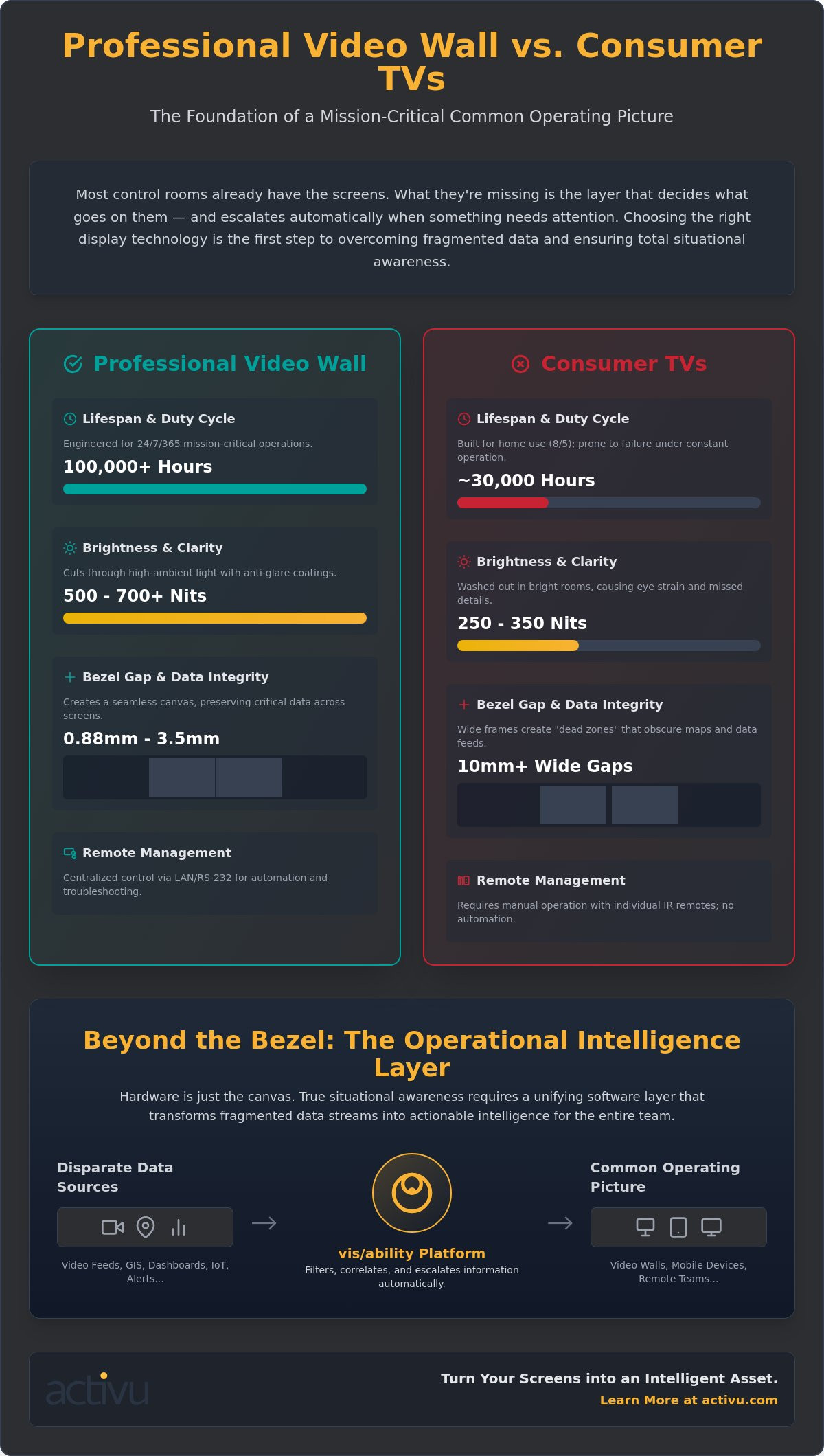
Operational failure in a command center is often traced back to hardware that was never designed for the job. The comparison of a professional video wall vs multiple consumer TVs starts with the internal circuitry, not just the screen size. Consumer units are engineered for a standard duty cycle of six to eight hours per day. In contrast, professional displays are built for 24/7 operation, featuring industrial-grade components that withstand the relentless demands of a mission-critical environment. Using retail displays in a high-stakes hub introduces a point of failure that can compromise situational awareness when it matters most.
This requirement for industrial-grade reliability extends to all high-stakes environments, including large-scale corporate productions and events. For organizations needing to maintain these high standards on a project basis, NextGen AV provides professional audio-visual equipment rentals and production services across Australia.
Brightness and visibility are equally decisive factors. Standard consumer TVs typically offer 250 to 350 nits of brightness, which often proves insufficient in the high-ambient light of a modern SOC, NOC, or Fusion Center. Professional panels provide 500 to 700 nits or more, paired with advanced anti-glare coatings. These features ensure that operators can monitor critical data without struggling against reflections or washed-out imagery, maintaining clarity across every shift.
Duty Cycles and Thermal Management
Constant operation generates significant heat, especially when screens are mounted in tight, stacked configurations. Consumer TVs lack the robust thermal management systems required to dissipate this heat effectively. Without active cooling or specialized heat sinks, these panels suffer from rapid thermal degradation. This leads to “burn-in,” where static UI elements become permanently ghosted on the screen, and significant color shifting that distorts critical visual data. Professional hardware incorporates sophisticated airflow designs and high-efficiency power supplies engineered to handle voltage fluctuations and the thermal stress of a 100,000-hour lifespan.
The Bezel Gap and Data Integrity
A video wall must provide a continuous, unified canvas to be effective for geospatial oversight or complex system monitoring. Consumer TVs feature wide plastic frames that create massive “dead zones” when tiled together. These gaps can easily obscure a moving target on a map, a specific sensor reading, or a line of code in a dense data feed. Professional panels utilize ultra-narrow bezels, ranging from 3.5mm down to a nearly invisible 0.88mm. This near-seamless transition preserves data integrity across the entire surface. Beyond the technical loss of information, fragmented visuals increase cognitive load. Operators must mentally “bridge the gap” between screens, which accelerates fatigue and increases the likelihood of missing a subtle but vital incident indicator.
The Hidden Risks and Lifecycle Costs of Consumer Hardware
The upfront price of a retail display is often a decoy that hides the true cost of ownership. While the initial savings seem attractive, the “replacement churn” associated with consumer-grade hardware quickly erodes any perceived benefit. Consumer TVs are built for a lifespan of roughly 30,000 to 40,000 hours, whereas professional panels are rated for 100,000 hours or more. When a consumer unit fails in a mission-critical hub, the costs aren’t limited to the hardware. You must also account for the labor of unmounting, the risk of damaging adjacent screens, and the inevitable downtime during the swap.
To mitigate these lifecycle risks, organizations often partner with experts like AVI Plus to ensure their professional screen installations are built for commercial-grade reliability and longevity from the start.
Remote management is another critical gap. Consumer models lack the centralized control interfaces, such as RS-232 or LAN ports, that allow IT teams to automate power cycles, adjust brightness, or troubleshoot from a central desk. In a high-stakes environment, operators shouldn’t have to walk around with a plastic infrared remote to manage individual screens. When evaluating a professional video wall vs multiple consumer TVs, the ability to orchestrate the entire display surface as a single, manageable asset is a requirement, not a luxury.
Sourcing identical hardware is a persistent challenge with retail models. Consumer SKUs change rapidly, often every six to nine months. If a single panel in a twelve-screen array fails after a year, finding an exact replacement with the same bezel width and chassis depth is nearly impossible. This forces agencies to either accept a mismatched, unprofessional appearance or replace the entire wall to maintain visual consistency. If you’re planning a new facility, our control room design services can help you avoid these costly lifecycle pitfalls from the start.
Warranty and Compliance Limitations
Using a consumer TV in a 24/7 commercial environment typically voids the manufacturer’s warranty immediately. This legal reality leaves your organization fully liable for all repair and replacement costs. For utilities and government agencies, this choice can also jeopardize NERC CIP compliance or enterprise insurance coverage, as these frameworks often mandate industrial-grade infrastructure. Professional systems are designed to meet these rigorous standards, ensuring your facility remains a reliable foundation for resilient operations.
The Re-Calibration Nightmare
Even if you manage to find a similar model for a replacement, a new consumer TV will never naturally match the color profile of panels that have been running for thousands of hours. This creates a distracting “checkerboard” effect that can lead to data misinterpretation. Professional panels include specialized internal sensors and calibration software. These tools allow technicians to color-match an entire array to within a few degrees of Kelvin, ensuring that a red alert icon looks identical on every square inch of the wall.
Beyond the Bezel: The Role of the Operational Intelligence Layer
Command centers often operate with a surplus of visual surface area but a deficit of meaningful insight. This operational gap occurs when data remains trapped within individual applications, forcing operators to manually piece together a narrative during a crisis. Most control rooms already have the screens. What they’re missing is the layer that decides what goes on them — and escalates automatically when something needs attention.
The technical distinction between a professional video wall vs multiple consumer TVs resides in the orchestration of data. While retail displays rely on manual input switching or basic hardware splitters, a professional system utilizes an operational intelligence layer. This software-driven approach transforms a wall of monitors into a single, cohesive common operating picture. It acts as the central nervous system of the command center, ensuring that the right information reaches the right people at the precise moment it is required.
Many teams rely on specialized evidence management platforms or real-time sensor tools. While these systems provide critical data, they offer only a partial solution for a comprehensive command operation. Without a unifying layer to aggregate these feeds alongside VMS, SIEM, and geospatial data, your team is left toggling between windows during a high-stakes event. A professional system integrates these disparate tools into a unified hub, making every piece of technology in the room more effective for the entire team.
Aggregating Complex Data Streams
Using multiple consumer TVs often forces a “monitor per app” architecture. Operators are assigned specific screens for specific tasks, which limits their ability to see the big picture. If an incident spans multiple systems, the information remains physically separated by plastic bezels and hardware limits. A professional video wall allows data to flow across the entire canvas regardless of physical boundaries. It dynamically aggregates real-time video, data visualizations, and live sensor feeds into a flexible layout that prioritizes essential information over raw data dumps.
Event-Driven Situational Awareness
True operational intelligence is proactive. Professional systems respond to external triggers, such as a security breach, a sudden power outage, or a critical system failure. When an event occurs, the vis/ability Platform can automatically reconfigure the entire video wall to show the most relevant data. This transition from manual monitoring to automated escalation ensures that operators never miss an incident. By removing the manual burden of data management, your team can focus entirely on the human judgment required to resolve the crisis.
Reducing Operator Fatigue and Cognitive Overload
The human element is the most critical component of any command center. When operators monitor a grid of consumer TVs, they aren’t just looking at data; they’re fighting their own biology. The physical gaps between screens and the lack of color uniformity force the brain to work harder to interpret a scene. This constant cognitive strain leads to fatigue, which directly correlates with a higher risk of missing subtle incident indicators. Choosing a professional video wall vs multiple consumer TVs is fundamentally a choice about supporting the human decision-makers who manage your operations.
Reliable situational awareness requires a visual environment that minimizes distractions. In high-stakes environments, the goal is to prioritize essential information rather than overwhelming the team with raw data dumps. A professional system provides the visual continuity necessary to maintain focus during long shifts, ensuring that the “mean time to resolution” remains low even during complex, multi-faceted incidents.
The Psychology of Visual Fragmentation
Large bezels on retail displays create a “jail cell” effect that disrupts the flow of visual information. The human brain naturally attempts to “knit together” these broken images, a process that consumes mental energy over a long shift. Professional panels minimize this burden with ultra-narrow bezels that allow for a fluid, continuous operating picture. Additionally, professional calibration prevents the eye strain caused by inconsistent brightness levels across the wall. In low-light control rooms, this precision ensures that operators remain alert and focused throughout their entire watch, reducing the psychological friction of data interpretation.
Automated Escalation and Focus
Raw data dumps are the enemy of clarity. Most control rooms already have the screens. What they’re missing is the layer that decides what goes on them; and escalates automatically when something needs attention. By implementing an operational intelligence layer, you transition to “management by exception.” The system acts as a sophisticated filter, only surfacing the most critical information when specific triggers are met. This prevents information overload and ensures that the team’s attention is always directed toward the highest-priority threat. For a deeper look at these principles, consult The Video Wall: A Strategic Guide.
Situational awareness shouldn’t stop at the control room door. Mobile vis/ability extends this intelligence to distributed teams, providing them with the same filtered, high-priority data on their personal devices. This ensures that field personnel and remote executives stay informed without being buried under irrelevant feeds. To optimize your facility for peak operator performance, explore our control room design services.
Activu Corporation vis/ability: Turning Glass into Operational Intelligence
Raw hardware provides the canvas, but Activu Corporation provides the intelligence required to navigate complex operational landscapes. While earlier discussions detailed why a professional video wall vs multiple consumer TVs offers superior durability and visual continuity, the ultimate value lies in how these tools empower the human operator. Activu Corporation vis/ability serves as the operational intelligence layer that unifies your entire technological ecosystem, ensuring that every decision is backed by a complete and accurate common operating picture. This platform acts as the bedrock for critical decision-making, transforming standard video displays into a powerful engine for situational awareness.
Every sector faces distinct challenges that generic retail solutions cannot address. Activu Corporation provides end-to-end design services to ensure your hardware and software are perfectly aligned with your mission. Whether you are managing complex power grids in Utilities or coordinating emergency responses in Public Safety, our experts engineer a solution that mirrors your specific operational reality. This human-centric approach prioritizes the individual’s ability to act with greater certainty when stakes are at their highest.
Unified Visibility Across the Enterprise
Operational intelligence must remain accessible beyond the walls of the primary command center. The vis/ability platform extends critical data to huddle rooms and mobile devices, keeping the entire organization synchronized. This enterprise-wide visibility is especially vital for a cybersecurity common operating picture. By visualizing network alerts alongside physical security feeds, Activu Corporation ensures that your team maintains a holistic view of all potential threats, whether they originate in the digital or physical realm.
Engineering Your Mission-Critical Future
Building a future-ready command center requires a collaborative partnership that goes beyond a hardware transaction. Activu Corporation experts work with your team to design a facility that addresses your specific operational gaps and prepares you for evolving challenges. This process involves a deep analysis of your data flows and team dynamics to ensure the resulting environment supports maximum efficiency. Most control rooms already have the screens. What they’re missing is the layer that decides what goes on them — and escalates automatically when something needs attention. By focusing on the human element within a digital context, we help you build a resilient foundation for the years ahead. Contact Activu Corporation today to move from a simple collection of screens to a sophisticated, intelligent operational hub.
Transitioning to Intelligent Command Operations
High-stakes oversight demands more than just high-definition glass. The technical comparison of a professional video wall vs multiple consumer TVs proves that retail hardware cannot sustain the 24/7 duty cycles required for resilient operations. Beyond the hardware; the true operational advantage lies in the intelligence layer that unifies siloed data and eliminates the cognitive strain caused by fragmented visuals. Your team needs a foundation that remains focused and analytical when the stakes are at their highest.
Founded in 1983; Activu brings decades of mission-critical experience to leaders in Federal Defense, Public Safety, and Global Energy. Our event-driven automation serves as a vigilant guardian; filtering noise to reduce mean time to resolution during your most pivotal moments. Most control rooms already have the screens. What they’re missing is the layer that decides what goes on them; and escalates automatically when something needs attention. Transitioning to a proactive common operating picture ensures that no critical incident goes unnoticed.
Empower your operators to act with greater certainty and absolute clarity. Request a Demo of the vis/ability Platform today to see how we transform standard displays into a sophisticated operational hub.
Frequently Asked Questions
Is it possible to use consumer TVs for a video wall in a 24/7 NOC?
No; consumer TVs lack the industrial-grade cooling and power supplies required for 24/7 operation. When comparing a professional video wall vs multiple consumer TVs; the retail models fail prematurely because they aren’t designed for the thermal stress of constant uptime. Using them in a Network Operations Center (NOC) leads to rapid panel degradation; including permanent image burn-in and significant color shifting that distorts critical data.
What is the main difference between a video wall controller and a simple HDMI splitter?
An HDMI splitter merely duplicates a single signal across multiple screens; showing the same image everywhere. A video wall controller is a sophisticated processor that manages multiple inputs and allows you to resize; move; and layer data feeds across the entire canvas. It enables the creation of a unified common operating picture; providing the flexibility needed to monitor complex geospatial data and live video feeds simultaneously.
How does bezel size affect operator performance in a command center?
Large bezels on consumer TVs create “dead zones” that obscure critical information like map coordinates or sensor data. This fragmentation forces the brain to mentally bridge the gaps; which increases cognitive load and operator fatigue during long shifts. Professional panels feature ultra-narrow bezels that ensure visual continuity; allowing for faster incident detection and reduced eye strain for the entire team.
Why do consumer TV warranties often exclude use in a SOC or EOC?
Consumer warranties explicitly exclude commercial or 24/7 use because the hardware isn’t engineered for constant operation. Manufacturers design retail models for a standard duty cycle of six to eight hours per day. Professional displays include warranties that cover round-the-clock operation in mission-critical environments like a Security Operations Center (SOC) or Emergency Operations Center (EOC); ensuring your facility remains compliant and insured.
Can professional video wall software integrate with my existing security cameras and SIEM?
Yes; the vis/ability platform is built to ingest data from disparate sources including VMS; SIEM; and CAD systems. Most control rooms already have the screens. What they’re missing is the layer that decides what goes on them; and escalates automatically when something needs attention. This integration ensures all your existing tools flow into a single; unifying hub for better situational awareness.
What is an operational intelligence layer in the context of situational awareness?
An operational intelligence layer is the software hub that orchestrates your data and automates situational awareness. It moves beyond simple video monitoring by filtering raw data and only surfacing essential information during an incident. This layer ensures that your team focuses on human judgment rather than manually managing multiple data feeds; reducing the mean time to resolution (MTTR) during a crisis.
How often do professional video wall panels need to be replaced compared to consumer TVs?
Professional panels are typically rated for 100,000 hours of operation; while consumer TVs often fail after 30,000 to 40,000 hours. In the context of a professional video wall vs multiple consumer TVs; the professional system offers a lifespan two to three times longer. This significantly reduces the long-term total cost of ownership and prevents the frequent replacement churn that disrupts mission-critical operations.
What happens to a video wall if one screen fails?
If a professional panel fails; it can be replaced with an identical model and re-calibrated to match the color and brightness of the rest of the wall. With consumer TVs; rapid SKU turnover makes finding a matching replacement nearly impossible after 12 months. This often leaves organizations with a mismatched display or forces them to replace the entire wall to maintain visual integrity across the command center.