
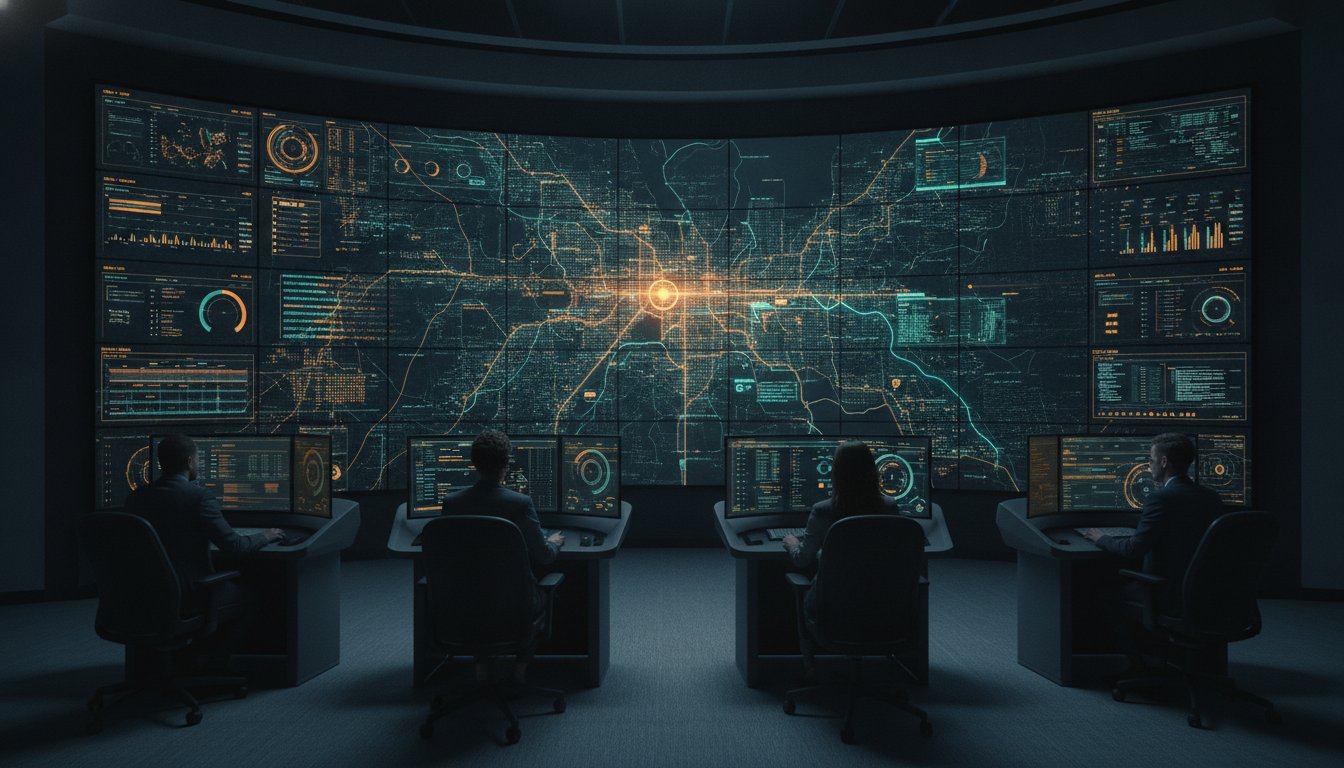
The most sophisticated command center in the world remains vulnerable if its operators are forced to hunt for information across fragmented screens. While many organizations invest in a distributed team collaboration platform to connect remote and on-site personnel, these tools often fail during the moments that matter most. You’ve likely experienced the fatigue of monitoring dozens of siloed data streams while critical incidents slip through the cracks due to communication lag. Most control rooms already have the screens. What they’re missing is the layer that decides what goes on them; and escalates automatically when something needs attention.
This article demonstrates how to transition from passive monitoring to a proactive operational intelligence layer. You’ll learn to create a unified operating picture that reduces operator fatigue and ensures seamless situational awareness across your entire enterprise. We will examine why many specialized platforms only provide a partial solution and how vis/ability serves as the unifying hub for total visibility. This approach provides the technical framework needed to turn raw data into actionable clarity for every team member, regardless of their location.
Key Takeaways
- Identify why fragmented systems and siloed data streams create cognitive overload for operators in high-stakes environments.
- Discover how an event-driven distributed team collaboration platform automates situational awareness by escalating critical events to the right personnel instantly.
- Learn how to move beyond passive video walls by implementing an intelligence layer that automatically filters and displays information based on operational priority.
- Explore methods for extending a unified operating picture beyond the command center to huddle rooms and mobile devices for seamless field coordination.
- Understand how integrating disparate tools into a single hub ensures operational resilience across utilities, transportation, and government sectors.
The Failure of General Collaboration Platforms in High-Stakes Operations
Operators in high-stakes environments often find themselves surrounded by sophisticated hardware but starved for actionable intelligence. The operational reality is a collection of fragmented systems that create siloed data. While a standard distributed team collaboration platform works well for marketing teams or software developers, it fails when seconds determine the outcome of a mission-critical incident. These general tools prioritize conversation over context, leading to a “noise problem” where critical alerts are buried under a mountain of non-essential chat notifications.
Project management and office communication software lack the capacity for real-time data ingestion required for a Security Operations Center (SOC). They’re built for asynchronous updates, not the immediate requirements of emergency response or utility grid management. Operators miss incidents because they’re forced to monitor too many disconnected streams, resulting in cognitive overload that slows decision-making. When the environment demands absolute precision, relying on tools designed for general business leads to dangerous visibility gaps.
Establishing a professional security operation requires more than just high-end software; for those in the planning stages, resources on how to start a security guard company offer the coaching and mentorship needed to build a resilient business from the ground up.
The Gap Between Communication and Situational Awareness
Situational awareness in a distributed command center requires more than just knowing that a team member is online. It demands a Common Operating Picture that provides visual verification of an event. Office-centric tools fail here because they don’t provide a unified operating picture. They rely on text-based descriptions of complex, evolving threats. In a high-pressure environment, reading a description is no substitute for seeing a live data feed or a geospatial overlay. This gap between communication and visual reality is where errors occur and response times lag.
Fragmented Systems and the Cost of Delayed Response
Many organizations suffer from “swivel-chair” operations, where operators must constantly move between disparate applications to piece together an event. Some teams use specialized tools to manage body camera footage, but these only provide a partial solution. Without a central hub to unify these feeds with other critical data, silos remain. This fragmentation is particularly dangerous when attempting to build a cybersecurity common operating picture. Every second spent switching between tabs or logging into different portals is a second lost in response time. A true distributed team collaboration platform for mission-critical work must aggregate real-time data and video streams into a single, authoritative view. This ensures that when a crisis hits, the focus remains on the solution rather than the software.
Solving Situational Awareness Problems with Event-Driven Intelligence
Efficiency in mission-critical environments relies on the transition from reactive observation to proactive response. Standard collaboration tools focus on the exchange of messages, but an effective distributed team collaboration platform must prioritize the exchange of intelligence. Operators shouldn’t spend their time searching for data. Instead, the data should find the operator. This shift is made possible through automated triggers that activate specific visual workflows the moment an anomaly is detected, drastically reducing the time between detection and action.
While specialized evidence management tools provide critical data for public safety, they often function as standalone repositories. They capture and store evidence, but they don’t naturally push that information to every stakeholder who needs it in real time. A unified hub transforms these tools from isolated data sources into components of a larger, more effective system. By integrating these feeds, teams gain a comprehensive view that a standard distributed team collaboration platform simply cannot replicate. This ensures that every tool in your stack contributes to a collective understanding of the operational environment.
Automating Workflows for Faster Incident Response
Automation is the most effective way to remove human error from the escalation process. In utility control rooms, a sensor alert regarding a substation failure shouldn’t wait for a manual report. In transportation hubs, a sudden drop in traffic flow should automatically trigger camera feeds at the nearest intersection. These triggers ensure that the right information reaches the right people without delay. Event-driven situational awareness serves as the essential bridge between raw data and human judgment, allowing teams to act with certainty rather than hesitation.
Integrating Specialized Tools into a Unified View
Standalone threat intelligence platforms and SIEM systems are excellent at identifying digital anomalies, but they often lack a collaborative visual component. An operational intelligence layer is necessary to unify SIEM and SOAR data into a format that the entire team can understand and act upon. The vis/ability Platform functions as this central hub, pulling data from disparate sources and presenting it as a cohesive narrative. This integration ensures that cybersecurity teams and physical security operators are looking at the same reality. Organizations looking to modernize their response can see how this works within specialized public safety environments to improve total awareness.
The Operational Intelligence Layer: Beyond Passive Video Walls
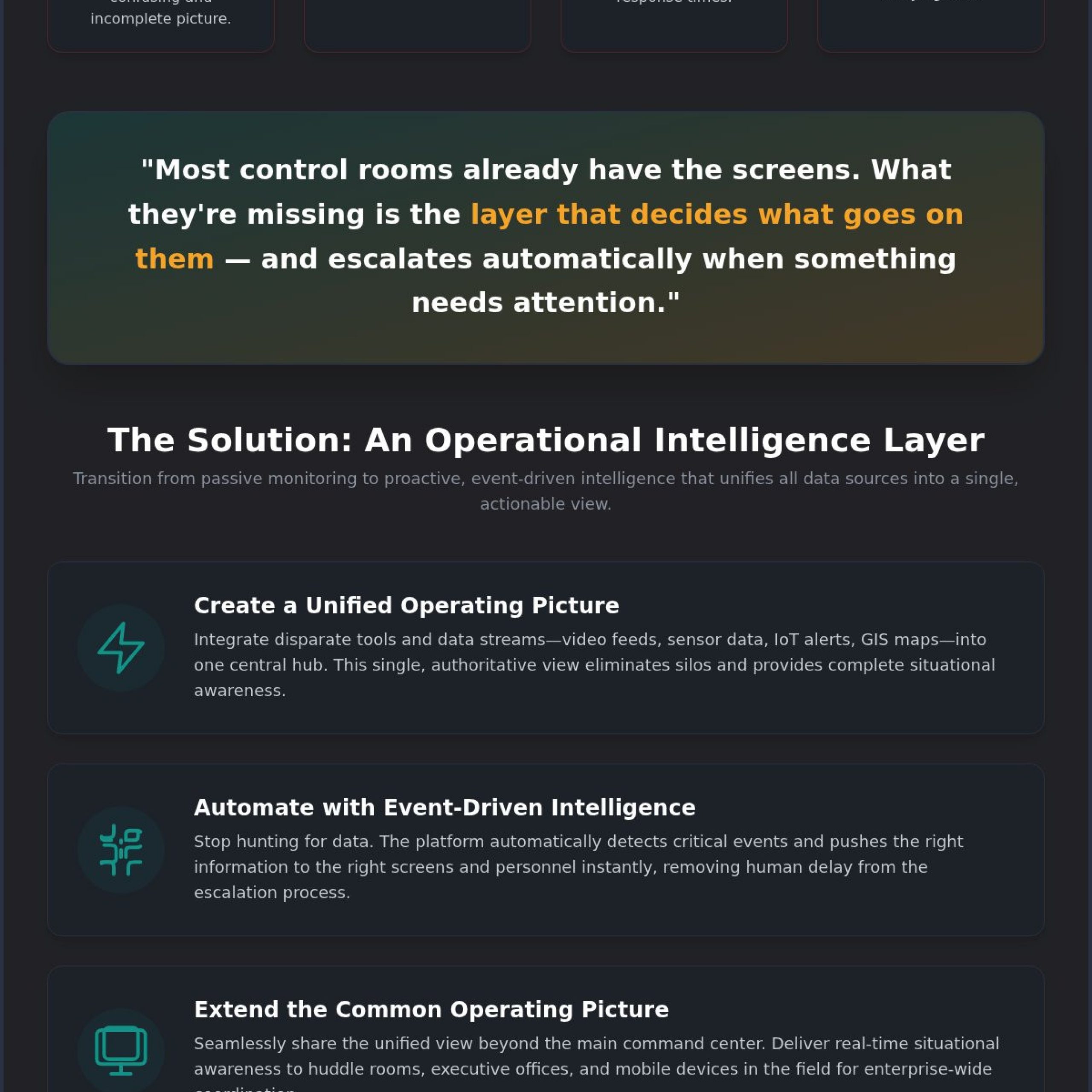
Most control rooms already have the screens. What they’re missing is the layer that decides what goes on them; and escalates automatically when something needs attention. This distinction is critical for any high-stakes environment. While a standard distributed team collaboration platform might facilitate a group chat, it cannot manage the deluge of data feeds coming into a modern dispatch center. A passive video wall is merely a collection of pixels. An active common operating picture, however, uses intelligence to prioritize what operators see based on the severity of the incident. This ensures that a critical sensor alert or a security breach is never lost in a sea of secondary information.
Passive Display vs. Active Intelligence
Traditional video wall controllers are often limited to manual switching or basic scheduling. This places the burden on the operator to decide which feed is important during a crisis. Intelligent software platforms remove this cognitive load by automating content management. When a threshold is met, the system pushes the relevant data to the forefront. This reduces operator fatigue and ensures that attention remains focused on resolution rather than navigation. The following comparison highlights the fundamental differences between general tools and specialized operational layers.
| Feature | General Collaboration | Operational Intelligence Layer |
|---|---|---|
| Data Ingestion | Manual and Asynchronous | Real-time and Automated |
| Visual Hierarchy | User-defined and Static | Event-driven and Dynamic |
| Escalation | Notification-based | Automated Visual Trigger |
Optimizing the Environment for Decision-Making
Operational readiness depends on both the software and the physical layout of the workspace. Professional control room design services ensure that the technical infrastructure supports the human element. High-quality Video Wall Systems act as the canvas for mission-critical data, but the vis/ability platform serves as the brain. It coordinates between the hardware and the software layer, ensuring that clarity is maintained even as complexity increases. By managing multiple data feeds simultaneously, it provides a bedrock for certain decision-making. This integration allows the distributed team collaboration platform to extend beyond a simple chat app, becoming a vital part of the tactical environment that empowers operators to act with absolute confidence.
Extending the Common Operating Picture to Distributed Field Teams
A true distributed team collaboration platform must ensure that a field agent standing miles away from headquarters sees exactly what the commander sees on the main video wall. Standard mobile apps often limit field personnel to text-based updates, which creates a dangerous disparity in situational awareness. What they’re missing is the layer that decides what goes on them; and escalates automatically when something needs attention. By extending this intelligence layer to mobile devices and huddle rooms, organizations maintain a cohesive narrative across all echelons of the operation, regardless of time zones or physical location.
Federal and defense teams require secure, reliable transport of critical data to maintain a common operating picture in austere environments. Relying on general chat tools for these missions is insufficient; these teams need the same visual reality as the command center to act with certainty. The operational intelligence layer provides this by serving as the central hub into which all other tools flow, ensuring that field-level decisions are based on the same real-time data as those made at headquarters.
Extending Visibility Beyond the Control Room
Ensuring parity of information between on-site and remote operators is the only way to eliminate communication lag. Mobile vis/ability tools allow field agents to access real-time video wall feeds directly on their devices, providing them with the geospatial oversight and data analysis needed for rapid response. In public safety environments, this might mean a tactical team seeing a live drone feed and floor plans simultaneously while the dispatch center coordinates the broader response. This level of integration ensures that every team member, whether in a command center or a mobile unit, operates from a single, authoritative source of truth.
Steps to Implement a Distributed Operational Intelligence Layer
Transitioning to a unified distributed team collaboration platform requires a methodical approach to ensure technical reliability and operational readiness. Follow these steps to bridge the gap between your command center and field teams:
- Step 1: Audit existing data silos and blind spots. Identify where data is being collected but not shared. This often includes standalone video management systems or siloed threat intelligence platforms that don’t communicate with the wider team.
- Step 2: Map critical event triggers for automated escalation. Define which anomalies require immediate visibility. This removes the human element from the initial detection phase, ensuring that critical incidents are pushed to the right screens automatically.
- Step 3: Deploy vis/ability to bridge field and command center teams. Implement the platform as the unifying layer that makes your existing tools useful for everyone, providing a secure and scalable way to distribute intelligence.
To see how these tools can integrate with your specific environment and eliminate your current visibility gaps, contact our operational experts for a technical consultation.
Achieving Operational Continuity with vis/ability
Operational continuity is the standard by which mission-critical organizations are judged. It requires a platform that remains stable when variables become complex and stakes are at their highest. vis/ability provides the bedrock for this decision-making process. By serving as the operational intelligence layer, it ensures that your team focuses on the mission rather than the mechanics of the software. This approach empowers individuals to act with greater certainty. When a crisis unfolds, clarity is the most valuable asset an operator can possess, and this platform delivers it by filtering out the noise and highlighting what truly matters.
Resilience through Visibility
Maintaining Operational Continuity during an incident depends on absolute technical reliability. In high-stakes environments like government, utilities, or transportation, a cybersecurity common operating picture is essential. It allows teams to see threats as they emerge across both physical and digital landscapes. This unified view ensures that a spike in network traffic or a physical security breach is immediately visualized for the entire team, preventing the communication gaps that lead to failure.
The Future of Mission-Critical Collaboration
The industry is moving from an era of managing tools to an era of managing operations. A standard distributed team collaboration platform often creates more work by adding another channel for operators to monitor. In contrast, vis/ability simplifies the environment by acting as the central hub for all data feeds. The long-term ROI is found in significantly reduced response times and the prevention of catastrophic operational failures. Organizations that implement this layer move beyond the limitations of general chat tools and into a state of proactive readiness. Activu is the partner for mission-critical resilience, providing the engine that powers successful operations worldwide. To see how vis/ability can unify your command center and field operations, schedule a specialized demo with our technical experts today.
Modernizing Your Mission-Critical Response
Effective operations depend on the transition from monitoring screens to managing intelligence. You’ve seen how fragmented systems and communication lag compromise situational awareness in high-stakes environments. By implementing an operational intelligence layer, you bridge the gap between the command center and distributed teams. This approach ensures that critical data reaches the right personnel the moment an event is detected, reducing cognitive load and accelerating response times. It’s the difference between being overwhelmed by data and being empowered by clarity.
Activu provides the bedrock for this transformation. Our solutions are trusted by Federal Government and Defense agencies; they also provide proven resilience for critical infrastructure leaders in the Utilities and Transportation sectors. When you deploy a distributed team collaboration platform built on vis/ability, you gain event-driven automation that secures your operational continuity. Request a Demo of the vis/ability Operational Intelligence Layer to see how we turn your existing screens into an active engine for success. Your team deserves the certainty that only unified intelligence can provide.
Frequently Asked Questions
What are the main situational awareness problems in control rooms?
Fragmented data streams and siloed information are the most common obstacles to effective situational awareness. Operators are frequently overwhelmed by monitoring too many disconnected applications, which leads to cognitive fatigue and communication lag. Without a unified operating picture, teams struggle to prioritize threats or detect anomalies across disparate systems. This complexity often results in missed critical incidents and delayed response times during high-stakes missions where every second is vital.
How do you manage multiple data feeds in a dispatch center?
Managing multiple data feeds effectively requires an operational intelligence layer that aggregates disparate sources into a single, cohesive view. By integrating geospatial data, live video, and sensor alerts, dispatch centers can eliminate “swivel-chair” operations and ensure that the most relevant information is always prioritized.
What is an EOC common operating picture solution?
An Emergency Operations Center (EOC) common operating picture solution is a centralized platform that provides a single, authoritative view of an unfolding incident. It integrates data from multiple agencies and field units, ensuring that every stakeholder sees the same visual reality. A robust distributed team collaboration platform like vis/ability enables this by pulling in real-time feeds and automating the display of essential information for faster, more accurate tactical decision-making.
Why do operators miss critical incidents on a video wall?
Operators often miss incidents due to cognitive overload and the “noise problem” inherent in monitoring passive displays. When a video wall shows too much non-essential information, the human eye cannot easily detect subtle anomalies or emerging threats. Missing a critical event is rarely a failure of the hardware itself; it’s a failure of information prioritization. Intelligent software is required to filter data and automatically push only the most relevant alerts to the forefront.
How does vis/ability differ from standard collaboration platforms like Slack?
Standard platforms like Slack focus on asynchronous chat and channel-based communication, which often creates more noise than clarity during a crisis. vis/ability is an operational intelligence layer designed for real-time visual verification and event-driven response. While some organizations use general tools, they lack the capacity to ingest live data streams or automate video wall content. vis/ability provides the absolute technical reliability required for mission-critical command operations; to ensure your underlying systems remain just as dependable, visit ITS Canada Inc.
Can distributed teams access the video wall feed remotely?
Yes, distributed teams can access real-time video wall feeds through mobile vis/ability tools. This ensures parity of information between the command center and field agents. Whether in a huddle room or on a mobile device, remote operators see the same unified operating picture as those on-site. This capability eliminates the dangerous communication gaps that often occur when remote teams are forced to rely solely on text-based descriptions or radio updates.
How do you integrate cybersecurity data into a common operating picture?
Mobile vis/ability empowers field personnel by providing them with the same high-level situational awareness found in the control room. Instead of receiving fragmented radio reports, field agents view live camera feeds and geospatial overlays on their own devices. This direct access to the distributed team collaboration platform allows for superior field coordination. It ensures that tactical decisions are based on the same real-time data used by commanders at headquarters.