
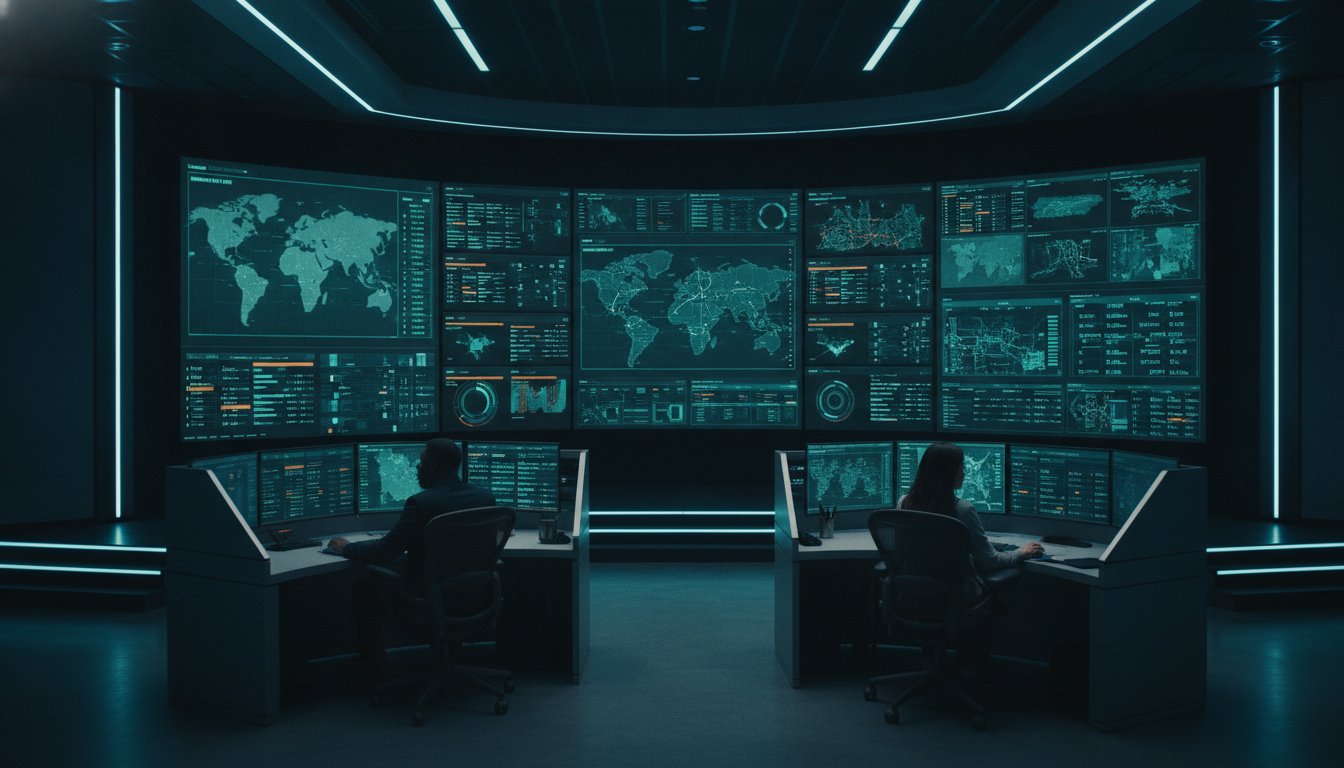
Your operators aren’t missing information. They’re drowning in it. Feeds from disparate systems, alerts competing for attention, data siloed across platforms that were never designed to speak to each other – this is the operational reality inside most control rooms today, and it’s quietly eroding the speed and accuracy of every decision made within them.
If you’re responsible for situational awareness in a control room, you already know the problem isn’t a lack of screens or data sources. It’s the absence of a coherent layer that pulls everything together, prioritizes what matters, and surfaces the right information to the right operator at the right moment. Cognitive overload isn’t a personnel issue. It’s a systems architecture issue.
This article breaks down how purpose-built operational intelligence transforms fragmented control room environments into unified command platforms. You’ll come away with a clear understanding of where situational awareness typically breaks down, what an integrated approach actually looks like in practice, and how organizations are using event-driven technology to reduce operator stress and accelerate decision-making when it counts most.
Key Takeaways
- Situational awareness in a control room is not about having more data – it’s about having the right operational intelligence layer that perceives, prioritizes, and surfaces what demands immediate attention.
- Data fragmentation across siloed systems is the primary driver of operator cognitive overload, and addressing it requires architectural change, not more screens or personnel.
- Automation and event-driven dashboards eliminate the manual burden of monitoring disparate feeds, allowing operators to focus on decisions rather than data collection.
- Most control rooms already have the screens. What they’re missing is the layer that decides what goes on them – and escalates automatically when something needs attention.
- Activu’s vis/ability platform functions as a unified operational intelligence hub, integrating feeds from platforms like Axon and Juvare to deliver a true common operating picture across command centers, huddle rooms, and mobile devices.
Understanding Situational Awareness in Control Rooms
At its core, situational awareness is the ability to perceive the elements of an environment, understand what they mean in context, and project how conditions will evolve. Psychologist Mica Endsley formalized this as a three-level model: perception, comprehension, and projection. In a control room, those three levels aren’t abstract theory. They’re the difference between a coordinated response and a cascading failure.
Operators aren’t just monitoring systems. They’re building a continuous mental model of a dynamic environment, updating it in real time, and making decisions that carry real consequences. When that model is incomplete or delayed, the cost isn’t a missed metric. It’s a missed incident.
The Role of Situational Awareness in Decision-Making
Poor situational awareness in a control room doesn’t typically announce itself as a failure. It shows up as delayed escalation, conflicting information between teams, or operators acting on stale data because that’s what their system surfaced last. The consequences accumulate quietly until they don’t.
Common Barriers to Effective Situational Awareness
The barriers aren’t mysterious. They’re structural. The most persistent include:
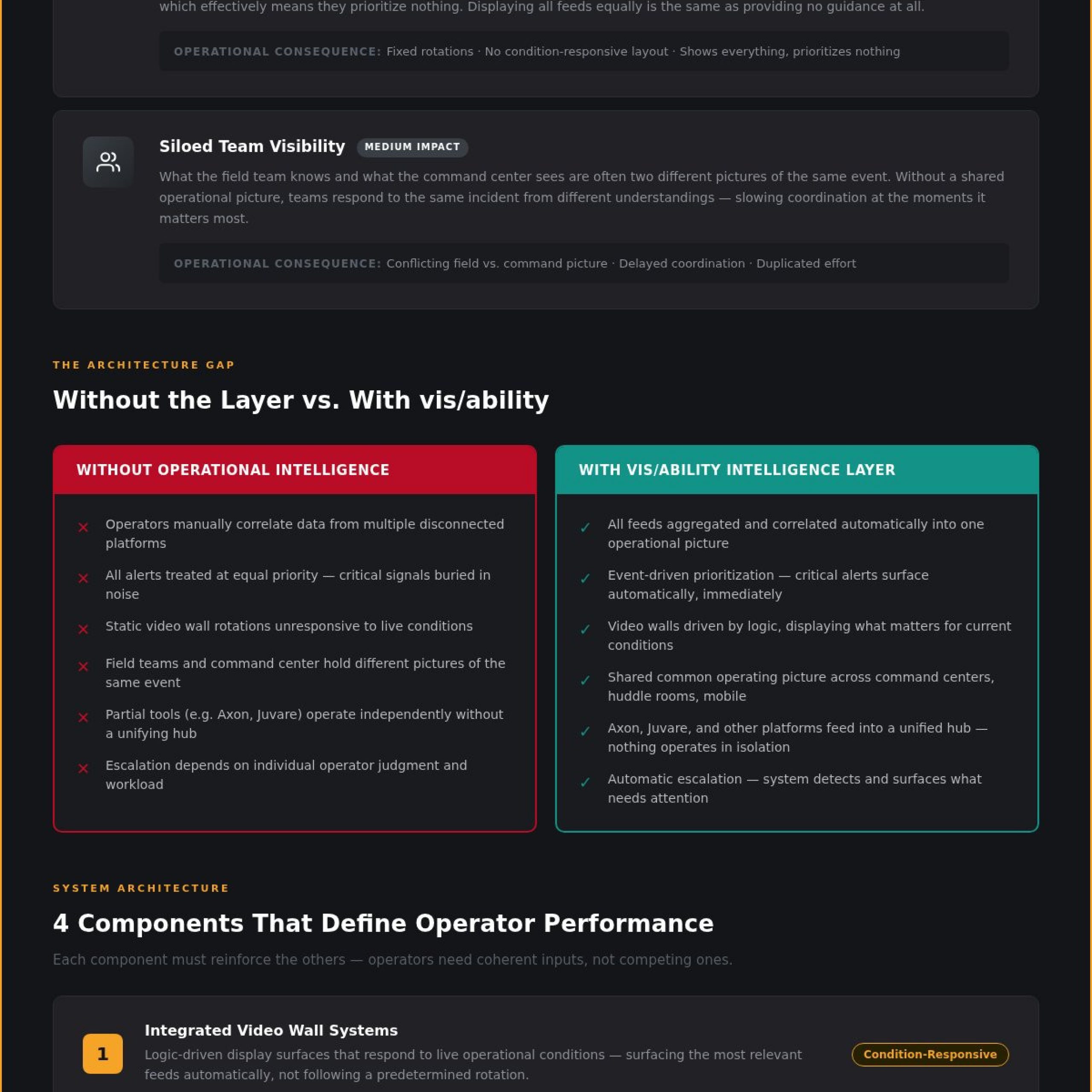
- Fragmented data sources: Systems that don’t communicate force operators to manually correlate information across platforms, introducing delay and error at every step.
- Alert fatigue: When every system generates its own notifications at equal priority, operators learn to tune them out. Critical alerts get lost in the noise.
- Outdated display infrastructure: Static video walls that cycle through feeds on a fixed rotation aren’t responsive to operational conditions. They show everything, which effectively means they prioritize nothing.
- Siloed team visibility: What the field team knows and what the command center sees are often two different pictures of the same event.
These aren’t personnel failures. They’re the predictable output of environments built without a unifying intelligence layer. Mission critical operations demand more than a collection of screens and feeds. They require an architecture that actively manages what operators see, when they see it, and what demands their attention first.
Most control rooms already have the screens. What they’re missing is the layer that decides what goes on them, and escalates automatically when something needs attention.
Key Components of a Situational Awareness Control Room
Building a control room that actually supports situational awareness requires more than assembling capable hardware. The components have to work as a system, each one reinforcing the others, so that operators receive a coherent picture rather than a collection of competing inputs. The situational awareness in high-stakes control environments documented by the FAA makes this point clearly: awareness degrades not when information disappears, but when it arrives without structure, priority, or context. The same principle applies in utilities operations centers, security fusion centers, and emergency dispatch environments.
Four components define whether a control room supports or undermines operator performance.
- Integrated video wall systems: A video wall is only as useful as what it displays. Static layouts that cycle through feeds on a fixed schedule show operators everything, which effectively communicates nothing. Video walls become operationally meaningful when they’re driven by logic, surfacing the feeds and data most relevant to current conditions rather than following a predetermined rotation.
- Real-time data aggregation: Operators cannot build an accurate mental model from data that’s thirty seconds old. Aggregating streams from disparate systems into a single, continuously updated view eliminates the manual correlation work that introduces both delay and error.
- Intuitive operator interfaces: Interface complexity is a direct tax on decision speed. When operators spend cognitive energy navigating a system, they have less available for the situation itself. Clean, consistent interface design reduces that friction and keeps attention where it belongs.
- A robust communication platform: Situational awareness breaks down at the seams between teams. When field personnel and command center operators are working from different information, coordination suffers. A shared communication layer closes that gap.
Designing for Optimal Situational Awareness
Ergonomic layout and display clarity aren’t aesthetic considerations. They’re performance variables. Operators working long shifts in poorly designed environments accumulate fatigue faster, miss more, and recover more slowly from high-demand periods. Consistent interface design across workstations reduces the cognitive switching cost that occurs when operators move between systems or hand off to colleagues. Activu’s control room design services address these factors as part of the operational architecture, not as an afterthought.
Integrating Data for a Unified View
A common operating picture isn’t a display format. It’s the outcome of disciplined data integration. When streams from security platforms, geospatial systems, communications tools, and sensor networks feed into a single aggregation layer, operators stop piecing together a picture and start working from one. The vis/ability platform functions as that aggregation layer, pulling inputs from across an organization’s technology stack into one coherent, event-driven view. That’s the architecture a true situational awareness control room requires.
Overcoming Data Fragmentation for Improved Awareness
Data fragmentation is the structural problem that most control room improvement initiatives fail to address directly. Organizations invest in new hardware, add workstations, hire additional personnel, and the problem persists. It persists because the issue isn’t capacity. It’s architecture. When a security feed lives in one platform, geospatial data in another, and incident logs in a third, operators aren’t working with information. They’re assembling it, manually, under pressure, in real time.
That assembly process has a cost. Every second an operator spends switching between systems to correlate data is a second not spent on the decision itself. Across a shift, those seconds compound into meaningful response delays. Across an incident, they can determine whether intervention happens inside or outside the critical window.
The Impact of Data Silos on Control Room Operations
Siloed systems don’t just slow operators down. They create divergent pictures of the same event. When a field team’s incident report, a camera feed, and a sensor alert aren’t aggregated into a single view, different operators in the same room can be working from genuinely different versions of what’s happening. Coordination breaks down at exactly the moment it’s most needed. Incident management in mission-critical environments requires a shared operational baseline, and fragmented systems make that baseline structurally impossible to maintain. The FAA’s documentation on situational awareness in control environments reinforces this point: degraded awareness is rarely caused by a lack of data, but consistently by data that arrives without structure, priority, or shared context.
Creating a Unified Common Operating Picture
A common operating picture is the operational outcome of disciplined data integration. It’s not a display format or a dashboard aesthetic. It’s what happens when every relevant data stream, video feed, sensor input, and communication channel flows into a single aggregation layer that surfaces the right information at the right moment.
Achieving that requires more than connecting systems. It requires a platform that actively manages what operators see based on current conditions, not a predetermined schedule. Public safety operations illustrate the stakes clearly: when dispatch centers, field units, and command leadership are all working from the same real-time picture, response coordination accelerates and the margin for missed escalation narrows substantially.
The situational awareness control room that actually performs under pressure isn’t the one with the most feeds. It’s the one with the intelligence layer that decides which feeds matter right now, and puts them in front of the operator who needs them. Most control rooms already have the screens. What they’re missing is the layer that decides what goes on them, and escalates automatically when something needs attention.
Leveraging Automation for Enhanced Situational Awareness
Manual monitoring is a losing proposition at scale. When operators are responsible for watching dozens of feeds, correlating inputs from separate systems, and deciding what warrants escalation, the process itself becomes the vulnerability. Automation doesn’t replace operator judgment. It removes the low-value work that consumes the cognitive capacity operators need for decisions that actually matter.
The distinction is important. Automating situational awareness tasks doesn’t mean removing humans from the loop. It means ensuring that by the time a human enters the loop, the system has already done the work of perceiving, filtering, and prioritizing. The operator receives a curated signal, not raw noise.
Event-Driven Dashboards: A New Era of Awareness
Static dashboards present a fixed view of the environment. Event-driven dashboards respond to it. When a threshold is crossed, an anomaly detected, or an incident flag triggered, the display adapts automatically, surfacing the relevant feeds, data, and alerts without waiting for an operator to notice something is wrong and manually navigate to it.
This architecture changes the fundamental dynamic of a situational awareness control room. Operators stop hunting for information and start receiving it. Automated alerts eliminate the reliance on human pattern recognition across high-volume feeds, where fatigue and attention limits create predictable blind spots. The vis/ability platform is built around this event-driven model, dynamically managing display content based on operational conditions rather than predetermined schedules. When something demands attention, the system escalates it. That’s the capability most control rooms are missing.
The Role of vis/ability in Automated Situational Awareness
vis/ability functions as the operational intelligence layer that sits above an organization’s existing technology stack. It doesn’t replace the tools already in use. It connects them, aggregates their outputs, and applies logic to determine what operators see and when. Integrations with platforms like Axon and Juvare pull specialized data into a single coherent view, eliminating the manual correlation work that currently falls to operators.
For operators, the practical effect is significant. Cognitive load drops when the system handles the filtering. Response times improve when escalation is automatic rather than dependent on someone noticing the right feed at the right moment. And across command centers, huddle rooms, and mobile devices, every stakeholder works from the same operational picture rather than a fragmented version of it.
Most control rooms already have the screens. What they’re missing is the layer that decides what goes on them, and escalates automatically when something needs attention. That’s precisely what vis/ability delivers. Connect with Activu to see how the platform integrates with your existing environment.
Activu vis/ability: The Future of Situational Awareness
Every capability discussed in this article converges in one place: the operational intelligence layer that transforms a fragmented control room into a unified command platform. vis/ability isn’t a dashboard or a display management tool. It’s the system that decides what operators see, when they see it, and what escalates automatically when conditions change. That’s a fundamentally different category of capability from anything a static video wall or siloed monitoring platform can provide.
The platform sits above an organization’s existing technology stack, aggregating inputs from security systems, geospatial tools, communications platforms, sensor networks, and specialized applications into a single coherent view. Operators stop assembling information and start acting on it. That shift, from manual correlation to automated intelligence, is where response times compress and decision quality improves.
Integrating vis/ability with Existing Infrastructure
Deployment doesn’t require replacing what already works. vis/ability connects to the systems organizations already rely on, pulling their outputs into a unified operational picture rather than forcing a technology overhaul. Integrations with platforms like Axon and Juvare bring specialized data into a shared view that no single platform can provide alone. Each of those tools solves a specific problem. vis/ability solves the problem of making them useful together.
The result is a common operating picture that spans command centers, huddle rooms, and mobile devices simultaneously. Every stakeholder works from the same real-time information, regardless of where they’re located. For organizations managing complex operational environments across multiple sectors, that shared baseline is the difference between coordinated response and fragmented reaction.
Real-World Applications and Success Stories
The practical impact of vis/ability is clearest in environments where the cost of delayed awareness is highest. In federal government and defense operations, command centers managing geographically dispersed assets require a level of integration that purpose-built platforms like vis/ability are specifically designed to deliver. When field data, sensor inputs, and communications feeds converge into a single event-driven display, command leadership gains the clarity to make decisions with confidence rather than caution.
Most control rooms already have the screens. What they’re missing is the layer that decides what goes on them, and escalates automatically when something needs attention. That’s what vis/ability delivers. Connect with Activu to see how the platform integrates with your existing environment and what a unified situational awareness control room looks like in practice.
Operational Clarity Starts With the Right Architecture
The core challenge inside most control rooms isn’t a shortage of data or screens. It’s the absence of an intelligence layer that makes all of it coherent under pressure. A true situational awareness control room requires more than connected hardware; it requires a platform that actively filters, prioritizes, and escalates so operators can focus on decisions rather than data assembly.
Trusted by federal government and defense agencies, and proven to reduce incident response times in SOC and NOC environments, Activu’s vis/ability platform delivers exactly that. It connects your existing tools, eliminates the manual correlation work that slows response, and ensures every stakeholder works from the same real-time picture, whether they’re at a command center workstation, a huddle room, or a mobile device.
The gap between fragmented feeds and coordinated response is an architectural problem with a clear solution. See how vis/ability transforms your SITREPs into actionable intelligence. Request a demo today.
Your operators are ready to perform at their best. Give them the platform that makes it possible.
Frequently Asked Questions
What is situational awareness in control rooms?
Situational awareness in a control room is an operator’s ability to perceive what’s happening across a dynamic environment, understand what those conditions mean, and anticipate how they’ll develop. It’s not simply watching feeds or reading data. It’s maintaining an accurate, continuously updated mental model under pressure, and making decisions that carry real operational consequences. When that model is incomplete or delayed, the cost shows up as missed escalations and slower response.
How do data silos affect situational awareness?
Data silos force operators to manually correlate information across disconnected platforms, which introduces both delay and error at every step. The deeper problem is that siloed systems can produce genuinely divergent pictures of the same event. Two operators in the same room, working from different feeds, may reach different conclusions about what’s happening. That divergence degrades coordination precisely when unified response matters most.
What are the benefits of automating situational awareness tasks?
Automation removes the low-value monitoring work that consumes the cognitive capacity operators need for actual decisions. When event-driven logic handles filtering, threshold detection, and alert prioritization, operators receive a curated signal rather than raw noise. The practical result is faster escalation of critical events and a measurable reduction in the fatigue that accumulates when humans are expected to pattern-match across high-volume feeds throughout a full shift.
How does vis/ability enhance control room operations?
vis/ability functions as the operational intelligence layer that sits above an organization’s existing technology stack, connecting tools like Axon and Juvare into a single aggregated view. It actively manages what operators see based on current conditions, not a fixed rotation or predetermined schedule. When something demands attention, the platform escalates it automatically. That capability closes the gap between fragmented feeds and coordinated response across command centers, huddle rooms, and mobile devices simultaneously.
What is a common operating picture (COP)?
A common operating picture is a shared, real-time operational view that gives every stakeholder, whether in the command center, a huddle room, or the field, the same accurate baseline. It’s the outcome of disciplined data integration, not a display format. Without a unifying platform to aggregate and prioritize incoming streams, organizations can’t maintain a true COP. Different teams end up working from different versions of the same event, and coordination suffers at the moments it’s most critical.
Why is data integration important for situational awareness?
Data integration is what transforms a collection of capable tools into a coherent situational awareness control room. Individual platforms solve specific problems well, but no single tool captures the full operational picture. When security feeds, geospatial data, sensor inputs, and communications channels flow into one aggregation layer, operators stop assembling information and start acting on it. Integration doesn’t just improve efficiency; it closes the structural gaps where incidents go undetected and escalations get missed.