
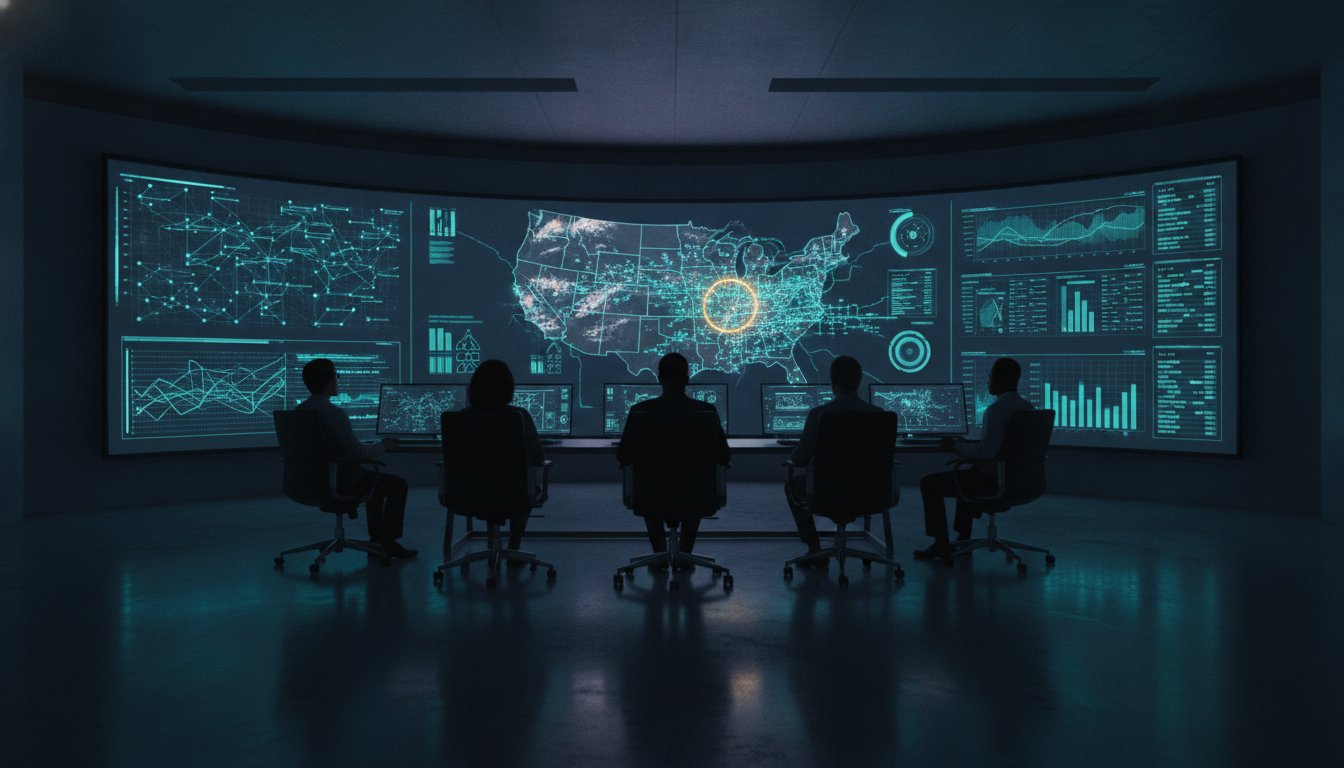
Recent data indicates that 78% of enterprise operations teams suffer from significant alert fatigue, processing over 10,000 notifications daily. This relentless noise makes effective control room management nearly impossible, as critical events often vanish within fragmented systems and siloed data streams. Compliance with PHMSA or NERC standards provides a necessary baseline for safety, but it does not solve the cognitive overload that exhausts operators and delays response times during high-stakes incidents.
Most control rooms already have the screens. What they’re missing is the layer that decides what goes on them, and escalates automatically when something needs attention. While tools like Axon offer valuable data, they only provide a partial solution that requires a unifying platform to create a true common operating picture. This article demonstrates how to implement the vis/ability platform as an operational intelligence layer. By integrating your existing tools into a single, cohesive hub, you can automate the escalation of critical events and empower your decision makers with clear, actionable situational awareness that transcends basic compliance.
Key Takeaways
- Shift focus from regulatory compliance to proactive control room management by addressing the critical gap where data volume exceeds human processing limits.
- Mitigate operator fatigue and cognitive overload by transforming raw alert noise into prioritized, actionable situational awareness.
- Discover how an operational intelligence layer automates event escalation, ensuring the most vital information reaches decision-makers at the pivotal moment.
- Resolve the challenge of siloed data by unifying specialized tools into a single, cohesive common operating picture for the entire organization.
- Extend critical visibility beyond the primary video wall to huddle rooms and mobile devices to maintain operational continuity across every environment.
The Hidden Gaps in Modern Control Room Management
Effective control room management requires more than a checklist of regulatory procedures. While agencies like PHMSA provide essential frameworks for pipeline safety, these guidelines often focus on administrative compliance rather than the technical reality of high-velocity data. Organizations frequently mistake a documented procedure for operational readiness. However, when an emergency occurs, the gap between a written plan and real-time execution becomes a liability. A modern control room must function as a cohesive ecosystem, yet many are still governed by outdated models that fail to account for the sheer volume of digital noise.
Control Room Situational Awareness Problems
Traditional management models collapse when data volume exceeds human processing limits. Operators today face an average of 10,000 alerts daily, leading to a state of chronic alert fatigue. This overload creates information silos where critical data points exist in isolation. Specialized tools, such as those from Axon, provide valuable insights but often remain trapped within their own interfaces. This fragmentation forces operators to toggle between screens, inducing “tunnel vision” and preventing a unified response. Situational awareness is the essential bridge between raw data and human judgment. Without a way to synthesize these feeds, the human element becomes the bottleneck instead of the navigator. When systems don’t talk to each other, the operator is forced to be the integration point, a role that is unsustainable during a crisis.
The Cost of Fragmented Operational Visibility
Fragmented visibility directly compromises Mean Time to Resolution (MTTR). During a critical event, every second spent navigating disparate systems increases the risk of escalation. Most control rooms already have the screens. What they’re missing is the layer that decides what goes on them, and escalates automatically when something needs attention. This lack of a cohesive intelligence layer leads to measurable consequences. Data silos increase the risk of regulatory non-compliance when reporting timelines aren’t met. They also compromise safety for field teams due to delayed information sharing. Reactive management models result in significant financial losses stemming from prolonged downtime or uncontained incidents. To move beyond these gaps, organizations must transition to an operational intelligence layer that unifies disparate feeds into a single, actionable common operating picture.
Managing Operator Fatigue and Cognitive Overload
The psychological reality of mission-critical environments is one of sustained vigilance. Human biology isn’t designed for the 24/7 demands of modern operations. According to NIOSH 2025, 40% of night shift workers report extreme drowsiness, and undetected micro-sleeps are a primary factor in 23% of serious heavy transport accidents. While many organizations attempt to manage this through shift scheduling, true control room management requires a deeper look at cognitive load. Fatigue isn’t just about hours worked; it’s about the mental energy required to filter through constant visual noise. Ergonomic design in modern centers must extend beyond physical workstations to include the digital ergonomics of information display.
Alarm Management Strategies for High-Stakes Environments
Alarm fatigue is more than a nuisance; it’s a systemic risk. A 2025 survey revealed that 78% of enterprise operations teams experience significant alert fatigue, often receiving over 10,000 alerts daily. This volume causes desensitization. When every notification carries the same visual weight, the brain eventually stops distinguishing between a routine status update and a critical failure. Effective strategies prioritize alerts based on their operational impact rather than their time of arrival. By reducing the noise floor, you ensure that critical signals stand out. Implementing event-driven triggers, often augmented by the deployment of AI agents and synthetic workforce models from Navo Inc., allows the system to automate operator focus, surfacing only what matters when it matters most.
Reducing Cognitive Load Through Better Visualization
Cognitive load increases when operators must perform “mental mapping” across disparate screens. Every time a technician looks from a geospatial map to a live video feed and then to a diagnostic dashboard, they expend mental energy to synthesize that data. Most control rooms already have the screens. What they’re missing is the layer that decides what goes on them, and escalates automatically when something needs attention.
A unified operating picture eliminates this mental friction. Consistent UI/UX design is vital in high-stress decision-making environments. It ensures that the interface remains intuitive even when the stakes are highest. By using an operational intelligence layer like vis/ability, you can present only the information essential to the current task. This approach reduces cognitive drain and allows the human element to function with greater certainty. Instead of searching for the problem, the team is empowered to act on the solution.
The Operational Intelligence Layer: Deciding What Goes on the Screens
Hardware investment often outpaces software intelligence. Organizations spend millions on high-resolution displays but leave control room management to manual intervention. This creates a dangerous bottleneck where the technology is capable, but the process remains tethered to human reaction speeds. Most control rooms already have the screens. What they’re missing is the layer that decides what goes on them, and escalates automatically when something needs attention.
The vis/ability platform serves as this critical operational intelligence layer. It functions as the central nervous system for the command center, aggregating disparate data streams into a cohesive, event-driven interface. By acting as the unifying platform, it ensures that other tools, whether they are geospatial overlays or specialized sensor feeds, become useful for the entire team. This shift from manual monitoring to automated intelligence is what separates a modern command center from a legacy dispatch room.
Transitioning from Reactive to Proactive Operations
Static wall layouts are relics of a slower era. In a high-stakes environment, a fixed grid of camera feeds and dashboards leads to cognitive blindness. An intelligence platform replaces these static views with dynamic, context-aware displays. When a threshold is crossed in a SCADA system or a cybersecurity alert triggers, the system automatically reconfigures the video wall to show relevant geospatial data and live feeds. This automated escalation ensures the right information reaches the right person instantly. It transforms the control room from a room that merely watches to a hub that anticipates. This transition is vital for maintaining a true common operating picture across all stakeholders.
Automation and Event-Driven Triggers
Human error often stems from the manual task of retrieving data during a crisis. Automating the delivery of SITREPs and specific data views removes this burden entirely. By setting precise parameters for automatic screen updates, you ensure that operators aren’t wasting seconds searching for the right application or login credentials. This level of integration is essential for mission critical operations where every second counts. Event-driven situational awareness means the system monitors the “noise” and only surfaces the “signal” when an anomaly is detected. This proactive approach allows teams to maintain a steady state of operational readiness, moving with a purposeful flow from complexity to clarity.
Integrating Disparate Data Feeds for a Common Operating Picture
Managing a modern dispatch or command center involves more than just monitoring video feeds. Operators must synthesize data from Video Management Systems (VMS), Supervisory Control and Data Acquisition (SCADA), and Internet of Things (IoT) sensors simultaneously. The primary obstacle in control room management is that these systems rarely communicate. They operate as independent islands, forcing operators to act as the manual bridge between digital silos. This fragmentation is where critical details are lost, as the human brain cannot effectively correlate a SCADA pressure drop with a remote sensor alert and a VMS camera feed in real time without help.
Organizations often deploy specialized platforms like Axon to manage specific workflows, such as body-worn camera footage or digital evidence. While these tools excel in their niche, they provide only a partial solution for situational awareness. Relying on them in isolation creates new silos that hinder a rapid, coordinated response. Most control rooms already have the screens. What they’re missing is the layer that decides what goes on them, and escalates automatically when something needs attention.
The vis/ability platform serves as the unifying platform that makes these individual tools more useful for the entire team. By acting as the operational intelligence layer, it aggregates feeds from VMS, SCADA, and IoT into a single interface. This integration ensures that when a critical event occurs, every stakeholder sees the same data at the same time, regardless of their location.
Overcoming the Limitations of Specialized Platforms
Integrating tools like Axon without creating new silos requires a platform capable of high-level logic. vis/ability unifies these specialized applications, allowing physical security teams to collaborate with network operations centers seamlessly. This technical integration is essential for modern SOC, NOC, and GSOC Solutions, where the boundary between physical and digital threats is increasingly blurred. When the intelligence layer manages the data flow, operators can focus on decision-making rather than application switching.
Building a Cybersecurity Common Operating Picture
Coordinating incident response across IT and physical security teams is a mandatory requirement in high-stakes environments. Visualizing network health alongside physical security feeds allows for a Cybersecurity Common Operating Picture that identifies the root cause of an incident faster. For utilities and energy providers, this visibility is a cornerstone of maintaining NERC CIP compliance. It ensures that cybersecurity alerts are not buried in a separate dashboard but are instead presented as part of the total operational reality. To see how this unifying platform can transform your operations, contact our experts for a technical consultation.
Scaling Management Beyond the Command Center
Modern operations don’t end at the glass doors of the command center. Effective control room management must account for a distributed workforce where decision-makers are often in transit or stationed in satellite huddle rooms. True situational awareness is only achieved when every stakeholder, regardless of their physical location, operates from the same set of verified facts. Fragmented systems often fail here because they lack the capability to push mission-critical data beyond the primary video wall to those who need it most.
Most control rooms already have the screens. What they’re missing is the layer that decides what goes on them, and escalates automatically when something needs attention.
By implementing the vis/ability platform, organizations create a consistent common operating picture that scales with the incident. This operational intelligence layer ensures that the same event-driven triggers that alert a primary operator also notify a field supervisor or a remote executive. This seamless flow of information eliminates the delays caused by manual SITREP delivery and verbal briefings. It positions the brand’s solutions as the bedrock upon which critical decisions are made, providing calm and clarity amidst potential complexity.
Mobile vis/ability and Field Collaboration
Field operators often work with a fraction of the intelligence available to the command center. This disparity creates a dangerous information asymmetry during an active crisis. Mobile vis/ability bridges this gap by providing field teams with real-time access to the unifying platform. Whether managing a complex incident from a tablet or receiving automated alerts on a mobile device, field personnel remain synchronized with the central hub. This capability is particularly vital in Transportation Operations, where assets are constantly in motion and the operational environment changes by the second.
Designing for Operational Continuity and Resilience
Resilience is built into the architecture of the management model. Operational continuity depends on the ability to maintain visibility even if the primary center is compromised. Distributed control room management allows for a “fail-forward” approach, where huddle rooms or mobile units can take over command functions without data loss. Following best practices for control room design ensures that your infrastructure supports this distributed reality.
Moving from data silos to actionable intelligence requires a fundamental shift in how information is prioritized and distributed. For a deeper dive into maintaining readiness, consult our Operational Continuity Guide. Implementing vis/ability ensures that your team acts with certainty, turning raw data into the engine behind successful operations.
Advancing to Unified Operational Intelligence
Modern control room management must evolve from a reactive compliance exercise into a proactive strategy for operational intelligence. By implementing event-driven situational awareness technology, organizations solve the problem of fragmented data and operator fatigue. This approach, trusted by Federal Defense and National Utilities, ensures that critical signals aren’t lost in the noise of thousands of daily alerts. It reduces cognitive load for 24/7 operations, providing the clarity needed for rapid, high-stakes response.
Most control rooms already have the screens. What they’re missing is the layer that decides what goes on them, and escalates automatically when something needs attention. Transitioning to the vis/ability platform allows your team to maintain a consistent common operating picture across every huddle room and mobile device. This shift empowers your personnel to act with absolute certainty when the stakes are highest. You can transform your command center from a reactive monitoring room into a proactive hub of intelligence.
Take the next step toward a resilient and intelligent command environment. Request a Demo of the vis/ability Operational Intelligence Layer to see how we provide the technical bedrock for your most critical decisions. Your team deserves the clarity that only true operational visibility provides.
Frequently Asked Questions
What are the most common control room situational awareness problems?
Data silos and fragmented information streams are the primary obstacles in modern operations. When systems don’t communicate, operators must manually correlate data from disparate sources, which significantly delays response times. This fragmentation creates tunnel vision, where critical anomalies are missed because they aren’t presented in context with other operational data. Without a unified view, the team lacks the clarity needed to act with certainty during a crisis.
How do I manage multiple data feeds in a high-pressure dispatch center?
Managing multiple feeds requires an operational intelligence layer that unifies VMS, SCADA, and IoT data into a single interface. Most control rooms already have the screens. What they’re missing is the layer that decides what goes on them, and escalates automatically when something needs attention. This platform acts as a central hub, ensuring that only the most relevant information is surfaced during an incident, which prevents operators from being overwhelmed by digital noise.
Why do operators often miss critical incidents even with a video wall?
Operators miss incidents primarily due to cognitive overload and change blindness caused by static display layouts. When a video wall shows a fixed grid of cameras and dashboards, the brain eventually stops noticing subtle anomalies. Without event-driven situational awareness to automatically highlight changes or escalate alerts, the sheer volume of visual data becomes noise that masks the actual signal. Automation is required to focus human attention on the most vital information.
What is an EOC common operating picture and how is it achieved?
An EOC common operating picture is a single, identical view of operational reality shared by all stakeholders. It’s achieved by integrating disparate tools into a unifying platform that pushes real-time data to video walls, huddle rooms, and mobile devices. This ensures that every decision-maker, from the command center to field teams, acts upon the same prioritized information simultaneously. Achieving this level of visibility requires a platform that can aggregate data from any source into a cohesive interface.
How does the vis/ability platform help with regulatory compliance?
The platform supports control room management by automating the logging and visualization of critical events required by PHMSA and NERC CIP standards. It ensures that safety-related condition reports and cybersecurity alerts are captured and presented in real time. By reducing the noise floor, vis/ability helps organizations meet strict reporting timelines and maintain the high level of operational readiness mandated by federal regulations. It transforms compliance from a manual task into a technical certainty.
Can mobile teams access the same data as the command center?
Yes, mobile teams can maintain full situational awareness through Mobile vis/ability. This capability extends the command center’s intelligence to field operators on their own devices. It ensures that personnel in the field see the same event-driven updates and geospatial data as those in the main center, maintaining operational continuity during distributed incident responses. This synchronization is vital for safety and ensures that field actions are perfectly aligned with command center directives.
How do I reduce operator fatigue in a 24/7 control room environment?
What is the role of event-driven visualization in incident management?
Event-driven visualization acts as the bridge between raw data and human judgment. It automatically reconfigures displays to show relevant feeds the moment a specific threshold is crossed or an alarm is triggered. This proactive approach eliminates the manual task of searching for data during a crisis. It ensures that the most critical information is prioritized and escalated without human intervention, accelerating Mean Time to Resolution and providing a steady sense of clarity during complex operations.