
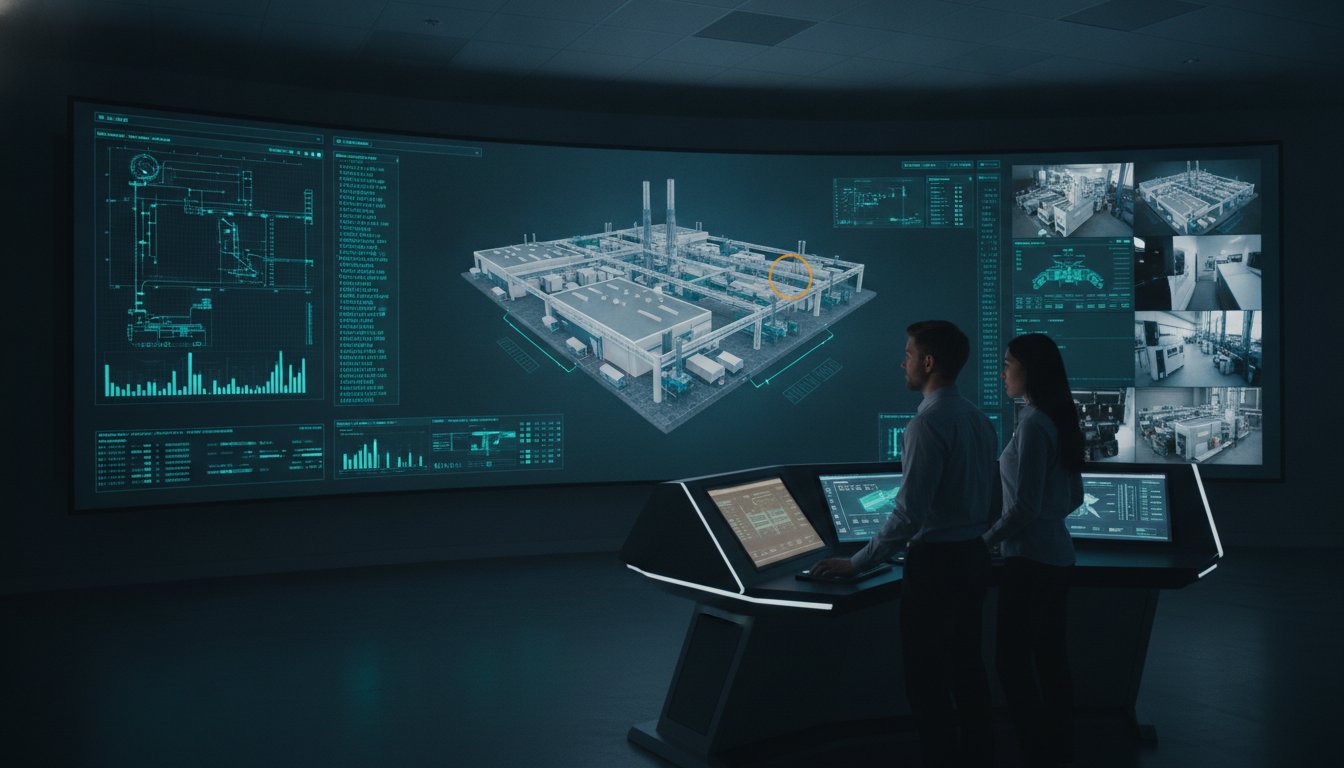
A manufacturing facility does not fail because of a lack of data. It fails because that data remains trapped in isolated silos. When a production anomaly occurs, operators shouldn’t have to hunt through SCADA feeds, VMS windows, and IIoT sensors to find the root cause. This fragmented reality within the typical Manufacturing Control Room leads to chronic alarm fatigue and missed escalations. Many organizations rely on tools like Axon or standalone SCADA systems, but these only provide a partial view of the environment. They lack the connective tissue required to create a true Common Operating Picture across the facility.
Most control rooms already have the screens. What they’re missing is the layer that decides what goes on them and escalates automatically when something needs attention. This article demonstrates how to transform your facility from a state of passive monitoring into a proactive operational intelligence hub. You’ll learn how to reduce response times and empower your team with event-driven situational awareness. We will examine the methodology for integrating disparate feeds into a unified platform that prioritizes essential information when stakes are at their highest.
Key Takeaways
- Identify the operational risks of fragmented data and siloed systems that lead to missed incidents and delayed responses.
- Evolve your Manufacturing Control Room from a passive viewing center into a proactive, event-driven intelligence hub.
- Deploy an intelligent layer that automates information escalation to ensure critical events receive immediate attention on the right screens.
- Reduce operator fatigue by prioritizing essential information across command centers, huddle rooms, and mobile platforms.
- Unify disparate tools into a single Common Operating Picture to empower faster and more certain decision-making during high-stakes operations.
The Crisis of Complexity in the Manufacturing Control Room
The modern plant floor is a massive generator of raw data. Every sensor, motor, and camera stream contributes to an unprecedented volume of information that flows into the Manufacturing Control Room every second. While this connectivity promises transparency, it often delivers the opposite. Operators are forced to manage an overwhelming volume of signals, most of which are irrelevant to the current operational state. When every system demands attention simultaneously, the truly critical events are easily lost in the noise. This environment requires a specialized approach to manufacturing process control that prioritizes clarity over raw data volume.
Fragmented Systems and the Cost of Siloed Data
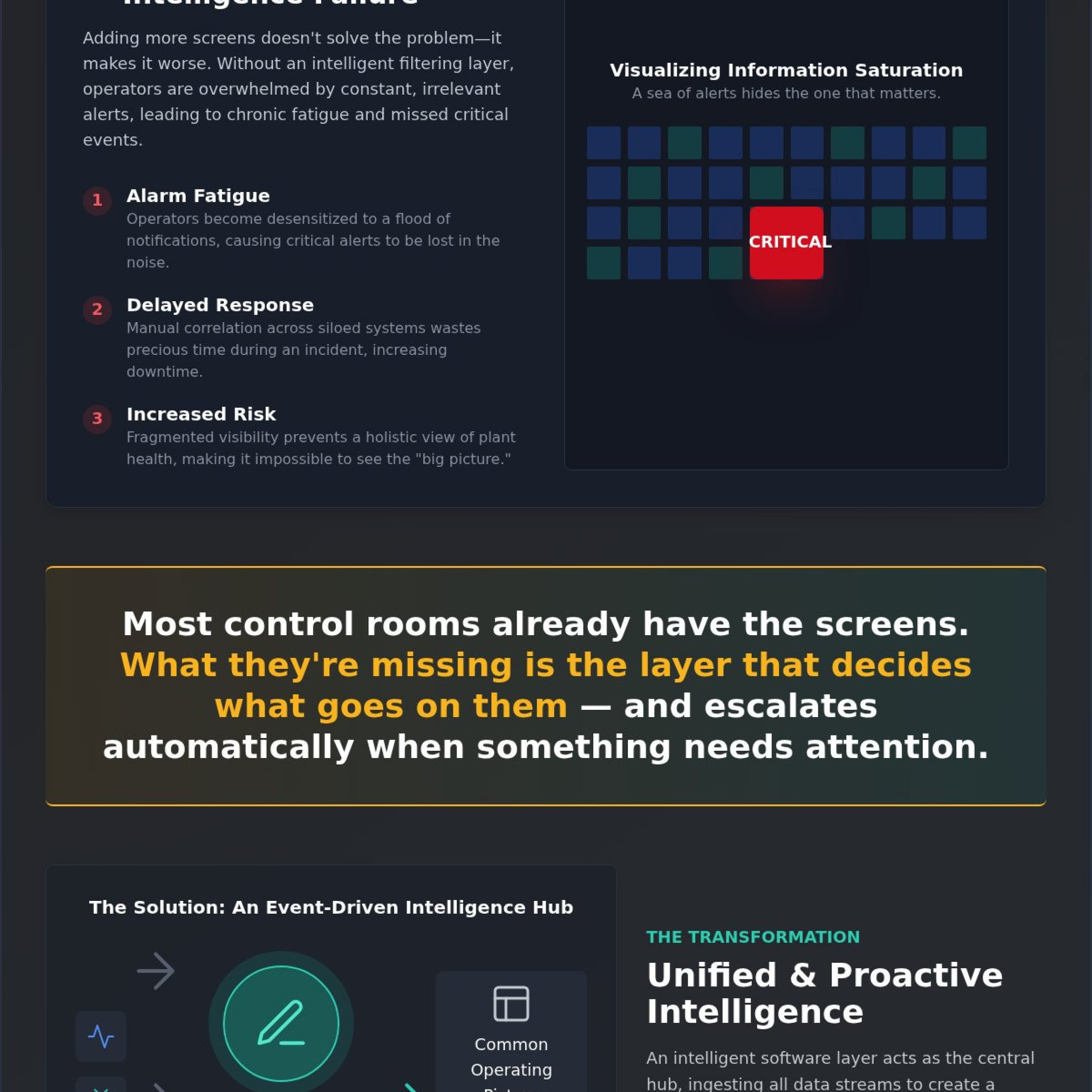
Industrial environments typically rely on a patchwork of legacy and modern tools. You likely have SCADA for process monitoring, a VMS for security, and various IIoT platforms for predictive maintenance. These systems rarely talk to each other. This creates “swivel-chair” operations, where an operator must manually correlate an alert on one screen with a video feed on another. This manual process is slow and prone to error. Fragmented visibility isn’t just an inconvenience; it’s a direct cause of production downtime. If a cooling pump fails, but the alarm is buried under a hundred routine notifications, the response will be delayed. By the time the team identifies the issue, the damage is already done. Siloed data prevents a holistic view of plant health, making it impossible to see the “big picture” when it matters most.
Operator Fatigue as a Systematic Intelligence Failure
Many organizations attempt to fix visibility issues by simply adding more hardware. They install larger video walls and more desktop monitors. However, historical developments in central production control environments show that human cognitive capacity is finite. Adding screens without an intelligent filtering layer actually decreases situational awareness. It increases the physical and mental strain on operators who must scan dozens of feeds for hours. This is a systematic failure, not a personal one. High-quality furniture and ergonomic chairs can’t solve the problem of information saturation. The Manufacturing Control Room needs a system that filters data based on operational priority, ensuring that operators only see what requires their immediate action.
The core issue is not a lack of hardware. It’s a lack of intelligent prioritization. Most control rooms already have the screens. What they’re missing is the layer that decides what goes on them, and escalates automatically when something needs attention. Without this intelligence, operators remain reactive, trapped in a cycle of alarm floods and screen fatigue that compromises the safety and efficiency of the entire facility.
Defining the Modern Process Control Environment
A modern Manufacturing Control Room functions as a mission-critical intelligence hub where raw data is synthesized into actionable insights. It is no longer just a centralized space for housing hardware or monitoring static feeds. In this environment, operational continuity depends entirely on the speed and accuracy of the human-machine interface. This shift represents a fundamental change in industrial philosophy, moving away from simple surveillance toward a proactive, event-driven model of situational awareness.
The Shift from Monitoring to Event-Driven Intelligence
Watching screens is a passive activity that invites human error and oversight. In contrast, responding to intelligence is an active, strategic function that minimizes risk. A proactive stance is mandatory for 24/7 facilities where even brief periods of downtime can result in significant financial loss. This transition is a core pillar of Mission Critical Operations. It moves the operator from a state of constant, exhausting surveillance to a state of targeted, high-certainty response. Most control rooms already have the screens. What they’re missing is the layer that decides what goes on them; and escalates automatically when something needs attention.
Essential Components of a High-Performance PCR
A high-performance environment integrates real-time telemetry, video streams, and geospatial data into a single, cohesive view. While hardware provides the foundation, the true power of the Manufacturing Control Room lies in the software integration layer. High-performance video wall systems provide the necessary canvas for shared awareness, but they must be supported by 24/7 reliability and robust cybersecurity. Adhering to established standards for ergonomic control room design ensures that the physical space supports the digital workflow. This approach reduces physical strain while maximizing the operator’s ability to focus on critical tasks.
This unified approach creates a true Common Operating Picture (COP). A COP ensures that every stakeholder, from the plant floor to the executive suite, sees the same reality at the same time. This alignment is the bedrock of operational certainty, allowing teams to act with confidence during complex incidents. Implementing a sophisticated vis/ability platform allows organizations to bridge the gap between fragmented data streams and decisive, automated action. By centralizing these disparate tools, facilities can maintain a steady state of readiness, ensuring that critical information is always prioritized and never ignored.
Bridging the Intelligence Gap: The Operational Layer
The effectiveness of a modern Manufacturing Control Room isn’t defined by the sheer volume of hardware installed. It’s measured by the speed at which an operator can transition from identifying an anomaly to executing a resolution. Most control rooms already have the screens. What they’re missing is the layer that decides what goes on them, and escalates automatically when something needs attention. This missing component is the bridge between raw data and decisive action. Without an intelligent layer to filter and prioritize information, the operator is left to manage a chaotic flood of signals that often obscure the most critical threats to production.
The Limitations of Siloed Manufacturing Tools
Traditional SCADA systems provide deep visibility into specific mechanical processes, yet they often operate in total isolation. They don’t account for security video, environmental sensors, or logistics data. While some organizations attempt to use standalone tools like Axon or traditional SIEMs to fill these gaps, these platforms only provide a partial view of the operational landscape. They lack the native ability to unify diverse data types into a single interface. This forces operators to act as the manual integration layer, jumping between disconnected systems to correlate an alarm with a physical location or a video stream. This manual workflow creates immense cognitive friction. It slows down response times and increases the likelihood that a subtle but critical anomaly will be buried in the noise of routine notifications.
Implementing a Unified Common Operating Picture
Achieving operational certainty requires a single, authoritative source of truth that’s accessible to every team member. The vis/ability platform functions as this unifying operational intelligence layer, aggregating data from across the enterprise into a cohesive Common Operating Picture. By integrating disparate tools into one central hub, you enhance the utility of your existing infrastructure for Manufacturing and Process Control. This approach ensures that data from SCADA, VMS, and IIoT sensors is no longer siloed. Instead, it’s processed and presented based on its relevance to the current operational state. This clarity allows for faster, more certain decision-making.
Strategic Design for 24/7 Manufacturing Operations
Most control rooms already have the screens. What they’re missing is the layer that decides what goes on them, and escalates automatically when something needs attention. This intelligent filtering is what separates a modern facility from one trapped in a cycle of reactive monitoring. By utilizing event-driven automation, the vis/ability platform ensures that visual cues are presented only when an incident exceeds pre-defined severity thresholds. This reduces the cognitive load on operators, allowing them to remain focused and analytical during their shifts.
Information Prioritization vs. Alarm Overload
Visual hierarchy in video wall design is a critical tool for reducing response times. High-contrast alerts and dynamic content layouts ensure that the most urgent data is always prominent. Unlike traditional methods that focus on physical adjustments to furniture, this approach solves the root cause of operator fatigue: information saturation. When the software layer handles the heavy lifting of data correlation, operators can act with greater certainty. The system serves as a vigilant guardian, highlighting production anomalies through automated visual cues that demand immediate resolution.
Extending Visibility Beyond the Control Room
Operational intelligence shouldn’t be confined to the four walls of a command center. Field engineers and remote executives require the same level of situational awareness to make informed decisions. Mobile vis/ability provides this essential bridge, allowing distributed teams to collaborate through a shared digital canvas. Whether a technician is on the plant floor or a manager is off-site, they can access the same real-time telemetry and video feeds. This ensures that everyone remains aligned on the facility’s current operational state through the vis/ability Platform.
Maintaining this level of transparency also requires a relentless focus on cybersecurity within the visualization environment. Protecting the integrity of the data streams is paramount for ensuring that the information displayed is both accurate and secure. To see how these design principles can transform your facility, you can contact our team for a specialized assessment. By integrating these strategic components, your team can achieve a state of clear, actionable intelligence that persists across every shift.
The Activu vis/ability Platform: Unifying the Ecosystem
The Activu vis/ability platform functions as the essential connective tissue within the modern Manufacturing Control Room. It is the operational intelligence layer that transforms fragmented data into a cohesive, mission-oriented environment. While individual systems like SCADA or Axon provide specific data points, they often provide only a partial solution. They lack the native ability to unify the entire facility’s oversight into a single, actionable view. vis/ability acts as the central hub where these tools finally become useful for the entire team, whether they are stationed at the main video wall, in a huddle room, or monitoring via mobile devices.
Most control rooms already have the screens. What they’re missing is the layer that decides what goes on them, and escalates automatically when something needs attention. By centralizing disparate streams, organizations move from a state of digital complexity to a state of clear, actionable intelligence. This logical progression from raw data to intelligence creates a sense of trust and inevitability in the decision-making process. vis/ability processes millions of data points to ensure that only the most relevant information reaches the human operator, bridging the gap between technical complexity and human judgment.
Event-Driven Automation for Real-Time Escalation
Event-driven automation removes the burden of manual surveillance and the fatigue that follows it. Instead of operators constantly scanning dozens of monitors, the system uses pre-set triggers to update screens instantly when an anomaly occurs. This mechanism significantly reduces the “time-to-know” for critical manufacturing incidents. When a pump fails, a safety sensor is tripped, or a temperature threshold is exceeded, the relevant video and telemetry data are pushed to the forefront immediately. This shift from passive watching to active, automated escalation ensures that response times are measured in seconds. It allows the Manufacturing Control Room to operate as a proactive engine of facility-wide safety and efficiency.
Securing the Manufacturing Common Operating Picture
A true Common Operating Picture must also encompass the health of the underlying industrial network. Securing a manufacturing environment requires real-time visibility into cybersecurity threats and network performance alongside production data. vis/ability allows teams to visualize these risks in a unified view, creating a Cybersecurity Common Operating Picture. This integrated perspective is vital for protecting critical infrastructure against both mechanical failure and external interference. It ensures that the bedrock upon which your operations are built remains secure and reliable.
By integrating these strategic components, your team can achieve a state of clear, actionable intelligence that persists across every shift. You can empower your team to act with greater certainty by implementing a solution designed for the highest stakes. To learn how this technology can be integrated into your specific environment, contact Activu for a tailored control room assessment. Our experts will help you identify the gaps in your current visibility and design a path toward a fully unified, event-driven operational intelligence hub.
Achieving Operational Certainty Through Unified Intelligence
The evolution of the Manufacturing Control Room depends on shifting from passive surveillance to proactive intelligence. Success in high-stakes environments requires more than just hardware; it demands a unified layer that synthesizes fragmented data into a single source of truth. Activu has been a leader in mission-critical visualization since 1983, providing the technical bedrock for global manufacturing, utilities, and transportation. Our vis/ability platform is specifically designed for the rigors of 24/7 environments where every second counts.
Most control rooms already have the screens. What they’re missing is the layer that decides what goes on them, and escalates automatically when something needs attention. By implementing this operational intelligence layer, you ensure that your operators remain focused on essential information rather than drowning in alarm floods. This transition reduces response times and secures your facility’s operational continuity against both mechanical failures and cybersecurity threats.
Take the next step in optimizing your facility’s situational awareness and decision-making speed.
Request a vis/ability demo to unify your manufacturing operations.
Empower your team with the clarity and certainty required to master the complexities of modern production.
Frequently Asked Questions
What is the difference between a process control room and a NOC?
A process control room focuses on industrial production and physical asset management, while a NOC manages IT infrastructure. In a Manufacturing Control Room, the stakes involve physical safety and production uptime, requiring the integration of SCADA and IIoT data alongside traditional network monitoring. While a NOC focuses on digital traffic, a process control environment must manage the intersection of cyber and physical operations.
How can I reduce operator fatigue in a 24/7 manufacturing environment?
Reducing fatigue requires an intelligent filtering layer that prioritizes essential information and reduces cognitive load. Most control rooms already have the screens. What they’re missing is the layer that decides what goes on them, and escalates automatically when something needs attention. This approach prevents alarm floods and ensures operators only interact with data that requires immediate, decisive action.
Can vis/ability integrate with my existing SCADA and VMS systems?
Yes, vis/ability is designed as a unifying hub for disparate manufacturing tools. It aggregates feeds from SCADA, VMS, and IIoT sensors into a single, cohesive interface. This eliminates the need for swivel-chair operations where operators must manually correlate data across disconnected systems, allowing for faster and more certain decision-making.
Why do operators miss incidents even with a large video wall?
Large video walls often contribute to information saturation rather than clarity if they lack an intelligent orchestration layer. Without event-driven logic to filter content, critical anomalies are buried under routine telemetry. Operators miss incidents because they’re overwhelmed by a static display of data that lacks visual prioritization or automated escalation of critical events.
What are the key design considerations for a manufacturing control room?
Design must prioritize visual hierarchy and ergonomic data flow to support high-stakes decision-making. Key considerations for a Manufacturing Control Room include the integration of real-time telemetry, the placement of video walls for shared awareness, and the implementation of software that automates the escalation of critical events. The environment must support both centralized command and distributed collaboration across the facility.
How does event-driven situational awareness improve plant safety?
It improves safety by significantly reducing the time-to-know for critical incidents. When a sensor detects a threshold breach, the system automatically pushes the relevant video and data to the operator’s attention. This proactive approach ensures that safety-critical events are never ignored or delayed by manual monitoring gaps, allowing for immediate intervention.
Is it possible to extend control room visibility to mobile devices?
Yes, mobile vis/ability allows field engineers and remote executives to access the same real-time data as the command center. This extension ensures that distributed teams remain aligned on the facility’s current operational state. It allows for faster coordination between the control room and personnel on the plant floor during production anomalies.
What is a Common Operating Picture (COP) in manufacturing?
A COP is a single, authoritative view of the entire facility’s operational status. It unifies data from across the enterprise, ensuring that every stakeholder sees the same reality at the same time. This alignment is essential for maintaining operational certainty and coordinating complex responses when stakes are at their highest.