
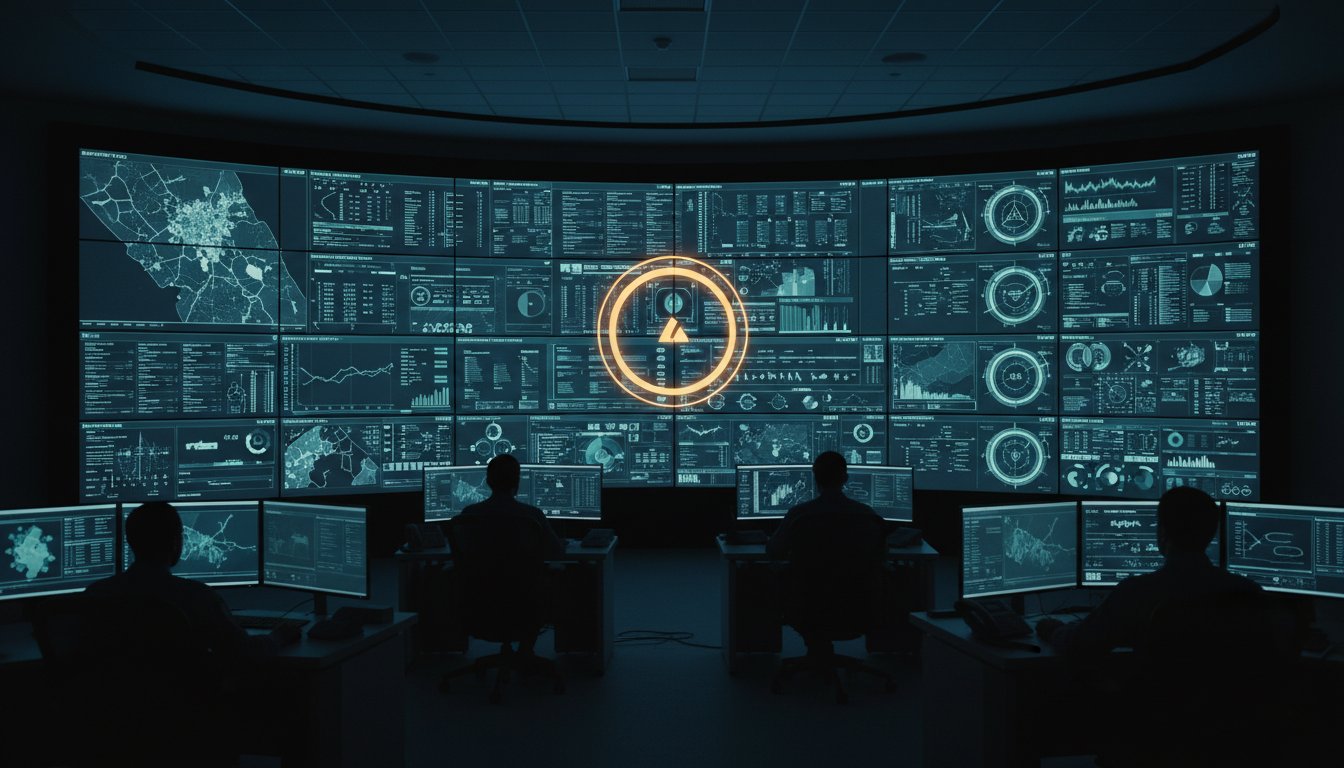
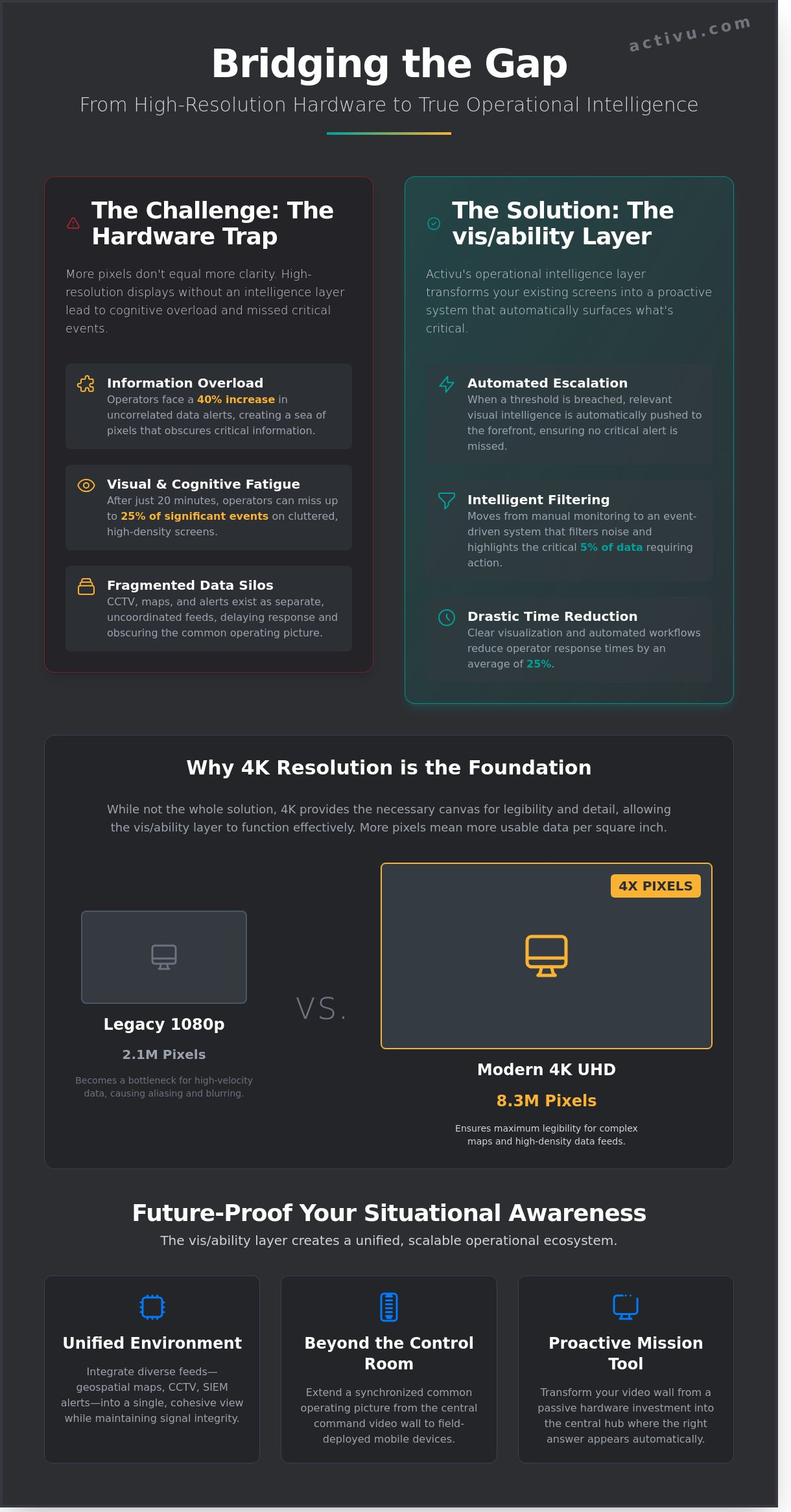
A high-density display is effectively useless if the operator viewing it is overwhelmed by a 40 percent increase in uncorrelated data alerts. In high-stakes environments like an EOC or utility command center, fragmented data feeds create silos that delay response times and obscure the common operating picture. Operators often suffer from severe visual fatigue when low-legibility screens force them to squint at critical telemetry, leading to missed incidents. While 4k resolution provides the necessary canvas, most control rooms already have the screens. What they’re missing is the layer that decides what goes on them, and escalates automatically when something needs attention.
You likely realize that more pixels alone won’t solve the underlying problem of information overload. This article demonstrates how high-density displays transform from a basic hardware spec into a vehicle for operational intelligence when paired with vis/ability, our specialized operational intelligence layer. We’ll explore how automated escalation and clear visualization reduce response times by 25 percent while providing a future-proof foundation for your entire mission-critical infrastructure.
Key Takeaways
- Identify the operational gap where fragmented data streams and siloed systems lead to cognitive overload, regardless of display quality.
- Discover how the vis/ability layer transforms existing screens into an intelligent system that automatically surfaces and escalates mission-critical information when it matters most.
- Leverage 4k resolution to ensure maximum legibility for complex geospatial mapping and high-density data feeds that require absolute technical precision.
- Implement best practices for integrating diverse feeds into a unified environment while maintaining signal integrity across the network using strategic infrastructure.
- Future-proof your situational awareness by extending a synchronized common operating picture from the command center to field-deployed mobile devices.
The Gap Between 4K Hardware and Operational Reality
Command centers often fall into a costly trap. They prioritize the procurement of ultra-high-definition displays while leaving their underlying data infrastructure fragmented. This creates a scenario where operators manage 8 million pixels of raw data without a cohesive strategy for interpretation. The disconnect between a high pixel count and the ability to make a life-saving decision is what we define as The Gap. While 4K resolution standards provide the canvas, they do not provide the context. Most control rooms already have the screens. What they’re missing is the layer that decides what goes on them; and escalates automatically when something needs attention.
Bridging this technical divide requires vis/ability. We define this as an operational intelligence layer that surfaces through the video wall to provide immediate clarity. Without this layer, a 4k resolution video wall is simply a larger version of a cluttered desktop. It remains a passive hardware investment rather than a proactive mission-critical tool. The goal is to move beyond the technical specifications of a display and focus on the intelligence it communicates.
Fragmented Systems and the Illusion of Clarity
Operators frequently juggle multiple data feeds, including CCTV, geospatial maps, and SIEM alerts. On a standard 4k resolution display, these inputs often exist in silos. This fragmentation creates “Siloed Visualization,” where critical incidents are obscured by screen clutter. Seeing more data is not the same as seeing what matters. Transitioning to event-driven situational awareness means moving away from manual monitoring toward a system that filters noise and highlights the 5% of data that requires immediate human intervention.
Why Operators Miss Incidents on High-Resolution Walls
Human performance degrades rapidly in high-density visual environments. Research in human factors engineering suggests that operators can miss up to 25% of significant events after just 20 minutes of continuous monitoring. High resolution increases the density of information, which can accelerate cognitive fatigue if the software fails to prioritize alerts. High-resolution walls must do more than just house data; they must be the place where the answer appears. Automatic escalation ensures that when a sensor trips or a threshold is breached, the relevant visual intelligence moves to the forefront. This prevents critical alerts from being buried in a sea of pixels, ensuring the video wall serves its primary purpose as a tool for decisive action.
Defining 4K Resolution: Technical Standards for Critical Operations
4K resolution is a grid of 8.3 million pixels that enables the simultaneous display of multiple high-density data sources. In mission-critical environments, this isn’t about aesthetics; it’s about the technical capacity to maintain legibility when every pixel represents a potential life-saving data point. A standard 4K Ultra HD (UHD) display utilizes a 3840×2160 pixel architecture. This density allows operators to view granular details in geospatial mapping and complex SCADA systems without the aliasing or blurring that plagues lower-resolution setups.
The physics of 4k resolution dictate its utility in the control room. By packing four times as many pixels into the same physical space as legacy systems, 4K provides the sharpness required for smaller text and intricate sensor feeds. This technical standard is formally detailed in the ITU-R Recommendation BT.2020, which sets the parameters for color space and resolution in high-performance visual systems. Without this density, operators often face control room situational awareness problems because they can’t distinguish between critical alerts and background noise on a crowded screen.
3840×2160 vs. Legacy Resolutions
Comparing 4K to legacy 1080p systems reveals a massive gap in operational capability. A 1080p screen offers roughly 2 million pixels, which quickly becomes a bottleneck when managing global infrastructure or high-velocity data feeds. By 2026, 4K will be the absolute baseline for operations centers because it provides significantly more data per square inch. Most control rooms already have the screens. What they’re missing is the layer that decides what goes on them, and escalates automatically when something needs attention. While organizations might use standard monitors or competing software, they often find these tools are only a partial solution that leaves data siloed and inaccessible.
Legibility and the Common Operating Picture
Achieving a true Common Operating Picture (COP) requires more than just high-resolution hardware. 4k resolution supports a COP by allowing for multiple windows to be tiled across a single display without losing critical detail. This is where vis/ability functions as an operational intelligence layer, surfacing the most relevant data onto the video wall at the exact moment it’s needed. High Dynamic Range (HDR) further enhances this by ensuring contrast in low-light sensor feeds, preventing the “washed out” look that causes operators to miss incidents. When data flows into a central hub, vis/ability ensures that the 8.3 million pixels on the wall actually translate into actionable intelligence.
If you’re struggling with how to manage multiple data feeds in a dispatch center, it’s time to look beyond the hardware. You can contact our team to see how an integrated intelligence layer can transform your visual workspace.
The vis/ability Layer: Deciding What Goes on the 4K Wall
Most control rooms already have the screens. What they’re missing is the layer that decides what goes on them, and escalates automatically when something needs attention. While a display might offer 8.3 million pixels inherent to 4k resolution, those pixels remain dormant or distracting without a brain to manage them. Organizations often fall into the trap of purchasing Commercial Off-the-Shelf (COTS) hardware, assuming that pixel density equals performance. It doesn’t. True situational awareness requires a bespoke intelligence architecture that filters noise and surfaces insights.
The vis/ability platform acts as this critical bridge. It functions as an operational intelligence layer, transforming a static wall into a dynamic tool. Instead of staring at 50 or more disjointed data feeds, operators see exactly what requires their judgment. Adhering to 4K resolution technical standards ensures visual fidelity, but vis/ability ensures that fidelity serves the mission. It moves beyond simple display management to become the engine of decision-making.
Automatic Escalation and Event-Driven Logic
Manual switching represents a catastrophic failure point in 24/7 mission-critical environments. When a crisis hits, operators don’t have the luxury of clicking through menus to find the right camera or map. The vis/ability platform monitors backend applications constantly. It identifies when a specific threshold is crossed, such as a localized power surge or a security breach. Once detected, the system automatically changes the wall layout to prioritize the incident. This process reduces the “time to eye” for critical alerts to near zero. It replaces human hesitation with automated visualization workflows, ensuring the right data arrives before the situation worsens.
Unifying Fragmented Feeds into a Single Hub
Fragmented systems create silos that hide emerging threats. In utilities and energy sectors, or complex transportation networks, data flows from hundreds of disparate sensors. These feeds often live in isolated applications that don’t communicate. vis/ability breaks these silos by positioning itself as the central hub. It ingests raw data and presents it as actionable intelligence on the 4k resolution wall. This unification allows a team to share a common operating picture, whether they’re in the main command center or a remote huddle room. The wall stops being a collection of monitors and starts being a single, cohesive source of truth. It provides clarity when the stakes are highest, ensuring no operator misses an incident because it was buried in a background feed.
Implementing 4K Feeds: Integration and Infrastructure
Operational gaps often stem from fragmented data streams that fail to reach the decision-maker in time. Most control rooms already have the screens. What they’re missing is the layer that decides what goes on them, and escalates automatically when something needs attention. Adding 4k resolution to a wall isn’t just about increasing pixel density; it’s about the infrastructure that maintains signal integrity across a distributed network.
Integrating Third-Party Data Sources
Bringing IPTV, VMS, and web apps into a single view requires more than simple windowing. Standalone tools like those from Axon provide critical field data, but they remain silos without a unifying platform. They’re only a partial solution. To be effective for the whole team, these feeds must flow into the vis/ability hub. This orchestration allows the team to overcome the limitations of software that lacks video wall logic. When a cybersecurity threat triggers an alert, the common operating picture must appear across distributed teams instantly. vis/ability acts as that central hub, turning fragmented data into actionable intelligence and ensuring that critical visibility isn’t trapped on a single operator’s workstation.
Infrastructure Requirements for 4K Video Walls
A 4k resolution feed requires significant network capacity. A single 3840×2160 stream encoded for mission-critical clarity can consume between 25 and 50 Mbps. Supporting these event-driven feeds across a network demands high-performance switches and robust backbones. The IPTV encoder plays a vital role here. It must maintain signal integrity while managing bitrates to prevent network congestion without compromising latency. Managing these feeds requires specific technical considerations:
- Network switches must support IGMP snooping to manage multicast 4K traffic efficiently.
- End-to-end latency should remain below 50 milliseconds for real-time camera control and response.
- Cabling infrastructure must support 10GbE to prevent bottlenecks at the core.
In SOC, NOC, and GSOC environments, infrastructure design must account for peak loads during major incidents. If the network cannot handle the simultaneous delivery of multiple high-resolution streams, latency increases and situational awareness suffers. For a deeper dive into these requirements, consult The Video Wall: A Strategic Guide to understand how to build for long-term operational reliability.
Learn how to unify your critical data streams by exploring the vis/ability platform.
Future-Proofing Situational Awareness with Activu
Fragmented systems and data silos often create a dangerous gap in mission-critical environments. When operators are forced to toggle between disconnected feeds, response times suffer and critical incidents go unnoticed. Most control rooms already have the screens. What they’re missing is the layer that decides what goes on them, and escalates automatically when something needs attention. Activu provides this essential intelligence through vis/ability, an operational layer that transforms a standard 4k resolution video wall from a passive display into an active partner in decision-making.
Engineering Intelligence for 2026 and Beyond
Control room design is undergoing a fundamental shift from static, manual monitoring to dynamic, event-driven environments. By 2026, the most effective command centers will no longer rely on operators to spot anomalies across dozens of feeds. Instead, the software will surface what matters most based on real-time triggers. This evolution is why Activu remains the bedrock for federal government and defense operations where technical failure is not an option. Activu transforms 4K displays into proactive decision-support systems that anticipate operator needs.
Our design services ensure that 4k resolution hardware is fully optimized for operational efficiency. We focus on the human element, ensuring that the high pixel density of modern displays reduces eye strain and improves the clarity of geospatial data and complex schematics. This technical reliability provides a sense of steady reassurance. It allows teams to remain focused and analytical when stakes are at their highest. The 4K hardware serves as the canvas, but vis/ability is the intelligence that paints the answer.
Next Steps for Your Mission-Critical Environment
Starting a control room refresh requires a strategy that prioritizes situational awareness over mere hardware specifications. Many organizations invest in expensive displays but fail to address the underlying problem of data overload. A successful upgrade must focus on achieving a unified operating picture that spans from the command center to mobile devices in the field. This ensures that field personnel and remote stakeholders see the exact same critical data as the dispatchers, facilitating seamless collaboration during a crisis.
- Identify the specific “pain points” where operators currently miss incidents due to visual noise.
- Utilize professional design services to map your data feeds into a cohesive vis/ability layer.
- Deploy automated escalation protocols that move critical data to the 4K wall the moment a threshold is crossed.
If you are ready to move beyond fragmented screens and achieve true operational visibility, the next step is a tailored assessment. We help you bridge the gap between raw data and certain action. Contact Activu today to consult with our engineers on building a more resilient, intelligent operating environment.
Master Your Operational Environment with Intelligent 4K Visualization
Fragmented systems and manual monitoring create persistent control room situational awareness problems. Hardware alone won’t bridge this gap. Most control rooms already have the screens. What they’re missing is the layer that decides what goes on them, and escalates automatically when something needs attention. Activu provides this essential bridge through vis/ability, an operational intelligence layer that surfaces through the video wall to serve as your central hub for all data feeds.
Since 1983, Activu has delivered over 40 years of mission-critical expertise to federal defense and global utility providers. By integrating 4k resolution into a managed workflow, we solve why operators miss incidents on a standard video wall. Our event-driven automation reduces response time by identifying threats before they escalate, ensuring your team focuses on the mission instead of the technology. You can extend these EOC common operating picture solutions across command centers, huddle rooms, and mobile devices. It’s time to transform your display into a proactive asset that empowers certain action and brings total clarity to your mission.
Request a demo of the vis/ability platform to see your 4K wall in action.
Frequently Asked Questions
What is the difference between 4K UHD and True 4K for control rooms?
4K UHD delivers a resolution of 3840×2160 pixels, which is the standard 16:9 aspect ratio for most mission-critical displays. True 4K, often used in digital cinema, provides 4096×2160 pixels. Most control rooms already have the screens. What they’re missing is the layer that decides what goes on them, and escalates automatically when something needs attention. Using UHD ensures that your 8.3 million pixels align perfectly with professional LED panels without stretching or distorting critical data during an emergency.
Why is 4k resolution important for situational awareness in a NOC?
High pixel density allows operators to monitor four times the data of a standard 1080p display while maintaining perfect legibility of small text and icons. 4k resolution is vital because NOC teams often face control room situational awareness problems when blurry maps or pixelated dashboards hide emerging threats. When vis/ability manages these feeds, it can highlight one specific anomaly among thousands of data points. This clarity prevents the 25 percent increase in response lag often caused by visual ambiguity.
Can my existing network infrastructure support 4K video wall feeds?
Your current 1Gbps network can support 4K video wall feeds if you employ high-efficiency H.265 compression or modern AV-over-IP protocols. Organizations that try to manage multiple data feeds dispatch center style using legacy hardware often hit bandwidth caps that cause latency. vis/ability solves this by acting as an intelligent hub, streaming high-bandwidth 4K content only when an automated trigger indicates that a mission-critical event requires full visual fidelity. This approach protects your 10Gbps backbone for the most vital data.
How does 4k resolution reduce operator fatigue in 24/7 environments?
4k resolution reduces eye strain by providing 140 pixels per inch, which creates sharper text and smoother lines that are easier for the brain to process during 12-hour shifts. Operators in 24/7 environments suffer from cognitive overload when they can’t quickly distinguish between status icons on low-quality screens. By providing a clearer image, the hardware reduces the physical effort of monitoring. vis/ability then layers on top of this clarity to ensure operators only focus on the three or four metrics that actually require human judgment.
Is 4k resolution necessary for huddle rooms and breakout rooms?
4k resolution is necessary in smaller spaces because participants sit much closer to the screen, making individual pixels visible on lower-quality displays. In a huddle room, 4K ensures that complex geospatial data or dense technical spreadsheets remain readable from only three feet away. While some teams use basic consumer displays, these lack the 24/7 reliability required for critical operations. vis/ability bridges the gap between the main command center and these breakout rooms, ensuring a consistent common operating picture across every device.
What happens if my source data isn’t in 4K resolution?
Your video wall processor will upscale lower-resolution sources to fit the 4K canvas, though this doesn’t add new detail to the original signal. Most control rooms already have the screens. What they’re missing is the layer that decides what goes on them, and escalates automatically when something needs attention. vis/ability manages this by intelligently windowing legacy 1080p feeds alongside native 4K maps. This prevents the blurry interpolation that often explains why operators miss incidents video wall displays should have caught.
How do vis/ability and 4K resolution work together to manage incidents?
vis/ability acts as the operational intelligence layer that filters 4K data to surface only what’s relevant during a live incident. While 4K provides the raw canvas, vis/ability provides the logic to populate it by aggregating fragmented systems into one view. When a sensor detects a perimeter breach, the software automatically pushes the 4K camera feed to the center of the wall. This ensures the team sees the answer immediately rather than searching through silos of data across multiple disconnected monitors.
What are the common mistakes when implementing 4K in an EOC?
One major mistake is failing to account for the 18Gbps bandwidth requirement of HDMI 2.0 cables, which leads to signal dropouts during EOC common operating picture solutions deployment. Another error is assuming that more pixels alone solve communication gaps. Organizations frequently invest in 4K hardware but leave it static. Without vis/ability to automate the escalation of data, the 4K wall becomes an expensive, clear wallpaper that fails to improve real-time decision-making when stakes are highest.