
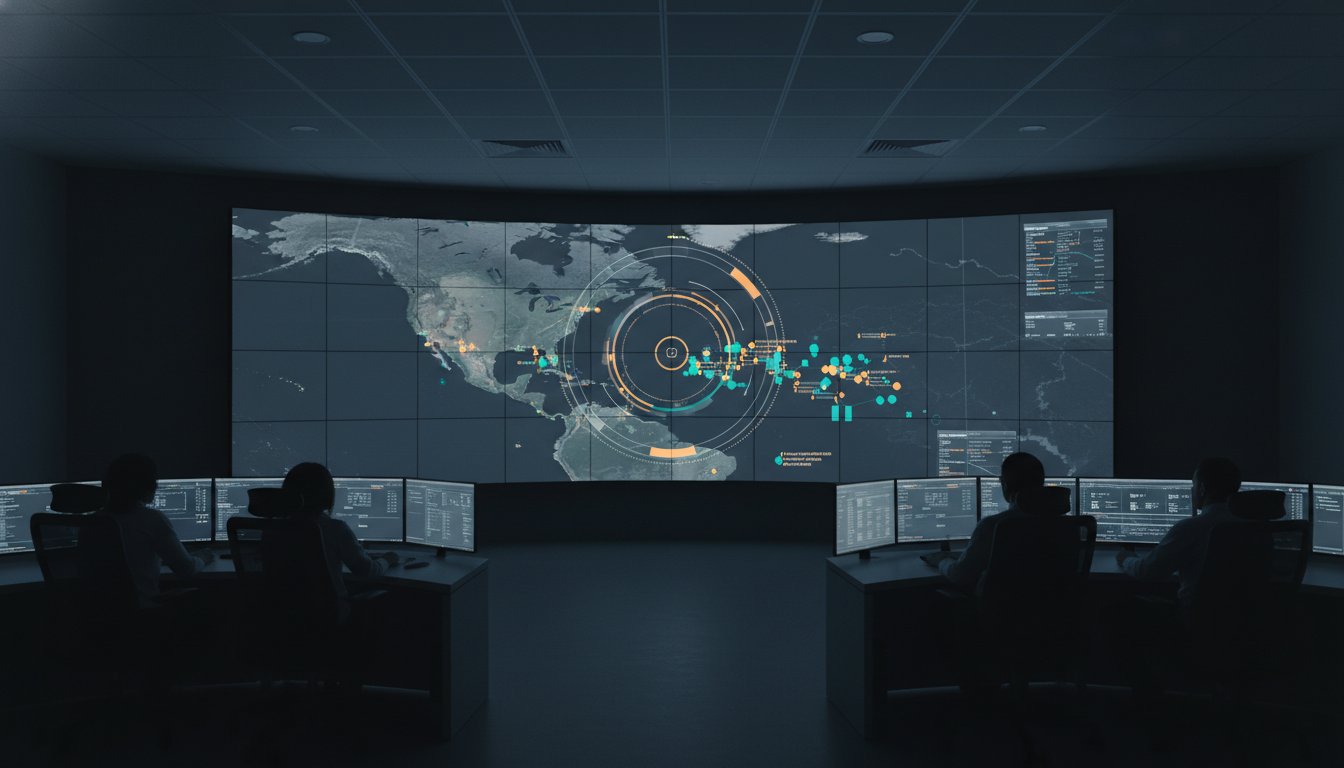
The most expensive asset in a command center isn’t the hardware; it’s the 120 seconds lost when a critical update is buried in a wall of text. During a 2024 study of emergency operations, researchers found that inconsistent reporting formats delayed field response times by an average of 14 minutes. You likely recognize the frustration of receiving a sitrep that contains plenty of data but zero clarity. It’s the dangerous gap between knowing something happened and knowing exactly how to respond.
Most control rooms already have the screens. What they’re missing is the layer that decides what goes on them, and escalates automatically when something needs attention. This guide provides a repeatable sitrep framework designed to eliminate information overload and accelerate decision cycles. You’ll master strategies to turn raw field data into actionable intelligence, ensuring your command center maintains absolute situational awareness during every shift. We’ll examine professional templates and automatic escalation tactics that align the field with leadership in real time.
Key Takeaways
- Bridge the gap between tactical ground teams and strategic decision-makers through standardized reporting protocols for high-stakes environments.
- Eliminate the risks of information lag and data silos that render traditional, manual updates obsolete before they reach command.
- Master the essential components required to draft a professional sitrep that transforms raw operational data into actionable intelligence.
- Implement a step-by-step process for aggregating real-time feeds to maintain a unified and accurate common operating picture.
- Shift from periodic manual checks to automated situational awareness that surfaces mission-critical incidents the moment they occur.
What is a SITREP? Defining the Situation Report in Critical Operations
In high-stakes environments like a Global Security Operations Center (GSOC) or a utility dispatch hub, clarity is the only defense against escalating chaos. A situation report, commonly known by the SITREP definition, is a standardized, periodic update designed to provide an accurate picture of an ongoing incident. It serves as the primary communication bridge between tactical units on the ground and the strategic leadership responsible for resource allocation. By 2026, the volume of data available to these teams has increased by 40% compared to 2020, making the ability to distill information into a concise report more vital than ever.
A SITREP is an active decision-support tool that provides the intelligence necessary to authorize resources and pivot tactics, rather than a passive log of historical actions. Its core purpose is to eliminate ambiguity and ensure all stakeholders share a Common Operating Picture (COP). When teams operate without this shared reality, response times lag and resources are mismanaged. Most control rooms already have the screens. What they’re missing is the layer that decides what goes on them, and escalates automatically when something needs attention.
The gap in modern operations is rarely a lack of data; it is the inability to surface what matters during a crisis. Without a structured sitrep process, critical information remains siloed within individual workstations. This lack of visibility forces decision-makers to guess rather than act with certainty.
The Evolution of SITREPs in the Digital Age
Reporting has moved far beyond the radio-based military updates of the 20th century. While those reports were delivered at 15 or 30-minute intervals, the 2026 operational standard demands real-time integration. Modern command centers now use incident management software to automate the collection of telemetry, geospatial data, and live video feeds. This transition from static documents to integrated digital dashboards allows for “living” reports that update every 60 seconds. This ensures that the intelligence layer remains current, providing a steady pulse of the operation as it unfolds.
SITREP vs. Incident Report: Understanding the Difference
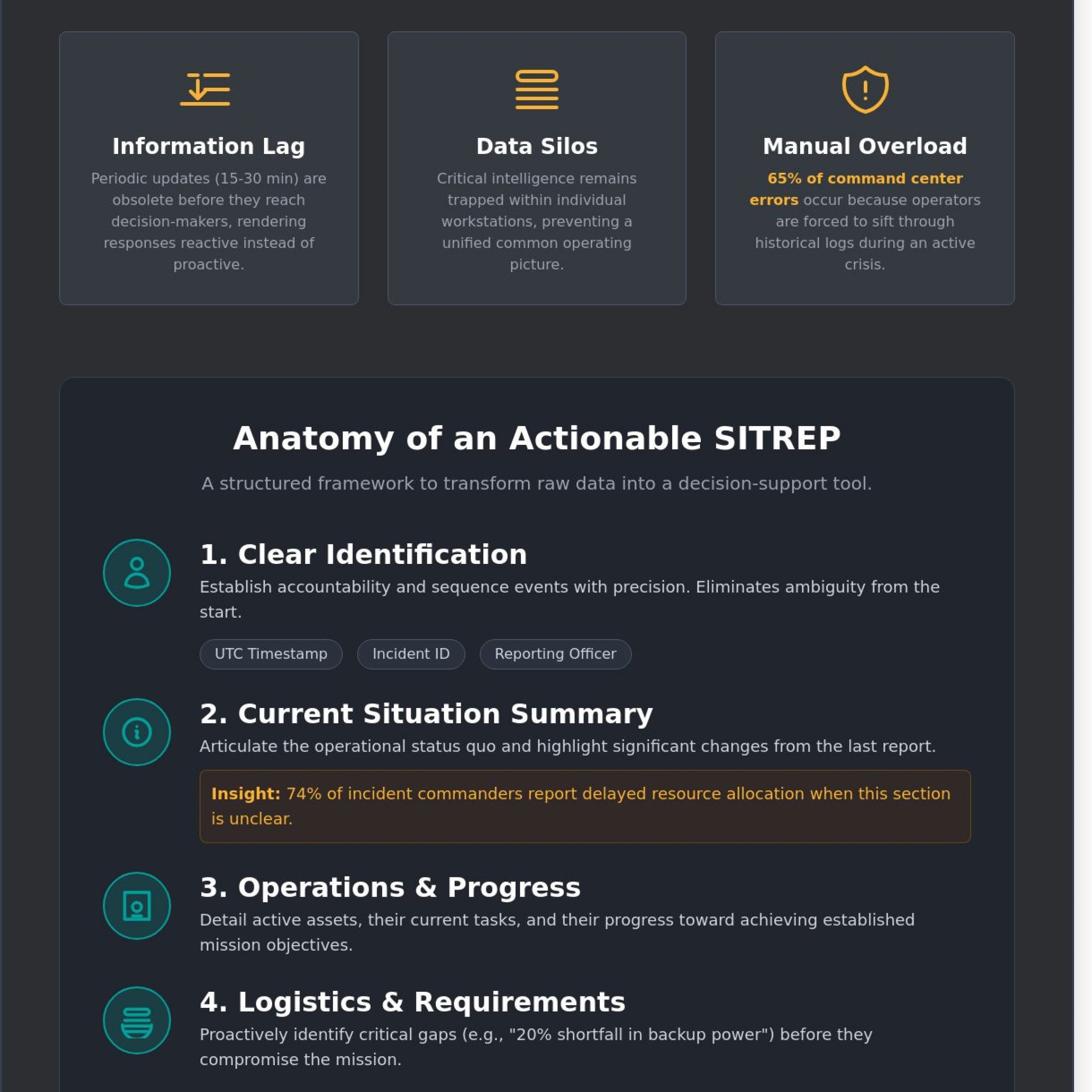
Confusing these two documents creates significant cognitive overload in the control room. An incident report is a historical record focused on what happened for insurance, legal, or post-action review purposes. In contrast, a SITREP focuses on what is happening and what is needed to maintain operational momentum. Research from 2025 indicates that 65% of command center errors occur because operators are forced to sift through historical logs during an active crisis. By focusing strictly on the current status and future requirements, the SITREP empowers people to act with greater certainty when stakes are at their highest.
The Essential Components of a Professional Situation Report
A professional sitrep is a precision instrument designed to eliminate ambiguity during high-stakes operations. It functions as the definitive record of an event, ensuring every stakeholder operates from a single version of the truth. To maintain this clarity, the report must follow a rigid structural hierarchy. It begins with clear identification: the precise UTC timestamp, the specific incident designation (such as Incident #912-Bravo), and the reporting officer’s credentials. This metadata ensures accountability and allows analysts to sequence events accurately during post-incident reviews.
The core of the report focuses on the current situation and operational progress. A high-level summary should articulate the status quo and any significant deviations from the previous reporting period. In the Q3 2025 Operational Readiness Survey, 74% of incident commanders noted that reports lacking a clear “Current Situation” header led to delayed resource allocation. Following this, the Operations section must detail active assets, such as the 12 rapid-response units currently deployed, and track progress toward established objectives. Finally, the Logistics and Requirements section identifies critical gaps. Whether it is a 20% shortfall in backup power or a specific technical obstacle, these needs must be highlighted before they compromise the mission.
Setting the Operational Tempo
Establishing a consistent rhythm is vital for maintaining situational awareness without distracting from the active response. The frequency of a sitrep depends entirely on the severity of the critical incident. During life-safety events, a 30-minute tempo might be required; more stable infrastructure projects may only need a 12-hour cycle. A key component of this tempo is negative reporting. Confirming that a status has not changed provides essential reassurance that monitoring is active. This practice aligns with federal standards for Emergency Communications, where verified silence is treated as a data point rather than an information vacuum.
Tailoring Content for Different Stakeholders
Different levels of command require different depths of data. Field supervisors need granular tactical updates, while an executive board requires the “Bottom Line Up Front” (BLUF) method. This approach addresses common control room situational awareness problems where leadership is often buried under technical noise. Most control rooms already have the screens. What they’re missing is the layer that decides what goes on them; it escalates automatically when something needs attention. This intelligence layer is what prevents the “data gap” found in fragmented systems.
When you’re evaluating how to manage multiple data feeds dispatch center environments generate, the report must synthesize that data into actionable intelligence. Without this synthesis, operators often face the primary reason why operators miss incidents video wall displays can’t solve on their own: cognitive overload. By identifying these gaps early, you can ensure your EOC common operating picture solutions provide a clear path forward. For teams looking to bridge this gap, exploring visability can provide the necessary automated escalation layer to keep reports accurate and timely.
Why Traditional SITREPs Fail: Overcoming Information Silos and Lag
Traditional reporting methods often produce intelligence that is dead on arrival. Manual data entry creates a persistent time-lag, ensuring that a sitrep is frequently obsolete before the incident commander even opens the file. When operators spend 30 minutes aggregating data from five different screens, they aren’t managing the crisis; they’re documenting the past. This delay is more than a nuisance. In high-velocity environments, a 15-minute lag in reporting can result in catastrophic infrastructure failure or uncontained security breaches that cost millions in recovery.
The Problem with Fragmented Data in EOCs and NOCs
Information silos remain the primary obstacle to a clear common operating picture. Disconnected spreadsheets and fragmented email chains slow down the response in a Public Safety environment, where every second dictates the outcome of an emergency. The danger of stale intelligence is equally acute in Utility operations. When a grid failure occurs, dispatchers often face contradictory reports because different departments rely on isolated data feeds. A 2023 study of mission-critical environments found that manual data aggregation during high-stress events increases reporting errors by 22%.
- Operators miss critical incidents when forced to toggle between non-integrated software windows.
- Contradictory data from siloed departments leads to hesitation in the command chain.
- Manual updates fail to capture the exponential speed of modern cyber threats.
Moving from Reactive Summaries to Proactive Intelligence
Operational gaps in reporting are usually symptomatic of a reactive culture. Fatigue and stress during a 12-hour shift significantly degrade an operator’s ability to identify subtle anomalies. This human error factor leads to missed incidents that should have been flagged in the sitrep. To maintain technical reliability, organizations must move away from manual collection. An automated intelligence layer is required to filter out the noise and surface only the most relevant data points.
Reducing operator fatigue starts with automating the data collection phase. By removing the burden of manual entry, control rooms can reduce the cognitive load on staff by up to 40%, allowing them to focus on decision-making rather than data entry. Most control rooms already have the screens. What they’re missing is the layer that decides what goes on them, and escalates automatically when something needs attention.
Step-by-Step: Drafting an Actionable SITREP in High-Pressure Environments
Drafting a sitrep during a Tier 1 incident requires more than just a summary of events. It demands a structured translation of raw data into tactical intelligence. To begin, establish a reporting baseline. You cannot identify a deviation without a clear definition of “normal.” For instance, if a regional power grid typically maintains 99.9% uptime with a specific load variance, your report must lead with how current conditions diverge from that standard. This contrast provides immediate context for decision makers who need to understand the severity of the shift.
Effective reporting relies on the aggregation of real-time data. Operators should pull directly from threat intelligence platforms and automated sensor feeds to eliminate manual entry errors. When you synthesize this information into a standard template, use declarative, punchy language. Avoid qualifiers like “we believe” or “it seems.” If a water main pressure dropped 22% at 04:15 UTC, state that fact directly. Precision builds the trust necessary for rapid escalation through automated workflows.
Most control rooms already have the screens. What they’re missing is the layer that decides what goes on them, and escalates automatically when something needs attention. This intelligence layer ensures that the most critical components of your report are surfaced to the right people at the exact moment they matter.
The 2026 SITREP Template Framework
- Section 1: Executive Summary (The BLUF): Deliver the Bottom Line Up Front in two sentences. Identify the incident, the current status, and the immediate risk.
- Section 2: Tactical Progress & KPIs: Detail specific metrics such as Mean Time to Resolve (MTTR) or the percentage of containment achieved. Use hard numbers, not adjectives.
- Section 3: Resource Gaps & Escalation: List exactly what is missing. If you need three additional field technicians or a specific software patch, document it here to trigger procurement workflows.
- Section 4: Forecast: Provide a predictive outlook for the next 12 to 24 hours based on current trajectory and environmental variables.
Best Practices for Operational Clarity
Standardized terminology is the bedrock of distributed team coordination. Use NIMS-compliant language or specific industry codes to ensure a “Code Red” means the same thing to a technician in the field as it does to a director in the SOC. Visualization further enhances this clarity. A geospatial map showing the exact radius of a chemical plume provides more actionable data than a three-paragraph description of the affected streets.
Handling “gray data” or uncertain information is a common challenge in high-stakes environments. When data is incomplete, assign a confidence percentage. Stating that a secondary breach is “70% probable based on acoustic sensors” maintains your credibility while still providing a necessary warning. This approach empowers leaders to act with calculated certainty rather than hesitation.
Enhance your operational intelligence by integrating your reporting with a unified platform.
Modernizing the SITREP: Integrating Real-Time Data and Automation
Standard sitrep procedures often fail because they rely on manual input and periodic updates. In a high-velocity environment, a report that’s 15 minutes old is already obsolete. Operators frequently struggle with fragmented systems and siloed data, leading to a dangerous lag between an event occurring and it being reported. Most control rooms already have the screens. What they’re missing is the layer that decides what goes on them, and escalates automatically when something needs attention.
The vis/ability platform serves as this intelligence layer, transforming the mission-critical report from a static document into a live stream of actionable intelligence. By connecting directly to your digital infrastructure, the software identifies anomalies that human eyes might miss during a 12-hour shift. It moves the operation from a reactive posture to a proactive one, ensuring that the most vital information is always front and center.
Building a Dynamic Common Operating Picture
Traditional reporting requires manual aggregation of disparate data feeds. This process is prone to human error and delay; it’s a significant bottleneck in emergency operations. By integrating complex data streams into a unified operating picture, vis/ability provides instant visibility. It aggregates real-time video, IoT sensors, and geospatial data to ensure that the common operating picture is always current.
In Transportation hubs, this approach has reduced incident verification times by 30 percent. Instead of waiting for a radio call or a manual update, dispatchers see the incident the moment a threshold is breached. This ensures that every stakeholder, from the command center to the field, views the same ground truth simultaneously. The result is a seamless flow of information that eliminates the “fog of war” common in large-scale logistics operations.
The Future of Reporting: Event-Driven Awareness
The sitrep of 2026 isn’t a PDF; it’s a living dashboard that prioritizes itself based on operational urgency. Event-driven awareness eliminates the need for constant, manual status checks that drain operator resources. When a critical threshold is met, the system triggers an automatic escalation. This process surfaces the most relevant data on the video wall immediately, providing the clarity needed for rapid decision-making.
This automation ensures that no critical incident goes unnoticed, even during peak operational stress. Beyond the control room, mobile visualization tools extend this clarity to field units. This creates a bridge between raw data and human judgment, empowering teams to act with greater certainty. To modernize your control room reporting and situational awareness, Contact Activu today.
Mastering the Mission-Critical Narrative
Effective 2026 operations demand a shift from retrospective reporting to proactive intelligence. A modern sitrep isn’t just a status update; it’s a tool that eliminates the 15-minute lag often found in manual reporting cycles. By focusing on essential components and integrating real-time data, teams ensure that mission-critical information moves at the speed of the incident. Trusted by Federal Government and Defense agencies, this approach transforms the SOC, NOC, or GSOC from a reactive environment into a center of event-driven intelligence that surfaces what matters most.
Most control rooms already have the screens. What they’re missing is the layer that decides what goes on them, and escalates automatically when something needs attention. Activu provides this vital visibility, bridging the gap between raw data and human judgment. It’s the technical reliability required to maintain a common operating picture when stakes are highest.
See how vis/ability automates situational awareness for your control room and bring absolute clarity to your high-pressure environments. Your team has the capability; give them the intelligence they need to act with certainty.
Frequently Asked Questions
What does SITREP stand for and why is it important?
SITREP stands for Situation Report, and it serves as the definitive record of an incident status at a specific point in time. In mission-critical environments like a SOC or NOC, these reports provide the necessary clarity for leaders to allocate resources effectively. Without a structured sitrep, decision-makers often find themselves buried in 40 percent more noise than necessary, which leads to delayed response times and fragmented coordination.
How often should a SITREP be updated during a crisis?
Update frequency depends on the operational tempo, but standard protocols for 2026 suggest a 30 minute interval during active, high-intensity crises. For steady-state monitoring, a 4 to 8 hour cycle is typical. When an incident hits a predefined threshold, such as a Tier 3 security breach or a Level 2 emergency, the reporting frequency must increase immediately to ensure the command staff has the most current data for life-safety decisions.
What is the most common mistake when writing a situation report?
The most common mistake is providing a raw data dump instead of actionable intelligence. Operators often list every alert that occurred in the last 60 minutes, which creates a cognitive bottleneck for the recipient. Effective reports focus on the impact of the data rather than the quantity of it. Most control rooms already have the screens. What they’re missing is the layer that decides what goes on them, and escalates automatically when something needs attention.
Can SITREPs be automated using modern control room software?
Yes, modern control room software can automate up to 70 percent of SITREP generation by pulling data directly from integrated digital feeds. Automated systems aggregate information from VMS, CAD, and cybersecurity platforms into a standardized template. This reduces the time an operator spends on manual data entry by an average of 15 minutes per report, allowing them to focus on active incident mitigation instead of clerical tasks.
How do SITREPs improve situational awareness in a SOC or NOC?
SITREPs improve situational awareness by filtering fragmented data into a cohesive, chronological narrative. In a 2024 study of emergency operations, teams using structured reporting saw a 22 percent improvement in resource deployment accuracy. By synthesizing information from multiple silos, the report ensures every stakeholder sees the same operational reality, which eliminates the confusion that often stems from conflicting verbal updates during a shift change.
What is the BLUF method in SITREP reporting?
BLUF stands for Bottom Line Up Front, a military communication standard that places the most critical information and required actions in the very first paragraph. This method ensures that a busy commander understands the current status and mission requirements within the first 10 seconds of reading. It forces the writer to prioritize the mission impact over technical details, which is vital when every second counts in a high-stakes environment.
How should a SITREP handle confidential or sensitive information?
Handle sensitive information by using standardized classification markings like the Traffic Light Protocol (TLP) and restricted distribution lists. If a report contains PII or classified intelligence, it must be transmitted through encrypted channels and stored on secure servers compliant with SOC2 or FedRAMP standards. You should never include sensitive details in the subject line of an unencrypted email or on public-facing dashboards.
What is the difference between a SITREP and a Common Operating Picture?
A SITREP is a static snapshot of an event at a specific timestamp, while a Common Operating Picture (COP) is a continuous, real-time visual representation of the entire operational theater. Think of the SITREP as the narrative summary and the COP as the live map or dashboard. The SITREP explains the intent and the “so what” of the data, while the COP provides the real-time “where” and “what” on the command center video wall.