
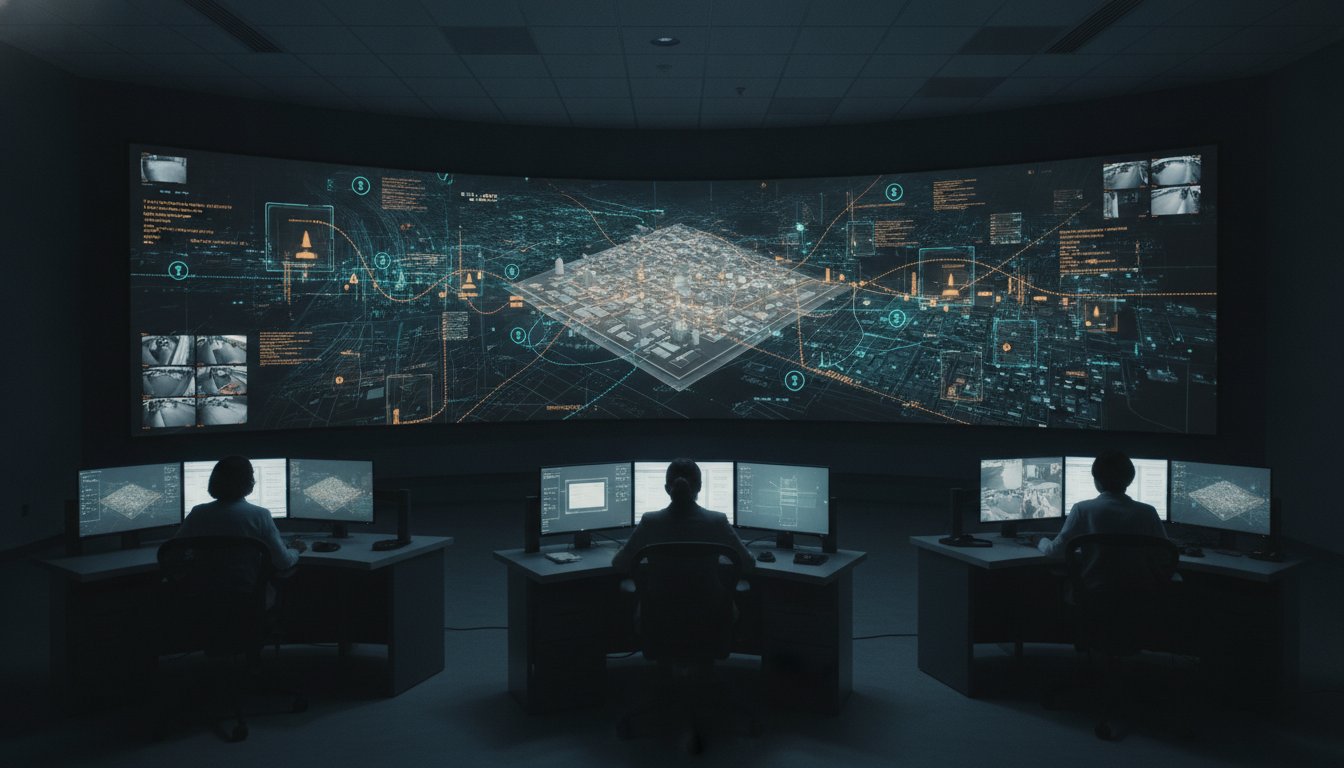
A wall of high-definition monitors is often the most expensive blind spot in a modern command center. While agencies invest heavily in visual hardware, the sheer volume of incoming data from CAD, ALPR, and CCTV systems frequently leads to cognitive overload. Modern Fusion Center technology must solve the problem of operators managing siloed applications that don’t communicate, which makes it far too easy to miss a critical incident buried in the noise. This fragmentation isn’t just a technical hurdle; it’s a direct threat to mission success and officer safety.
You’ve likely experienced the frustration of having all the necessary information available but no way to unify it into a single, actionable view. True situational awareness requires integrating these disparate data streams into a centralized operational intelligence layer. This article outlines the blueprint for building a Real-Time Intelligence Center that automates data escalation and provides a common operating picture. We’ll explore how to reduce operator fatigue and achieve faster incident response times through a truly integrated command environment that supports both headquarters and mobile units.
Key Takeaways
- Understand the transition from forensic-based data silos to proactive centers focused on immediate threat detection.
- Identify why high-performance hardware alone cannot provide true situational awareness without an intelligent data orchestration layer.
- Discover how modern Fusion Center technology unifies fragmented feeds from CAD, ALPR, and CCTV into a single, automated operational intelligence layer.
- Evaluate the limitations of standalone tools and learn how a centralized hub prevents operator overload during high-stakes incidents.
- Learn how to extend situational awareness to mobile field units, ensuring every responder acts on the same reliable intelligence.
Defining Fusion Center Technology and the RTIC Evolution
A Fusion center serves as the nerve center for information sharing between federal, state, and local agencies. Historically, these hubs focused on forensic analysis, meaning they processed data after an event to build cases or identify long-term trends. Modern Fusion Center technology has shifted this paradigm toward real-time operational intelligence. Instead of looking backward, today’s infrastructure supports intelligence-led policing that prioritizes proactive incident management. This shift ensures that data doesn’t just sit in a database; it actively informs the next tactical move.
The evolution from traditional centers to the Real-Time Intelligence Center (RTIC) marks a shift from strategic oversight to tactical execution. While a national fusion center might analyze regional threat patterns, a jurisdiction-specific RTIC focuses on the immediate “now.” It provides the technical backbone for rapid response. This transition requires a move away from static databases toward the dynamic, event-driven systems found in modern fusion center control rooms. These environments integrate live video, GPS locations, and emergency alerts into a single stream of actionable information.
The Objectives of Modern Intelligence Hubs
Modern hubs aim to establish a unified operating picture that spans across multiple agencies. When a major incident occurs, police, fire, and EMS must see the same data to coordinate effectively. Fusion Center technology facilitates this by delivering pre-arrival intelligence directly to field units. This visibility improves first responder safety by identifying hazards before they arrive on the scene. By providing this clarity, agencies reduce the time between incident detection and decisive action, ensuring resources are deployed where they’re needed most.
Why Traditional Command Centers Struggle
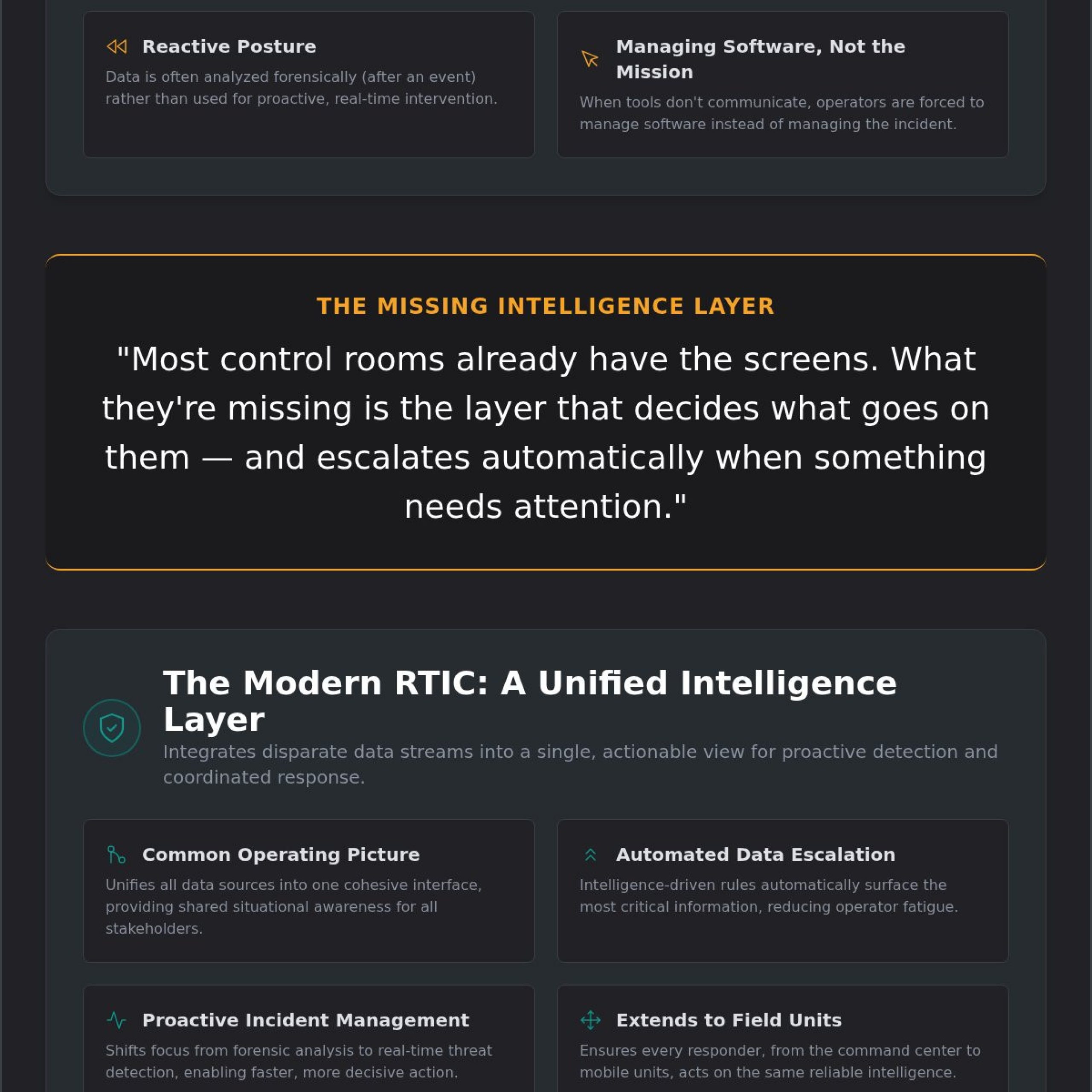
Many agencies still operate under the “Wall of Windows” model. This approach relies on operators manually watching dozens of separate feeds, from CCTV to CAD alerts. It creates a significant cognitive load, as humans aren’t wired to correlate fragmented data under extreme stress. Siloed applications that don’t share information force operators to toggle between screens, often leading them to miss critical events. When data remains trapped in individual tools, the result is a reactive posture that delays response times and increases operational risk. Operators end up managing software instead of managing the mission.
The Essential Infrastructure of a Real-Time Intelligence Center
Building a robust RTIC requires more than just high-end hardware. It demands a sophisticated suite of Fusion Center technology that can withstand the rigors of 24/7 public safety operations. This infrastructure serves as the connective tissue between the National Network of Fusion Centers and local tactical response teams, ensuring that intelligence flows seamlessly from federal databases to the street level.
At the core of this environment sit high-performance video wall systems. These aren’t simple displays; they’re strategic assets that facilitate shared situational awareness across the entire command floor. By integrating Computer-Aided Dispatch (CAD) data with GIS mapping layers, agencies can visualize exactly where incidents occur in relation to available resources, allowing for more precise unit allocation and faster response times.
Real-time sensor integration adds a layer of automated intelligence to the modern command center. License Plate Recognizers (LPR), gunshot detection systems, and IoT sensors provide instantaneous alerts that would otherwise require manual monitoring by stressed staff. The integration of this Fusion Center technology allows for the seamless aggregation of live video streams from CCTV, body-worn cameras, and aerial assets into a unified interface, giving commanders a total view of the operational theater.
Data Aggregation and Visualization Standards
High-resolution visualization is critical for identifying subtle threats in high-activity environments. Fragmented software feeds must be combined into a single cohesive interface to prevent operator fatigue and ensure no detail is overlooked. Effective control room design ensures that these systems remain accessible and functional during prolonged, high-stakes deployments, protecting the health of the operators who guard the community.
Bridging the Communication Gap
Commanders must synchronize visual data with radio dispatch and field reports to maintain a common operating picture. This synchronization is vital for managing multi-jurisdictional critical incidents where seconds matter. Technical reliability ensures that during large-scale public safety events, the flow of information remains uninterrupted. Most control rooms already have the screens. What they’re missing is the layer that decides what goes on them, and escalates automatically when something needs attention. This intelligent orchestration ensures that the right data reaches the right person at the exact moment of decision. If your agency struggles with siloed data, you can learn how to unify your command center operations here.
The Limitations of Fragmented Public Safety Tools
Public safety agencies today rely on a complex stack of specialized software. Many organizations utilize high-performance platforms for digital evidence management or advanced video surveillance. While these are capable tools, they often create a fragmented operational environment. Operators find themselves trapped in a cycle of application fatigue, constantly switching between disconnected browser tabs and desktop applications to piece together a story. This fragmentation prevents the formation of a true Common Operating Picture (COP), leaving command staff to make critical decisions based on incomplete or delayed information. The cognitive shift required to move between these disparate systems introduces a delay that can be costly during a rapidly evolving incident.
The expanded mission of fusion centers now encompasses all-hazards response and community safety, making the stakes for information clarity higher than ever. When Fusion Center technology remains siloed, the primary goal of intelligence-led policing is undermined. Most control rooms already have the screens. What they’re missing is the layer that decides what goes on them, and escalates automatically when something needs attention. Without this orchestration, the technical burden shifts from the system to the human, who is already operating under extreme stress. A modern center requires a system that correlates data behind the scenes rather than forcing an operator to act as the manual bridge between software packages.
Why Siloed Tools Need a Unifying Layer
Visualizing cross-platform data during a high-stress incident is nearly impossible without a central hub. Existing software often lacks the capability to escalate local events to the entire team simultaneously, leaving team members in the dark while an operator struggles to share a screen. A unifying platform doesn’t replace these tools; it enhances the utility of existing public safety investments by pulling their data into a single, cohesive interface. This ensures that a gunshot detection alert from one system immediately triggers the nearest surveillance cameras from another, presenting the result to the operator without any manual intervention. This level of automation ensures that the technology works for the user, not the other way around.
The Operational Cost of Inefficient Awareness
Inefficient awareness carries a heavy price in the field. Manual data retrieval and correlation can add minutes to response times when every second is vital. Fragmented information access leads to incomplete situation reports, which can jeopardize officer safety and leave responders unprepared for what they’ll face on the scene. By adopting a modern incident management software framework, agencies can bridge these technical gaps. This approach replaces manual searching with automated intelligence, ensuring that clarity is the standard, not the exception, during a crisis. When responders have accurate, real-time data, they act with greater certainty and achieve better outcomes for the community.
Operational Intelligence: The Escalation Layer
Most control rooms already have the screens. What they’re missing is the layer that decides what goes on them, and escalates automatically when something needs attention. This intelligent orchestration is what separates a modern intelligence hub from a traditional dispatch center. By implementing an escalation layer, agencies move beyond passive monitoring. This type of Fusion Center technology acts as a filter, ensuring that operators aren’t buried under a mountain of non-essential data. It creates a proactive environment where the system identifies critical events before a human even realizes they’ve occurred.
Event-driven situational awareness is the core of this transformation. In a mission-critical context, this means the technical infrastructure reacts to real-time inputs. When the system detects a specific trigger, such as a high-priority CAD alert or a sensor hit, it reconfigures the visual environment to prioritize that incident. This automation doesn’t replace the operator; instead, it follows a “human-in-the-loop” model. The technology handles the repetitive task of data correlation, clearing the way for professionals to apply their judgment where it’s needed most. It empowers human decision-making by providing absolute clarity during the most chaotic moments of an operation.
Automating the Common Operating Picture
Automation ensures that the common operating picture is always relevant. By setting specific triggers, such as gunshot detection or license plate hits, the system can initiate dynamic video wall layout changes. These changes adapt to active critical incidents in real time. Instead of an operator manually searching for the correct CCTV feed, the relevant data finds them. This immediate delivery of intelligence reduces the “time to glass,” ensuring that commanders see the scene exactly as it unfolds without delay. You can explore how the vis/ability platform automates your escalation layer to achieve this level of precision.
Reducing Operator Cognitive Overload
In high-stakes environments, cognitive overload is a constant threat to accuracy. Effective Fusion Center technology uses visual hierarchy to focus attention on mission-critical displays. By filtering out routine data streams, the system presents only the intelligence that’s relevant to the current mission. This reduction in noise prevents fatigue and ensures that operators remain sharp during long shifts. Operational intelligence is the bridge between raw data and decisive action. When this bridge is functional, the result is a faster, safer, and more coordinated response to every public safety challenge.
Building a Proactive RTIC with Activu Corporation vis/ability
Activu Corporation provides the vis/ability platform as the essential operational intelligence layer for the modern RTIC. With over 40 years of experience in high-stakes environments, Activu Corporation offers the central hub where disparate data streams converge to provide absolute clarity. By implementing this platform, agencies move beyond the limitations of fragmented Fusion Center technology. The software doesn’t merely display information; it orchestrates it, ensuring that every team member sees exactly what they need at the moment of a pivotal decision. This orchestration transforms raw data into a proactive tool for public safety.
Many organizations already utilize powerful tools for digital evidence and real-time video management. While these systems are vital, they often operate in isolation, providing only a partial solution that requires a unifying layer to create a full common operating picture. The vis/ability platform unifies these tools into a single interface. It bridges the technical gap between specialized applications, allowing CAD alerts, GIS mapping, and live video to flow into a unified interface. This integration ensures that existing investments work harder for the entire team, from command staff to field responders.
Extending Visibility to Field Operations
True situational awareness shouldn’t stop at the command center’s walls. Mobile vis/ability extends this operational intelligence layer directly to field officers, providing them with real-time command center data on their own devices. By enabling this level of digital collaboration, Activu Corporation ensures that everyone acts on the same intelligence, regardless of their physical location. This synchronization is critical for maintaining operational continuity during complex incidents where conditions change by the second. Whether in a huddle room or a patrol vehicle, the mission remains unified and the data remains reliable.
Next Steps for RTIC Implementation
Transitioning from a reactive center to a proactive intelligence hub requires a strategic roadmap focused on technical reliability. This process typically involves:
- Professional control room design services to optimize the physical and digital environment for efficiency.
- Prioritizing data integrations based on specific jurisdictional threats and sensor requirements.
- Extending the common operating picture to mobile and remote units to ensure field-wide awareness.
To see this Fusion Center technology in action, you can request a tailored demo of the vis/ability platform. This allows your team to experience how automated intelligence can transform your command operations and deliver the clarity needed when stakes are at their highest.
Advancing Your Intelligence Operations
The transition from a reactive command center to a proactive Real-Time Intelligence Center depends on the strength of your orchestration layer. Most control rooms already have the screens. What they’re missing is the layer that decides what goes on them, and escalates automatically when something needs attention. By implementing advanced Fusion Center technology, agencies can finally break down the silos between CAD, GIS, and VMS platforms. This unified approach doesn’t just reduce cognitive load; it empowers operators to act with absolute certainty when every second counts.
Leading public safety agencies nationwide now rely on event-driven automation to significantly reduce incident response times. This technical reliability ensures that critical data reaches the right person, whether they’re on the command floor or using mobile devices in the field. You can see how Activu Corporation vis/ability powers the modern RTIC by unifying your existing tools into a single, seamless interface. Building a more resilient and visible operation is the most effective way to protect your team and your community.
Frequently Asked Questions
What does RTIC stand for in law enforcement?
RTIC stands for Real-Time Intelligence Center. It represents a tactical evolution in law enforcement, shifting from forensic analysis to immediate, live-action support. Unlike a strategic fusion center that might look at long-term trends, an RTIC provides the technical infrastructure to monitor active incidents as they unfold. This allows commanders to deploy resources more effectively based on real-time visual and data-driven insights from the ground, ensuring a more precise response to emerging threats.
How does Fusion Center technology differ from traditional dispatch software?
Traditional dispatch software is designed primarily for call management and resource logging. In contrast, modern Fusion Center technology acts as a sophisticated orchestration layer that unifies disparate systems. It doesn’t just record data; it visualizes it by integrating video, mapping, and sensor hits into a single view. This creates a proactive environment where information is automatically escalated to the right people, rather than remaining trapped in a static database or disconnected application.
What are the most critical data feeds for a Real-Time Intelligence Center?
A successful center relies on the integration of Computer-Aided Dispatch (CAD), Geographic Information Systems (GIS), and Video Management Systems (VMS). These core feeds provide the location and visual context necessary for rapid response. Beyond these, secondary feeds like license plate recognition and gunshot detection provide automated alerts. When these feeds flow into a unified platform, they provide the comprehensive visibility required for intelligence-led policing and officer safety in high-stakes environments.
Can an RTIC integrate with body-worn camera systems?
Yes, an RTIC can integrate with various body-worn camera platforms and digital evidence management systems. These integrations allow command staff to view live footage from the field alongside fixed CCTV and aerial assets. However, these feeds are most effective when they are orchestrated within a broader operational intelligence layer. This prevents the footage from being just another siloed window and instead makes it a vital part of a unified common operating picture.
What is the role of a Common Operating Picture (COP) in an RTIC?
The Common Operating Picture serves as the single source of truth for all responding agencies and units. By synchronizing maps, video, and incident logs, the COP ensures that headquarters and field units are acting on the same intelligence. This synchronization is critical for multi-jurisdictional coordination. It eliminates the confusion caused by fragmented reports and allows commanders to make decisive tactical choices based on a unified, real-time visual environment that everyone can see.
How can command center data be shared with officers in the field?
Intelligence is shared through mobile extensions of the command center platform. These tools allow field responders to access live video feeds, GIS layers, and incident alerts directly on their mobile devices or vehicle terminals. This extension of visibility ensures that officers have pre-arrival intelligence before entering a scene. It bridges the communication gap between the command floor and the street, fostering a safer and more informed response to every call for service.
Why do operators in Fusion Centers suffer from cognitive overload?
Cognitive overload occurs when operators are forced to manually correlate data from dozens of disconnected software applications. Toggling between fragmented windows while monitoring radio traffic creates immense mental strain, which can lead to missed incidents. Most control rooms already have the screens. What they’re missing is the layer that decides what goes on them, and escalates automatically when something needs attention. This intelligent filtering is essential to maintain operator focus and clarity.
What is event-driven situational awareness?
Event-driven situational awareness is a proactive model where Fusion Center technology uses automated logic to detect and visualize threats. Instead of requiring an operator to constantly watch every camera, the system reconfigures the display wall the moment a specific trigger, like a high-priority CAD alert, is detected. This ensures that critical information finds the operator immediately. By automating the discovery phase, agencies can significantly reduce response times and improve overall mission success.