

A $2 million investment in a Security Operations Center often results in nothing more than a high-tech room where operators drown in fragmented data. While organizations focus on hardware, they frequently overlook the foundational SOC design principles required to turn telemetry into action. Operators face relentless fatigue as they manually correlate siloed feeds while incidents slip through the cracks. This overload creates dangerous delays and prevents teams from maintaining a common operating picture across distributed environments.
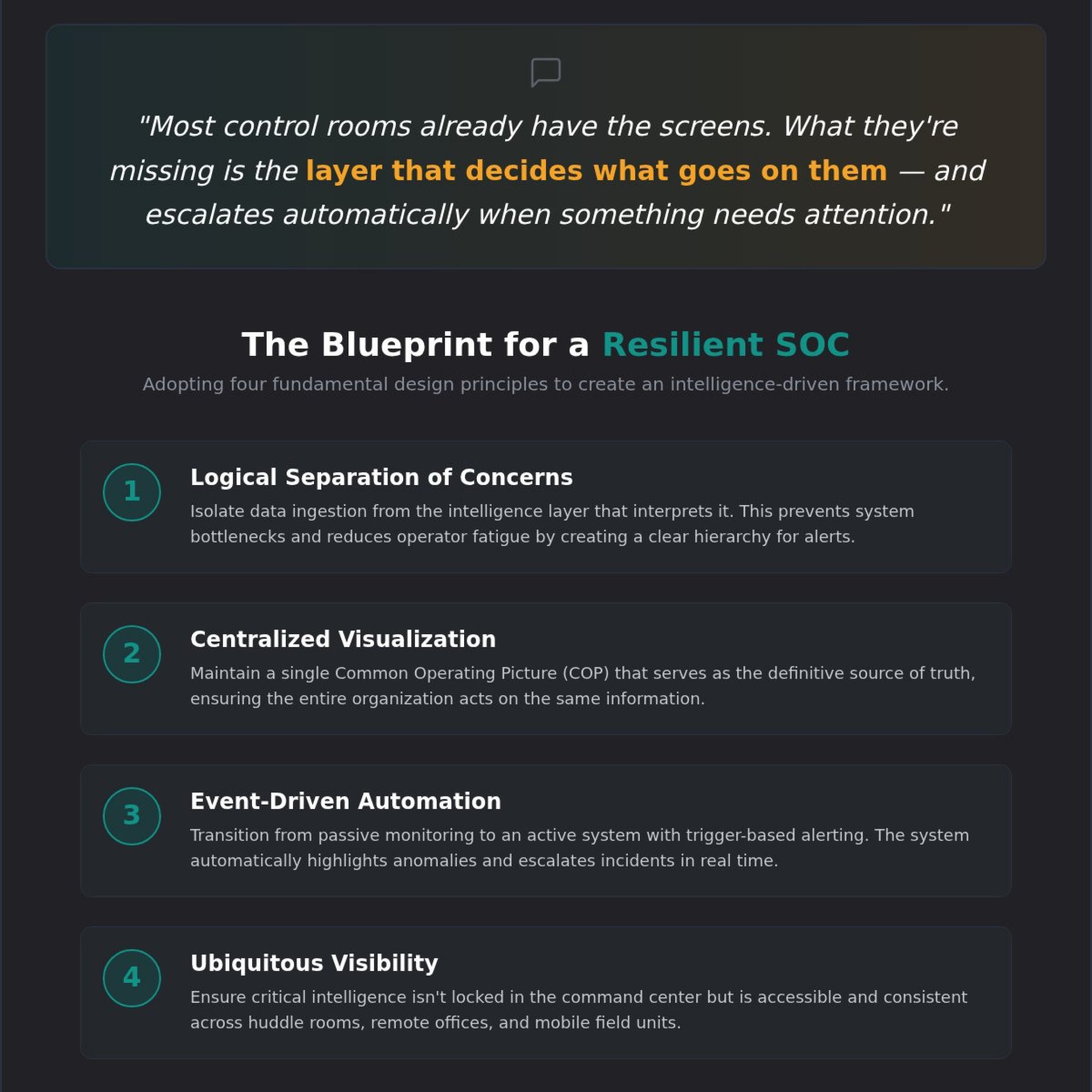
You likely recognize the frustration of seeing your team toggle between disconnected tools only to miss the alert that matters. Most control rooms already have the screens. What they’re missing is the layer that decides what goes on them, and it escalates automatically when something needs attention. Relying on standalone platforms like Axon provides only a partial solution, as they lack the integration to create a full common operating picture. This article explores how to architect an event-driven framework that reduces cognitive load. We’ll define the operational intelligence layer that unifies your data, ensuring your team acts with absolute certainty when stakes are highest.
Key Takeaways
- Identify why hardware-heavy designs fail to solve fragmented data issues and how to shift toward an intelligence-first architecture.
- Master fundamental SOC design principles that separate data management from visualization to reduce cognitive load on operators.
- Recognize the limitations of specialized tools that offer only a partial solution and require a unifying hub for cross-platform context.
- Build a framework for event-driven situational awareness that automates the escalation of critical incidents across your entire team.
- Establish a common operating picture that scales seamlessly from the huddle room to mobile field units for absolute decision certainty.
Why Traditional SOC Designs Fail: The Burden of Fragmented Systems
Many organizations invest heavily in a Security Operations Center (SOC) only to find their response times lagging. While a 2026 global study found the average planned budget for establishing a SOC is approximately $2 million, much of that investment is wasted if the architecture remains fragmented. The failure isn’t usually a lack of talent or tools. It’s a fundamental flaw in the application of SOC design principles. When systems remain siloed, operators spend more time navigating interfaces than neutralizing threats, creating severe control room situational awareness problems.
There’s a common misconception that visibility equals the number of monitors on a wall. In reality, adding more screens often just adds more noise. Without a unifying architecture, every new data feed increases the likelihood of information overload. Teams struggle with how to manage multiple data feeds in a dispatch center when those feeds aren’t correlated. Operators often juggle:
- Geospatial maps and asset tracking
- Real-time video surveillance streams
- Cybersecurity logs and network alerts
This sensory bombardment leads to a state where the brain stops processing critical anomalies because it’s too busy filtering out the irrelevant background. This is why operators miss incidents on a video wall even when the data is right in front of them.
The Cognitive Load of Data Silos
Manually correlating information across disparate platforms imposes a heavy mental tax. When analysts jump between different windows to confirm a single event, their focus fractures. This prevents a cohesive response strategy. Unlike generic frameworks that view interdependence as an architectural weakness, we recognize its link to operator burnout. In 24/7 environments, constant context-switching leads to information fatigue. It’s why operators miss incidents despite having data in front of them. Cognitive exhaustion leaves little energy for critical judgment.
The “Screen-First” Trap
Many design projects fail because they prioritize hardware over operational workflow. They start with video wall dimensions rather than the needs of the human at the console. This “screen-first” approach treats the symptom without addressing the cause. Most control rooms already have the screens. What they’re missing is the layer that decides what goes on them, and escalates automatically when something needs attention. Organizations must adopt SOC, NOC, & GSOC solutions. Modern SOC design principles require an intelligence layer that transforms monitors into a high-functioning command environment.
Fundamental Design Principles for a Resilient SOC Architecture
Resilience in a high-stakes environment depends on more than just high-resolution displays. It requires a deliberate architectural framework that prioritizes actionable intelligence over raw data volume. To move beyond the noise and fragmentation discussed previously, organizations must adopt core SOC design principles that structure how information is processed, visualized, and shared. These principles ensure that when a critical event occurs, the system supports the human operator rather than overwhelming them.
A modern architectural roadmap centers on four pillars:
- Logical Separation of Concerns: Isolating data ingestion from data interpretation to prevent system-wide bottlenecks.
- Centralized Visualization: Maintaining a single Common Operating Picture (COP) that serves as the definitive source of truth for the entire organization.
- Event-Driven Automation: Transitioning from passive monitoring to active, trigger-based alerting that highlights anomalies in real time.
- Ubiquitous Visibility: Ensuring that critical intelligence isn’t locked in the command center but is accessible to huddle rooms and mobile field units.
Applying Separation of Concerns to Operational Data
In software engineering, Separation of Concerns (SoC) involves isolating distinct aspects of functionality to reduce complexity. When applied to a Security Operations Center, this principle dictates that raw data streams must be decoupled from the intelligence layer that interprets them. Many legacy environments use “flat” designs where every alert, regardless of its severity, carries equal visual weight. This lack of hierarchy is a primary cause of operator fatigue. By aligning with frameworks like CISA’s Technical Reference Architecture, designers can create resilient systems that prioritize high-impact telemetry while archiving background noise.
Establishing the Operational Intelligence Layer
The bridge between raw data and human judgment is the operational intelligence layer. Most control rooms already have the screens. What they’re missing is the layer that decides what goes on them, and escalates automatically when something needs attention. This layer functions as a central hub where geospatial data, video streams, and network logs converge into a unified view.
The vis/ability Platform provides this essential foundation. It doesn’t just display information; it filters and correlates it to ensure that strategic decision-makers see exactly what they need at the moment of a pivotal decision. This architectural approach transforms a collection of disconnected monitors into a proactive engine for situational awareness. If you’re ready to move beyond hardware-centric limitations, you can speak with our design experts to begin mapping your unified operating picture.
The Fallacy of the “Single-Tool” SOC: Overcoming Partial Solutions
Many teams fall into the trap of believing a single software platform can manage every facet of their operation. While organizations use specialized tools like Axon for specific incident types, these platforms only provide a partial solution. They lack the cross-platform context needed to manage threats that move between digital and physical domains. Relying on a single vendor for a unified view often leads to vendor lock-in and creates gaps where data remains inaccessible to other systems. Robust SOC design principles prioritize a vendor-neutral hub that integrates diverse COTS solutions rather than forcing the team into a closed ecosystem. Applying these SOC design principles ensures your architecture remains flexible enough to adapt to evolving threats.
The Limitations of Point Solutions
Specialized platforms fail when an incident crosses domains. A cyberattack targeting power grid controls or physical access systems requires a response that no standalone SIEM or video management tool can coordinate alone. These tools create blind spots because they don’t share a common data language, forcing operators to manually bridge the gap during a crisis. This fragmentation increases the risk of error when stakes are at their highest. According to our analysis of COTS for Mission-Critical Operations, the lack of interoperability is a primary driver of operational failure. Adhering to ISACA’s SOC Best Practices demands a more integrated approach that values modularity and system-wide visibility.
Unifying the Cybersecurity Common Operating Picture
A Cybersecurity Common Operating Picture (COP) is the visual synthesis of network health and threat intelligence, providing a unified view that connects digital vulnerabilities with physical operational realities. In a resilient architecture, SIEM and SOAR data shouldn’t exist in a vacuum; they must be visualized alongside physical security feeds to provide full context. Most control rooms already have the screens. What they’re missing is the layer that decides what goes on them, and escalates automatically when something needs attention.
The vis/ability platform serves as the central hub for this synthesis. It provides the connective tissue between technical alerts and human judgment, ensuring every team member sees the same prioritized information. By positioning vis/ability as the operational intelligence layer, organizations can finally move past the limitations of point solutions and achieve true operational clarity. This architectural foundation empowers individuals to act with greater certainty when every second counts.
Implementing Event-Driven Visualization in the SOC
Building a resilient architecture requires moving beyond static displays and manual correlation. Implementing modern SOC design principles means shifting from constant surveillance to intelligent, event-driven response. This transition occurs through a structured four-step process that aligns technical capability with operational reality. First, map critical incident workflows to identify which specific data triggers require immediate eyes-on-glass. Second, integrate disparate applications into a single API-driven environment to eliminate the silos that cause response delays. Third, define automated escalation rules that dictate how visual data should change during an event. Finally, extend the common operating picture to mobile and remote stakeholders to ensure total situational awareness.
From Reactive Monitoring to Proactive Escalation
Operators can’t stare at hundreds of camera feeds and logs indefinitely without losing focus. Event-driven intelligence replaces the overwhelming “wall of video” with a “wall of relevance” that highlights only the essential information. When a specific threshold is met, the system triggers automatic layout changes based on incident severity. Most control rooms already have the screens. What they’re missing is the layer that decides what goes on them, and escalates automatically when something needs attention. This methodology is detailed in our framework for Incident Management Software, which prioritizes clarity during high-stakes operations. By automating the visual hierarchy, you empower your team to act with certainty instead of hunting for data.
Ensuring Distributed Collaboration
A command center is only as effective as its ability to communicate with those on the ground. Modern design must support huddle rooms and mobile units to prevent information bottlenecks. Using Mobile vis/ability ensures that field teams receive the same prioritized data as the command center, maintaining continuity during an incident. Operational continuity is the ability to maintain visibility across any device, regardless of the user’s location. This ensures that the bedrock of critical decisions remains stable, whether your team is in a central hub or a remote field unit. This seamless transition between the command center and the field is what allows modern operations to scale. To see how this architectural layer can transform your operations, explore the vis/ability platform today.
The vis/ability Advantage: Designing for Operational Clarity
The vis/ability platform serves as the bedrock of a modern, resilient Security Operations Center. It addresses the fundamental flaw inherent in hardware-heavy designs that prioritize screen real estate over actionable intelligence. Most control rooms already have the screens. What they’re missing is the layer that decides what goes on them, and escalates automatically when something needs attention. By applying advanced SOC design principles, this operational intelligence layer unifies fragmented data into a cohesive common operating picture. This transformation ensures that technology serves the mission rather than complicating it.
This architectural approach empowers individuals to act with greater certainty during the moments that matter most. In high-stakes sectors like Utilities & Energy, where grid stability is a matter of national security, or Transportation, where public safety depends on real-time geospatial awareness, vis/ability provides the clarity needed for decisive action. The platform acts as the essential bridge between raw telemetry and human judgment. It filters out the background noise of daily operations to highlight the critical anomalies that require immediate intervention.
A Partner in Mission-Critical Success
Activu brings decades of experience to every project through our specialized control room design services. We understand that technical reliability is the foundation of operational readiness. Our team provides the steady reassurance and technical expertise required to build environments that remain focused and analytical when stakes are at their highest. We don’t just provide software; we provide a partnership that ensures your command center is prepared for any contingency. This commitment to mission success allows your organization to transition from a state of complexity to a state of actionable intelligence.
Next Steps for Your SOC Redesign
The path to operational clarity begins with a comprehensive situational awareness audit. This process identifies the gaps in your current data feeds and determines where siloes are creating dangerous blind spots. You don’t have to abandon your existing infrastructure to achieve a modern operating picture. Our vis/ability platform is designed to integrate legacy systems into a unified intelligence layer. This ensures that your previous investments remain useful while gaining the benefits of event-driven automation. For those managing complex infrastructures, our insights into Federal Government and Defense standards offer a roadmap for achieving the highest levels of operational continuity. When you’re ready to redefine your command center’s capabilities, contact our experts to begin your architectural transformation.
Architect Your Command Center for Decisive Action
Relying on fragmented data feeds and siloed tools like Axon provides only a partial solution to modern threats. True resilience requires a shift from monitoring hardware to mastering an operational intelligence layer. By adopting core SOC design principles, you move beyond the noise of disconnected monitors and establish a common operating picture that empowers your team. Most control rooms already have the screens. What they’re missing is the layer that decides what goes on them, and escalates automatically when something needs attention.
Activu brings over 40 years of mission-critical experience to your SOC redesign. Our vis/ability platform provides the event-driven situational awareness escalation needed to stay ahead of evolving risks. It seamlessly integrates with your existing legacy systems to create a unified hub where every decision is backed by intelligence. You don’t have to settle for information fatigue or delayed responses. It’s time to secure the bedrock of your operations by moving from complexity to clarity. Request a Demo of the vis/ability Platform today and ensure your team acts with absolute certainty when every second counts.
Frequently Asked Questions
What are the core pillars of modern SOC design?
Modern SOC design principles prioritize the unification of fragmented data into a single, actionable common operating picture. The core pillars include event-driven situational awareness, logical separation of concerns, and ubiquitous visibility across all devices. By shifting from a hardware-centric model to an intelligence-first architecture, organizations ensure that critical information reaches decision-makers without the noise of irrelevant telemetry. This structure transforms a collection of tools into a proactive engine for operational readiness.
How do I reduce operator cognitive overload in a Security Operations Center?
Reducing cognitive overload requires moving away from the “wall of video” approach that forces analysts to filter raw data manually. Instead, implement an operational intelligence layer that prioritizes essential information based on incident severity. By using automated triggers to change screen layouts, operators only see the data relevant to the current threat. This methodology minimizes sensory bombardment and ensures that human judgment is reserved for high-stakes decisions rather than tedious data sorting.
What is the difference between a video wall and an operational intelligence layer?
A video wall consists of the physical displays and hardware used to view data, while an operational intelligence layer is the logic that manages that information. Most control rooms already have the screens. What they’re missing is the layer that decides what goes on them, and escalates automatically when something needs attention. Activu’s vis/ability platform provides this layer, serving as the central hub that makes hardware useful by providing context and automated situational awareness.
Can vis/ability integrate with my existing SIEM and SOAR tools?
Specialized tools like Axon provide only a partial solution because they lack the cross-platform context required for a full common operating picture. vis/ability integrates these point solutions with your existing SIEM and SOAR tools to act as a unifying hub. While some organizations use standalone platforms for specific incident types, vis/ability provides the necessary operational intelligence layer that makes these tools useful for the entire team across the command center and mobile devices.
How does event-driven situational awareness improve incident response times?
Event-driven situational awareness improves response times by automating the escalation of critical data. In traditional environments, operators must manually correlate alerts from different systems, causing dangerous delays. An event-driven architecture uses pre-defined triggers to push relevant video and data to the forefront instantly. This proactive approach eliminates the time spent hunting for information, allowing your team to act with greater certainty at the moment of a pivotal decision.
Is it possible to extend the SOC common operating picture to mobile devices?
Extending the common operating picture to mobile devices is a critical requirement for modern distributed operations. Through Mobile vis/ability, field units and remote stakeholders can access the same prioritized data as the command center. This ensures operational continuity across huddle rooms and handheld devices, regardless of location. By maintaining a single source of truth for the entire team, organizations can scale their response and maintain situational awareness from the center to the edge.
Why do operators miss critical incidents in traditional control rooms?
Operators miss critical incidents because of information fatigue caused by fragmented systems and siloed data feeds. When a control room relies on dozens of monitors showing raw, unprioritized video, the human brain eventually stops processing anomalies. This sensory overload creates dangerous blind spots. Without a layer to filter noise, incidents slip through the cracks even when the data is visible. Implementing advanced SOC design principles solves this by automating visual hierarchy.
What role does Separation of Concerns play in mission-critical system design?
Separation of Concerns (SoC) reduces system complexity by isolating data ingestion from the intelligence layer that interprets it. In mission-critical design, this prevents “flat” architectures where every alert carries equal visual weight. By decoupling these functions, you can manage raw telemetry in the background while only presenting high-impact information to the operator. It’s a foundational principle for building resilient systems that remain focused and analytical when stakes are at their highest.