
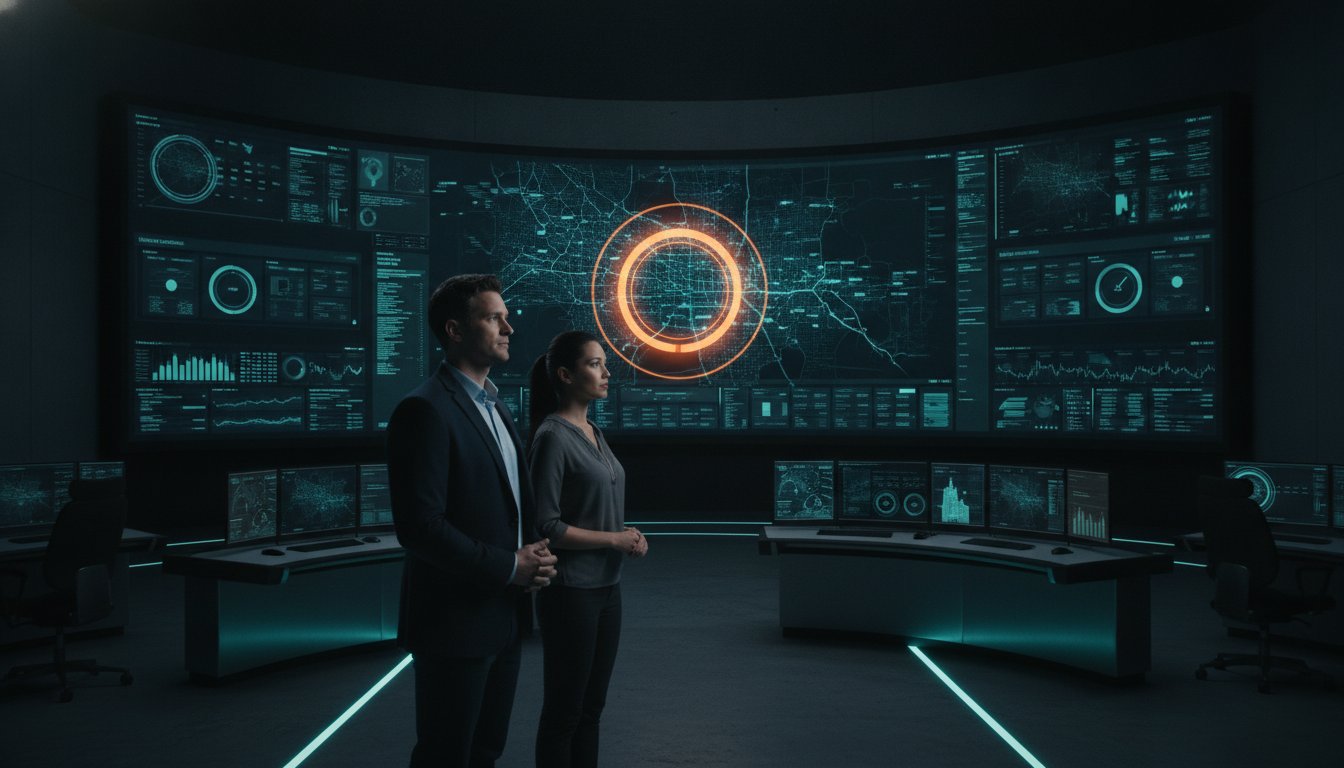
Operational resilience depends on the critical seconds between a system alert and a human response rather than the sheer number of monitors on a wall. In high-stakes environments, the cost of downtime represents more than just lost revenue; it impacts safety and mission success. You likely recognize the cognitive fatigue that comes from managing disconnected screens while vital alerts get buried in system silos. Designing resilient control room systems involves moving beyond simple hardware redundancy to build a foundation of absolute technical reliability.
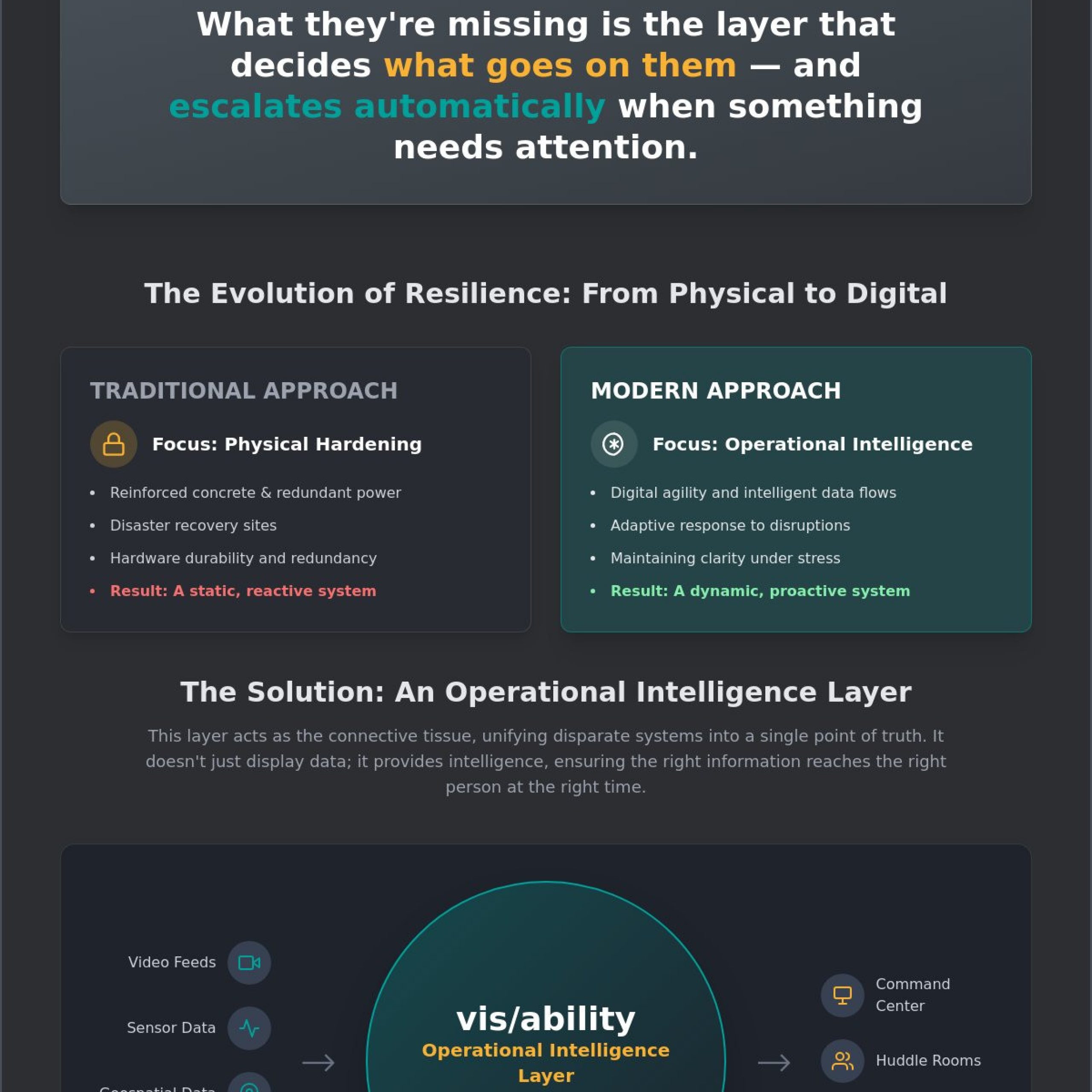
Most control rooms already have the screens. What they’re missing is the layer that decides what goes on them, and escalates automatically when something needs attention. While tools like Axon provide valuable data, they often remain partial solutions that fail to provide a complete common operating picture. This article outlines the architectural principles needed to transform fragmented data into actionable operational intelligence. You’ll learn how to implement an operational intelligence layer that unifies your command center, huddle rooms, and mobile field units into a single, proactive force.
Key Takeaways
- Define resilience as the capacity to maintain clarity and control during extreme operational stress, shifting the focus from hardware redundancy to digital agility.
- Master the architectural principles of designing resilient control room systems by introducing a central intelligence layer that automates the escalation of critical events.
- Break down organizational silos by integrating fragmented data feeds into a unified operating picture that bridges the gap between raw data and human judgment.
- Optimize human performance by reducing cognitive load through event-driven visualization, ensuring operators only see information that demands immediate action.
- Establish seamless collaboration across the entire organization by extending command center intelligence to mobile field units and distributed teams.
The Evolution of Resilience in Control Room Design
Resilience is often misunderstood as simple durability. In a mission-critical environment, true resilience is the capacity to maintain situational awareness and execute precise decisions under extreme operational stress. It isn’t just about the hardware staying on; it’s about the information remaining clear when the stakes are highest. Designing resilient control room systems requires a fundamental shift in how we perceive the command center. We’re moving away from a world where physical hardening was the only priority toward an era defined by digital agility and the intelligent management of data flows.
The traditional approach to control room design focused on the visible: large video walls and impressive workstation arrays. However, a “screens-only” strategy often fails during complex incidents. When data arrives from dozens of disconnected sources, operators face a wall of noise rather than a clear path to action. This fragmentation creates operational blind spots where critical alerts are missed simply because they were siloed in a secondary system. True resilience ensures that the system remains an asset rather than a liability during a crisis.
From Physical Hardening to Operational Intelligence
For decades, the industry defined resilience through reinforced concrete, redundant power supplies, and disaster recovery sites. While these remain essential, they are merely the baseline. Modern Resilience engineering suggests that a system’s ability to adapt to unexpected disruptions is what defines its success. Ensuring operational continuity in 24/7 environments now depends on how quickly a team can transition from reactive monitoring to proactive incident management. This shift requires a move from static hardware setups to dynamic intelligence layers that prioritize the most vital information at the moment of decision.
Identifying Common Situational Awareness Problems
Operators often miss incidents not because they lack data, but because they have too much of it without context. Screen clutter and sensory overload are the primary enemies of effective response. Many organizations rely on specialized point solutions that provide high-quality video or sensor data but only offer a fraction of the total picture. These tools often operate in isolation, requiring manual correlation by already stressed staff. History shows that siloed information frequently leads to delayed responses. In recent industrial incidents, teams often had all the necessary data points across different screens, yet no single person had the unified perspective required to connect them before a failure occurred. Designing resilient control room systems means solving this visibility gap before the first monitor is even mounted.
The Architecture of an Operational Intelligence Layer
Designing resilient control room systems requires a structural blueprint where every data feed converges into a single point of truth. This operational intelligence layer serves as the connective tissue between disparate hardware and the people tasked with making high-stakes decisions. Most control rooms already have the screens. What they’re missing is the layer that decides what goes on them, and escalates automatically when something needs attention. Without this layer, a command center is merely a collection of expensive monitors showing uncoordinated data.
The vis/ability platform acts as the bedrock for mission-critical operations by providing a unified operating picture. It integrates complex applications and real-time geospatial data, allowing teams to see the entire operational landscape at once. This architecture ensures that when a crisis occurs, the system doesn’t just display data; it provides intelligence. By prioritizing essential information, the platform ensures that the right data reaches the right person at the exact moment it’s needed.
The Limitations of COTS and Partial Integrations
Many organizations assume that commercial off-the-shelf (COTS) solutions are sufficient for mission-critical integration. While COTS hardware provides a cost-effective starting point, it lacks the specialized software layer needed to unify fragmented systems. For instance, specialized field sensor tools or digital evidence platforms offer excellent data, but they only provide a fragment of the total operational picture. They aren’t designed to be the central hub for an entire enterprise. Relying on these partial integrations creates a disjointed experience where operators must manually bridge the gap between tools. A resilient strategy requires a unifying software layer that supports team-wide visibility and scales across the entire organization, from the command center to mobile devices.
Building a Cybersecurity Common Operating Picture
Resilience must account for both physical and digital threats simultaneously. In sectors like utilities and energy, visualizing network health alongside physical security feeds is vital for total operational readiness. A cybersecurity common operating picture allows Security Operations Center (SOC) teams to accelerate response times during multi-vector threats. By seeing a cyber intrusion alert on the same map as a physical perimeter breach, teams can recognize the broader intent of an attack. Adhering to technical standards, such as the Human-System Interface Design Review Guidelines, ensures that these integrated views remain usable and don’t overwhelm the operator with unnecessary complexity. To see how this architecture functions in a live environment, you can connect with our design experts for a detailed walkthrough of integrated systems.
Solving Fragmented Data and System Silos
Data silos represent more than just a technical hurdle; they are a direct threat to operational readiness. When designing resilient control room systems, the primary objective is to eliminate the manual correlation of information, which often fails during high-velocity incidents. In a busy public safety dispatch center, operators must manage dozens of concurrent data feeds. If a dispatcher has to manually hunt for a specific camera feed while coordinating a response, the system has already failed. Event-driven situational awareness solves this by automating the flow of information from disparate sensors directly to the decision-maker. This ensures that the system works for the operator, rather than the operator working for the system.
Integrating Disparate Data Streams
Modern operations generate a massive volume of real-time telemetry, video, and geospatial data. Technical excellence in this area requires a platform capable of aggregating these feeds into a cohesive view. Research into Human Factors in Design of Control Rooms highlights that cognitive load increases exponentially when operators must toggle between unrelated applications. The vis/ability platform addresses this by normalizing complex data streams for the video wall. This ensures that telemetry from a SCADA system appears alongside relevant CCTV feeds and GIS maps, providing immediate context. By reducing the time spent on navigation, teams can focus entirely on resolution during critical events.
Collaborative Resilience Across the Enterprise
Resilience isn’t confined to the four walls of the command center. In complex sectors like transportation and logistics, the common operating picture must extend to huddle rooms and mobile field units. Distributed teams need the same level of data integrity as those seated in the primary facility. When a critical event occurs, strategic leaders and technical experts often need to collaborate from different locations. A truly resilient architecture facilitates this by allowing the same operational intelligence layer to be accessed on any device. This seamless extension of visibility ensures that every stakeholder, whether in the field or the boardroom, acts on the same intelligence. This unified approach eliminates the confusion of verbal updates, replacing it with a shared, real-time understanding of the mission.
Designing for the Human Element: Reducing Cognitive Load
Resilience fails when the human operator is overwhelmed by the systems designed to support them. In 24/7 environments, the bottleneck for operational success isn’t the bandwidth of the network; it’s the cognitive bandwidth of the person at the console. Designing resilient control room systems means treating the operator’s attention as a finite, mission-critical resource. If an interface requires an operator to manually correlate data from five different screens during an emergency, the risk of human error increases exponentially.
Information Prioritization and Alarm Management
Logic-based triggers are the first line of defense against cognitive fatigue. These triggers highlight critical anomalies automatically, allowing operators to ignore the steady state and focus entirely on deviations. In a SOC or NOC, information prioritization is the automated process of surfacing high-criticality data while suppressing secondary notifications to ensure immediate action on primary threats. This filtering ensures that the most urgent threats never get lost in a sea of routine telemetry.
Event-Driven Intelligence in Action
Effective intelligence moves a team from reactive monitoring to proactive incident management. When a sensor threshold is crossed, a resilient system reacts by reconfiguring the display environment to match the event. This transition ensures the human-in-the-loop is never left searching for context. The platform provides the necessary geospatial data and live video feeds instantly, allowing the operator to act with absolute certainty. This automated workflow removes the burden of constant manual monitoring, preserving the team’s mental energy for complex problem-solving. To optimize your team’s performance, explore our operational intelligence solutions.
Implementing vis/ability: The Logic of Resilient Operations
Establishing a resilient operation requires a platform that does more than just aggregate feeds. It must provide the logic that transforms raw data into decisive action. Most control rooms already have the screens. What they’re missing is the layer that decides what goes on them, and escalates automatically when something needs attention. The vis/ability platform serves as this essential hub, ensuring that every integrated tool contributes to a single mission goal. Activu Corporation’s design services bridge the technical gap between hardware installations and the software logic required to manage them. This holistic approach ensures that workstations, video walls, and data processing units work in perfect unison to maintain operational readiness, regardless of the complexity of the incident.
Designing resilient control room systems involves more than just selecting high-end monitors. It requires a deep understanding of how information flows through an organization during a crisis. Activu Corporation’s experts analyze your specific operational reality to identify where fragmented systems create lag or confusion. By positioning vis/ability as the operational intelligence layer, we ensure that your existing investments in technology become more useful for the entire team. This platform doesn’t replace your specialized tools; it unifies them, providing the bedrock upon which critical decisions are made with absolute confidence.
Mobile vis/ability: Resilience in the Field
Resilience is compromised if situational awareness stops at the command center doors. True operational continuity requires extending the common operating picture to mobile users for real-time field coordination. This capability is vital when key decision-makers are outside the control room but must still provide strategic guidance during an unfolding event. Secure, low-latency data transmission to handheld devices ensures that field units receive the same high-fidelity intelligence as the dispatch center. This synchronization eliminates the ambiguity of verbal reports and allows distributed teams to act with the same level of certainty as their counterparts in the main hub. By maintaining visibility across huddle rooms and mobile devices, organizations eliminate the communication gaps that often lead to mission failure.
Future-Proofing Mission-Critical Infrastructure
As we plan for the massive data volumes of 2026 and beyond, systems must be built to scale without losing performance. In sectors like manufacturing and process control, industrial resilience depends on the ability to integrate emerging sensor technologies into existing workflows. Future-proofing isn’t just about adding more storage or larger displays; it’s about refining the logic that prioritizes essential information. Adhering to rigorous security and performance standards ensures that your infrastructure remains a quiet, powerful engine behind successful operations. The transition from raw data to actionable intelligence is the final step in securing your mission. To begin building a foundation of absolute technical reliability, contact Activu Corporation to design your resilient system today.
Achieving Operational Certainty Through Intelligent Design
Designing resilient control room systems requires a departure from traditional, hardware-first thinking. True resilience is found in the operational intelligence layer that unifies fragmented data and prioritizes essential information for the human operator. By reducing cognitive load and automating the escalation of critical incidents, your team can maintain a common operating picture even under the most extreme conditions. This approach ensures that every decision is backed by real-time, actionable intelligence rather than raw, uncoordinated data streams.
Activu provides specialized engineering for high-performance mission control, a methodology trusted by federal government and defense agencies. Our event-driven automation escalates critical incidents instantly, providing the bedrock upon which your most vital operations depend. Most control rooms already have the screens. What they’re missing is the layer that decides what goes on them, and escalates automatically when something needs attention. We invite you to request a demo of the vis/ability platform to see resilient operations in action. Build the foundation your mission deserves.
Frequently Asked Questions
What are the core components of a resilient control room system?
A resilient system consists of a robust operational intelligence layer, high-performance video wall systems, and event-driven automation. These components ensure that data flows seamlessly from sensors to decision-makers without manual intervention. Designing resilient control room systems requires a focus on digital agility rather than just physical hardening. This architecture allows the command center to adapt to changing conditions and maintain situational awareness during high-stress incidents.
How does event-driven situational awareness improve operator response times?
Event-driven situational awareness improves response times by automatically surfacing the most relevant information when specific thresholds are crossed. Instead of operators scanning dozens of screens for anomalies, the system alerts them to critical changes instantly. This proactive approach eliminates the delay inherent in manual monitoring. It ensures that the team spends their time resolving the issue rather than searching for the data required to understand it.
Can vis/ability integrate with my existing COTS software and hardware?
Yes, vis/ability is designed to act as the unifying hub for your existing commercial off-the-shelf (COTS) applications and hardware. It normalizes disparate data streams, making specialized tools more useful for the entire team. While some organizations use standalone tools like Axon, these often provide only a partial solution. vis/ability integrates these fragments into a full common operating picture that scales across your entire mission-critical infrastructure.
How do you prevent operator fatigue in a high-density data environment?
Operator fatigue is prevented through strict information prioritization and the suppression of non-essential data noise. By using logic-based triggers, the system only displays information that demands immediate action. This strategy reduces the cognitive load on operators, allowing them to remain focused and analytical during long shifts. Most control rooms already have the screens. What they’re missing is the layer that decides what goes on them, and escalates automatically when something needs attention.
What is the role of a Common Operating Picture (COP) in disaster recovery?
A Common Operating Picture provides a single, synchronized view of reality that remains consistent across distributed teams during a disaster. It serves as the bedrock for coordination between the command center and remote recovery sites. By ensuring everyone acts on the same intelligence, the COP eliminates the confusion of conflicting reports. This unified visibility is essential for maintaining operational continuity and accelerating the recovery of critical infrastructure.
Why is a software intelligence layer more important than the video wall hardware itself?
How does mobile vis/ability support distributed mission-critical teams?
Mobile vis/ability extends the common operating picture to handheld devices, ensuring field units have the same real-time intelligence as the command center. This capability facilitates seamless collaboration between technical experts in the hub and tactical teams on the ground. Secure, low-latency transmission allows distributed teams to coordinate their actions with absolute certainty. It removes the reliance on verbal updates, replacing them with high-fidelity visual data and geospatial context.
What industries benefit most from resilient control room design?
Industries that manage high-stakes, 24/7 operations benefit most, including public safety, utilities, defense, and transportation. These sectors face complex challenges like cybersecurity threats and distributed logistics where the cost of downtime is extreme. Any organization that relies on the rapid correlation of data from disparate sensors needs a resilient design to ensure mission success. This architecture provides the steady reassurance and technical reliability required to manage complexity in any mission-critical environment.