

As of March 2026, 78% of broadcasters have adopted the srt protocol to manage their most critical video feeds. This rapid adoption isn’t just a trend; it’s a response to the inherent instability of the public internet. When an operator relies on a remote video stream, even a brief delay or a single dropped packet can compromise a mission. You’ve likely experienced the frustration of fragmented data or high-latency feeds that fail exactly when a decision needs to be made. Most control rooms already have the screens. What they’re missing is the layer that decides what goes on them, and escalates automatically when something needs attention.
We understand that technical reliability is the bedrock of your operations. This article explains how the Secure Reliable Transport protocol enables sub-second latency and robust AES-256 encryption over standard internet connections. You’ll discover how the vis/ability platform acts as the operational intelligence layer, unifying these secure srt streams into a single common operating picture. We’ll examine the methodology behind the protocol and how it transforms unpredictable data into clear, actionable intelligence for your team.
Key Takeaways
- Learn why the srt protocol is the foundation for low-latency video transport over the public internet, ensuring mission-critical data remains secure through AES encryption.
- Understand the mechanics of Automatic Repeat Request (ARQ) and how it maintains stream integrity even across unpredictable or congested network conditions.
- Identify the operational limitations of legacy protocols like RTMP and HLS when applied to high-stakes command and control environments.
- Recognize the risks associated with fragmented video feeds and how a unified operating picture prevents critical decision-making delays.
- Discover how the vis/ability platform serves as an operational intelligence layer, automatically escalating essential information when incidents require immediate attention.
Understanding SRT: Secure Reliable Transport Protocol Explained
Reliable video is operational bedrock. The Secure Reliable Transport (SRT) protocol is an open-source video transport technology designed specifically to deliver low-latency, high-quality video across the unpredictable public internet. While the automotive industry uses the same acronym for high-performance engines, in the context of IT and command centers, srt represents the modern standard for moving sensitive data through congested networks. The protocol solves the fundamental instability of the public internet, which often suffers from packet loss and jitter that legacy protocols cannot handle. Without this stability, remote feeds become a liability rather than an asset for decision-makers who require real-time clarity.
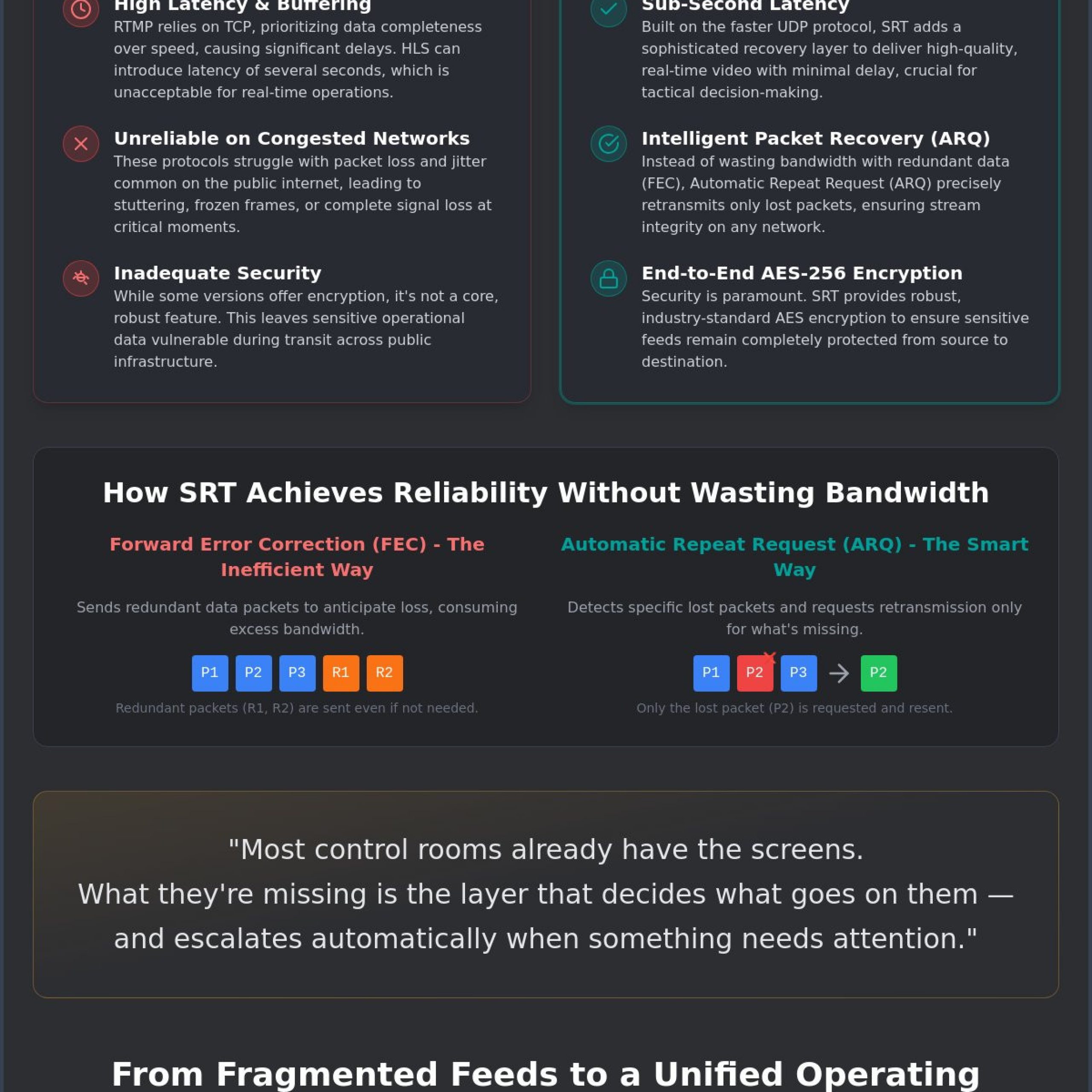
Older organizations often struggle with RTMP. While RTMP is common for social media streaming, it relies on TCP, which prioritizes data completeness over speed. This logic often results in “buffering” or significant delays that are unacceptable during a tactical operation where every second counts. SRT utilizes UDP, which is inherently faster, but adds a sophisticated recovery layer to ensure the video remains clear. Using srt allows for professional-grade stream quality even when network conditions fluctuate, providing the technical reliability required for mission-critical oversight. This ensures that the engine behind your operations center remains focused and analytical when stakes are highest. It provides a clear path forward for teams moving away from expensive, rigid hardware toward more flexible, software-defined architectures.
The Origins of the SRT Protocol
Haivision developed the protocol to address “first mile” challenges. In 2017, they transitioned it to an open-source model and co-founded the SRT Alliance. As of July 2026, this alliance includes over 700 member organizations. While the protocol remains an IETF Internet-Draft, its adoption is driven by its open-source reference implementation. Broadcasters have embraced it rapidly, with a 78% adoption rate recorded as of March 2026.
Key Benefits for Command and Control
Operational readiness depends on visibility. SRT provides resilience against packet loss using an Advanced Repeat Request (ARQ) mechanism. The protocol identifies specific gaps and requests retransmission without interrupting the flow. This results in sub-second latency, a massive improvement over HLS or DASH. Security is equally paramount. The protocol supports end-to-end AES-256 encryption, ensuring sensitive feeds from a SOC remain protected while in transit across public infrastructure.
How SRT Protocol Solves the Latency and Security Dilemma
Operational intelligence depends on the integrity of the data stream. If a video feed stutters or drops frames during a critical incident, the resulting ambiguity can lead to tactical errors. The srt protocol addresses this by implementing a sophisticated handshake process that simplifies firewall traversal. By using caller, listener, or rendezvous modes, the protocol establishes a secure connection between endpoints without requiring complex network reconfigurations that often delay deployment. This technical methodology ensures that the link remains stable even when traversing restrictive corporate or government security layers. It provides a reliable foundation for teams that cannot afford the downtime associated with traditional streaming setups.
ARQ vs. FEC: Why SRT Chooses Smarter Error Correction
Traditional streaming often relies on Forward Error Correction (FEC). FEC sends redundant data packets to anticipate loss. This approach frequently wastes significant bandwidth; it forces the network to carry redundant data that may never be needed. For high-resolution 4K feeds, this overhead is unsustainable. SRT employs Automatic Repeat Request (ARQ) instead. This mechanism only requests the specific packets that failed to arrive. It preserves throughput and ensures the stream timing remains precise. As detailed in the SRT protocol IETF draft, this selective retransmission allows for a lean, high-performance stream that maintains sub-second latency even on congested cellular networks. This efficiency is vital as cellular network usage for live contribution has reached 54% as of 2026.
Securing Sensitive Operational Data
Security cannot be an afterthought in high-stakes environments. The srt protocol provides robust end-to-end protection through AES-128 and AES-256 encryption. This isn’t merely about obscuring the feed; it’s about ensuring that sensitive operational data remains inaccessible to unauthorized entities while in transit. When implementing Cybersecurity Common Operating Pictures, this encryption ensures that field-level intelligence reaches the command center without compromise. Maintaining this level of data integrity is essential for operators who must act with absolute certainty. The protocol ensures that the bridge between raw data and human judgment is never compromised by external threats.
Achieving this balance of speed and security is the first step toward true situational awareness. Organizations looking to integrate these high-performance feeds into a broader tactical framework often find that the vis/ability platform provides the necessary oversight to turn raw streams into actionable intelligence.
SRT vs. Legacy Protocols: RTMP, HLS, and RTSP Compared
Operational centers often inherit legacy protocols that were never intended for mission-critical oversight. While RTMP and HLS serve the consumer market effectively, they introduce risks that can compromise a command operation. Choosing the right protocol isn’t just a technical preference; it’s a strategic decision that impacts how quickly your team can respond to a developing incident. The srt protocol provides the technical reliability that legacy standards lack, particularly when moving sensitive data across the public internet. Most organizations find that relying on consumer-grade protocols creates a bottleneck that slows down the entire decision-making process.
The RTMP Sunset: Why It’s Time to Move On
RTMP has been a staple for social media streaming for years, but its limitations are becoming a liability in the transportation and utility sectors. It lacks native encryption and relies on an aging handshake process that doesn’t account for modern cybersecurity threats. RTMP’s reliance on TCP also causes significant latency when packet loss occurs. As network conditions fluctuate, the protocol’s performance degrades quickly. SRT provides a superior alternative by offering end-to-end AES encryption and a more resilient transport layer. Upgrading to srt-capable encoders ensures your infrastructure is ready for high-stakes data delivery without the security gaps inherent in older standards.
Speed and Stability: The Deciding Factors
Latency is the primary differentiator between success and failure in a Real-Time Crime Center (RTCC). HLS is designed for massive scale, which is ideal for streaming a movie to millions of viewers, but it results in delays of 10 to 30 seconds. In a mission-critical environment, a 30-second delay means you’re watching history, not reality. SRT achieves sub-second latency, often delivering video in under 500 milliseconds. This speed allows for proactive incident management rather than reactive observation. For those designing an incident management software framework, these millisecond gains are what empower operators to act with certainty. RTSP is often used for local CCTV, but it lacks the error correction needed to survive the “noisy” public internet, making SRT the only viable choice for remote operational visibility.
The transition to srt represents a move toward event-driven situational awareness. By prioritizing speed and security, organizations can ensure that their video feeds are assets rather than liabilities. This protocol ensures that the most critical information is delivered with absolute clarity, regardless of the network’s condition. It serves as the quiet, powerful engine behind successful operations, providing the bedrock upon which critical decisions are made.
Deploying SRT in Modern Control Room Environments
Most control rooms already have the screens. What they’re missing is the layer that decides what goes on them — and escalates automatically when something needs attention.
The vis/ability platform serves as this operational intelligence layer. It acts as the central hub into which all other tools flow. It unifies srt feeds with other data streams to create a full common operating picture. This ensures that technical tools empower individuals to act with greater certainty. By unifying these streams, the platform makes other tools useful for the entire team, whether they are in a command center, a huddle room, or on mobile devices.
Hardware and Software Requirements
Deployment begins with selecting SRT-capable encoders and decoders. Using Commercial Off-The-Shelf (COTS) hardware reduces costs and avoids the proprietary traps of legacy systems. These devices handle encryption and packet recovery at the edge. This keeps the central network lean and efficient. Hardware is only one part of the equation. Long-term resilience requires protocol-agnostic software that aggregates these feeds. Integrating these streams into video wall systems ensures that every team member has access to the same high-resolution intelligence.
Managing Multiple Data Feeds Efficiently
Monitoring dozens of streams simultaneously often leads to operator fatigue. Human attention is a finite resource. It shouldn’t be spent staring at static feeds where no activity is occurring. A unifying layer is required to manage bandwidth and visualization effectively. This layer filters incoming data and presents only the feeds relevant to the current mission. Organizations that implement this event-driven approach see a significant improvement in response times. They reduce the risk of missed incidents. The focus shifts from merely watching screens to actively managing operational outcomes. You can contact our team to discuss how to optimize your control room workflows.
Orchestrating SRT Feeds with Activu vis/ability
Deploying the srt protocol provides the necessary transport, but raw data alone doesn’t ensure a successful outcome. Most control rooms already have the screens. What they’re missing is the layer that decides what goes on them, and escalates automatically when something needs attention. The vis/ability platform serves as this essential operational intelligence layer. It functions as the central hub where disparate data streams, including srt video, are unified into a single, cohesive interface that empowers teams to act with absolute certainty.
While some organizations rely on tools like Axon to manage field assets, these often provide only a partial solution. They lack the comprehensive integration required to create a full common operating picture across an entire enterprise. Without a unifying layer, operators remain trapped in a reactive cycle, manually switching between applications while critical details slip through the cracks. vis/ability closes this gap by transforming srt feeds from isolated signals into integrated components of a broader tactical strategy. It makes other tools useful for the entire team, whether they are in a command center, a huddle room, or on mobile devices.
Automated Escalation and Event-Driven Awareness
The value of a modern command center lies in its ability to prioritize essential information. vis/ability utilizes event-driven visualization to manage cognitive load and prevent operator fatigue. When a real-time alert is triggered by an integrated sensor or third-party application, the platform automatically promotes the relevant srt feed to the primary video wall. This ensures that the most critical visual data is always front and center when a pivotal decision is required. This methodology is particularly vital for federal and defense operations where clarity and speed are non-negotiable. By automating the escalation process, the platform provides the bedrock upon which critical decisions are made.
Beyond the Video Wall: Collaboration Everywhere
Operational visibility shouldn’t be confined to a single room. The vis/ability platform extends the reach of high-fidelity, low-latency srt streams to huddle rooms and mobile devices. This ensures that every stakeholder, whether they’re at a desk or in the field, sees the same high-fidelity data. Mobile vis/ability allows distributed teams to maintain a shared understanding of a developing situation, facilitating faster coordination and more accurate human judgment. This level of technical reliability and accessibility is the quiet, powerful engine behind successful operations. If you’re ready to move beyond fragmented systems, you can contact us to design your SRT-ready control room and establish a truly unified operating environment.
Securing Operational Clarity for the Next Mission
The transition to the srt protocol represents a fundamental shift from reactive monitoring to proactive incident management. By delivering sub-second latency and robust encryption over the public internet, this technology ensures that your team maintains visibility when it matters most. You no longer have to choose between speed and security. You can now leverage a professional-grade transport layer that remains stable even under the most unpredictable network conditions.
Most control rooms already have the screens. What they’re missing is the layer that decides what goes on them, and escalates automatically when something needs attention. The vis/ability platform provides this critical oversight by offering native integration for Secure Reliable Transport feeds. It is currently operational in the world’s most demanding NOCs and SOCs, where it reduces incident response time through automated escalation and event-driven visualization.
Establishing a unified common operating picture is the key to empowering your team to act with greater certainty. Request a Demo of the vis/ability Platform today to see how we turn raw data into actionable intelligence. Your operations deserve the technical reliability that only a truly integrated intelligence layer can provide.
Frequently Asked Questions
What does SRT stand for in the context of video streaming?
SRT stands for Secure Reliable Transport. It is an open-source video transport protocol designed to deliver high-quality video over unpredictable networks like the public internet. By utilizing a UDP-based architecture, it provides a stable alternative to legacy standards that often fail under poor network conditions. This technology is essential for organizations that require technical reliability when moving sensitive data from remote locations to a central command center for real-time analysis.
How much latency does the SRT protocol add to a video feed?
The protocol typically achieves sub-second latency, often delivering video in under 500 milliseconds. This performance is a result of its efficient packet recovery mechanism, which avoids the heavy overhead of traditional streaming methods. The exact latency is configurable, allowing operators to balance speed with stream stability based on the round-trip time of the specific network path being used for the mission.
Is SRT better than RTMP for mission-critical operations?
The srt protocol is significantly more effective than RTMP for high-stakes environments. RTMP was designed for commercial web streaming and lacks the native encryption and sophisticated error correction required for professional oversight. It offers a future-proof path for organizations that need to maintain low-latency and high-security feeds without the buffering or security gaps inherent in older, TCP-based protocols.
Can SRT streams be encrypted for secure government use?
Yes, the protocol supports robust end-to-end security via AES-128 and AES-256 encryption. This ensures that sensitive operational data remains protected while in transit across the public internet. Government and defense agencies rely on this high level of encryption to maintain a secure common operating picture. It guarantees that the bridge between raw data and human judgment remains inaccessible to unauthorized entities during critical missions.
Do I need special hardware to use the SRT protocol?
What happens to an SRT stream if the internet connection is unstable?
When a connection becomes unstable, the protocol uses an Automatic Repeat Request (ARQ) mechanism to recover lost packets. Unlike older methods that might drop the entire stream, the protocol identifies the missing data and requests retransmission immediately. This ensures the video remains clear and the timing stays precise, providing decision-makers with a continuous and reliable view of the operation even during network congestion.
How does SRT handle firewall traversal for remote operations?
The protocol simplifies firewall traversal through a flexible handshake process involving caller, listener, and rendezvous modes. This methodology allows the protocol to establish secure connections through restrictive security layers without requiring complex or intrusive network reconfigurations. It simplifies the deployment of remote monitoring systems, ensuring that technical hurdles don’t delay the flow of essential information to the command center.
Can the Activu vis/ability platform manage SRT feeds from multiple vendors?
The vis/ability platform acts as a unifying operational intelligence layer that manages srt feeds from any vendor. Most control rooms already have the screens. What they’re missing is the layer that decides what goes on them, and escalates automatically when something needs attention. vis/ability provides this layer, integrating multiple data streams into a single platform that empowers teams to act with greater certainty.