
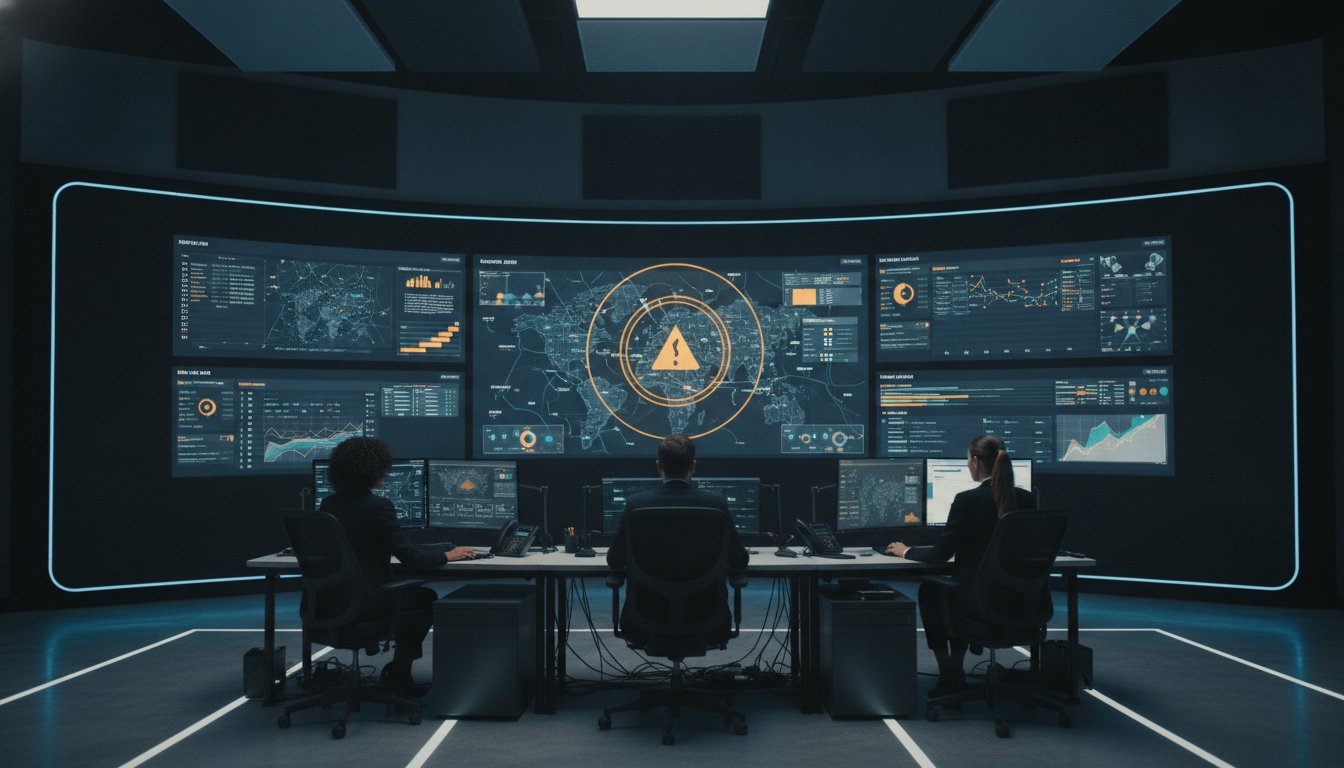
An operator toggling between twelve different browser tabs isn’t managing a crisis; they’re fighting the interface. In high-stakes environments, the sheer volume of data often creates more fog than clarity. When centralized monitoring and control software fails to unify these inputs, critical incidents are easily missed under a mountain of noise. Most control rooms already have the screens. What they’re missing is the layer that decides what goes on them — and escalates automatically when something needs attention.
Transform raw data into actionable intelligence by implementing vis/ability as your operational intelligence layer. While platforms like Axon provide essential feeds, they offer only a partial solution that requires a central hub to be truly effective. This guide details how to reduce mean time to response and automate critical escalations. You’ll learn to synchronize distributed teams through a platform that ensures the right information reaches the right person when every second counts.
Key Takeaways
- Identify the operational risks of fragmented visibility and learn how centralized monitoring and control software serves as the central brain for high-stakes decision-making.
- Shift from passive observation to active intelligence by implementing a software layer that filters noise and prioritizes critical information on your existing displays.
- Bridge the data gaps left by siloed tools to create a unified common operating picture that provides clarity for both command center staff and remote teams.
- Implement event-driven automation to reduce operator fatigue and ensure that high-severity incidents trigger immediate, automated escalations across the platform.
- Extend situational awareness beyond the video wall with mobile integration, ensuring that field personnel and decision-makers stay synchronized during urgent events.
The Hidden Costs of Fragmented Operational Visibility
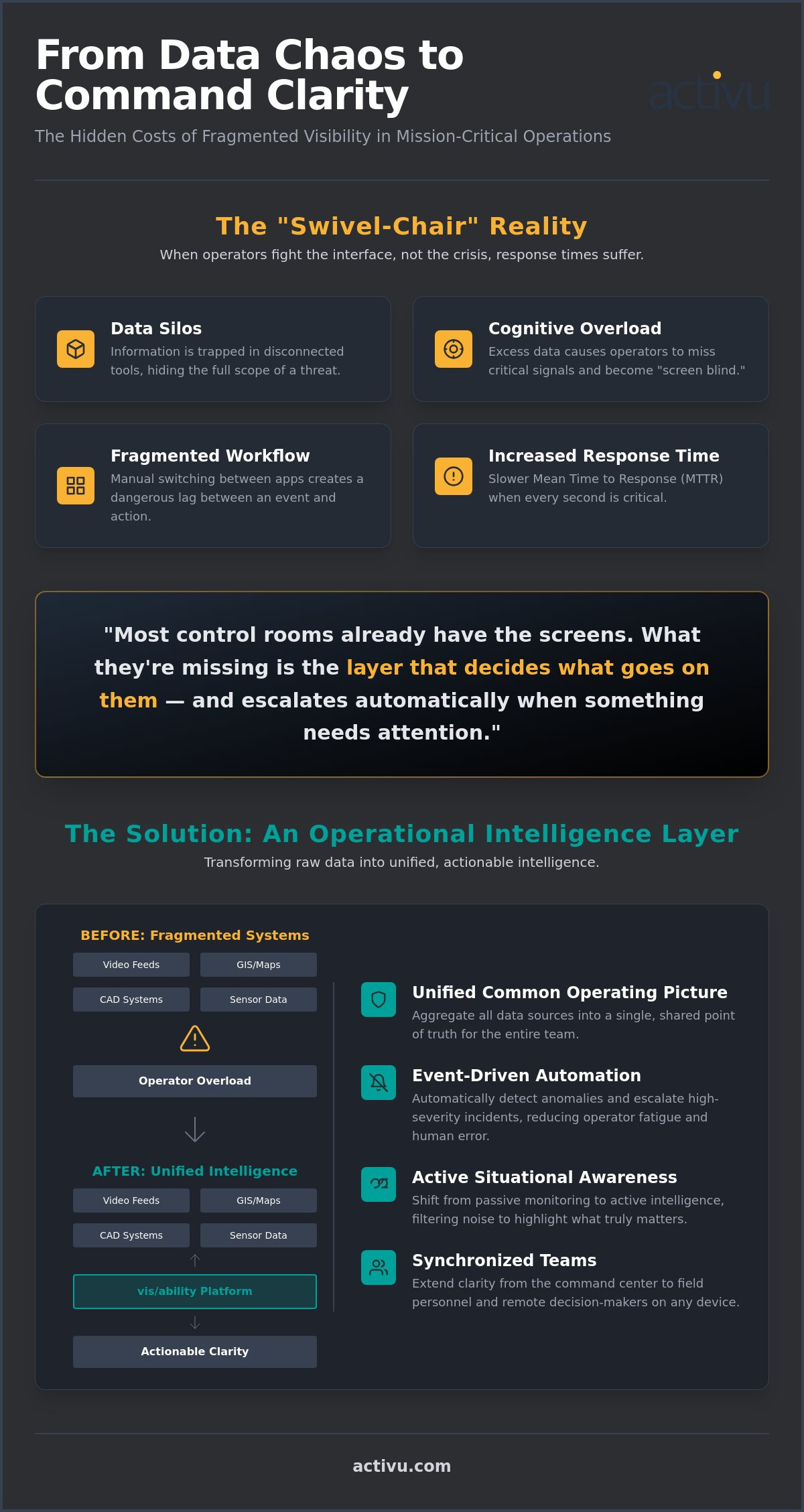
In high-pressure command centers, speed is the primary metric of success. Centralized monitoring and control software functions as the operational brain, synthesizing vast streams of data into a coherent narrative for decision-makers. Without this central nervous system, organizations suffer from a “swivel-chair” effect. Operators find themselves manually bridging the gap between disconnected applications, jumping from CAD systems to live video feeds and geospatial maps. This fragmented workflow doesn’t just slow down the team; it creates a dangerous lag between the moment an event occurs and the moment a human acts. In other regulated sectors, similar challenges are addressed by specialized platforms; for example, Adviqor enables financial advisors to manage their marketing campaigns within strict compliance frameworks, reducing the friction of manual oversight.
Data silos are the silent killers of operational efficiency. When information is trapped within specific departments or proprietary tools, the full scope of a threat remains hidden. For example, a physical security breach might be visible on one screen while a corresponding network anomaly appears on another. If these systems don’t talk to each other, the connection between them remains invisible. Effective centralized monitoring and control software eliminates these blind spots by acting as a single point of truth. Many organizations fall into the trap of believing that more monitors equal better situational awareness. In reality, screen saturation often achieves the opposite. If an operator must monitor ten different apps across twenty screens, they aren’t seeing the big picture. They are merely looking at a digital mosaic of noise.
Why Operators Miss Critical Incidents
The Problem with Fragmented Incident Management
Siloed tools prevent the creation of a unified common operating picture. When public safety or utility teams use isolated platforms, coordinating a multi-department response becomes a logistical nightmare. Modern Incident Management Software for Mission-Critical Environments must break these silos to ensure everyone sees the same truth. Historically, organizations relied on basic Remote monitoring and management (RMM) to maintain system uptime. However, modern high-stakes operations require more than just technical connectivity. They need a platform that synthesizes diverse data streams into a single, actionable truth that can be shared across the entire command structure, from the center to the field.
Defining the Operational Intelligence Layer in 2026
Modern operations center on the synthesis of information rather than its mere collection. Centralized monitoring and control software has evolved from a simple display utility into a sophisticated operational intelligence layer. This layer acts as the indispensable bridge between raw data streams and human judgment. It doesn’t just show what’s happening; it interprets the significance of incoming signals to help operators maintain focus. Most control rooms already have the screens. What they’re missing is the layer that decides what goes on them, and escalates automatically when something needs attention.
Moving from passive monitoring to active situational awareness requires a fundamental shift in how teams interact with technology. Passive systems wait for a human to notice a change on a screen, which often leads to delayed responses. Active systems, powered by intelligent software, detect anomalies and present them to the operator before a crisis matures. This transition relies on Commercial Off-the-Shelf (COTS) flexibility. Modern hubs require software that integrates with existing IT infrastructure rather than relying on proprietary, closed-loop hardware that limits scalability and increases long-term costs.
The Role of vis/ability in Modern Operations
The visability platform serves as the central hub for mission-critical teams. It aggregates real-time data, geospatial information, and diverse video streams into a single, unified view. While specialized tools like Axon provide critical field data, they often function as partial solutions that remain siloed from the broader operational context. By serving as the operational intelligence layer, vis/ability unifies these disparate tools, making them useful for the entire team. Whether staff are in a command center or using mobile devices, they access a consistent common operating picture that drives certain action. If you’re looking to modernize your command center, you can contact our experts to discuss your specific requirements.
Hardware vs. Software: Prioritizing Intelligence
A common misconception in control room design is that display technology is the most important investment. While high-resolution Video Wall Systems are necessary for visibility, they remain static without the right software. The software layer is more critical because it makes the hardware “event-aware.” Instead of displaying the same twelve camera feeds indefinitely, an event-aware system automatically reconfigures the display when a sensor triggers an alert. This ensures that the most critical information is always front and center, empowering individuals to act with greater certainty during pivotal moments.
Beyond Siloed Data: Creating a Unified Common Operating Picture
Traditional monitoring systems often focus exclusively on Video Management Systems (VMS). While seeing a live feed is valuable, it lacks the context necessary for high-stakes decisions. Modern situational awareness requires a fusion of visual data with real-time telemetry. Centralized monitoring and control software serves as the engine for this fusion, pulling in diverse data types to provide a comprehensive common operating picture. When operators can see how a mechanical failure correlates with a security alert, they move from guessing to knowing.
In public safety, organizations frequently rely on tools like Axon. While these are effective for evidence management and field recording, they provide only a partial solution. They lack the ability to correlate field video with CAD (Computer-Aided Dispatch) events or regional GIS data in a single interface. To achieve true operational readiness, these siloed tools must flow into a unifying platform that provides context to the visual feed. This ensures that a commander isn’t just watching a video, but understands the broader tactical environment surrounding it.
Geospatial (GIS) data is another critical pillar. In a crisis, knowing what is happening is as important as knowing exactly where it is happening. Integrating GIS feeds allows commanders to visualize incident proximity to critical infrastructure or personnel locations. This spatial awareness transforms abstract alerts into actionable intelligence. It provides the geographic anchor needed to coordinate a response across multiple agencies or jurisdictions with absolute precision.
Integrating Mission-Critical Applications
Most organizations already use a variety of specialized tools. They have CAD for dispatch, GIS for mapping, and social media scrapers for public sentiment. The problem isn’t a lack of tools; it’s the lack of a unifying layer. The vis/ability platform acts as the central hub where these applications converge. Instead of operators managing separate login credentials and interfaces, they see a synchronized view. This integration ensures that every team member, whether in a command center or a huddle room, acts on the same information. You can see how this applies to Public Safety Solutions by exploring our integrated approach.
Visualizing Cybersecurity and Network Health
Cybersecurity operations require the same level of visual clarity as physical security. Modern Security Operation Centers (SOCs) utilize SIEM and SOAR data to track threats, but raw logs often obscure the big picture. Visualizing this threat intelligence allows teams to identify patterns that might be missed in a text-based dashboard. By integrating network health metrics into the centralized monitoring and control software, organizations gain a holistic view of their security posture. This visibility speeds up incident response and ensures that network anomalies are addressed before they impact critical operations. Learn more about optimizing SOC and NOC Control Rooms to handle these complex data streams.
Event-Driven Automation: Reducing Operator Cognitive Load
The future of proactive operations lies in event-driven visualization. In high-stakes environments, the bottleneck is rarely a lack of data; it is the human capacity to process it. Centralized monitoring and control software must do more than aggregate diverse feeds. It must act as an intelligent filter that identifies anomalies and presents them only when they require intervention. This shift from manual oversight to automated awareness ensures that operators remain focused on high-value decision-making rather than routine monitoring.
Modern systems utilize specific triggers to manage information flow. When a sensor detects a breach or a system reaches a critical threshold, the software reconfigures the video wall layouts instantly. This automated response ensures that the most relevant camera feeds, geospatial maps, and data dashboards are front and center the moment they are needed. By automating these transitions, organizations prevent the cognitive saturation that occurs when vital signals are lost in a sea of “normal” telemetry. Most control rooms already have the screens. What they’re missing is the layer that decides what goes on them, and escalates automatically when something needs attention.
How to Manage Multiple Data Feeds in a Dispatch Center
Managing a high volume of inputs in a dispatch center requires a structured framework for information prioritization. During a high-stress event, operators cannot afford to waste seconds toggling between disconnected applications. Automated workflows within the vis/ability platform solve this by pushing critical feeds to the foreground based on incident severity. If a high-priority call enters the CAD system, the software can automatically pull the nearest camera feeds and relevant building plans onto the operator’s workstation. This reduction in manual “swivel-chair” activity directly lowers the mean time to response (MTTR) and allows the team to act with greater certainty. If your team is struggling with information overload, you can speak with our design experts to streamline your workflow.
Automating the SITREP and Escalation Process
Manual reporting is a significant bottleneck during active incidents. Centralized software eliminates this delay by auto-generating situation reports (SITREPs) based on the data captured during the event. This ensures that stakeholders receive immediate, accurate updates without distracting the operators from their primary mission. Automated escalation protocols also ensure that notifications are sent to the correct personnel on their mobile devices or in secondary huddle rooms simultaneously. This seamless flow of information is essential for maintaining resilience across the entire organization. For a deeper look at building these resilient structures, consult our Mission Critical Operations Guide.
Implementing vis/ability: The Future of Centralized Control
The transition from reactive monitoring to a proactive intelligence model marks the final stage of operational maturity. By deploying centralized monitoring and control software that prioritizes essential information, organizations move beyond simply watching events to anticipating them. This evolution transforms the command center from a cost center into a strategic asset. Most control rooms already have the screens. What they’re missing is the layer that decides what goes on them, and escalates automatically when something needs attention.
Deploying vis/ability as your operational intelligence layer ensures that the technology serves the mission rather than the other way around. This platform serves as the central hub where disparate data streams, from cybersecurity metrics to physical security feeds, finally converge. It empowers individuals to act with greater certainty because the system has already performed the heavy lifting of data filtering and prioritization. True centralized control isn’t confined to a single physical room; it extends to huddle rooms, remote offices, and the mobile devices of personnel in the field.
Extending Visibility to the Field
Field agents often operate as disconnected sensors, possessing critical local knowledge that rarely reaches the center in real time. Mobile vis/ability Tools bridge this gap by turning every mobile device into an extension of the command center. Personnel can stream live footage back to the video wall or receive geospatial updates that ensure they remain synchronized with the broader mission. This two-way flow of information creates a truly unified common operating picture that persists regardless of an individual’s physical location. It ensures that the expertise of the command center is always available to those at the tactical edge.
Strategic Planning and Control Room Design
A resilient operations center requires more than just high-end displays. It demands a software-defined architecture paired with professional design services to ensure the environment supports the team’s workflow. While some organizations look to hardware resellers for basic equipment, this approach often overlooks the collaborative design necessary for high-stakes environments. Hardware-centric solutions fail to address the software layer that actually manages the data. The long-term ROI of a software-defined hub is found in its ability to adapt to new threats without requiring a total hardware overhaul. Achieving this level of readiness requires a partner who understands both the technological and human elements of a mission-critical mission. You can contact Activu for a consultation to begin designing your future operational layer.
Achieving Operational Readiness Through Unified Intelligence
Operational excellence in high-stakes environments depends on the ability to filter noise and prioritize action. Fragmented systems and siloed data streams are no longer just an inconvenience; they’re a direct threat to mission success. By implementing a robust centralized monitoring and control software strategy, organizations transform their existing infrastructure into a proactive intelligence hub. This shift ensures that operators are no longer overwhelmed by screen saturation but are instead empowered by automated escalations and a unified common operating picture.
The vis/ability platform provides the essential operational layer that traditional tools lack. It offers seamless integration with Axon, SIEM, and CAD systems, creating a synchronized environment that scales with your needs. Trusted by Federal Government and Defense agencies, our event-driven situational awareness solutions provide the bedrock for critical decision-making. Most control rooms already have the screens. What they’re missing is the layer that decides what goes on them, and escalates automatically when something needs attention.
Take the next step toward absolute operational clarity. Request a demo of the vis/ability operational intelligence layer to see how we can unify your command center. Your team deserves the certainty that only a fully integrated, intelligent platform can provide.
Frequently Asked Questions
What is centralized monitoring and control software?
Centralized monitoring and control software functions as the operational intelligence layer that unifies disparate data streams into a single, actionable interface. It serves as the brain of the command center, aggregating feeds from CAD, GIS, and video management systems to provide a comprehensive view of the operational environment. This technology ensures that decision-makers don’t waste time toggling between disconnected applications during a crisis.
How does centralized monitoring reduce operator fatigue?
It reduces fatigue by automating information prioritization and filtering out irrelevant background noise. Instead of requiring operators to monitor dozens of static feeds, the software highlights only the anomalies that require human intervention. This targeted approach prevents cognitive overload and ensures that personnel remain focused and analytical when stakes are at their highest.
Can centralized monitoring software integrate with existing hardware?
Yes, modern centralized monitoring and control software is designed to integrate with existing displays and IT infrastructure. Most control rooms already have the screens. What they’re missing is the layer that decides what goes on them, and escalates automatically when something needs attention. Utilizing COTS-based solutions like vis/ability allows organizations to leverage their current investments while adding a sophisticated intelligence layer.
What is the difference between a video wall and a common operating picture?
A video wall is the physical hardware used for display, while a common operating picture is the synthesized data layer shared across the entire team. A common operating picture provides context and meaning to the visual feeds, ensuring that everyone from the command center to the field sees the same version of the truth. Without the intelligence layer, a video wall is simply a collection of disconnected images.
How does event-driven visualization work in a command center?
Event-driven visualization uses pre-defined triggers from sensors or mission-critical applications to automatically update display layouts. When a high-priority incident occurs, the software reconfigures the video wall to show relevant camera feeds and geospatial data instantly. This proactive model eliminates the need for manual searching and ensures that critical information is always front and center at the moment of a pivotal decision.
Why is application integration important for a NOC or SOC?
Integration is vital because it breaks down the silos between tools like SIEM, network monitors, and physical security feeds. In a NOC or SOC, seeing a network anomaly alongside a physical security alert can reveal a coordinated threat that might otherwise go unnoticed. Unifying these applications into a single hub creates a more resilient and responsive security posture that empowers the entire team to act with greater certainty.
How can centralized monitoring improve cybersecurity response?
It improves response by visualizing the organization’s cybersecurity common operating picture in real time. By translating complex logs into a visual format, security teams can identify patterns and anomalies much faster than by reviewing text-based dashboards. This visibility speeds up the response to potential breaches and ensures that critical infrastructure remains protected through a proactive intelligence model.
Does centralized monitoring software support mobile users?
Yes, the vis/ability platform extends situational awareness to mobile devices and remote huddle rooms. This ensures that field personnel and distributed teams stay synchronized with the command center at all times. Mobile users can receive automated alerts and contribute live data back to the central hub, maintaining a shared common operating picture across the entire organization regardless of physical location.