
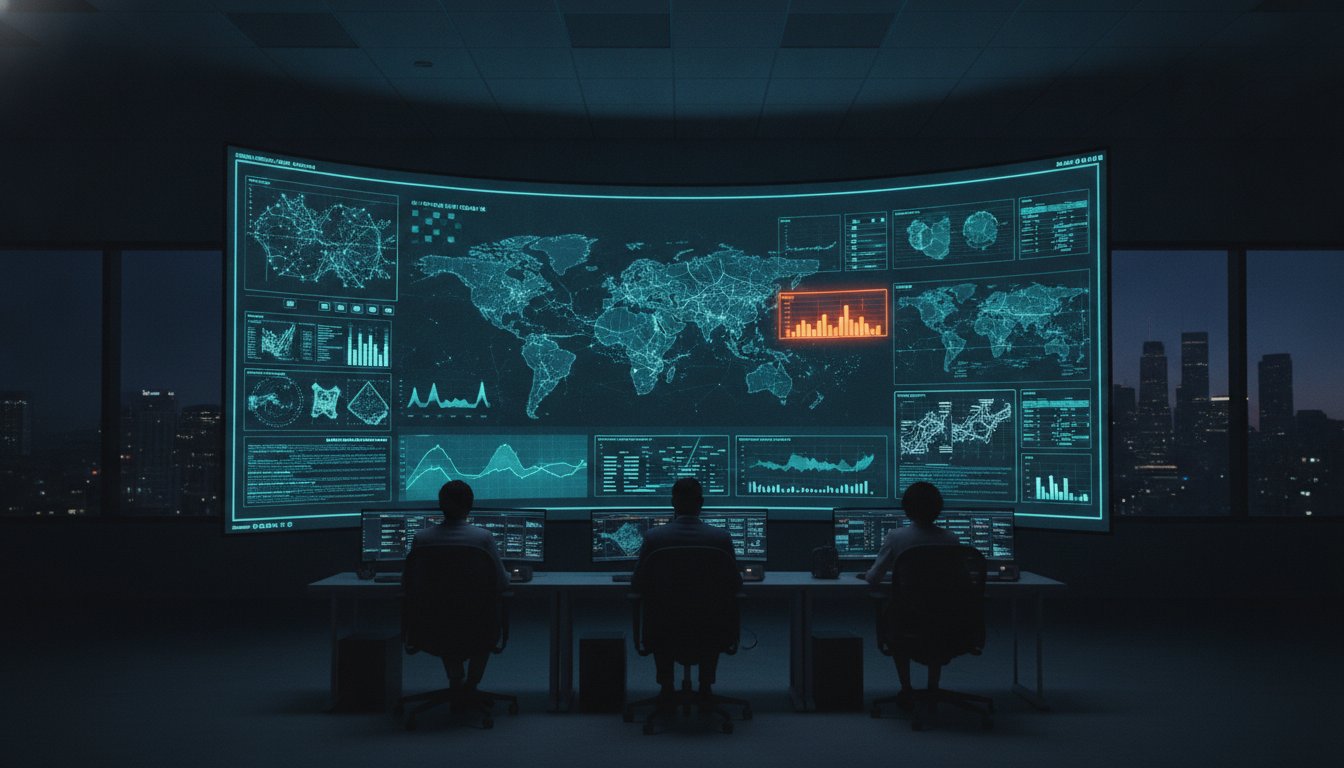
With network downtime costs averaging 5,600 dollars per minute, the margin for error in your Network Operations Center has effectively vanished. You likely recognize the strain of managing a high-stakes environment where operators struggle against constant information overload. Monitoring dozens of screens with siloed data feeds often leads to fatigue and missed incidents that threaten your operational readiness. Most control rooms already have the screens. What they’re missing is the layer that decides what goes on them, and escalates automatically when something needs attention.
You deserve a system that provides calm and clarity amidst technical complexity. This article explores how a modern Network Operations Center functions when integrated with an operational intelligence layer, like vis/ability, to drive proactive incident management. We’ll examine how to unify your fragmented data feeds into a single operating picture. This approach ensures your team has the visibility needed to reduce response times and maintain control across distributed environments, from the command center to mobile devices. By the end of this guide, you’ll understand how to transform raw data into the actionable intelligence required for certain decision-making.
Key Takeaways
- Understand the role of a modern Network Operations Center as the proactive engine behind 24/7 uptime for mission-critical utilities and financial services.
- Identify the core functions of real-time infrastructure monitoring, including patch management and equipment performance tracking.
- Learn to combat operator fatigue and cognitive overload by reducing the visual noise generated by siloed data feeds.
- Explore the strategic design principles necessary to build a command environment focused on visibility and seamless collaboration.
- Recognize why an operational intelligence layer is the missing component that transforms raw data into a unified operating picture.
The Evolution of the Network Operations Center in Mission-Critical Environments
A Network operations center (NOC) serves as the central hub for monitoring and managing complex computer, telecommunications, or satellite networks. In high-stakes environments, this facility acts as the primary defense against systemic failure. For sectors like utilities, financial services, and transportation, 24/7 uptime isn’t a goal; it’s a non-negotiable requirement. The cost of a single minute of downtime is a massive liability. Maintaining immediate visibility into infrastructure health is essential for operational continuity. These centers must maintain a state of constant readiness to protect mission-critical assets from both internal errors and external threats.
Historically, these facilities functioned reactively, responding only after a failure occurred. Modern operations have shifted toward proactive situational awareness. This transition requires a level of oversight that anticipates disruptions before they cascade into outages. Achieving this state remains difficult when operators are buried under a mountain of raw data. True situational awareness requires more than just seeing data; it requires understanding the context of that data in real time. Without this clarity, a team is simply watching a clock count down to the next incident.
The Core Purpose of Modern Network Operations
The primary objective of a modern Network Operations Center is to maintain high availability across distributed networking environments. Operators ensure that end-users experience seamless connectivity, regardless of the physical location of the infrastructure. Beyond daily monitoring, the NOC plays a critical role in disaster recovery and business continuity. It provides the structured environment necessary to execute rapid failover protocols during emergency events. This focus on reliability ensures that critical services remain functional even under extreme stress, providing a bedrock of stability for the entire organization.
Fragmented Systems: The #1 Barrier to Operational Readiness
Most organizations struggle with fragmented systems that create significant blind spots. While tools like SIEM, SOAR, and NMS provide valuable data, they often exist in silos. This results in “swivel-chair management,” where operators must manually jump between multiple screens and applications to correlate information. This fragmentation slows human judgment at the exact moment when speed is most critical. When data is siloed, the ability to form a common operating picture vanishes, leaving the team vulnerable to missed incidents. Most control rooms already have the screens. What they’re missing is the layer that decides what goes on them, and escalates automatically when something needs attention. Having more data doesn’t equate to better intelligence; it often leads to cognitive overload that obscures the most critical information.
Core Capabilities and Functions of a Modern NOC
The modern facility provides a unified interface for incident response coordination. When a disruption occurs, the team must act with absolute certainty. Fragmented tools often hinder this process. Most control rooms already have the screens. What they’re missing is the layer that decides what goes on them, and escalates automatically when something needs attention. Aligning these functions with industry best practices ensures that the command center remains an asset rather than a source of confusion during a crisis.
Network Monitoring and Optimization
Real-time oversight involves analyzing bandwidth usage to identify bottlenecks before they trigger systemic outages. Personnel track the performance of physical equipment alongside cloud-based infrastructure to maintain a comprehensive view of the network. Integrating threat intelligence platforms into this workflow allows for immediate risk assessment. This proactive stance ensures that performance remains optimal even as network demands fluctuate. By focusing on optimization, the team can extend the lifecycle of assets and prevent the degradation of mission-critical services.
Incident Management and Escalation Workflows
Effective response relies on standardized communication and structured workflows. Standardizing Situation Reports (SITREPs) ensures that all stakeholders receive clear, concise information during a crisis. When critical thresholds are breached, the system should trigger automated escalation to notify the appropriate subject matter experts. This reduces the time spent on manual coordination and accelerates the path to resolution. Implementing purpose-built solutions within your Network Operations Center allows teams to maintain control when stakes are at their highest. If your current environment feels overwhelmed by data feeds, you might consider how the vis/ability platform can unify your operating picture.
Overcoming Cognitive Overload: Why Operators Miss Incidents
In high-pressure environments, an abundance of information often becomes the greatest obstacle to resolution. The “wall of data” common in many facilities creates significant visual noise that actively works against the operator. This environment forces personnel to filter through thousands of data points manually, leading to severe cognitive overload. When an operator is responsible for monitoring dozens of screens over a long shift, the psychological impact is profound. Decision fatigue sets in, making it increasingly difficult to distinguish a critical system failure from routine background alerts. Understanding the role and capabilities of a NOC requires acknowledging that human limitations are part of the technical equation.
Traditional video walls often fail because they treat all data with equal importance. They display a static grid of information that requires constant human interpretation. This creates a dangerous gap between raw monitoring tools and actual situational awareness. Most control rooms already have the screens. What they’re missing is the layer that decides what goes on them, and escalates automatically when something needs attention. Without this intelligent filtering, the most critical alerts are frequently buried under irrelevant status updates, leading to missed incidents that could have been prevented.
The Problem with Fragmented Video Feeds
Fragmented systems are the primary reason why incidents go unnoticed until they become full-scale outages. Standard monitoring platforms are useful for specific tasks, but they only provide a partial common operating picture. They lack the integration necessary to correlate disparate data points into a single narrative. In many cases, critical data remains “trapped” on an individual operator’s workstation, invisible to the rest of the team. This lack of transparency increases the risk that zero-day threats or subtle hardware failures will be overlooked during the handoff between shifts.
Defining a True Common Operating Picture (COP)
Establishing a true common operating picture requires moving beyond simple screen mirroring. It involves intelligent data aggregation where the system identifies relationships between different data feeds. A unified operating picture is essential for cross-departmental collaboration, ensuring that everyone from the technician to the executive sees the same reality in real time. This level of visibility is the bedrock of resilience. For a deeper look at how to structure these environments for maximum reliability, consult our Mission Critical Operations Guide. By centralizing intelligence, you empower your team to act with certainty rather than reacting to the loudest alarm.
Strategic NOC Design: Building for Visibility and Collaboration
High-performance command environments demand a deliberate synthesis of physical ergonomics and digital intelligence. Success depends on engineering a facility that supports rapid decision-making under stress. This process begins by auditing your operational reality to identify where silos exist and where data flow breaks down. Most control rooms already have the screens. What they’re missing is the layer that decides what goes on them, and escalates automatically when something needs attention. Strategic design ensures the environment adapts to the incident, providing clarity when the pressure is greatest.
A structured design methodology follows these critical stages:
- Step 1: Assess operational requirements and data feed complexity to determine the necessary scope of oversight.
- Step 2: Design the physical environment, focusing on console furniture, ergonomics, and lighting to reduce operator fatigue.
- Step 3: Engineer the video wall system to ensure maximum high-performance visualization across all workstations.
- Step 4: Implement an operational intelligence layer to manage content escalation and data prioritization.
- Step 5: Extend visibility to mobile and distributed stakeholders to maintain a common operating picture outside the main facility.
Engineering High-Performance Video Wall Systems
Precision in visualization is a requirement for mission-critical oversight. Engineering these systems involves more than choosing a screen size. It requires careful management of 4K resolution and bitrate to ensure that data remains legible and real-time feeds don’t suffer from latency. While some organizations use standard COTS hardware, these often lack the durability required for 24/7 environments. Specialized mission-critical displays provide the reliability needed for constant operation. For a deeper technical analysis, review The Video Wall Strategic Guide to understand how to align your hardware with your operational goals.
Extending the NOC Beyond the Control Room
Operational readiness extends beyond the physical walls of the Network Operations Center. Modern collaboration requires that field technicians and remote executives see the same real-time data as the command center staff. Mobile tools allow for this distributed visibility, enabling secure collaboration in huddle rooms or remote offices. This extension relies on Secure Reliable Transport (SRT) to maintain data integrity across various network conditions. By unifying these disparate locations, you ensure that every decision is based on the most current intelligence available. If you’re ready to modernize your facility, Activu Corporation provides control room design services to help you build a foundation for absolute technical reliability.
Activu vis/ability: The Operational Intelligence Layer for Your NOC
Most control rooms already have the screens. What they’re missing is the layer that decides what goes on them, and escalates automatically when something needs attention. Activu Corporation provides this essential functionality through the vis/ability platform. By serving as the central hub into which all other monitoring tools flow, it creates a unified environment for the modern Network Operations Center. This operational intelligence layer ensures that technical reliability is maintained even as data volume increases. It provides the calm and clarity necessary for high-stakes decision-making, allowing leaders to focus on resolution rather than navigating technical complexity.
Event-driven situational awareness is the core differentiator of this technology. Instead of forcing operators to sift through every alert, the system identifies the most critical information based on real-time operational triggers. This methodology reduces the background noise that leads to missed incidents. It positions the brand’s solutions as the bedrock upon which critical decisions are made. Every action is supported by the most relevant data available, ensuring that the human element remains focused on the mission. This proactive nature transforms the command center from a reactive monitoring facility into a powerful engine for service delivery.
The platform is designed to scale with the complexity of your environment. Whether you are managing a utility grid, a transportation network, or a federal defense operation, the intelligence layer adapts to your specific requirements. It prioritizes essential information based on the severity of the event, ensuring that the most urgent threats receive immediate attention. This level of oversight is necessary in environments where downtime carries significant financial and safety risks. By centralizing the management of your data feeds, you gain a level of control that point solutions cannot provide.
Unifying Disparate Data into Actionable Intelligence
Partial solutions often leave significant gaps in visibility by monitoring only specific subsets of the infrastructure. Activu Corporation fills these gaps by integrating every disparate application into a single, cohesive operating picture. The system automates content changes on the video wall, ensuring that the right data appears at the right moment without manual intervention. This level of automation is vital for SOC and NOC solutions that must respond to rapidly evolving threats with absolute certainty. By bridging the gap between raw data and human judgment, the platform makes every other tool in your environment more useful for the entire team.
Empowering the Human Element
The ultimate goal of this technology is to empower the individuals responsible for mission-critical operations. By showing only what is essential, vis/ability reduces operator fatigue and enhances the speed of human judgment. This clarity allows teams to act with greater certainty during the most demanding phases of an incident. Whether the team is in a command center, a huddle room, or collaborating via mobile devices, the intelligence layer maintains a consistent flow of information. This ensures that field technicians and remote stakeholders see the same real-time data as the command center staff. To see this platform in action, request a demo of the vis/ability platform and discover how to unify your operational reality.
Achieving Operational Readiness through Intelligent Integration
A resilient Network Operations Center is defined by its ability to separate critical signals from background noise. Throughout this guide, we have examined how the evolution from reactive monitoring to proactive situational awareness requires a fundamental shift in how data is visualized and shared. By prioritizing the human element through strategic design and intelligent automation, organizations can significantly reduce the risk of missed incidents. Most control rooms already have the screens. What they’re missing is the layer that decides what goes on them, and escalates automatically when something needs attention.
Activu Corporation provides the technical foundation for this transformation, drawing on over 40 years of control room design expertise. Our platforms are trusted by Federal Government and Defense agencies, as well as critical providers in the Utilities and Energy sectors, to maintain absolute technical reliability. Implementing an operational intelligence layer ensures that your team remains the decisive force behind every operation. It is time to move beyond fragmented feeds and establish a state of clear, actionable intelligence across your entire enterprise. See how vis/ability unifies your NOC operations and provides the bedrock for your most critical decisions.
Frequently Asked Questions
What is the difference between a NOC and a SOC?
A Network Operations Center primarily focuses on ensuring network availability, performance, and uptime. Its objective is to manage infrastructure health and prevent service disruptions across telecommunications or satellite networks. In contrast, a Security Operations Center (SOC) is dedicated to identifying, analyzing, and mitigating cybersecurity threats. While their goals differ, modern operations often require these two entities to collaborate closely to maintain a comprehensive cybersecurity common operating picture.
How does a Network Operations Center improve network security?
A Network Operations Center improves security by providing continuous oversight of firewalls, network security software, and access points. Personnel execute rigorous patch management and software installation protocols to close vulnerabilities before they’re exploited. By monitoring for anomalies in traffic patterns, the team can identify potential breaches in real time. This proactive stance ensures that security remains an integral part of daily network maintenance rather than a reactive afterthought.
What are the most important tools used in a NOC?
Can a NOC be managed remotely or must it be on-site?
Modern centers can be managed through a hybrid model that combines on-site presence with remote oversight. While a physical command center provides a centralized location for collaboration, mobile visibility tools allow field technicians and remote stakeholders to access the same real-time data. Secure Reliable Transport (SRT) ensures that these remote feeds maintain high integrity. This flexibility allows organizations to maintain operational readiness regardless of where their subject matter experts are physically located.
What is situational awareness in a network operations context?
Situational awareness is the ability to perceive, comprehend, and project the status of the networking environment. In a Network Operations Center, this means moving beyond simple data collection to understand the context of every alert. It requires identifying how a single hardware failure might impact broader service delivery. True situational awareness allows a team to anticipate disruptions before they occur, ensuring that critical infrastructure remains functional and secure at all times.
How do you reduce operator fatigue in a 24/7 NOC environment?
Reducing fatigue requires a combination of ergonomic design and intelligent data prioritization. High-performance video wall systems should be engineered to minimize visual noise by displaying only essential information. Automating routine alerts prevents cognitive overload, allowing operators to focus on high-priority incidents. By implementing an intelligence layer that filters and escalates data automatically, organizations protect their personnel from decision fatigue and ensure that critical incidents aren’t overlooked.
What is the role of a common operating picture in incident response?
A common operating picture provides a single, unified view of the operational environment for all stakeholders. During an incident, it ensures that every team member, from the technician to the executive, is working from the same set of facts. This alignment is essential for rapid coordination and effective response. By integrating disparate data into one platform, a COP eliminates the confusion caused by siloed feeds and enables faster, more certain decision-making when stakes are highest.
How does vis/ability integrate with existing network monitoring tools?
The vis/ability platform functions as a central hub that unifies existing monitoring tools like SIEM, VMS, and NMS. It uses application integration to pull data from these partial solutions and display it within a cohesive interface. When specific triggers are met, the platform automatically escalates relevant content to the video wall or mobile devices. This ensures that your existing investments become more useful by contributing to a comprehensive and event-driven situational awareness platform.