
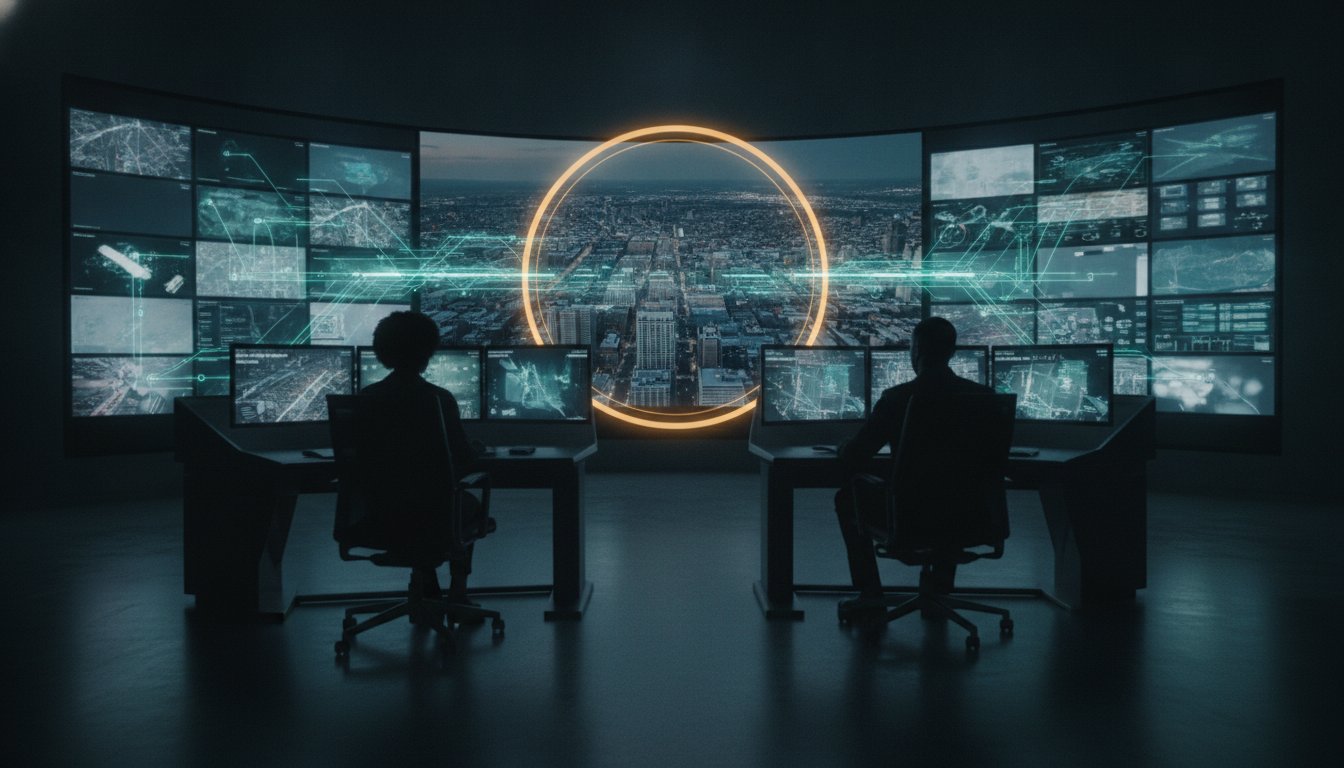
Monitoring a wall of fifty video feeds is no longer a measure of security; it is a recipe for human error. When operators are forced to manage fragmented systems and siloed data, the cognitive load becomes a liability that delays response times during critical incidents. You recognize the exhaustion of staring at screens while waiting for something to happen, knowing that a single missed pixel could mean a failed mission. Effective video stream integration must do more than just put pictures on a wall.
Most control rooms already have the screens. What they’re missing is the layer that decides what goes on them, and escalates automatically when something needs attention. While many platforms provide critical data, they often remain partial solutions that lack the cohesion required for a full common operating picture without a unifying hub.
This article demonstrates how to move beyond simple displays to a sophisticated operational intelligence layer. You’ll discover how the vis/ability platform unifies disparate feeds into a single, actionable operating picture that automates situational awareness. We will examine the transition from manual monitoring to event-driven oversight, ensuring your team maintains clarity whether they’re in the command center or responding via mobile devices.
Key Takeaways
- Identify why fragmented feeds lead to operator cognitive overload and how to eliminate the “swivel-chair” effect in high-stakes environments.
- Master the technical requirements of resilient video stream integration, utilizing SRT and HEVC protocols to maintain low latency across distributed networks.
- Understand the distinction between a standard VMS and an operational intelligence layer that automatically decides which information requires immediate human attention.
- Implement event-driven triggers to automate the escalation of critical video feeds, ensuring that essential data is never lost in a sea of passive monitors.
- Build a unified common operating picture that synchronizes decision-making across command centers, huddle rooms, and mobile responders.
The Hidden Cost of Fragmented Video Streams in Control Rooms
Video stream integration in a mission-critical context is the technical process of aggregating disparate visual data into a cohesive workflow. It isn’t simply a matter of hardware connectivity. It’s about ensuring that a feed from a remote sensor or a field camera reaches the right decision-maker at the exact moment it becomes relevant. When this process is fragmented, the result is a significant gap between seeing an event and responding to it.
Many command centers suffer from the “swivel-chair” problem. Operators must manually pivot between a Video Management System (VMS), Computer-Aided Dispatch (CAD), and various browser tabs to piece together a single incident. This fragmentation creates a dangerous lag in response times. Technical integration often relies on the Real-Time Streaming Protocol (RTSP) to manage media delivery, but without a unifying layer, these streams remain siloed. When seconds dictate the outcome of a high-stakes operation, the friction of switching interfaces is a risk you can’t afford. A modern video stream integration strategy eliminates this friction by consolidating tools into a single, proactive hub.
Identifying the Gaps in Traditional Monitoring
Siloed data creates blind spots that are often invisible until a crisis occurs. In a 24/7 environment, the human brain isn’t designed to monitor dozens of static screens for hours on end. Cognitive overload sets in quickly, causing operators to stop analyzing and start merely observing. When an operator is overwhelmed by too many inputs, they’re likely to miss the subtle indicators of a developing incident. Raw video feeds without context or automated triggers are essentially expensive wallpaper. They occupy space on a video wall but provide zero actionable intelligence, leaving your team reactive rather than prepared.
The Shift Toward Operational Intelligence
Technical Requirements for Resilient Stream Integration
Resilient video stream integration demands a technical foundation that prioritizes absolute reliability over mere connectivity. In high-stakes environments, the choice of protocol determines whether your team acts on real-time intelligence or outdated data. While H.264 remains the baseline for many legacy systems, High Efficiency Video Coding (HEVC) is now essential for delivering high-definition clarity across bandwidth-constrained networks. The evolution of these standards, supported by initiatives like the NIST Digital Video Exchange Standards, ensures that data remains interoperable across different jurisdictions and agencies.
Managing latency is a primary concern for distributed mission-critical networks. Secure Reliable Transport (SRT) has emerged as a vital tool for this purpose. It provides the low-latency delivery of a dedicated line while operating over the public internet. By utilizing SRT, organizations can maintain stream integrity even when network conditions are unpredictable. This level of technical precision allows a central command center to share a unified view with remote decision-makers without compromising security or speed.
Optimizing Bitrate and Resolution for Decision Support
Clarity is useless if it chokes the network. Effective decision support requires a careful balance between high-resolution detail and available throughput. Hardware-based encoding offers the lowest latency for fixed installations, but software-based solutions provide the flexibility needed for mobile and remote field units. When managing video stream integration for mobile users, the system must automatically adjust bitrates to suit the connection quality. This ensures that a field responder receives a stable, actionable image even on a low-bandwidth link. If you’re looking to enhance your current setup, exploring how the vis/ability platform manages these variables can provide a clear path forward.
Protocol Standards and Interoperability
Legacy analog feeds shouldn’t be a barrier to modern operational awareness. A successful integration strategy uses encoders to bridge the gap between older hardware and modern digital streams. Relying on COTS solutions for mission-critical ops ensures that your infrastructure remains flexible and future-proof. Avoid proprietary traps that limit your ability to scale. By using commercial off-the-shelf hardware, you gain the freedom to integrate new sensors and data sources as they emerge, keeping your operational intelligence layer at the cutting edge of technical capability.
VMS vs. Operational Intelligence: Why Your Video Wall Needs a Brain
A Video Management System (VMS) is often mistaken for a complete situational awareness solution. While these platforms excel at recording and archiving footage, they remain inherently passive. They provide the evidence of a past event but rarely the context of a developing crisis. For complex operations like utility Network Operation Centers (NOCs) or transportation hubs, relying solely on a VMS creates a dangerous intelligence gap. These environments require more than just video; they need the integration of SCADA systems, weather data, and geospatial mapping to form a complete picture.
Most control rooms already have the screens. What they’re missing is the layer that decides what goes on them, and escalates automatically when something needs attention. Without this “brain,” your video wall is just a collection of pixels that consumes operator attention without providing direction. Effective video stream integration must serve as the connective tissue between raw visual data and the logic of your operation. It transforms a passive display into a dynamic tool that empowers your team to act with certainty.
Breaking Down System Silos
Standard security platforms often prioritize video storage over data utility. This security-centric focus fails when non-security personnel, such as engineers or dispatchers, need real-time insights from non-video sources. Specialized platforms provide valuable field data, but they remain partial solutions that require a unifying layer to create a full common operating picture. By integrating VMS feeds with real-time application data, you break down the silos that prevent a unified response. Your entire team, from the command center to the huddle room, needs access to the same intelligence, not just the security desk. This ensures that every department operates from a single version of the truth.
The vis/ability Intelligence Layer
The vis/ability platform acts as the central engine for all incoming data, filtering out the noise to highlight only the essential information. It positions itself as the operational intelligence layer that makes other tools useful for the entire enterprise. This system doesn’t just display streams; it manages them based on event-driven triggers. When a critical threshold is met in a SIEM or SCADA platform, the intelligence layer ensures the relevant video feed is instantly prioritized on the main wall. This automation reduces the cognitive load on operators, allowing them to focus on decision-making rather than manual system navigation. By moving beyond simple displays, you ensure that your technology serves as a vigilant guardian of your operations.

Best Practices for Implementing Event-Driven Visualization
Event-driven visualization transforms a static command center into a reactive, intelligent organism. Traditional monitoring relies on operators manually searching for incidents across a sea of monitors, an approach prone to exhaustion and oversight. By defining specific triggers, your system can automatically surface the most relevant data based on external alerts. This shift ensures that video stream integration serves a higher purpose than just display; it becomes the primary mechanism for directing human attention to where it’s needed most.
Most control rooms already have the screens. What they’re missing is the layer that decides what goes on them, and escalates automatically when something needs attention. Without this automated oversight, even the most sophisticated video wall remains a passive asset. Measuring the impact of this automation is straightforward: it’s found in the drastic reduction of response times and the elimination of “dead air” where incidents go unnoticed because they weren’t manually selected for viewing.
Automating the Escalation Workflow
Integrating Security Information and Event Management (SIEM) or Security Orchestration, Automation, and Response (SOAR) platforms allows the system to recognize threats before an operator does. IoT sensors and telematics data act as the scouts of your operation. When a sensor detects a perimeter breach or a critical pressure drop, the operational intelligence layer triggers a specific layout change on the video wall. This reduces the “mean time to awareness” by providing immediate visual cues. Instead of hunting through browser tabs or VMS menus, your team receives the right information at the right time. This automated video stream integration ensures that the first notification of a crisis is accompanied by the visual evidence needed to resolve it.
Collaborative Visualization Beyond the Control Room
A Common Operating Picture (COP) is only effective if it reaches every decision-maker, regardless of their physical location. Extending your visualization capabilities to huddle rooms and mobile field units ensures that the intelligence gathered in the NOC isn’t trapped within its four walls. Using Mobile vis/ability, field technicians can view the same live feeds and data layers as the command staff. This level of unified visualization is critical in the transportation and utilities sectors, where incidents often occur miles away from the central office. Seamless collaboration between the NOC and the field reduces confusion and accelerates the recovery of services. To see how these automated workflows can be tailored to your specific environment, contact our operational experts for a consultation.
The vis/ability Approach to Stream Integration
The vis/ability platform serves as the bedrock for modern command operations, transforming how global enterprises manage high-stakes environments. It functions as a vigilant guardian, ensuring that your team remains focused and analytical even when stakes are at their highest. By positioning itself as the central hub into which all other tools flow, vis/ability provides the steady reassurance that no critical detail will be overlooked. This approach moves beyond simple hardware connectivity to create a true operational intelligence layer that empowers individuals to act with greater certainty.
Most control rooms already have the screens. What they’re missing is the layer that decides what goes on them, and escalates automatically when something needs attention. Activu’s approach to video stream integration addresses this gap by prioritizing essential information over raw data volume. Whether your operation spans a single command center or a globally distributed network, the platform scales to maintain a unified operating picture. This scalability ensures that decision-makers at every level of the organization have access to the same actionable intelligence, regardless of their location or device.
Unifying Your Tech Stack
Standalone Video Management Systems (VMS) and Computer-Aided Dispatch (CAD) platforms often provide only a partial solution for situational awareness. They create fragmented views that require operators to manually bridge the gap between different data sources. vis/ability unifies these disparate tools into a single, proactive hub, making them more useful for the entire team. In Public Safety and Federal Government and Defense environments, this integration has proven essential for transforming raw data into a decisive operational advantage. By filtering out the noise of non-essential feeds, the platform ensures that the human element remains the focus of the digital context, allowing experts to apply their judgment where it matters most.
Future-Proofing Your Control Room
A software-defined visualization strategy is the only way to stay ahead of evolving technical requirements. As new protocols like SRT and HEVC become standard, your infrastructure must adapt without requiring expensive hardware overhauls. vis/ability provides this flexibility, allowing you to integrate new sensors, applications, and video sources as they emerge. This long-term value lies in the platform’s ability to remain the quiet, powerful engine behind your operations, regardless of how your technical needs change. If you’re ready to move from passive displays to a state of clear, actionable intelligence, the next step is a professional evaluation of your environment. Contact Activu for a tailored design consultation to begin building your operational intelligence layer.
Achieving Operational Clarity Through Intelligent Integration
Transitioning from reactive monitoring to proactive intelligence is a technical necessity for modern high-stakes environments. You’ve seen how fragmented data and manual workflows create dangerous gaps in situational awareness. Effective video stream integration resolves these challenges by transforming raw feeds into a unified, actionable operating picture. By prioritizing essential information, your team can maintain absolute focus when it matters most.
Most control rooms already have the screens. What they’re missing is the layer that decides what goes on them, and escalates automatically when something needs attention. Activu provides the bedrock for this transformation through patented event-driven automation and end-to-end control room design expertise. Our solutions are the quiet, powerful engine behind successful operations for Global 500 companies and federal agencies worldwide. You can move beyond the complexity of fragmented systems toward a state of total operational certainty.
Request a vis/ability Demo to Unify Your Operations and secure the clarity your mission demands. Your team is ready for a smarter way to manage the moment of a pivotal decision.
Frequently Asked Questions
What is the difference between a VMS and video stream integration?
A Video Management System (VMS) primarily functions as a repository for recording and archiving footage. Integration is the proactive process of unifying these feeds into a live operational workflow. While a VMS records what happened, integration provides the real-time intelligence needed to manage an active crisis. It’s a fundamental shift from forensic storage to active decision support.
How can I integrate video streams from different manufacturers into one wall?
You can unify disparate hardware by using a software-defined operational intelligence layer that supports open protocols. Most control rooms already have the screens. What they’re missing is the layer that decides what goes on them, and escalates automatically when something needs attention. This technology aggregates streams from various manufacturers into a single interface, eliminating the need for proprietary hardware locks.
Can I view integrated video streams on a mobile device securely?
Yes. Mobile vis/ability extends the common operating picture to field units, ensuring that remote decision-makers see the exact same data as the command center. Secure transport protocols protect the integrity of these streams across public and private infrastructure. This provides absolute technical reliability for responders who must act while on the move.
Does video stream integration increase network latency in a NOC?
Professional video stream integration actually improves network performance by optimizing how data is distributed. By using advanced codecs like HEVC and transport protocols like SRT, the system manages bandwidth more efficiently. It prioritizes the most critical feeds, ensuring that essential information reaches the operator without the lag associated with unmanaged raw data.
How does event-driven visualization reduce operator fatigue?
Event-driven visualization eliminates the need for operators to monitor dozens of static screens for hours at a time. The system uses automated triggers from SIEM or IoT sensors to surface relevant video only when an incident occurs. This reduction in cognitive load allows your team to remain focused and analytical when stakes are at their highest.
What protocols are best for low-latency video stream integration?
Secure Reliable Transport (SRT) and High Efficiency Video Coding (HEVC) are the preferred standards for mission-critical operations. SRT provides low-latency delivery over unpredictable networks, while HEVC maintains high-definition clarity at lower bitrates. These protocols ensure that your operational intelligence layer remains responsive and accurate during urgent events.
Can I integrate real-time data from SIEM or other field sensors with my video feeds?
Yes, you can integrate these sources into a single proactive hub. It’s important to recognize that many field data tools provide only a partial solution for situational awareness. They require a unifying platform like vis/ability to correlate their data with live video and other operational inputs, creating a complete and actionable operating picture.
Is it possible to share a unified operating picture with remote huddle rooms?
The vis/ability platform is designed to synchronize information across distributed sites. This ensures that a huddle room or a secondary EOC sees the same prioritized data as the main command center. By maintaining a single version of the truth, your organization can improve collaboration and ensure faster, more certain decision-making across the entire enterprise.