
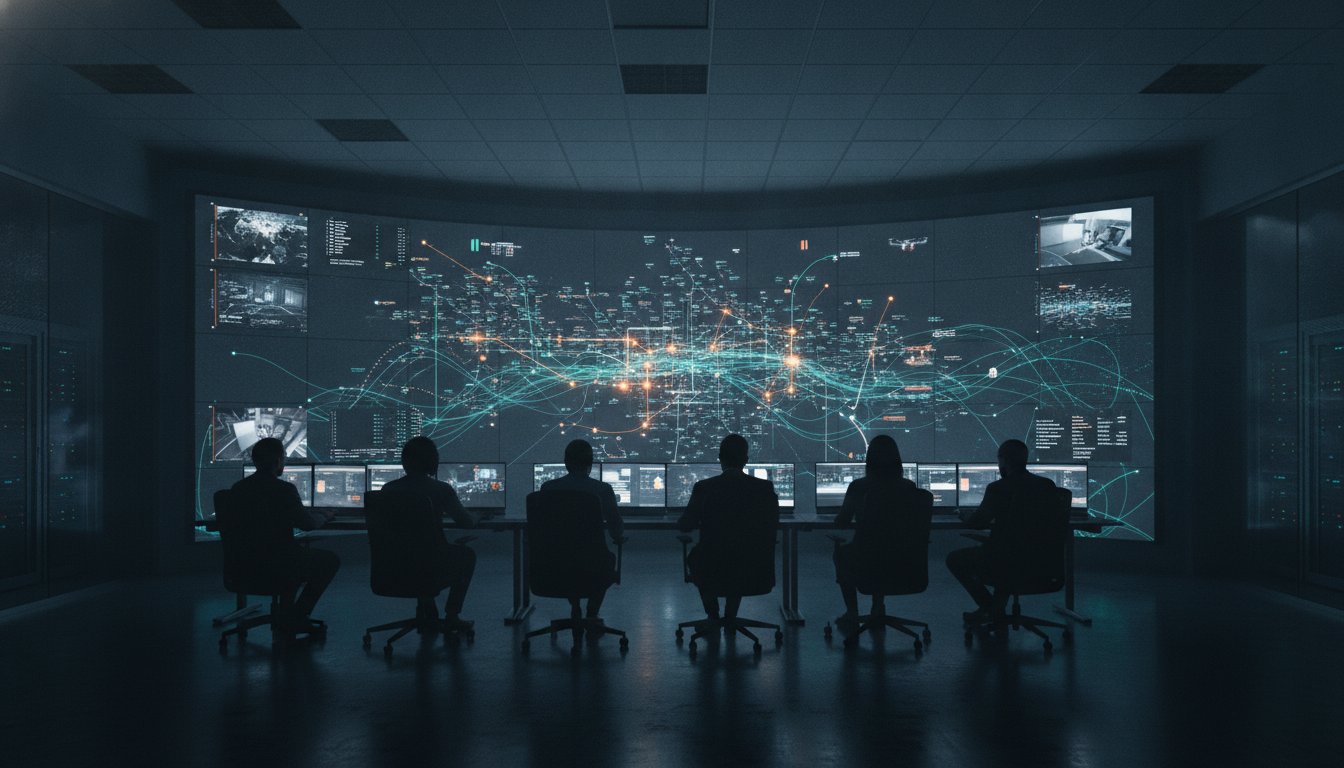
By 2025, fusion centers nationwide are projected to see a substantial increase in information requests, potentially mirroring growth rates of over 40% that highlight the escalating pressure on these critical intelligence hubs to manage massive data volumes. Understanding what is a fusion center requires looking beyond the physical room to the collaborative ecosystem designed to detect, prevent, and respond to threats by unifying disparate data. You likely recognize the intense friction of managing fragmented feeds from multiple agencies while trying to maintain a big-picture view during an active threat. Operators often become overwhelmed by disconnected screens, struggling to find the signal within the noise of siloed dispatch and video tools that provide only a partial view of the operational landscape.
Most control rooms already have the screens. What they’re missing is the layer that decides what goes on them, and escalates automatically when something needs attention. This article defines the strategic role of these centers in national security and explains how an operational intelligence layer transforms raw data into actionable situational awareness. We’ll provide a roadmap for achieving a true Common Operating Picture (COP) and strategies to reduce your incident response times by moving toward vis/ability from Activu Corporation.
Key Takeaways
- Understand what is a fusion center and its strategic function as a multi-agency intelligence hub designed to detect, prevent, and respond to complex threats.
- Identify the operational gaps caused by fragmented data and “Wall of Glass” syndrome, where excessive screens often lead to decreased situational awareness.
- Learn how an operational intelligence layer serves as the central hub to unify siloed tools, such as video feeds or GIS feeds, into a single Common Operating Picture.
- Discover the roadmap for transitioning from reactive monitoring to event-driven situational awareness that prioritizes essential information for decision-makers.
- Explore strategies for extending critical intelligence beyond the command center to huddle rooms and mobile devices to ensure seamless coordination during active incidents.
What is a Fusion Center? Defining the Intelligence Hub
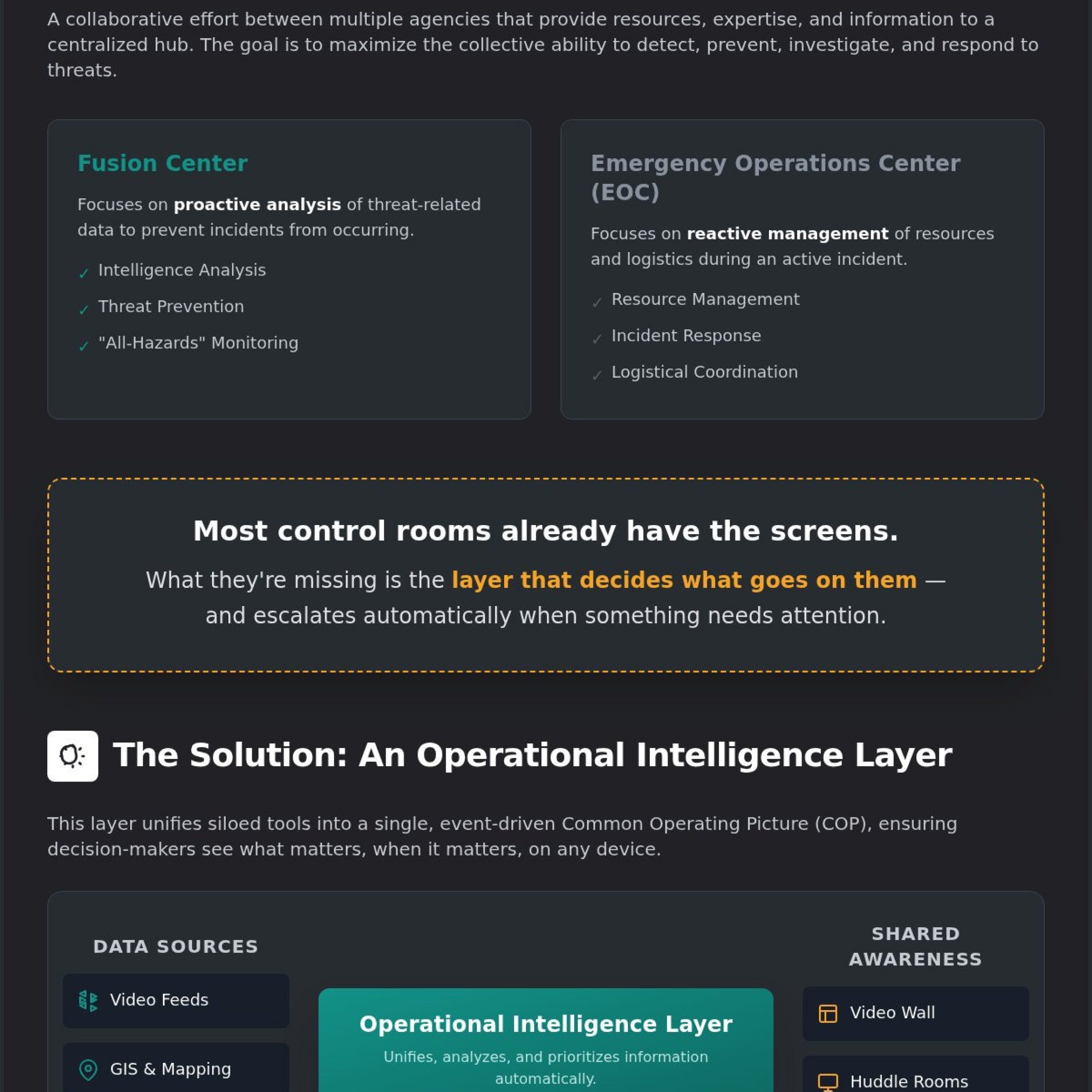
A Fusion center is a collaborative effort between two or more agencies that provide resources, expertise, and information to a centralized hub. The goal is to maximize the collective ability to detect, prevent, investigate, and respond to criminal and terrorist activity. While many people confuse these with Emergency Operations Centers (EOCs), the distinction is critical for mission success. While an EOC manages resources and logistics during an active incident, a fusion center focuses on the proactive analysis of threat-related data to prevent those incidents from occurring. Understanding what is a fusion center involves recognizing its role as the primary node in a National Network of over 80 locations coordinating with federal partners like the DHS and FBI.
Most control rooms already have the screens. What they’re missing is the layer that decides what goes on them – and escalates automatically when something needs attention. Without this intelligence layer, the collaborative potential of these agencies is often hindered by fragmented data and siloed communication. Activu Corporation provides the technological bedrock that allows these diverse agencies to function as a single, unified entity, ensuring that critical information is prioritized and shared in real time.
The Evolution of Information Sharing
The origins of these hubs lie in the post-9/11 landscape, where breaking down the intelligence silos between federal and local authorities became a national priority. Since then, the model has transitioned into an “all-hazards” approach. Modern centers now monitor everything from cyber threats and natural disasters to public health crises. This expanded scope demands absolute technical reliability and 24/7 operational readiness, as even a few seconds of downtime can compromise the entire intelligence cycle.
Types of Fusion Centers in 2026
The intelligence landscape is diverse, consisting of State and Major Urban Area Fusion Centers that serve as the primary nodes for public safety. However, the model has also been adopted by private enterprises. Corporate Fusion Centers allow global organizations to monitor threats to business continuity and supply chains with the same rigor as government entities. Increasingly, organizations are deploying Virtual Fusion Centers, which leverage distributed teams and Mobile vis/ability to maintain situational awareness across geographic boundaries, ensuring that the mission continues regardless of where personnel are located.
The Structure and Roles Within a Modern Fusion Center
Operational success depends on the seamless integration of personnel from diverse backgrounds. Multi-Agency Coordination (MAC) brings together police, fire, emergency management, and private sector partners under one roof to create a collective intelligence environment. This structure supports the intelligence cycle, a methodical process of planning, gathering, processing, and disseminating actionable data to field units. When evaluating what is a fusion center, it’s essential to look at how these roles interact within a high-performance ecosystem. Activu Corporation supports Public Safety and Fusion Centers by providing the tools necessary for these multi-disciplinary teams to synchronize their efforts during active threats.
Governance provides the necessary guardrails for these operations. Establishing a firm legal framework for data privacy and civil liberties, such as 28 CFR Part 23 compliance, ensures that information sharing remains ethical and lawful. Most control rooms already have the screens. What they’re missing is the layer that decides what goes on them – and escalates automatically when something needs attention. By implementing an operational intelligence layer, leadership can ensure that governance policies are reflected in the way data is visualized and shared across the network.
Key Operational Personnel
Intelligence Analysts form the core of the facility, tasked with identifying critical patterns within vast streams of raw information. They are supported by Liaison Officers, who bridge the communication gap between the center and external agencies like the FBI or local dispatch. Meanwhile, IT and Security Operations teams maintain the Cybersecurity Common Operating Picture, ensuring the technical infrastructure remains resilient against unauthorized access or digital disruptions.
The Role of Human-Centric Design
Operational Challenges: Data Silos and Information Overload
Operators face a constant barrage of data from CAD systems, GIS overlays, and social media monitoring tools. This creates the “Wall of Glass” syndrome, where an abundance of visual information actually obscures situational awareness. When an analyst’s focus is divided across dozens of disconnected monitors, the risk of missing “weak signals”, those subtle indicators of a burgeoning threat, increases significantly. Cognitive overload is a documented reality in 24/7 monitoring environments, where the human element is frequently the first point of failure.
Defining what is a fusion center in a practical sense requires acknowledging these operational friction points. According to the Department of Homeland Security, these centers are focal points for threat-related information; yet many struggle with data latency. Manual processes for creating SITREPs often slow down the dissemination of time-sensitive intelligence. This delay means field units receive information that is already minutes or hours old, compromising the safety of responders and the public alike.
Most control rooms already have the screens. What they’re missing is the layer that decides what goes on them, and escalates automatically when something needs attention. Without this intelligence layer, the video wall becomes a static display of everything rather than a tool for decisive action. The result is a reactive posture that waits for an incident to become obvious rather than identifying it in its earliest stages.
The Danger of Partial Solutions
Some organizations rely on specialized tools like Axon to manage video evidence and real-time feeds. While effective for their specific purpose, these platforms only provide a partial view of the total operational landscape. They require a unifying layer to create a full Common Operating Picture. Static video walls exacerbate this problem by displaying all feeds at once without highlighting what is critical. This lack of prioritization leads directly to operational continuity failures, where the system fails to support the mission during peak stress periods.
Identifying the Gaps in Situational Awareness
Siloed data remains the primary hurdle for multi-agency coordination. When critical information is trapped in individual agency applications, communication breakdowns are inevitable. Sharing a unified view with distributed teams or mobile users becomes an exercise in frustration, often requiring verbal descriptions of visual data. Operators miss incidents when using traditional, non-integrated video walls because the system lacks the logic to surface high-priority events, forcing the human eye to do the work of an automated algorithm. This gap between raw data and actionable intelligence is where mission-critical errors occur.
The Technology Stack: From Static Displays to Intelligence Layers
High-performance Video Wall Systems are the visible face of the center, but hardware alone doesn’t define what is a fusion center in the modern era. These displays must be engineered for 24/7 mission-critical reliability to support constant oversight. However, the true value lies in the Common Operating Picture (COP). A COP provides a single, unified view of the operational environment, ensuring that all stakeholders see the same data at the same time. This visibility is the bedrock upon which critical decisions are made, moving the organization from a reactive posture to proactive prevention.
Application integration is the process of connecting disparate software feeds, such as CAD, GIS, and weather alerts, into a cohesive intelligence ecosystem. While some organizations use platforms like Axon to manage video evidence, these tools often function as isolated silos. They provide only a partial solution and require a unifying layer to create a full common operating picture. Without this, operators are left manually correlating data across disconnected applications, which increases the risk of error during high-stress incidents. True situational awareness requires that these tools flow into a central hub rather than remaining fragmented.
The Operational Intelligence Layer
Most control rooms already have the screens. What they’re missing is the layer that decides what goes on them, and escalates automatically when something needs attention. This is where the vis/ability Platform excels, acting as the central hub for all fusion center data streams. It transforms the video wall from a passive monitor into an active participant in the mission. By utilizing event-driven intelligence, the system automatically escalates critical data to the forefront only when specific triggers are met. This ensures that analysts focus on threats rather than managing software. You can learn more about incident management software designed specifically for these high-stakes environments.
Modernizing with COTS Solutions
Transitioning to Commercial Off-the-Shelf (COTS) solutions allows agencies to achieve rapid deployment and scalability without the long lead times of custom hardware. These solutions are built to satisfy rigorous NERC CIP and cybersecurity compliance standards, ensuring the tech stack remains resilient against both physical and digital threats. The vis/ability platform makes other tools useful for the entire team, from the center to the field, by providing a secure, synchronized stream of intelligence. To see how this integration improves your operational readiness, contact Activu for a consultation.
Elevating Fusion Center Intelligence with Activu vis/ability
Operations managers often face the challenge of fragmented systems where critical threat data remains siloed within individual agency applications. This fragmentation prevents a clear understanding of what is a fusion center‘s ultimate goal: proactive prevention rather than reactive monitoring. Most control rooms already have the screens. What they’re missing is the layer that decides what goes on them – and escalates automatically when something needs attention. Activu’s vis/ability platform serves as this essential operational intelligence layer, unifying data from sources like Axon and GIS into a single, cohesive view. While Axon provides valuable video evidence, it remains a partial solution that lacks the cross-platform integration required for a complete Common Operating Picture.
Since 1983, Activu has engineered control room solutions for high-stakes environments, providing the bedrock upon which mission-critical decisions are made. With over 40 years of experience in federal government and defense, we understand that technical reliability isn’t optional. Our custom design services optimize both hardware and software to ensure maximum operational efficiency, allowing teams to collaborate across physical boundaries. Through Mobile vis/ability, the intelligence gathered at the center flows seamlessly to huddle rooms and mobile devices. This ensures that field units and leadership share the same real-time situational awareness, regardless of their location.
The Activu Advantage in 2026
The shift toward event-driven situational awareness marks the end of passive monitoring. Instead of analysts searching for incidents on a “Wall of Glass,” the system surfaces high-priority events based on specific triggers. This transition creates a unified operating picture that serves as the single source of truth for multi-agency environments. By prioritizing essential information, vis/ability empowers individuals to act with greater certainty. Discover how Activu supports Federal Government and Defense by providing the tools necessary for modern intelligence hubs.
Next Steps for Operations Managers
Evaluating what is a fusion center within your own organization requires an honest assessment of current situational awareness gaps. If your operators are overwhelmed by disconnected screens or if data latency is slowing your incident response times, your mission is at risk. Future-proofing your operations for a data-intensive landscape means moving beyond hardware to an intelligent software layer. We invite you to contact our team for a custom control room design consultation to begin building a more resilient, proactive intelligence ecosystem.
Securing the Future of Mission-Critical Intelligence
Achieving true situational awareness requires moving beyond the “Wall of Glass” to an environment where data works for the analyst. We’ve examined how these hubs function as collaborative nerve centers, and why fragmented feeds from siloed tools often fail to provide the big picture during high-stakes events. Transitioning to an event-driven model ensures that your team remains focused on the mission rather than managing disconnected screens.
Defining what is a fusion center for the modern era involves implementing an operational intelligence layer that unifies every sensor and application into a single source of truth. Most control rooms already have the screens. What they’re missing is the layer that decides what goes on them, and escalates automatically when something needs attention. Activu has served as a vigilant guardian for federal agencies and the National Network of Fusion Centers since 1983, providing the technical bedrock required for absolute operational readiness.
Request a demo of the vis/ability platform for your fusion center. Our team is ready to help you bridge the gap between raw data and decisive action, ensuring your operators act with absolute certainty when stakes are at their highest. Let’s build a more resilient and proactive intelligence ecosystem together.
Frequently Asked Questions
What is the primary purpose of a fusion center?
The primary purpose is to provide a collaborative environment where multiple agencies share resources and expertise to detect, prevent, and respond to criminal or terrorist activity. It serves as the focal point for analyzing threat-related data from diverse sources to protect local and national interests. By centralizing this intelligence, these hubs move organizations from a reactive posture to proactive threat mitigation.
How many fusion centers are currently in the National Network?
There are currently over 80 fusion centers within the National Network, serving as the primary nodes for state and local coordination with federal partners. These centers ensure that threat information flows efficiently between different levels of government. This distributed network allows for a standardized approach to information sharing and situational awareness across the United States.
What is the difference between a fusion center and an Emergency Operations Center (EOC)?
A fusion center focuses on intelligence analysis and prevention, while an EOC manages resources and logistics during an active incident. Understanding what is a fusion center involves recognizing its role in identifying threats before they escalate into crises. EOCs are tactical response hubs, whereas fusion centers are strategic intelligence nodes designed for ongoing, long-term situational awareness.
What technology is essential for a modern fusion center in 2026?
Essential technology includes high-performance video wall systems and an operational intelligence layer that unifies disparate data feeds. Most control rooms already have the screens. What they’re missing is the layer that decides what goes on them, and escalates automatically when something needs attention. This software hub is critical for managing the massive data volumes and complex integrations required in modern operations.
How do fusion centers protect privacy and civil liberties?
Centers protect liberties by adhering to strict legal frameworks, specifically 28 CFR Part 23. This regulation governs the collection and storage of criminal intelligence to ensure that privacy rights aren’t violated during data gathering. Rigorous internal audits and oversight from federal partners further verify that information sharing remains within lawful boundaries and maintains public trust.
What is a Common Operating Picture (COP) in a fusion center context?
A Common Operating Picture is a single, synchronized display of relevant information shared across all agencies and stakeholders. It eliminates the confusion of fragmented data by providing a “single source of truth” for the entire operational team. A robust COP ensures that decision-makers in the command center see the same real-time data as personnel responding on mobile devices.
Can fusion centers be used by private corporations?
How does event-driven automation improve fusion center operations?
Event-driven automation improves operations by automatically surfacing critical information based on predefined triggers. This reduces cognitive overload for analysts who would otherwise have to monitor dozens of static screens manually. By escalating only the most relevant data, automation ensures that operators don’t miss “weak signals” that could indicate a significant, developing threat requiring immediate attention.