
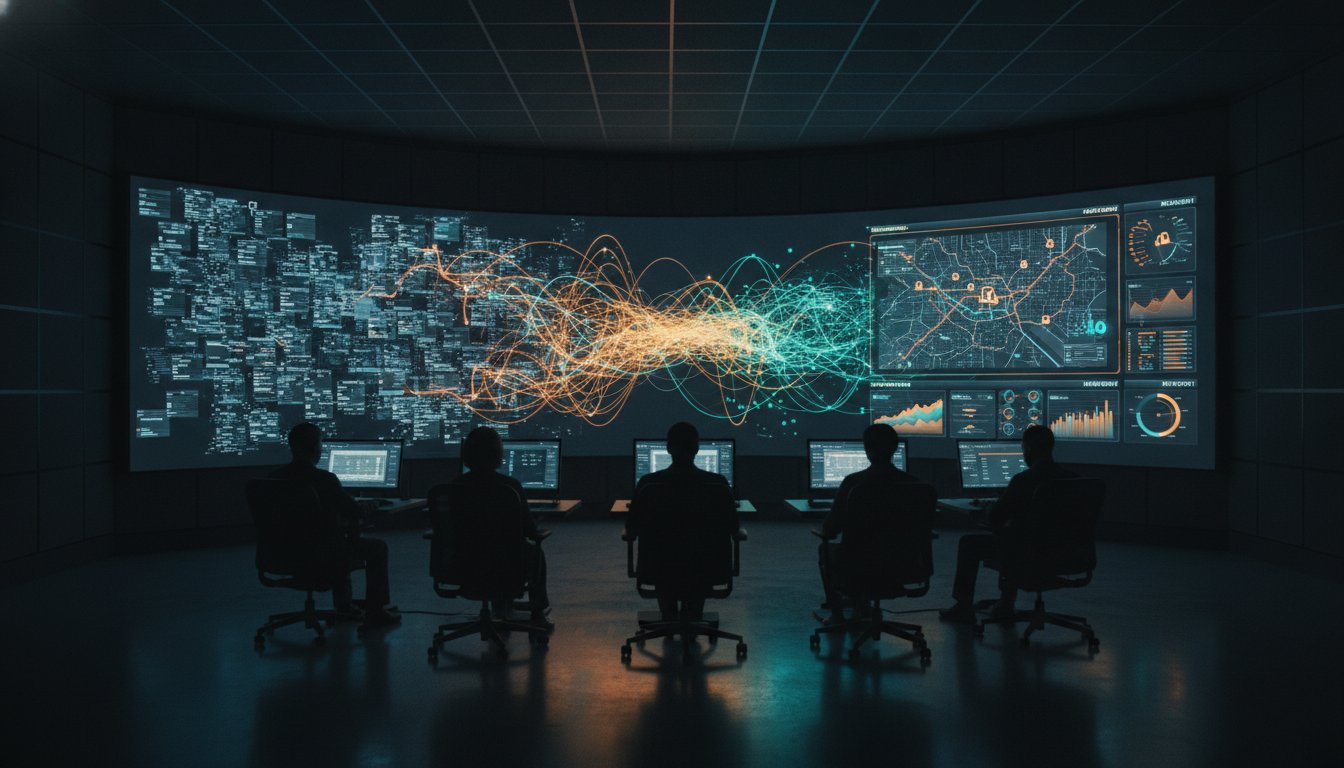
Fragmented data streams compromise operational speed. You’ve likely felt the strain of information overload as operators juggle dozens of feeds, manually correlating data while critical seconds tick away. When essential information stays trapped with a single operator instead of the whole team, response times suffer. Most organizations invest in common operating picture software hoping for clarity, yet they often find themselves managing fragmented streams that require constant human intervention to make sense of the chaos.
Most control rooms already have the screens. What they’re missing is the layer that decides what goes on them, and escalates automatically when something needs attention. Discover how to transform fragmented data streams into a unified, event-driven common operating picture that empowers faster decision-making at the moment it matters most. We will examine the shift from passive monitoring to proactive intelligence through vis/ability, the operational intelligence layer that reduces cognitive load and ensures seamless collaboration between the command center and mobile field units.
Key Takeaways
- Eliminate the “swivel-chair” effect by moving beyond fragmented data silos that delay response times during high-stakes operations.
- Understand how modern common operating picture software transforms static displays into dynamic, event-driven platforms for real-time situational awareness.
- Recognize the distinction between simply displaying information and utilizing an operational intelligence layer that automatically escalates critical incidents.
- Learn to integrate disparate tools like Juvare or Axon into a unified hub, ensuring a single source of truth for both command centers and mobile field units.
- Reduce operator cognitive load through automated workflows that prioritize essential information when seconds count.
The Crisis of Fragmented Data in Modern Command Centers
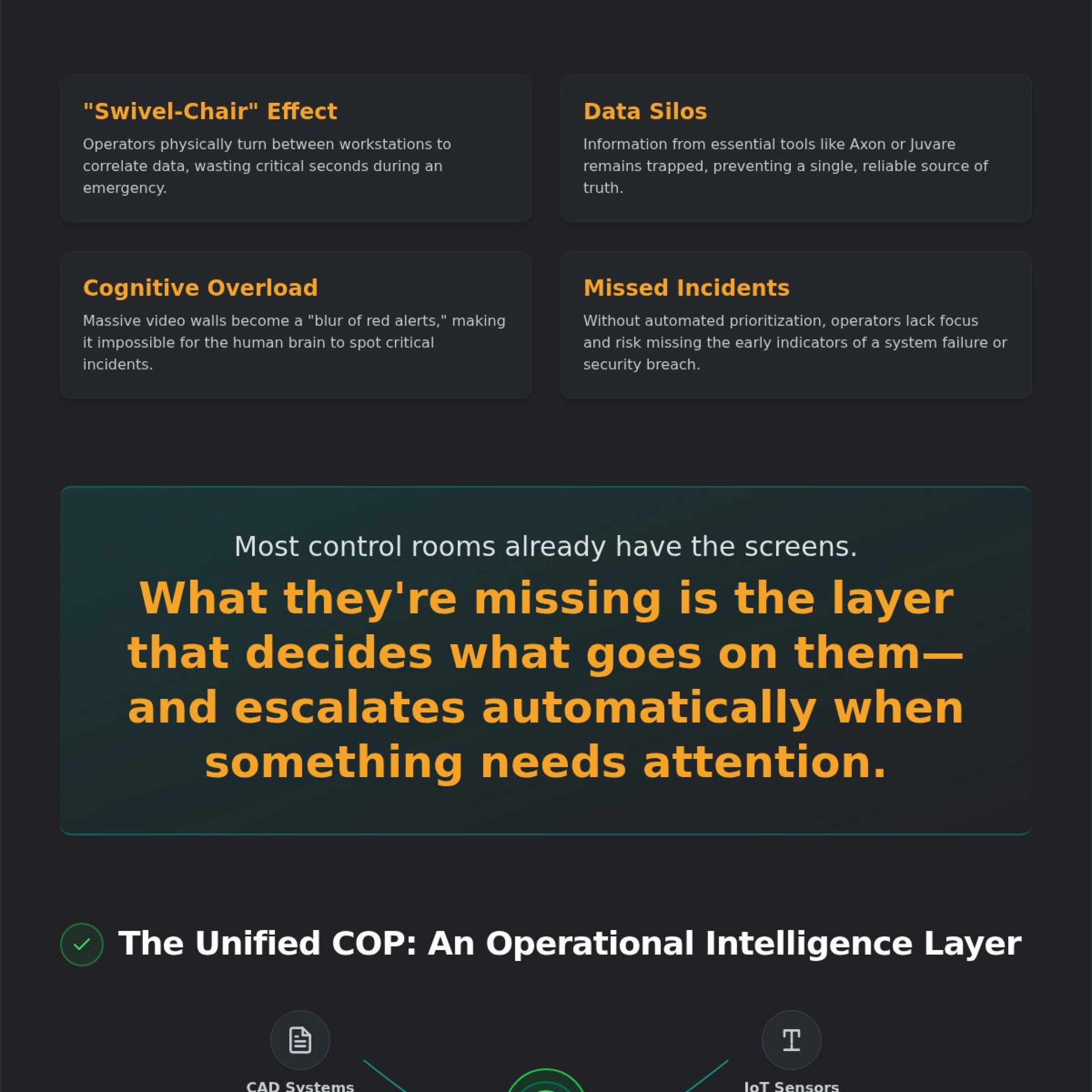
Operators in high-stakes environments face a relentless tide of information. They often navigate the “swivel-chair” effect, physically turning from one workstation to another to correlate data between disparate systems. This manual process isn’t just inefficient; it’s dangerous. When an emergency strikes, the time spent toggling between a CAD system, a video management platform, and a weather feed is time lost for decisive action. Data silos ensure that critical intelligence remains isolated. A field unit using a tool like Axon might see a live body-cam feed, but if that visual isn’t integrated into the broader command center workflow, the supervisor lacks the context needed to deploy additional resources. These tools provide only a partial solution, leaving a gap that requires a unifying platform to close.
Traditional dashboards often exacerbate these Common Operational Picture (COP) challenges. They present a “wall of green” that looks impressive during calm periods but becomes a blur of red alerts during a crisis. This is the hidden cost of screen fatigue. In a 24/7 mission-critical environment, the human brain cannot maintain peak focus on dozens of static metrics. Most common operating picture software fails because it prioritizes data volume over data relevance, forcing humans to act as the integration layer between fragmented screens.
Control Room Situational Awareness Problems
Situational awareness is not the same as data collection. Many organizations mistake “having the data” for “understanding the event.” The gap between raw data and actionable intelligence is where errors happen. When operators are forced to hunt for the “signal in the noise,” they risk missing the early indicators of a system failure or a security breach. Siloed tools provide only a narrow slice of the landscape. Without a unifying platform, these partial views never coalesce into a single, reliable truth. True situational awareness requires a system that filters out the irrelevant and highlights the essential.
Why Operators Miss Incidents on Large Video Walls
There’s a persistent myth that more screens lead to better visibility. In reality, massive video walls often contribute to cognitive overload. When every feed is displayed at equal priority, nothing stands out. Operators don’t miss incidents because they lack the footage; they miss them because they lack the focus. Manual data correlation is a fragile process that breaks under the pressure of a real-world incident. Effective common operating picture software must do more than just display feeds; it must direct attention to the most critical data points based on pre-defined operational thresholds.
Most control rooms already have the screens. What they’re missing is the layer that decides what goes on them, and escalates automatically when something needs attention.
Defining Modern Common Operating Picture (COP) Software
Modern common operating picture software acts as the central hub for mission-critical intelligence. It creates a centralized tactical display that integrates disparate data streams into a single, unified understanding of the operational environment. Historically, these systems were static maps used primarily by military commanders. We see this evolution clearly in the U.S. Army’s Command Post of the Future (CPOF), which demonstrated how shared visualization could synchronize efforts across a distributed force. Today, the technology has moved beyond simple map overlays to become dynamic, event-driven platforms that prioritize information based on real-time urgency.
There is a fundamental difference between a standard dashboard and a mission-critical COP. A dashboard typically provides a retrospective look at performance metrics. In contrast, an enterprise-grade COP is built for active management during live incidents. It provides geospatial oversight that allows leaders to see exactly where assets are positioned in relation to emerging threats. Most control rooms already have the screens. What they’re missing is the layer that decides what goes on them, and escalates automatically when something needs attention. This is the role of an operational intelligence layer, which serves as the bedrock for certain decision-making.
The Core Components of a Unified Operating Picture
A truly unified system must aggregate data from every available source without overwhelming the human operator. This includes IoT sensors, GIS layers, and specialized applications like Juvare or Axon. While these tools are valuable, they often function as independent silos. The common operating picture software must serve as the unifying platform, ensuring that every stakeholder, whether in the command center or using mobile vis/ability in the field, sees the same tactical reality at the same time.
Geospatial and Tactical Data Integration
Precision is mandatory in high-bandwidth environments. Modern platforms overlay real-time assets onto a single spatial data platform, requiring a meticulously maintained GIS data dictionary to ensure accuracy across all domains. This integration allows for the seamless handling of telemetry and high-definition video feeds. When a sensor threshold is crossed, the system doesn’t just record the data; it triggers a visual change in the command center. This ensures that the most relevant information is always front and center, allowing teams to act with absolute technical reliability when stakes are highest.
The Missing Layer: Why Screens Alone Are Not a COP
A sea of monitors does not constitute a tactical advantage. Many organizations invest heavily in high-resolution hardware, assuming that increased visibility automatically leads to better outcomes. However, there is a stark difference between displaying information and managing operations. Without a logic-driven engine behind the glass, a video wall is simply a collection of pixels. To achieve true situational awareness, organizations must follow established frameworks like the Joint Emergency Services Interoperability Principles (JESIP), which emphasize the need for a shared understanding of an incident. This understanding is impossible when operators are drowning in raw data feeds that lack context or prioritization.
Most control rooms already have the screens. What they’re missing is the layer that decides what goes on them, and escalates automatically when something needs attention. Effective common operating picture software provides this missing layer by filtering out the background noise. It ensures that the team only sees the data that demands immediate action, transforming the control room from a reactive monitoring station into a proactive command center. This shift allows leaders to focus on the human judgment required for complex decisions rather than the manual labor of data correlation.
The Operational Intelligence Layer Explained
At the heart of this transformation is vis/ability, the operational intelligence layer that serves as the central hub for all critical data. Unlike standalone tools that offer partial views, vis/ability aggregates feeds from across the entire enterprise. It automates the escalation process. When a specific threshold is met, the software doesn’t just log an event; it changes the layout of the video wall to show the relevant cameras, maps, and telemetry. This significantly reduces the time between incident detection and decisive human action, ensuring that the right information reaches the right people at the exact moment it’s needed.
Beyond the Video Wall: Extending the COP
Operational intelligence must not be confined to the four walls of the command center. For a common operating picture to be effective, it must reach every stakeholder, regardless of their location. Mobile vis/ability extends this unified view to field units, huddle rooms, and executive offices. This ensures that a supervisor on a mobile device and an operator at the main console are looking at the exact same tactical reality. Maintaining this continuity across distributed teams is vital for multi-domain operations where coordination is the difference between success and failure.
Key Capabilities of Enterprise-Grade COP Platforms
Effective common operating picture software must do more than aggregate data; it must synthesize it into a coherent tactical advantage. Enterprise-grade platforms provide seamless application integration, pulling information from specialized tools like Juvare for emergency management or Axon for digital evidence. While organizations often use these tools for specific tasks, they provide only a partial solution when used in isolation. vis/ability serves as the operational intelligence layer that unifies these disparate streams, ensuring that the entire team operates from a single source of truth across video walls, huddle rooms, and mobile devices.
A core differentiator of a modern COP is event-driven visualization. Rather than requiring operators to manually switch views, the system monitors data thresholds and automatically triggers specific layouts. If a sensor detects a breach or a system failure, the software instantly populates the relevant cameras, maps, and procedures. Most control rooms already have the screens. What they’re missing is the layer that decides what goes on them, and escalates automatically when something needs attention. This automation reduces cognitive load and ensures that the most critical information is never lost in the noise.
How to Manage Multiple Data Feeds in a Dispatch Center
Dispatch centers must balance a constant influx of CAD, radio, and video feeds. Managing these requires a strategy that prioritizes “incident-specific” layouts. When a call comes in, the common operating picture software should automatically populate the video wall with data relevant to that specific geographic area or incident type. The integration of SIEM and SOAR data into a COP provides a unified view of security alerts and automated response workflows, ensuring that digital threats are addressed with the same tactical precision as physical incidents. This approach allows dispatchers to focus on coordination rather than screen management.
Cybersecurity and Network Posture Visualization
Modern operations face threats that are both physical and digital. A Cybersecurity Common Operating Picture bridges the gap between the Security Operations Center (SOC) and the Physical Security Operations Center (PSOC). By monitoring threat intelligence and network health in real-time, leaders can visualize how a cyber-attack might impact physical infrastructure. This unified posture allows for a more robust defense and a faster recovery. To see how these capabilities can transform your command center, you can explore our control room solutions and speak with an expert today.
Implementing an Event-Driven COP with vis/ability
Activu provides the foundation for mission-critical certainty. Transitioning to a proactive operational model requires more than just high-end displays; it demands a synergy between specialized software and the physical environment. vis/ability serves as this bedrock, acting as the operational intelligence layer that makes every other tool more effective. While some organizations attempt to use out-of-the-box GIS solutions, these often lack the sophisticated automation and custom engineering required for high-stakes environments. Activu designs the entire ecosystem, from the software architecture to the video wall engineering, ensuring that the technology serves the mission with absolute technical reliability.
Most control rooms already have the screens. What they’re missing is the layer that decides what goes on them, and escalates automatically when something needs attention. By implementing vis/ability, organizations move from a state of complexity to a state of clear, actionable intelligence. This transition ensures that the common operating picture software remains the quiet, powerful engine behind every successful operation, allowing commanders to lead with confidence when stakes are at their highest.
Tailoring the COP for Your Industry
Every industry faces unique operational challenges that require precise visualization. EOC common operating picture solutions must aggregate data from across jurisdictions to ensure a unified response during large-scale emergencies, moving beyond the simple map views provided by basic GIS tools. In the energy sector, managing utility grids and energy infrastructure requires event-driven triggers that alert operators to load imbalances or equipment failures before they cascade into outages. Public safety agencies benefit from Real-Time Crime Center (RTCC) integration, where high-bandwidth video and CAD data converge to provide officers in the field with immediate tactical intelligence through mobile vis/ability.
The Path to Proactive Operations
The shift from reactive monitoring to proactive management begins with the configuration of automated workflows and escalation rules. Operators should no longer spend their shifts scanning rows of monitors for anomalies. Instead, the common operating picture software should be configured to escalate critical incidents automatically based on pre-defined operational thresholds. Training focuses on acting upon intelligence rather than simply observing data, which reduces cognitive load and allows the team to focus on human judgment. You can learn more about the vis/ability platform and how it serves as the unifying hub for your mission-critical data. This approach empowers individuals to act with greater certainty, turning raw data into a decisive tactical advantage.
Advance to Proactive Operational Certainty
Operational success depends on the speed and accuracy of your decisions. Moving beyond fragmented data silos requires a fundamental shift in how your team interacts with information. By implementing advanced common operating picture software, you replace manual correlation with automated intelligence. This ensures your command center remains focused on the mission rather than the technology. Most control rooms already have the screens. What they’re missing is the layer that decides what goes on them, and escalates automatically when something needs attention.
Activu provides the bedrock for these high-stakes environments. Trusted by Federal Government and Defense agencies, the vis/ability platform reduces response times through automated escalation and seamless integration with your mission-critical applications. It’s time to move from a reactive state to a model of proactive clarity. We invite you to request a demo of the vis/ability platform to see how we can transform your operational landscape. Take the first step toward a more resilient and responsive future today.
Frequently Asked Questions
What is the primary purpose of common operating picture software?
The primary purpose of common operating picture software is to provide all stakeholders with a single, synchronized view of real-time data and tactical information. It enables diverse teams to operate from the same factual foundation, which is essential for coordinating complex responses. By aggregating video feeds, GIS data, and sensor alerts, the software ensures that decision-makers can act with speed and certainty during high-stakes incidents.
How does a COP differ from a standard business dashboard?
A standard business dashboard typically displays historical performance metrics or static data for retrospective analysis. In contrast, a mission-critical COP is an active intelligence platform designed for live operational management. It prioritizes real-time events and dynamic data streams. Most control rooms already have the screens. What they’re missing is the layer that decides what goes on them, and escalates automatically when something needs attention.
Can COP software integrate with existing legacy systems and applications?
Yes, the vis/ability platform is specifically engineered to integrate with existing legacy systems and specialized mission-critical applications. It serves as a unifying hub that pulls data from disparate sources like CAD, VMS, and IoT sensors. This allows organizations to leverage their current investments while eliminating the data silos that typically hinder operational speed.
How does event-driven visualization reduce operator fatigue?
Event-driven visualization reduces operator fatigue by filtering out background noise and highlighting only the information that requires immediate intervention. Instead of manually monitoring dozens of static feeds, operators are alerted by automated triggers that change the video wall layout based on pre-defined thresholds. This significantly lowers cognitive load and prevents the “wall of green” effect that leads to missed incidents.
Is it possible to extend the common operating picture to mobile users in the field?
It’s entirely possible and necessary to extend the common operating picture to mobile users through tools like Mobile vis/ability. This ensures that field units see the exact same tactical reality as the command center. Maintaining this visual continuity across distributed teams is vital for ensuring that everyone, from the boots on the ground to the executive office, remains synchronized during a crisis.
What industries benefit most from implementing a common operating picture?
How does a COP improve cybersecurity response times?
A COP improves cybersecurity response times by visualizing network health and threat intelligence alongside physical security feeds. This unified posture allows Security Operations Centers (SOC) to identify how a digital breach might impact physical assets or personnel. By bridging the gap between cyber and physical domains, organizations can execute more coordinated and effective mitigation strategies when stakes are highest.
What should I look for when evaluating COP software providers?
When evaluating providers, prioritize those who offer a true operational intelligence layer rather than just a display management tool. Look for seamless application integration, robust event-driven automation, and a proven track record in high-stakes environments. You should also ensure the provider can design the entire environment, from the software architecture to the physical video wall engineering, to ensure absolute technical reliability.