

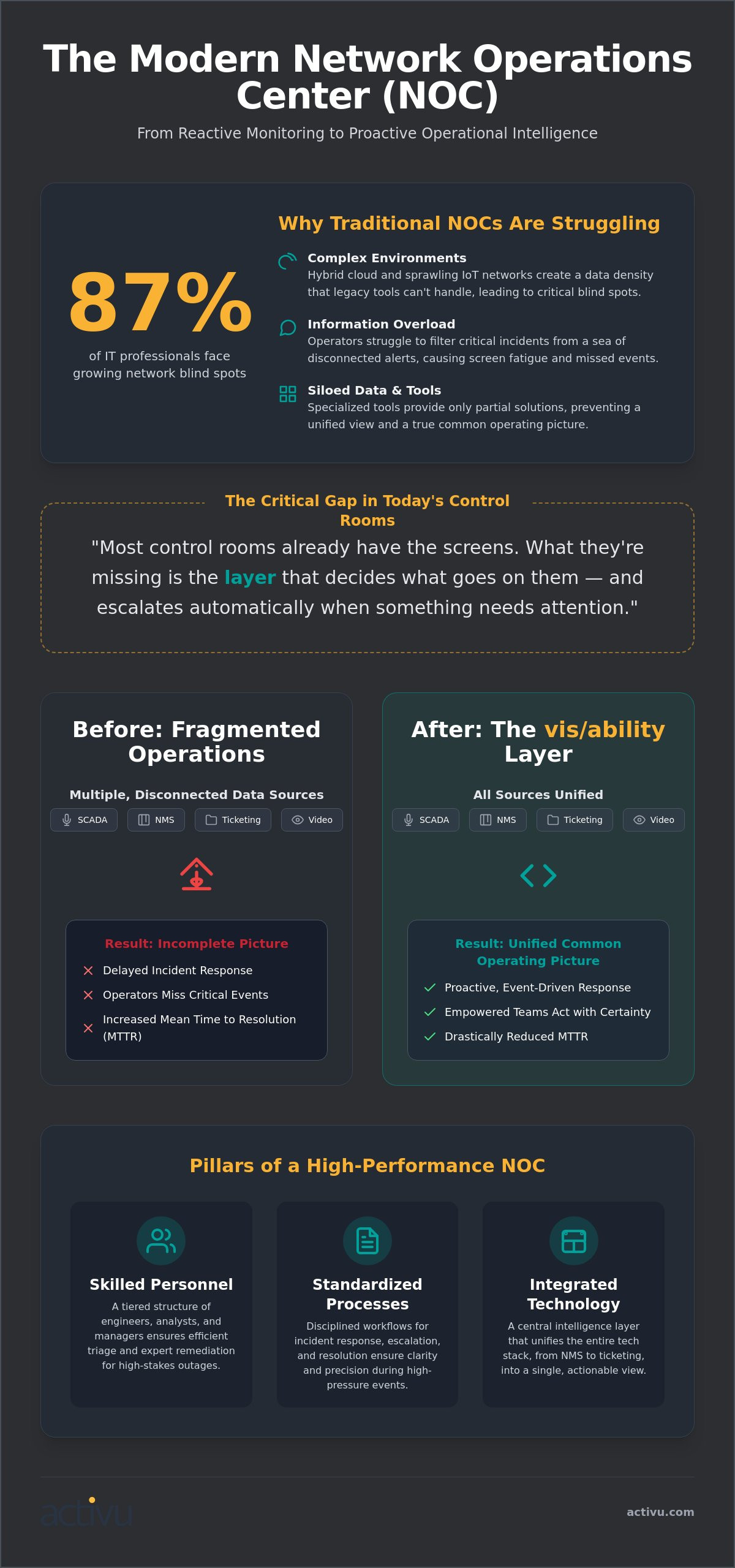
Recent reports show that 87% of IT professionals now face growing network blind spots caused by complex cloud and hybrid environments. For a modern Network Operations Center, these gaps represent more than just a technical challenge; they’re a risk to the bedrock of your organization’s uptime. You’ve likely felt the strain of information overload as operators struggle to filter critical incidents from a sea of disconnected alerts.
Operators frequently battle screen fatigue while managing siloed data that prevents a unified view of network health. While specialized tools like Axon offer important data, they often provide only a partial solution that lacks the necessary integration for a full common operating picture. Most control rooms already have the screens. What they’re missing is the layer that decides what goes on them, and escalates automatically when something needs attention.
In this guide, you’ll discover how to evolve your facility into a high-performance hub using vis/ability as your operational intelligence layer. We’ll outline a blueprint for operational resilience that reduces mean time to resolution and empowers your team to act with certainty, whether they’re in the command center or responding from the field.
Key Takeaways
- Understand why a modern Network Operations Center must move beyond simple monitoring to provide true operational intelligence and mission-critical resilience.
- Identify the systemic weaknesses of fragmented data and learn why partial solutions often fail to prevent critical incidents during high-pressure events.
- Discover how to bridge the gap between raw data and human judgment by implementing a layer that automates escalation and prioritizes essential information.
- Learn how the vis/ability platform integrates disparate tools into a unified common operating picture for seamless collaboration across distributed teams.
- Gain a blueprint for reducing mean time to resolution (MTTR) by transforming your control room into a proactive, event-driven command center.
What is a Network Operations Center (NOC)?
A Network operations center serves as the primary tactical hub for an organization’s digital infrastructure. It functions as the centralized location where technical teams maintain 24/7 oversight, management, and rapid incident response. This facility acts as the first line of defense against service degradation, protecting the enterprise from the catastrophic effects of unplanned outages. While a corporate Network Operations Center might focus on internal application availability, those serving public utilities or government agencies manage systems where failure can impact national security or public safety. The mission has shifted significantly. It’s no longer enough to operate in a reactive break-fix mode. Modern operations demand proactive situational awareness where teams anticipate threats before they manifest as downtime. This requires a transition from simply watching monitors to actively managing the flow of intelligence.
The Evolution of Network Monitoring
Network oversight has moved far beyond the era of physical status boards and manual logs. Today’s environments rely on sophisticated digital dashboards, yet the underlying complexity has scaled faster than the tools used to manage them. In 2026, the proliferation of hybrid cloud architectures and sprawling IoT networks has created a data density that traditional monitoring can’t handle. These legacy systems often provide a fragmented view, leaving operators to guess which alerts matter most. Traditional monitoring is no longer sufficient for mission-critical resilience because it lacks context. True operational readiness requires a move away from simple pings and toward deep operational intelligence. Most control rooms already have the screens. What they’re missing is the layer that decides what goes on them; it escalates automatically when something needs attention.
Why 24/7 Visibility is Non-Negotiable
Network uptime correlates directly to brand reputation and financial stability. A single hour of downtime can cost millions in lost revenue and irreversible damage to customer trust. The NOC plays a vital role in maintaining operational continuity, ensuring that essential services remain available regardless of technical volatility. This constant vigilance transforms the NOC into a vigilant guardian of the organization’s core mission. Beyond the financial stakes, constant oversight is often a legal requirement. For utilities, strict adherence to NERC CIP standards isn’t optional. Continuous visibility provides the audit trails and real-time control necessary to meet these rigorous regulatory demands. This ensures the grid remains secure and reliable under all conditions, providing a sense of calm and clarity even during peak load or cyber threats. Technical tools empower individuals to act with greater certainty when the stakes are highest.
Core Components of a High-Performance NOC
A high-performance Network Operations Center relies on the seamless orchestration of three critical pillars: skilled personnel, standardized processes, and integrated technology. These components must function in unison to achieve a meaningful reduction in Mean Time to Repair (MTTR). When a critical incident occurs, the speed of resolution depends entirely on how quickly the system converts raw data into actionable intelligence. Success isn’t measured by the volume of alerts generated, but by the clarity and precision of the team’s response. This synergy ensures that the Network Operations Center remains a proactive force rather than a reactive one.
Personnel and Operational Roles
Skilled personnel form the bedrock of any command environment. Operational roles are typically structured to ensure maximum efficiency, featuring NOC Engineers for deep technical remediation, Analysts for initial triage, and Managers to oversee strategic coordination. A disciplined, tier-based support structure, moving from Tier 1 through Tier 3, ensures that routine maintenance doesn’t distract senior experts from complex, high-stakes outages. Human-centric design is vital in this context. Without a system that prioritizes essential information, operators quickly succumb to screen fatigue. The goal is to provide a sense of calm and clarity, where technical tools empower individuals to act with greater certainty when stakes are at their highest.
The Technology Stack: Beyond Simple Monitoring
The modern technology stack begins with a Network Management System (NMS) and a robust ticketing platform. However, many organizations find that these tools create fragmented dashboards that require exhausting manual correlation. Some teams use products like Axon to manage specific video feeds, yet they often realize these only provide a partial solution. They lack the logic necessary to unify disparate data streams into a single, cohesive common operating picture. Screens on the wall are only as useful as the intelligence layer feeding them.
Most control rooms already have the screens. What they’re missing is the layer that decides what goes on them; it escalates automatically when something needs attention. This requirement for event-driven visualization transforms the video wall from a static display into a dynamic hub for operational intelligence. By integrating real-time video, geospatial data, and application streams into a unified platform, the entire team gains the visibility needed to maintain mission-critical resilience. This approach eliminates siloed data and ensures that the most critical information is always front and center, allowing for seamless collaboration between local and remote teams.
The Critical Gap: Why Traditional NOCs Struggle with Data Silos
Traditional Network Operations Center architectures often fail at the moment of peak crisis. Operators find themselves trapped in a “swivel-chair” workflow, manually cross-referencing data between disconnected applications. This fragmentation isn’t just a minor annoyance; it’s a fundamental risk to mission-critical resilience. When a service degradation occurs, the relevant data is often spread across a dozen different monitors. Some teams incorporate tools like Axon for video management, but these only provide a partial solution. Without a unifying layer, operators must still perform the mental heavy lifting of correlating video feeds with network telemetry. This manual correlation slows response times and introduces the potential for human error when seconds matter most.
Most control rooms already have the screens. What they’re missing is the layer that decides what goes on them; and escalates automatically when something needs attention. Without this intelligence, the video wall becomes a source of distraction rather than a tool for clarity. Information overload leads to a state where operators are busy but not effective, buried under a mountain of alerts that lack context or prioritization.
NOC vs. SOC: Bridging the Intelligence Divide
Network operations focus on performance and availability, while security operations focus on threat detection and mitigation. Historically, these teams operated in silos, yet the underlying infrastructure is the same. A Cybersecurity Common Operating Picture is now essential for the modern NOC. Seeing a spike in traffic alongside a security alert provides the context needed for a decisive response. Without this unified view, teams waste precious minutes debating whether an issue is a hardware failure or a malicious attack. Technical tools must empower individuals to act with greater certainty by merging these two worlds into a single pane of glass.
The Hidden Cost of Fragmented Data Streams
Manual data verification is a silent productivity killer. Every time an operator stops to verify an alert across multiple silos, the mean time to resolution (MTTR) climbs. This fragmentation creates several operational risks:
- The Operator Miss: Critical incidents go unnoticed because they’re buried under irrelevant noise or secondary alerts.
- Information Overload: Screen fatigue sets in quickly when operators must monitor dozens of static dashboards.
- Siloed Decision Making: Remote teams and local operators see different data, leading to misaligned response efforts.
The vis/ability platform serves as the operational intelligence layer that solves these problems. It acts as the central hub where all other tools flow, making them useful for the entire team regardless of their physical location. By automating the prioritization of essential information, vis/ability ensures that the right data reaches the right person at the right moment, transforming the Network Operations Center from a room full of screens into a powerful engine for operational success.
Designing a NOC for Maximum Situational Awareness
A physical Network Operations Center is often built around its displays, yet the true value lies in the intelligence governing those pixels. Effective design prioritizes essential information over raw data volume. This approach ensures that operators remain focused on high-level decision-making rather than getting lost in a sea of secondary alerts. Most control rooms already have the screens. What they’re missing is the layer that decides what goes on them, and escalates automatically when something needs attention. By focusing on the cognitive needs of the team, organizations can transform their facility from a passive monitoring room into a proactive command center.
Optimizing the Video Wall for Operator Clarity
Visual hierarchy is the foundation of any successful common operating picture. In a mission-critical environment, the most vital telemetry must always occupy the central field of view. High-performance video wall systems do more than just show data; they create a shared reality that aligns local and remote teams. Dynamic layouts allow the display to change automatically based on incident severity. For example, during a routine period, the wall might show general health metrics. When a critical threshold is breached, the layout shifts to prioritize the specific failure point. Expert control room design services help plan these ergonomic efficiencies, ensuring that every visual cue reduces cognitive load rather than adding to it.
Implementing Event-Driven Workflows
Modern situational awareness requires a shift from “always on” monitoring to “on when it matters” intelligence. This event-driven approach uses automation to trigger specific visual spaces exactly when they are needed. Imagine a scenario where a significant network failure occurs. Instead of an operator manually searching for the right dashboard, the vis/ability platform automatically populates the video wall with relevant geospatial maps, diagnostic feeds, and communication channels. This immediate transition provides the calm and clarity required for rapid remediation. It eliminates the “swivel-chair” management where operators jump between disconnected applications. Technical tools must empower individuals to act with greater certainty, and event-driven workflows are the engine behind that capability. To begin optimizing your operational environment, consider consulting with our experts for Control Room Design Services today.
Transforming Your NOC into an Operational Intelligence Hub
The transition from a reactive facility to a proactive hub requires more than just updated software. It demands a fundamental shift in how organizations perceive the Network Operations Center. When viewed as a strategic asset, the NOC becomes the engine for operational success, providing the clarity required to navigate high-stakes environments. This evolution is made possible by the vis/ability platform, which serves as the essential operational intelligence layer. It transforms the command center into a unified environment where technical experts and strategic decision-makers act with absolute certainty.
Most control rooms already have the screens. What they’re missing is the layer that decides what goes on them; it escalates automatically when something needs attention. By implementing this logic, organizations move beyond the limitations of fragmented monitoring. This approach empowers leadership to make informed decisions based on a unified view of the enterprise, rather than relying on disparate reports from siloed departments.
To ensure these informed decisions translate into swift action, organizations can leverage autonomous workflow tools like omni-smart.ai to manage broader business operations and eliminate manual bottlenecks.
vis/ability: The Layer That Decides What Matters
The platform aggregates data from disparate sources to provide true event-driven awareness. While tools like SIEM and SOAR generate critical alerts, they often contribute to information overload without a unifying platform to provide context. Some teams rely on Axon for video oversight, but these systems only offer a partial solution and require a separate layer to create a full common operating picture. The vis/ability platform integrates these existing tools into a central hub, filtering out the noise to ensure that operators focus only on what requires immediate action. This Common Operating Picture (COP) is the bedrock of critical incident management, ensuring that every team member sees the same prioritized information at the same time.
Extending Visibility to Mobile and Distributed Teams
Operational resilience depends on seamless collaboration that extends far beyond the physical walls of the control room. Mobile vis/ability tools ensure that field technicians and executive leadership remain connected to the central intelligence hub. This extension of visibility allows for rapid decision-making regardless of location. Technical tools empower individuals to act with greater certainty, bridging the gap between raw data and human judgment. Whether in a huddle room or on a mobile device, every stakeholder gains access to the same actionable intelligence.
This unified approach ensures that the organization remains focused and analytical when the stakes are at their highest. By prioritizing essential information and automating escalation, vis/ability provides the calm and clarity needed to maintain mission-critical uptime. Operational continuity is not just a goal; it is the inevitable result of a well-integrated command operation. To learn more about building a resilient environment, explore our vis/ability platform or contact us for Control Room Design Services today.
Secure Your Operational Future
Operational resilience in the modern Network Operations Center requires a departure from traditional, siloed monitoring. Prioritize essential information to protect uptime and maintain brand reputation. Integrating disparate data streams into a single, cohesive common operating picture provides the clarity needed for certain action during critical incidents. This transformation ensures that technical tools serve as a bridge between raw data and human judgment, empowering operators to manage complexity with calm and precision.
Activu’s vis/ability platform provides this essential operational intelligence layer, reducing cognitive load for 24/7 operators while ensuring seamless integration with your existing IT and security tools. Trusted by Fortune 500 companies and federal agencies, our solutions are the bedrock upon which high-stakes decisions are made. Most control rooms already have the screens. What they’re missing is the layer that decides what goes on them, and escalates automatically when something needs attention. Request a demo of the vis/ability platform to unify your NOC operations. Take the first step toward a more resilient and intelligent command environment today.
Frequently Asked Questions
What is the primary difference between a NOC and a SOC?
A NOC focuses on network performance and uptime, while a SOC (Security Operations Center) identifies and mitigates security threats. In modern mission-critical environments, these two functions often overlap. This convergence requires a unified visualization layer to ensure that network health and security posture are managed concurrently, providing a single source of truth that empowers teams to act with greater certainty when stakes are high.
How many operators do I need for a 24/7 Network Operations Center?
Why is situational awareness important in a NOC?
Situational awareness allows operators to understand why an event matters and what its potential impact is. Without it, operators suffer from alarm fatigue, where they’re overwhelmed by data and unable to prioritize critical incidents. True awareness provides the calm and clarity needed to act with certainty when stakes are at their highest, serving as the essential bridge between raw data and human judgment.
Can I build a NOC using existing hardware?
Yes, most organizations can leverage their current screens and monitoring tools. Most control rooms already have the screens. What they’re missing is the layer that decides what goes on them, and escalates automatically when something needs attention. The vis/ability platform is designed to sit on top of your existing infrastructure to provide that missing operational intelligence layer, making your current tools more useful for the entire team.
What are the common challenges in running a Network Operations Center?
The most frequent challenges include fragmented data from siloed tools, operator fatigue from constant monitoring, and the difficulty of maintaining a common operating picture across distributed teams. Addressing these requires a combination of ergonomic design and event-driven automation. These solutions help eliminate the swivel-chair management that often slows down incident response times in a high-stakes Network Operations Center, ensuring that mission-critical resilience is never compromised.
How does event-driven visualization work?
Event-driven visualization uses pre-set triggers from monitoring tools to automatically change what’s displayed on the video wall. For example, if a server goes down, the system automatically pulls up the relevant network map, recent logs, and a live feed of the data center. This ensures the team has immediate context without wasting time on manual data retrieval, allowing for faster remediation and much higher operational continuity.