
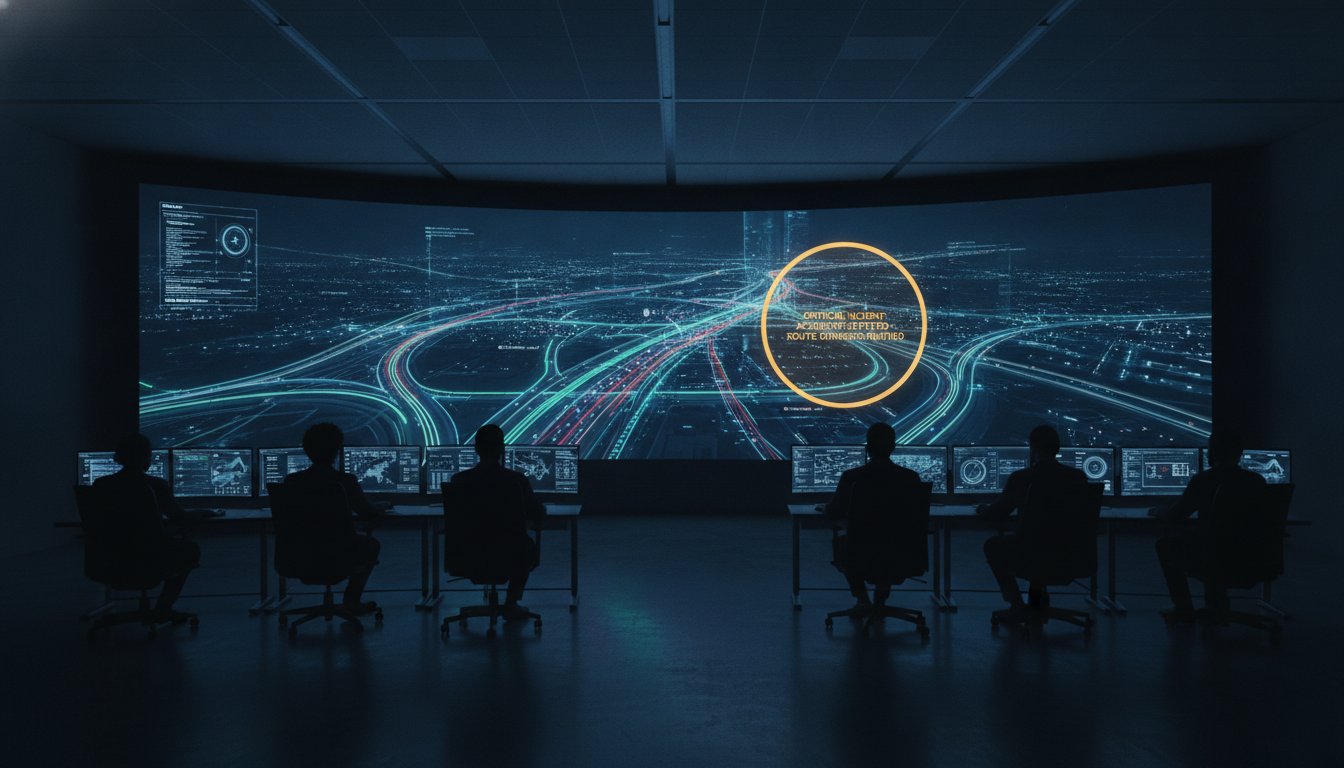
Delayed response times are rarely a failure of personnel; they are a symptom of a system that buries critical information under a mountain of noise. Managing a modern TMC means fighting a constant battle against fragmented data from siloed ITS systems. You’ve likely felt the frustration of watching operators struggle with fatigue while monitoring dozens of disparate feeds, knowing that manual escalation processes are eating away at critical response windows. When every second impacts travel time reliability and public safety, raw data without context remains an operational liability.
Most control rooms already have the screens. What they’re missing is the layer that decides what goes on them, and escalates automatically when something needs attention. You need to move beyond reactive monitoring to achieve true operational readiness. This article explores how to transform fragmented data into actionable intelligence using a dedicated operational intelligence layer. We’ll outline the path to a unified operating picture, the benefits of automated incident detection, and the strategies for seamless collaboration between your center and field units.
Key Takeaways
- Understand why the modern TMC serves as the central nervous system for regional infrastructure and how to transition from reactive monitoring to proactive incident management.
- Identify the critical limitations of hardware-centric control rooms and why high-performance screens require a sophisticated intelligence layer to be truly effective.
- Learn how an operational intelligence layer integrates disparate ITS and CAD feeds to automate incident detection and information escalation.
- Discover the strategy for establishing a unified operating picture that ensures seamless collaboration between the command center and mobile field units.
Defining the Traffic Management Center (TMC) in 2026
The modern Traffic Management Center (TMC) functions as the central nervous system of regional transportation infrastructure. It’s no longer just a facility for observing video feeds; it’s an intelligence hub where data from thousands of sensors, connected vehicles, and emergency services converge. The mission remains clear: ensure the safe, efficient movement of people and goods through proactive management. As regional networks grow in complexity, the role of these centers has shifted from passive observation to active, data-driven oversight.
Traditional operations often relied on manual observation, but the scale of modern networks makes that approach obsolete. Effective centers now utilize an Advanced Traffic Management System (ATMS) to aggregate data and provide a baseline of situational awareness. This evolution allows agencies to address incident detection, congestion management, and emergency response coordination with surgical precision. By integrating real-time analytics, operators can identify patterns before they escalate into regional gridlock.
The Core Purpose of Modern Traffic Operations
Operators must visualize real-time traffic flow and sensor data with absolute clarity to maintain network integrity. This involves more than just seeing a jam; it requires understanding the underlying cause through integrated systems. Coordination with public safety and emergency management agencies is the bedrock of rapid incident clearance. The TMC is the mission-critical hub for regional resilience, providing the foundational intelligence needed to stabilize the network during crises.
Key Stakeholders in Success
Success depends on a diverse group of professionals who rely on the center’s data for distinct objectives. Traffic engineers manage daily flow and adjust signal timing to mitigate congestion based on real-time inputs. First responders require immediate updates to navigate safely and reach incident scenes faster. Strategic planners utilize historical data to justify infrastructure improvements and long-term investments. Each stakeholder requires a specific view of the same reality to act with certainty.
Critical Components of an Effective TMC Infrastructure
Building a high-performance TMC requires a shift from consumer-grade hardware to mission-critical infrastructure. Every component must support absolute technical reliability to ensure that operators remain focused when stakes are highest. A robust network architecture serves as the backbone, providing the low-latency video streaming necessary for real-time incident management. Without this foundation, even the most skilled operators are hindered by delayed feeds and fragmented oversight.
Ergonomic control room design plays an equally vital role in operational success. It isn’t merely about comfort; it’s about reducing operator fatigue during long shifts. Strategic lighting, adjustable consoles, and intuitive spatial layouts empower personnel to maintain peak performance. When the physical environment supports the human element, decision-making becomes more precise and response times naturally improve. This structural baseline is what allows a team to manage complexity without succumbing to it.
Visualization and Video Wall Systems
High-performance video wall systems provide the shared situational awareness necessary for a unified response. Detailed surveillance requires 4K resolution and high dynamic range to identify license plates or debris in low-light conditions. Organizations must move beyond static grids that overwhelm the eye. Instead, dynamic layouts should surface relevant feeds based on real-time priorities. For agencies looking to optimize their physical environment, professional control room design services ensure that the technology and the space work in perfect harmony.
Data Integration: The ITS Backbone
True visibility comes from aggregating feeds from loop detectors, CCTV cameras, and weather sensors into a cohesive stream. Integrating Intelligent Transportation Systems (ITS) with Computer-Aided Dispatch (CAD) data allows the center to correlate sensor alerts with field reports. Adopting Commercial Off-the-Shelf (COTS) hardware allows for faster implementation and easier scalability compared to proprietary, hardware-locked systems.
Following TMC video sharing best practices ensures that these data streams remain secure and accessible across the agency. Most control rooms already have the screens. What they’re missing is the layer that decides what goes on them, and escalates automatically when something needs attention. This infrastructure is only as powerful as the intelligence driving it. To see how this works in a live environment, you can contact our experts for a technical demonstration of event-driven visualization.
The Missing Layer: Why Screens Alone Aren’t Enough
Investment in high-resolution video walls and advanced sensor arrays is a critical first step, but hardware alone cannot solve the problem of cognitive overload. In a high-pressure TMC, operators are often tasked with monitoring hundreds of camera feeds and data streams simultaneously. This creates a dangerous environment where critical details are easily overlooked. When an operator must manually scan a massive grid of screens to identify a stalled vehicle or a debris hazard, the system relies entirely on human stamina rather than technical intelligence.
Fragmented systems create operational siloes that inevitably delay incident response. Many agencies utilize powerful standalone tools like Axon for specific digital evidence or field visibility, but these platforms only provide a partial view of the total operational reality. They require a unifying layer to bridge the gap between disparate data points and a full common operating picture. Without this integration, the “swivel-chair” effect forces operators to jump between interfaces, losing precious seconds during life-safety events.
Identifying Gaps in Situational Awareness
Siloed data leads directly to missed incidents and delayed SITREPs. Traditional Video Management Systems (VMS) are excellent for recording and playback, but they lack the logic to correlate a spike in road-sensor occupancy with a specific camera feed. This technological gap means that significant events may go unnoticed until a citizen calls 911. Fragmented data acts as a persistent barrier to decisive action, forcing leadership to make high-stakes choices based on incomplete or outdated information.
The Operational Intelligence Layer
To achieve true operational readiness, organizations must implement a hub that unifies disparate data streams into a single, proactive environment. Most control rooms already have the screens. What they’re missing is the layer that decides what goes on them, and escalates automatically when something needs attention. This is the primary function of the vis/ability Platform. It acts as the central intelligence engine, filtering out the daily noise of routine traffic to highlight only the events that require immediate human intervention. By automating the delivery of essential information, the platform ensures that the right data reaches the right person at the moment of a pivotal decision.

Enhancing Situational Awareness with Event-Driven Intelligence
Transitioning a TMC from a reactive monitoring post to a proactive intelligence center requires a methodical approach to data orchestration. Agencies must move beyond the simple collection of feeds and focus on how that information is prioritized during a crisis. This transformation follows a logical progression of technical integration and operational refinement:
- Consolidate ITS, CCTV, and CAD feeds into a unified platform to eliminate the need for multiple interfaces.
- Establish specific triggers for automatic escalation, ensuring that high-priority incidents like wrong-way drivers or roadway debris are surfaced immediately.
- Develop a Common Operating Picture (COP) that provides a single, authoritative source of truth for all stakeholders.
- Extend visibility to mobile field units, allowing responders to view live video and geospatial data on-site.
- Analyze historical event data to identify bottlenecks in response protocols and refine automated workflows for future events.
Event-Driven Visualization in Action
Most control rooms already have the screens. What they’re missing is the layer that decides what goes on them, and escalates automatically when something needs attention. This event-driven approach ensures that the video wall isn’t just a static display of cameras; it becomes a dynamic tool that reacts to real-time data. When a sensor detects an anomaly, the vis/ability Platform can automatically populate the relevant camera feeds and CAD notes on the main display. This reduces the time between detection and resource dispatch, which is a critical metric for effective incident management software for mission-critical environments.
Mobile vis/ability and Field Collaboration
True situational awareness doesn’t stop at the walls of the command center. While organizations often use tools like Axon to capture field video, these systems frequently lack the integration needed to inform the entire team. They provide a partial view that remains siloed from the broader traffic management context. By utilizing Mobile vis/ability, agencies bridge the gap between the center and the field. Responders gain access to the same intelligence layer as the dispatchers, allowing for a synchronized response that improves safety for both the public and field personnel. Secure, mobile-first platforms allow regional partners to share updates directly from the scene, ensuring that the COP remains accurate as the situation evolves. This level of collaboration ensures that every unit acts with the same set of facts, regardless of their physical location.
To see how event-driven intelligence can transform your operations, explore our transportation solutions and schedule a technical briefing with our team.
Future-Proofing Your TMC with Activu vis/ability
Activu vis/ability serves as the foundational operational intelligence layer for the modern TMC. While many organizations rely on fragmented systems that require constant manual attention, vis/ability unifies these disparate tools into a single, proactive operating environment. It acts as the central hub into which all other data streams flow, from ITS sensors and weather alerts to CAD updates. This integration ensures that technical tools empower individuals to act with greater certainty when stakes are highest. By centralizing these feeds, the platform transforms a collection of isolated tools into a powerful engine for regional safety.
Operational continuity is maintained through distributed collaboration and absolute technical reliability. Whether your team is in a central command center, a remote huddle room, or using mobile devices in the field, everyone sees the same prioritized information. Most control rooms already have the screens. What they’re missing is the layer that decides what goes on them, and escalates automatically when something needs attention. Activu provides this essential bridge between raw data and human judgment, ensuring that no critical incident is lost in the noise of routine operations.
The Activu Advantage for Transportation
Metropolitan areas facing complex traffic patterns require systems that scale with their infrastructure. The vis/ability Platform is designed to grow from small regional hubs to national operations centers without sacrificing performance or speed. This scalability ensures that as your network expands, your situational awareness remains absolute. By prioritizing essential information, agencies can achieve measurable improvements in response times during critical incidents. Our transportation solutions are built on decades of experience in high-stakes environments, ensuring that your center remains a vigilant guardian of regional mobility.
Getting Started with a Unified COP
Modernizing your operations begins with a thorough assessment of your current environment to identify visibility gaps and system siloes. Transitioning to an event-driven model requires a strategic approach to data orchestration rather than simply adding more hardware. Activu offers comprehensive control room design services tailored to the unique needs of transportation authorities, ensuring that your physical space and digital tools work in tandem. The path to a more proactive TMC involves moving beyond reactive monitoring and embracing a unified common operating picture that serves the entire organization. To begin this transformation, contact Activu to modernize your TMC operations and achieve the operational clarity your mission demands.
Advancing Toward Operational Excellence
Modernizing transportation operations requires more than an investment in high-resolution hardware; it demands a fundamental shift in how information is prioritized and shared. True operational readiness is achieved when fragmented data from siloed systems is transformed into a unified operating picture. This evolution allows your team to move beyond constant monitoring and focus on decisive action. By integrating real-time ITS data and CAD feeds into a single intelligence hub, you ensure that critical incidents never go unnoticed.
Most control rooms already have the screens. What they’re missing is the layer that decides what goes on them, and escalates automatically when something needs attention. The vis/ability platform provides this essential bridge, offering seamless integration with legacy systems and event-driven automation that reduces response times. Leading transportation authorities nationwide already depend on this technology to maintain clarity when stakes are at their highest. You have the opportunity to stabilize your regional network and empower your operators with the certainty they need to act.
Request a Demo of the vis/ability Platform for Your TMC to see how event-driven intelligence can transform your operations. Your path to a safer, more efficient transportation network starts with a single, clear common operating picture.
Frequently Asked Questions
What does TMC stand for in a transportation context?
TMC stands for Traffic Management Center, which serves as the central hub for monitoring regional transportation networks and coordinating incident responses. These centers act as the nerve center for a region’s infrastructure, utilizing data from sensors and cameras to maintain flow and safety. Modern operations rely on these facilities to manage congestion and facilitate rapid communication between stakeholders and the public.
As these centers improve the traveler experience on the road, other digital platforms focus on the destination itself; you can explore Digital Travel Guides and App Monetization to learn how travel apps are shaping the modern journey.
How do I improve situational awareness in a Traffic Management Center?
Improving situational awareness requires moving beyond basic monitoring to an event-driven intelligence model. Most control rooms already have the screens. What they’re missing is the layer that decides what goes on them, and escalates automatically when something needs attention. By implementing an operational intelligence layer, you can unify siloed data and ensure that operators see only the information relevant to the current mission.
What are the common problems faced by TMC operators?
Operators frequently struggle with cognitive overload caused by the requirement to monitor hundreds of static video feeds simultaneously. Fragmented data from siloed systems often leads to delayed response times and manual escalation errors during high-pressure events. These challenges are exacerbated by “swivel-chair” operations, where personnel must jump between disparate software interfaces to gain a complete view of a single incident.
Can vis/ability integrate with my existing ITS and VMS systems?
Yes, the vis/ability platform is designed to integrate seamlessly with your existing Intelligent Transportation Systems (ITS) and Video Management Systems (VMS). It acts as a unifying hub that aggregates data from disparate sources into a single common operating picture. This allows your agency to leverage previous hardware investments while adding the intelligence necessary for automated incident detection and escalation.
What is the difference between a TMC and a NOC?
A TMC focuses on the management of physical roadway infrastructure and regional traffic flow, while a Network Operations Center (NOC) manages telecommunications and IT infrastructure. While both environments require high-performance visualization, the Traffic Management Center requires specialized integration with geospatial data and emergency dispatch systems. The primary mission of a traffic center is public safety and travel time reliability across a physical network.
How does event-driven visualization reduce operator fatigue?
Event-driven visualization reduces fatigue by filtering out non-essential “noise” and surfacing only relevant data during a confirmed incident. Operators no longer need to scan dozens of screens manually to identify a stalled vehicle or roadway debris. By automating the delivery of critical feeds to the video wall, the system allows personnel to remain focused and analytical when their judgment is needed most.
Is mobile access secure for TMC operations?
Mobile access is secure when implemented through dedicated platforms that prioritize encrypted, mission-critical data sharing over consumer-grade connections. Secure mobile tools allow field units to access the same real-time intelligence as the command center without compromising network integrity. This ensures that responders have the situational awareness they need while maintaining the high cybersecurity standards required for government infrastructure.
What is a Common Operating Picture (COP) in traffic management?
A Common Operating Picture is a single, authoritative view of real-time data that is shared across all responding agencies and units. It ensures that everyone, from the dispatchers in the center to the responders on the shoulder, acts based on the same tactical reality. A true COP eliminates the gaps created by siloed tools, providing a bedrock of reliable information for pivotal decision-making.