
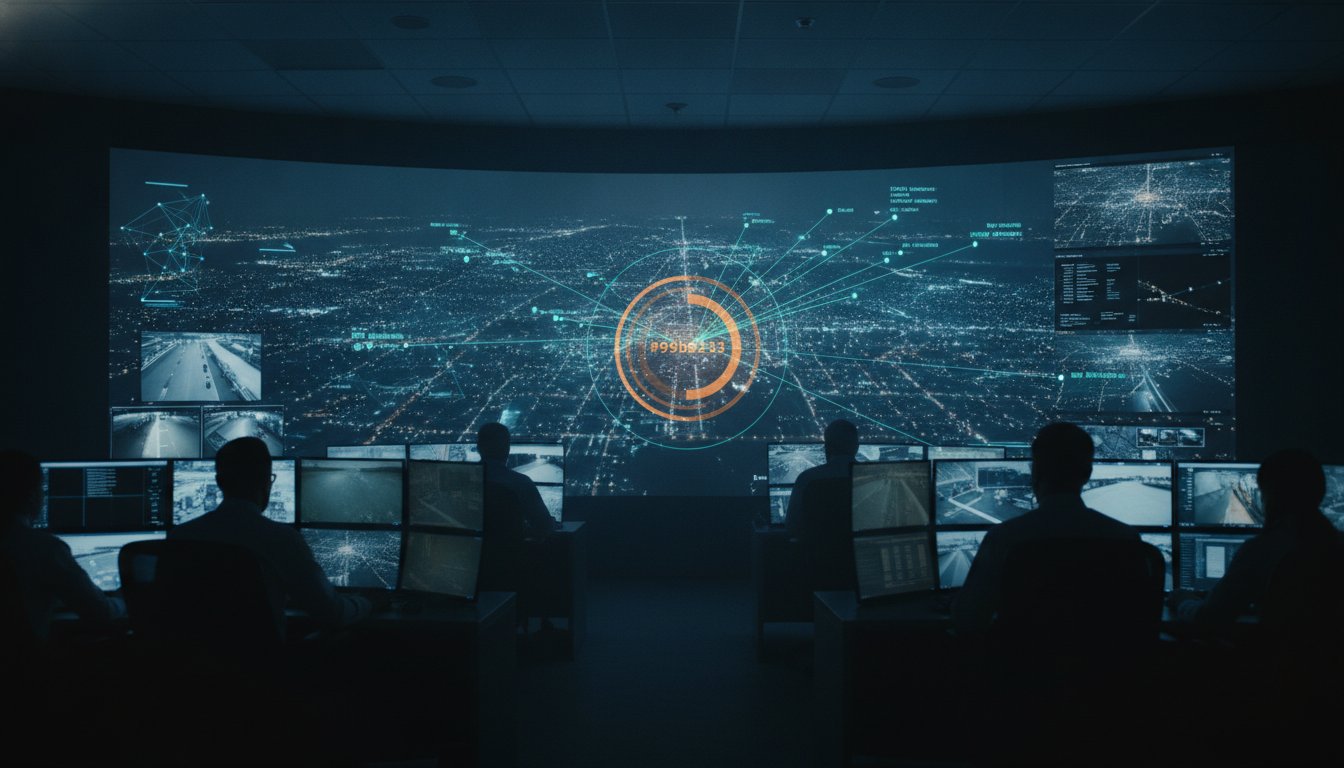
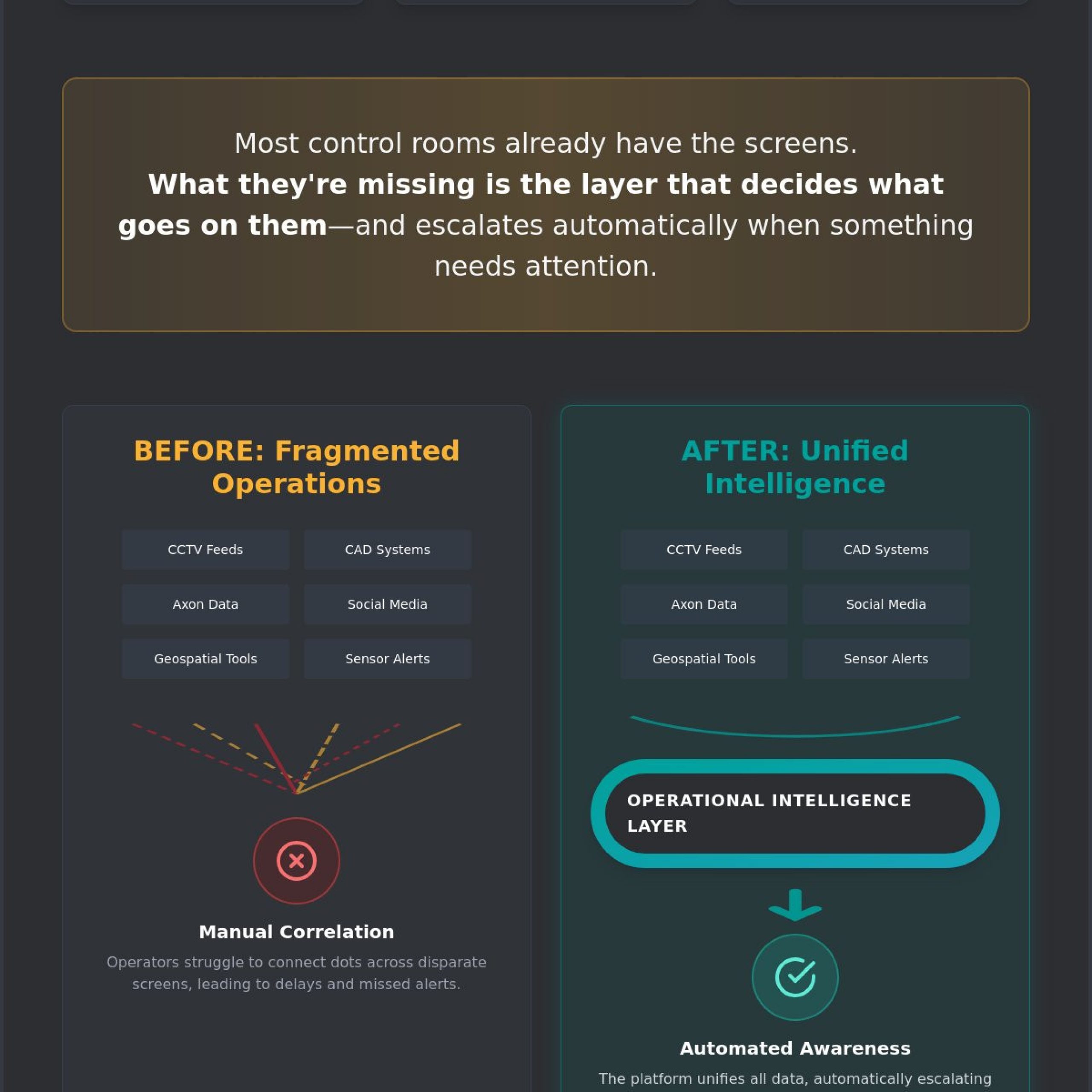
A Fusion Center succeeds or fails based on the intelligence layer that unifies its data, regardless of how many physical screens are in the room. You’ve likely felt the strain of managing eighty different data feeds while critical alerts get buried under routine noise. Most control rooms already have the screens. What they’re missing is the layer that decides what goes on them, and escalates automatically when something needs attention.
When data remains siloed between agencies, response times suffer and situational awareness becomes a fragmented puzzle. This article explains how to leverage vis/ability as an operational intelligence layer to transform that chaos into a seamless common operating picture. We’ll explore how integrating tools like Axon into a central hub allows your team to move past the limitations of partial solutions. You’ll discover how to automate the detection of critical threats, ensuring your operators focus on making decisions rather than manual data correlation.
Key Takeaways
- Understand why a modern Fusion Center must evolve into a multi-disciplinary hub for all-hazards response and intelligence sharing.
- Learn to resolve the data deluge by unifying siloed feeds that lead to operator fatigue and missed incidents.
- Discover how the vis/ability platform serves as a central operational intelligence layer to integrate disparate tools into a unified command hub.
- Leverage event-driven situational awareness to automate critical threat escalation; ensuring your team acts on what matters most.
- Explore the intersection of ergonomic design and technical reliability to build a more resilient and responsive operations environment.
Understanding the Role of the Modern Fusion Center
A Fusion center serves as the primary focal point for the receipt, analysis, and dissemination of threat-related information between federal, state, local, tribal, and territorial (SLTT) partners. While these centers originated as counter-terrorism hubs following the events of 9/11, their scope has expanded significantly. By 2026, the National Network of Fusion Centers, which includes 80 designated sites across the United States, has evolved into a multi-disciplinary infrastructure. These centers now address a broad spectrum of “all-hazards” threats, including criminal activity, cybersecurity breaches, and public health emergencies.
True fusion is not achieved simply by placing analysts from different agencies in the same physical space. It requires a deep technical integration where data from disparate sources is processed into a single, cohesive stream. Most control rooms already have the screens. What they’re missing is the layer that decides what goes on them, and escalates automatically when something needs attention. Without this intelligence layer, the “fusion” remains purely organizational rather than operational. It’s the difference between seeing data and understanding it in real time.
The Evolution of Situational Awareness
Situational awareness has moved far beyond static map-based tracking. Modern operations demand dynamic, real-time data feeds that update as incidents unfold. This evolution is driven by the necessity of SLTT partnerships, where a state-level center must ingest local dispatch data and federal threat streams simultaneously. A fusion center is a technology-enabled intelligence hub that synthesizes these diverse inputs to empower decisive human action during a crisis. This shift ensures that frontline personnel and leadership share the same operational reality at all times.
Primary vs. Recognized Fusion Centers
The Department of Homeland Security differentiates between primary and recognized centers. Primary centers typically serve an entire state and receive the highest priority for federal resources under the Federal Resource Allocation Criteria (RAC) policy. Recognized centers serve major urban areas or specific jurisdictions. Regardless of their designation, both types must maintain a high-performance Common Operating Picture (COP) to remain effective. The technology stack available often depends on federal grant funding, but the requirement for technical reliability remains constant. Achieving this level of operational efficiency often begins with specialized Control Room Design Services to ensure the physical environment supports the rapid analysis of complex data sets.
The Data Deluge: Overcoming Fragmented Systems
High-stakes environments don’t suffer from a lack of data. They suffer from a lack of clarity. In a typical Fusion Center, analysts face a relentless stream of inputs from license plate readers, CAD systems, social media monitors, and geospatial tools. When these feeds remain siloed, the responsibility of correlating that data falls entirely on the human operator. This manual process is slow and prone to error. It creates a dangerous gap where a critical threat might be visible on one of fifty screens but remains unaddressed because it hasn’t been unified with other intelligence.
The National Network of Fusion Centers relies on the rapid exchange of information to protect communities. However, having access to information isn’t the same as having situational awareness. Most control rooms already have the screens. What they’re missing is the layer that decides what goes on them, and escalates automatically when something needs attention. Without this automated prioritization, the very tools meant to assist the mission become obstacles.
Why Operators Miss Critical Incidents
Cognitive load is the primary enemy of operational readiness. Research into human factors shows that an operator’s ability to detect incidents drops significantly as the number of monitored feeds increases. When analysts must perform “swivel-chair” integration, physically moving between different workstations or software tabs to piece together a story, response times lag. This delay isn’t just a technical inconvenience. During an active threat, those lost seconds represent a failure in the mission-critical response. The gap between raw data and actionable intelligence is where incidents are missed.
The Shortcomings of Partial Solutions
Many organizations attempt to solve these problems by layering specialized tools like Axon or various dispatch platforms. While these are powerful for their specific functions, they often operate as standalone silos. They provide only a partial view of the total operating environment and require a unifying layer to create a full common operating picture. Relying on Commercial Off-the-Shelf (COTS) solutions without a central hub forces your team to act as the integration layer. A video wall might display every feed at once, but visibility alone doesn’t equal intelligence. To move from a reactive posture to a proactive one, centers need an operational intelligence layer that aggregates these streams into a single source of truth. You can learn more about building this foundation by exploring the vis/ability platform.
Building the Operational Intelligence Layer
The operational intelligence layer acts as the central nervous system for a modern Fusion Center. It’s the unifying hub where raw data from SIEM, SOAR, and complex geospatial platforms converges into a single, intelligible stream. Without this layer, analysts are forced to toggle between windows, losing precious time while trying to piece together a coherent story from fragmented alerts. This technical foundation ensures that intelligence isn’t just collected, but is actively used to drive response strategies.
Most control rooms already have the screens. What they’re missing is the layer that decides what goes on them, and escalates automatically when something needs attention. Integrating these systems within the National Network of Fusion Centers creates a force-multiplier effect. When a cybersecurity threat detected by a SIEM platform is instantly correlated with physical security footage and geospatial maps, the resulting clarity allows for a much faster, more coordinated response. This level of integration transforms a reactive monitoring station into a proactive intelligence hub.
vis/ability as the Central Hub
The vis/ability platform serves as the bedrock for this integration. It pulls video streams and real-time data from disparate applications, making specialized information accessible to everyone in the room, not just the operator at a specific desk. By centralizing these feeds, the platform transforms individual tools into a collective asset. This is critical because specialized tools like Axon only provide a partial view of the environment; they require a unifying layer to bridge the gaps between different data types. This eliminates the bottleneck of manual data entry and ensures that when an automated trigger occurs, the relevant visual data is immediately pushed to the video wall or specific workstations.
Extending Visibility to the Field
Mission-critical response doesn’t stop at the walls of the command center. To maintain a consistent Common Operating Picture, visibility must extend to huddle rooms, remote leadership, and personnel in the field. Mobile vis/ability ensures that decision-makers have access to the same intelligence layer whether they’re on a smartphone, tablet, or laptop. This continuity is vital during evolving incidents where stakeholders are geographically dispersed. It bridges the gap between the analysts at the center and the responders on the ground, ensuring every action is based on the most current, unified intelligence available regardless of the user’s physical location.
Event-Driven Situational Awareness in Action
Event-driven visualization shifts the focus from constant, manual monitoring to exception-based response. In a high-pressure Fusion Center, analysts shouldn’t spend their shifts staring at static feeds hoping to catch a deviation from the norm. Instead, the operational intelligence layer identifies the deviation and presents it immediately. This approach ensures that the team’s cognitive resources are reserved for decision-making rather than data hunting. By showing only what matters when it matters, the system provides a level of clarity that is impossible to achieve through manual oversight alone.
Most control rooms already have the screens. What they’re missing is the layer that decides what goes on them, and escalates automatically when something needs attention. In Public Safety, this might look like a gunshot detection sensor triggering the nearest PTZ cameras to orient toward the sound and display the live stream on the main video wall. For Utilities, an unexpected drop in voltage at a substation can automatically trigger a layout change that shows the geospatial map of the affected grid alongside live security feeds from that site. These automated triggers ensure that the first few seconds of an incident are spent on response rather than orientation.
Automating the Common Operating Picture
By setting specific parameters, the operational intelligence layer removes the need for manual data display. When a sensor or data threshold is met, the system executes a pre-defined script to adjust the visualization across all connected devices. This process eliminates the “human-in-the-loop” for the initial display of data, ensuring that critical information is never missed due to operator distraction or fatigue. Event-driven logic transforms a reactive NOC into a proactive hub by ensuring that the right information finds the right person at the right time. This automation allows the Fusion Center to scale its operations without necessarily increasing its headcount, as the platform handles the heavy lifting of data correlation and presentation.
Real-Time Threat Visualization
Modern threats are often hybrid, involving both digital and physical components. A Cybersecurity Common Operating Picture integrates threat intelligence from network sensors with physical security inputs to provide a total view of the risk landscape. If a server room door is forced open while a brute-force attack is detected on that same local network, vis/ability escalates these combined alerts to the center of the display automatically. This immediate visualization allows the team to coordinate a unified response across IT and physical security departments. Visualizing these complex relationships in real time is essential for rapid incident coordination in environments where every second counts. To see how these automated triggers can enhance your operational readiness, contact our team for a demonstration.
Designing a Resilient Fusion Center for 2026
Resilience in a high-stakes environment is the product of a deliberate synergy between physical ergonomics and technical reliability. A Fusion Center cannot function at peak efficiency if the physical layout hinders the flow of information or if the technology stack fails during a crisis. True operational continuity requires a facility that supports analysts through every phase of the intelligence cycle, from initial data ingestion to final dissemination. Most control rooms already have the screens. What they’re missing is the layer that decides what goes on them, and escalates automatically when something needs attention.
Planning for long-term success means designing for scalability. Whether your organization is building a small urban intelligence hub or a statewide primary center within the National Network, the infrastructure must accommodate evolving data streams. As threat landscapes shift toward hybrid digital and physical attacks, the ability to integrate new sensors and software without a total overhaul is a core requirement for resilience. Utilizing specialized Control Room Design Services ensures that your facility is built on a foundation of technical excellence and operational readiness.
Optimizing the Operator Environment
Operator fatigue is a significant risk factor that often goes unaddressed in technical specifications. Intelligent video wall placement and ergonomic console design are essential to maintain focus during long shifts. Proper management of ambient light and acoustics reduces the cognitive load on analysts, allowing them to process complex information with greater accuracy. The physical workspace must be designed to complement your Incident Management Software, ensuring that the visual interface is accessible and intuitive. When the environment supports the human element, the speed and accuracy of the entire team improve.
Next Steps: From Strategy to Implementation
Moving from a fragmented operating model to a unified one begins with a comprehensive operational gap analysis. This process identifies where siloed data feeds and manual workflows are slowing down your response times. Integrating the vis/ability platform into your existing infrastructure provides the operational intelligence layer needed to unify your tools without requiring a “rip and replace” of current systems. This transition can be achieved without operational downtime, ensuring that your mission remains active throughout the upgrade. We invite you to contact Activu for a custom assessment of your center, where we can help you bridge the gap between raw data and actionable intelligence.
Elevating Operational Readiness through Unified Intelligence
Building a resilient operations environment requires a shift from passive monitoring to active, event-driven intelligence. You’ve seen how fragmented data and siloed systems create a cognitive burden that slows response times and risks missed incidents. By implementing vis/ability as your operational intelligence layer, you unify disparate feeds into a single source of truth. This integration ensures that your team isn’t just watching screens; they’re acting on prioritized, actionable information. Trusted by Federal and Defense agencies, our platform provides seamless integration with existing SIEM and SOAR tools to create a truly common operating picture.
The transition from a reactive posture to a proactive hub is essential; it’s the only way to maintain control in high-stakes environments. Don’t let your mission be limited by manual data correlation or fragmented visibility. Request a Demo of the vis/ability Platform for Your Fusion Center to see how we can help you reduce response times and empower your operators to act with absolute certainty. Your team deserves a foundation built on technical reliability and mission-focused clarity.
Frequently Asked Questions
What is the primary purpose of a fusion center?
A fusion center serves as a focal point for the receipt, analysis, and sharing of threat intelligence between federal, state, and local partners. Its primary goal is to prevent criminal activity and enhance public safety through an all-hazards approach. By synthesizing diverse data streams, these centers empower decision-makers with a comprehensive view of the threat landscape. This structure ensures that frontline personnel receive timely, actionable intelligence to mitigate risks effectively.
How does a fusion center differ from a standard SOC or NOC?
While a SOC or NOC typically focuses on specific network health or organizational security, a fusion center is inherently multi-disciplinary. It integrates data from law enforcement, emergency management, and private sector partners to address broad public safety concerns. This collaborative model allows for the correlation of criminal intelligence with physical and cyber threats. The scope is wider, moving beyond internal monitoring to regional or statewide situational awareness.
What technologies are essential for a modern fusion center?
Essential technologies include high-performance video wall systems, geospatial mapping platforms, and a robust operational intelligence layer. A modern Fusion Center also requires seamless integration with SIEM and SOAR tools to manage the influx of digital threat data. These tools must work together to provide a unified view, as fragmented hardware often leads to operator fatigue. Technical reliability is the bedrock upon which critical, life-saving decisions are made during active incidents.
How do fusion centers handle data privacy and civil liberties?
Fusion centers operate under strict federal and state guidelines to protect civil liberties and individual privacy. In early 2026, centers in California underwent audits to ensure compliance with privacy laws and data sharing regulations. These facilities use rigorous vetting processes and secure information-sharing protocols to manage sensitive intelligence. Maintaining public trust is as vital to the mission as the technical capability to detect and mitigate evolving threats.
Can a fusion center be managed remotely or via mobile?
Yes, advanced platforms like vis/ability extend the command environment to mobile devices and remote huddle rooms. This capability ensures that field responders and off-site leaders see the same real-time data as the analysts in the main center. Mobile access maintains a consistent common operating picture during evolving crises where geographic displacement is common. It bridges the gap between the physical command center and the point of incident response to ensure continuity.
What is an event-driven common operating picture?
An event-driven common operating picture is a dynamic visualization that automatically updates based on specific data triggers or sensor events. Instead of showing every feed at once, it prioritizes the most critical information on the video wall. For example, a network breach or gunshot detection can instantly trigger a relevant layout change. This automation reduces cognitive load by ensuring operators only see what requires immediate human judgment when stakes are at their highest.
How do fusion centers integrate data from different agencies?
Integration is achieved by aggregating siloed data feeds from CAD, records management systems, and real-time sensors into a central hub. Most control rooms already have the screens. What they’re missing is the layer that decides what goes on them, and escalates automatically when something needs attention. This unifying layer makes specialized tools from different agencies useful for the entire command team. It eliminates the need for manual data correlation during high-pressure operations.
Why is vis/ability considered an operational intelligence layer?
vis/ability is considered an operational intelligence layer because it serves as the unifying platform into which all other mission-critical tools flow. It doesn’t replace existing software like Axon; instead, it aggregates their outputs to create a full common operating picture. By centralizing these feeds, it empowers the human element within a digital context. It acts as the intelligent engine that turns raw data into clear, actionable situational awareness for the entire team.