
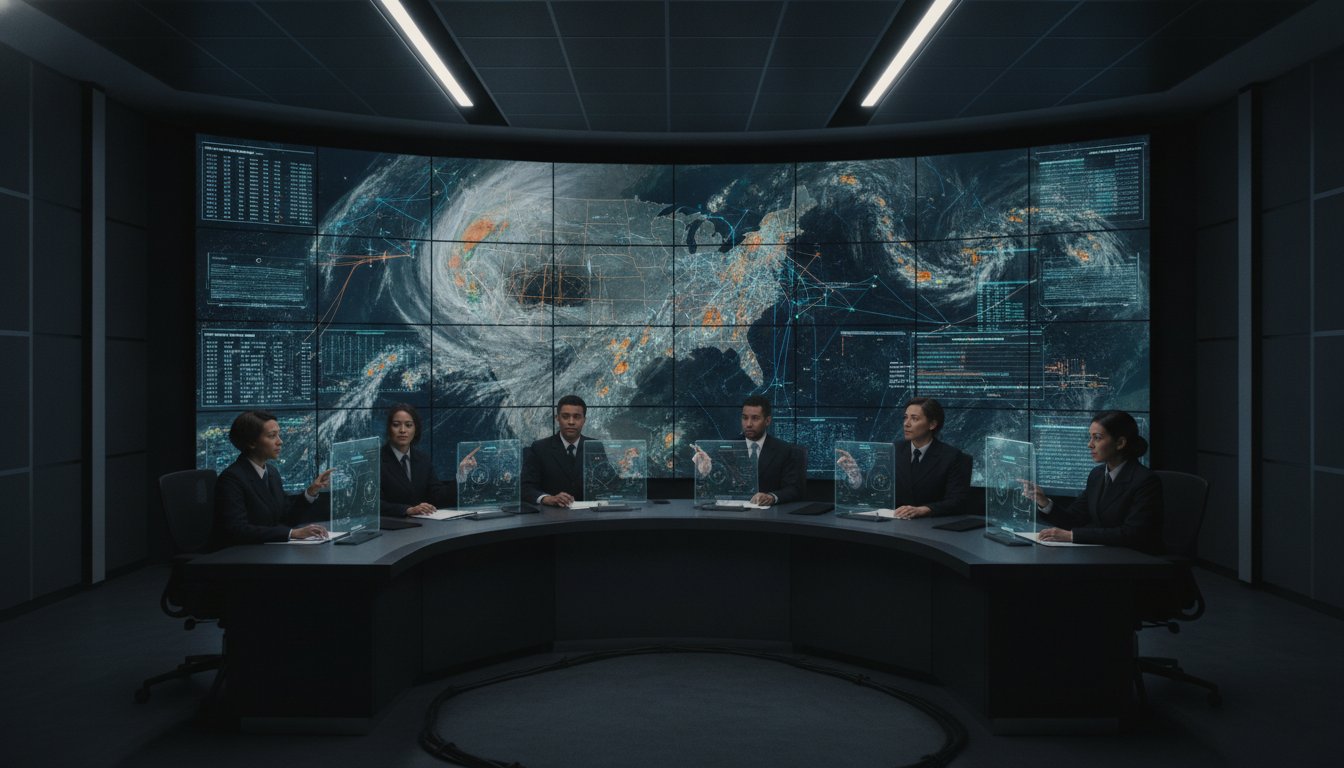
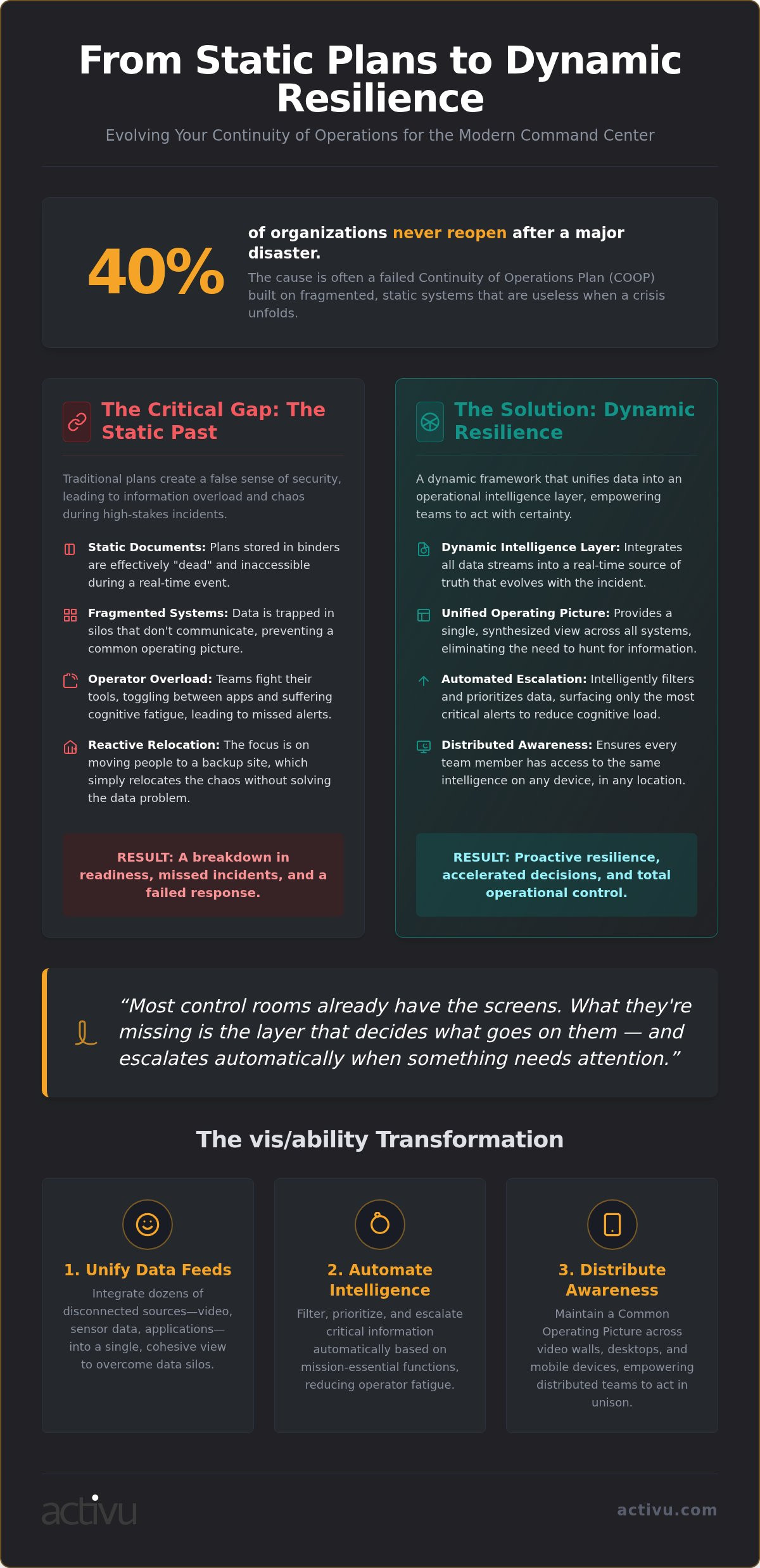
FEMA reports that 40% of organizations never reopen after a major disaster. In high-stakes command environments, a failed Continuity of Operations Plan represents more than a financial loss; it’s a fundamental breakdown in readiness. Operators often struggle with fragmented systems that refuse to communicate, leading to information overload during the exact moments when clarity is required. Maintaining situational awareness across distributed teams becomes nearly impossible when data remains trapped in silos. Most control rooms already have the screens. What they’re missing is the layer that decides what goes on them, and escalates automatically when something needs attention.
We understand that true resilience requires more than a static document stored on a shelf. This article explains how to evolve your COOP into a dynamic, event-driven operational intelligence framework. You’ll learn how to achieve unified visibility and accelerate decision-making through the vis/ability platform, which serves as the unifying operational intelligence layer for your team. We’ll explore the transition from reactive recovery to proactive resilience, ensuring your organization remains functional regardless of the disruption by empowering individuals to act with greater certainty.
Key Takeaways
- Static documents often fail during high-stakes incidents because they lack the flexibility to address real-time data silos and fragmented systems.
- Evolve your Continuity of Operations Plan from a manual record into a dynamic framework that prioritizes mission-essential functions through real-time data integration.
- Transitioning to event-driven situational awareness reduces operator cognitive load by automating the escalation of critical intelligence when it matters most.
- Implementing vis/ability as an operational intelligence layer creates a unified common operating picture that remains resilient during physical site disruptions.
- Empower distributed teams with mobile access to the same intelligence used in the command center to maintain total operational control across any location.
The Critical Gap in Traditional Continuity of Operations Planning
A Continuity of Operations (COOP) is often viewed as a regulatory hurdle or a static document stored in a heavy binder. In reality, it represents the strategic architecture required to sustain mission-essential functions during an emergency. Federal guidance provides the basic framework, but the operational reality in modern command centers is far more complex. Traditional plans focus heavily on physical checklists and personnel rosters. They often ignore the digital infrastructure required to maintain control when primary sites fail or systems become overwhelmed. A plan that only exists on paper is effectively useless when a crisis unfolds in real-time.
The primary reason a Continuity of Operations Plan fails isn’t a lack of intent. It’s the presence of fragmented systems. When a high-stress event occurs, data flows from dozens of disconnected sources. If these systems don’t talk to each other, the plan remains a “dead” document. Static binders create a false sense of security. They assume that having a backup location is enough. However, if you move to a new room but can’t see your data, you’ve simply relocated the chaos. We must move toward a dynamic, event-driven approach where intelligence is prioritized over simple relocation.
Why Siloed Data is the Enemy of Resilience
In a crisis, information overload is as dangerous as a total blackout. Operators face intense fatigue when they must toggle between multiple applications to find a single truth. This fragmentation is exactly why operators miss incidents video wall displays were meant to catch. When critical alerts are buried under layers of irrelevant data, response times slow down. True resilience requires a framework where data is filtered and prioritized automatically. Building this level of operational discipline often mirrors the standards required for international quality certifications, where experts like Align Quality provide the necessary consulting and process guidance. Without a unifying layer, your team is left fighting the tools rather than the incident.
From Relocation to Distributed Situational Awareness
Historically, continuity meant moving a team to a “hot site.” Modern operations require a shift toward distributed situational awareness. It’s about maintaining a Common Operating Picture (COP) across any device, whether in a SOC, NOC, or fusion center. Most control rooms already have the screens. What they’re missing is the layer that decides what goes on them, and escalates automatically when something needs attention. Operational readiness isn’t about where you sit. It’s about what you can see and how quickly you can act on it. By focusing on visibility rather than just physical space, organizations ensure that mission-critical decisions are based on real-time intelligence, not outdated records.
Defining Mission-Essential Functions for Real-Time Resilience
A robust Continuity of Operations Plan identifies Mission-Essential Functions (MEFs) as the non-negotiable activities that must persist during any disruption. Identifying these functions requires an operational lens that looks beyond organizational charts to the actual data streams that keep a mission alive. Protecting critical infrastructure relies on the ability to maintain situational awareness when primary systems are compromised. If you can’t see the status of your power grid or your transport network, you can’t manage the response. Every decision made during a crisis depends on the integrity and visibility of these core functions.
The complexity of modern infrastructure means that MEFs are often supported by a web of interconnected digital assets. Analyzing these dependencies is vital for operational readiness. When a high-stakes event occurs, the ability to prioritize information becomes the difference between a controlled response and a catastrophic failure. This prioritization ensures that the most critical data is always front and center, allowing leadership to maintain control even when resources are distributed or remote.
Mapping Data to Mission Goals
Every mission goal depends on a specific set of data feeds. Effective MEF support requires integrating these feeds into a unified view. While some organizations utilize tools like Axon for specific video or evidence needs, these provide only a partial solution. They lack the context of the broader operational environment and require a unifying layer to create a full common operating picture. High-stakes decision-making requires incident management software that acts as a central hub. Most control rooms already have the screens. What they’re missing is the layer that decides what goes on them, and escalates automatically when something needs attention. By bridging these gaps, vis/ability ensures that the right data reaches the right person at the right time.
The Cybersecurity Requirement in Modern COOP
Cybersecurity is no longer a separate IT concern; it’s a fundamental COOP requirement. With the average cost of an IT outage reaching $33,333 per minute according to 2026 industry data, visualizing network health is a prerequisite for operational continuity. Modern threats require a Cybersecurity Common Operating Picture that integrates threat intelligence directly into the primary operational view. This is especially critical in SOC, NOC, GSOC, and fusion center control rooms where cyber and physical threats often overlap. Operators must be able to see network anomalies alongside physical security feeds to maintain a complete picture of readiness.
Integrating these disparate feeds into a single platform allows teams to act with absolute certainty. You can explore how this operational intelligence layer secures your environment against modern disruptions and ensures your mission-essential functions never falter.
The Evolution of COOP: Static Records vs. Event-Driven Intelligence
Traditional continuity strategies often rely on reactive incident response. This model assumes that an organization can wait for an alarm to trigger a move to a secondary site or the activation of a backup protocol. In a mission-critical environment, this delay is unacceptable. A modern Continuity of Operations Plan requires a shift toward proactive, event-driven visualization. For institutions in highly regulated sectors, such as consumer financial services, this evolution is often guided by digital transformation and risk management experts like Versapien, who help ensure that regulatory compliance is maintained throughout the modernization process. Standard Commercial Off-The-Shelf (COTS) solutions frequently lack a unifying hub. They provide raw data but fail to provide actionable context. This leaves the burden of synthesis on human operators who are already under extreme pressure. The operational intelligence layer serves as the essential bridge between raw data and human judgment, ensuring that critical decisions are made with absolute clarity. By integrating these systems, organizations move away from manual recovery checklists toward a state of constant readiness.
Waiting for an alarm to sound is often too late for effective continuity. In a busy dispatch center, the cognitive load of managing dozens of data feeds leads to fatigue and oversight. Fragmented visibility across disconnected screens makes it difficult to generate accurate SITREPs quickly. When an incident occurs, operators shouldn’t have to hunt for information across multiple platforms. This friction causes delays that can escalate a manageable disruption into a full-scale crisis. Relying on manual notifications means that by the time a supervisor is aware of the problem, the window for a proactive response has already closed. True resilience depends on eliminating these gaps in visibility before they impact the mission.
Leveraging Event-Driven Situational Awareness
Event-driven intelligence represents the ability to see exactly what matters at the moment it matters. Instead of staring at static feeds, teams receive dynamic updates based on predefined triggers. Most control rooms already have the screens. What they’re missing is the layer that decides what goes on them, and escalates automatically when something needs attention. The vis/ability platform provides this automation, pushing critical intelligence to the forefront without human intervention. This ensures that the most relevant data is always visible to the entire team, whether they are in the primary command center or a remote huddle room. This approach transforms the COOP from a manual record into a powerful engine for operational survival. For a deeper look at building these resilient systems, consult our mission critical guide for blueprinting success. By automating the flow of information, you empower your team to act with certainty during the most demanding phases of an operation.
Implementing a Distributed Common Operating Picture
A resilient Continuity of Operations Plan must move past the concept of physical relocation as the primary strategy for survival. If an emergency forces the abandonment of a primary command center, the mission shouldn’t pause while teams synchronize at a secondary site. Building a distributed Common Operating Picture (COP) ensures that the intelligence required to run the operation is available everywhere simultaneously. This requires moving from a hardware-centric model to a software-defined intelligence layer. Most control rooms already have the screens. What they’re missing is the layer that decides what goes on them, and escalates automatically when something needs attention. By implementing this layer, organizations maintain control even if a physical location is compromised.
Building the Operational Intelligence Layer
The first step in creating a site-resilient COP involves aggregating real-time data from every disparate application your team relies on. This includes SCADA systems for infrastructure monitoring, Video Management Systems (VMS) for physical security, and SIEM platforms for network health. The vis/ability platform acts as the central unifying hub for these feeds, processing multiple data streams into a single, actionable view. Relying on standalone hardware or proprietary video wall processors creates a significant liability in a modern COOP strategy. If that specific hardware fails or becomes inaccessible, the entire plan collapses. A true operational intelligence layer scales seamlessly from the main video wall to individual desktops and mobile devices, ensuring that the platform, not the room, holds the mission logic.
Ensuring Continuity for Distributed Teams
Maintaining a single version of the truth (SVT) is the most difficult challenge during a site failure. When teams are forced into remote huddle rooms or mobile environments, information often becomes fragmented and unreliable. In high-stakes sectors like utilities-energy or transportation, a split-second delay in data synchronization can lead to catastrophic results. Extending situational awareness to mobile users ensures that field technicians and remote supervisors see the exact same data as the command center, regardless of their physical location. This level of integration eliminates the data silos that often plague emergency operations during the transition to a backup facility. You can contact our team today to learn how to unify your distributed operations under a single, resilient platform that survives any site failure.
Ensuring Operational Continuity with vis/ability
A Continuity of Operations Plan is only as effective as the technology used to execute it. In high-stakes environments, the transition from a standard operating state to a contingency state must be instantaneous and seamless. vis/ability provides the bedrock for this resilience, acting as the operational intelligence layer that bridges the gap between raw data and human judgment. It solves the core situational awareness problems that plague modern command centers by prioritizing essential information during a crisis. While many organizations struggle with fragmented systems, vis/ability creates a unified environment where every tool contributes to a single, clear objective.
Operational success in the federal government and defense sectors requires the ability to share critical content across disparate networks and locations. vis/ability enables this level of collaboration, ensuring that decision-makers at every level have access to the same real-time intelligence. Most control rooms already have the screens. What they’re missing is the layer that decides what goes on them, and escalates automatically when something needs attention. By implementing this event-driven framework, you move from the complexity of data overload to the clarity of actionable intelligence.
Unifying Your Mission-Critical Ecosystem
Building a resilient ecosystem requires more than just adding new tools; it requires a platform that makes existing tools more effective. For example, some agencies use Axon to manage video and evidence data. While some organizations utilize these tools, they only provide a partial solution. They lack the necessary unifying layer to create a full common operating picture. vis/ability integrates these feeds into a broader context, providing the EOC common operating picture solutions required to manage a modern crisis. In an Emergency Operations Center, a Cybersecurity Common Operating Picture is equally vital. Visualizing network health alongside physical security feeds ensures that mission success is never compromised by an unseen digital threat. This level of technical reliability provides the calm and clarity needed to lead through potential complexity.
Next Steps: From Planning to Execution
Transitioning from a static plan to a dynamic operational framework begins with a thorough audit of your current visualization gaps. You must identify where data silos exist and where information overload threatens situational awareness. Our control room design services play a critical role in this preparation, helping you architect a space and a system optimized for continuity. We encourage you to move beyond manual record-keeping and embrace a platform designed for the highest stakes. You can contact Activu today for a comprehensive visibility assessment to ensure your organization remains resilient in the face of any disruption.
Advancing Toward Total Operational Resilience
A modern Continuity of Operations Plan requires a departure from manual checklists in favor of automated, real-time intelligence. Organizations must prioritize the integration of fragmented data feeds to eliminate the silos that cause information overload during a crisis. By implementing an operational intelligence layer, teams achieve a unified visibility that persists even if primary sites fail. Most control rooms already have the screens. What they’re missing is the layer that decides what goes on them, and escalates automatically when something needs attention.
Activu provides the bedrock for these mission-critical environments. Our vis/ability platform is trusted by federal, utility, and public safety organizations to maintain 24/7 readiness through event-driven situational awareness. It integrates all your essential data feeds into a single version of the truth, allowing you to act with absolute certainty when stakes are highest. You can Request a Demo of the vis/ability Platform to see how we unify your command center operations. We look forward to helping you build a more resilient future.
Frequently Asked Questions
What is the difference between a COOP and a Disaster Recovery (DR) plan?
COOP focuses on the continuation of mission-essential functions, while DR focuses on the restoration of IT infrastructure and data systems. A Continuity of Operations Plan ensures the organization remains functional during a disruption. DR is a subset of the broader continuity strategy. While DR gets the servers running, COOP ensures operators have the visibility needed to make decisions. It’s about maintaining the mission’s lifeblood, not just the hardware components.
How do mission-critical environments maintain situational awareness during a site failure?
Mission-critical environments maintain awareness by using a software-defined operational intelligence layer rather than relying on site-specific hardware. This allows the common operating picture to transition seamlessly to backup locations or remote huddle rooms. Most control rooms already have the screens. What they’re missing is the layer that decides what goes on them, and escalates automatically when something needs attention. This ensures that data remains accessible and synchronized regardless of the physical status.
What are the core elements of a modern Continuity of Operations Plan?
A modern Continuity of Operations Plan must include mission-essential functions, orders of succession, and delegations of authority. Beyond these administrative basics, it requires event-driven situational awareness and a distributed common operating picture. These technical elements ensure the plan is actionable in real-time. It must also account for interoperable communications and the ability to aggregate data feeds from disparate sources, providing a single version of the truth across the entire organization.
Why do traditional video walls fail to support COOP requirements?
Traditional video walls often fail because they are built as standalone hardware silos. They lack the intelligence to prioritize information or scale content to remote users. When an incident occurs, these systems often suffer from fragmented visibility, making it difficult for operators to see what matters most. Without a unifying platform like vis/ability, the video wall becomes a passive display rather than an active tool for incident management and operational continuity during high-stakes disruptions.
Can a Common Operating Picture be extended to mobile or remote teams?
Yes, a common operating picture can be extended to mobile and remote teams through a platform-independent intelligence layer. This ensures that field technicians and remote supervisors see the exact same data as the command center. By leveraging mobile vis/ability, organizations eliminate the information gaps that typically occur when personnel are away from the primary video wall. This level of integration is essential for maintaining total operational control during distributed or remote emergency operations.
How does automated escalation improve response times in an EOC?
Automated escalation improves response times by removing the manual burden of identifying and reporting incidents. Instead of operators hunting through dozens of feeds, the system pushes critical data to the forefront based on predefined triggers. This reduces the cognitive load in the EOC and ensures that supervisors are notified immediately when a threshold is met. By automating these workflows, organizations can transition from reactive monitoring to proactive, event-driven response and faster decision-making.
What is the role of cybersecurity in a Continuity of Operations Plan?
Cybersecurity is a foundational element of modern continuity because mission-essential functions rely heavily on digital infrastructure. A Continuity of Operations Plan must include a Cybersecurity Common Operating Picture to monitor network health in real-time. This allows operators to identify and mitigate digital threats that could compromise physical operations. Integrating cyber threat intelligence into the primary operational view ensures the organization remains resilient against both physical and digital disruptions at all times.
How often should a Continuity of Operations Plan be tested and updated?
FEMA guidance suggests that organizations should review and update their continuity plans at least annually. However, mission-critical environments often benefit from more frequent testing through tabletop exercises and live drills. Testing ensures that personnel are familiar with succession orders and that the operational intelligence layer functions as expected during a site failure. Regular updates are necessary to account for changes in technology, personnel, and the evolving threat landscape facing modern critical infrastructure.