
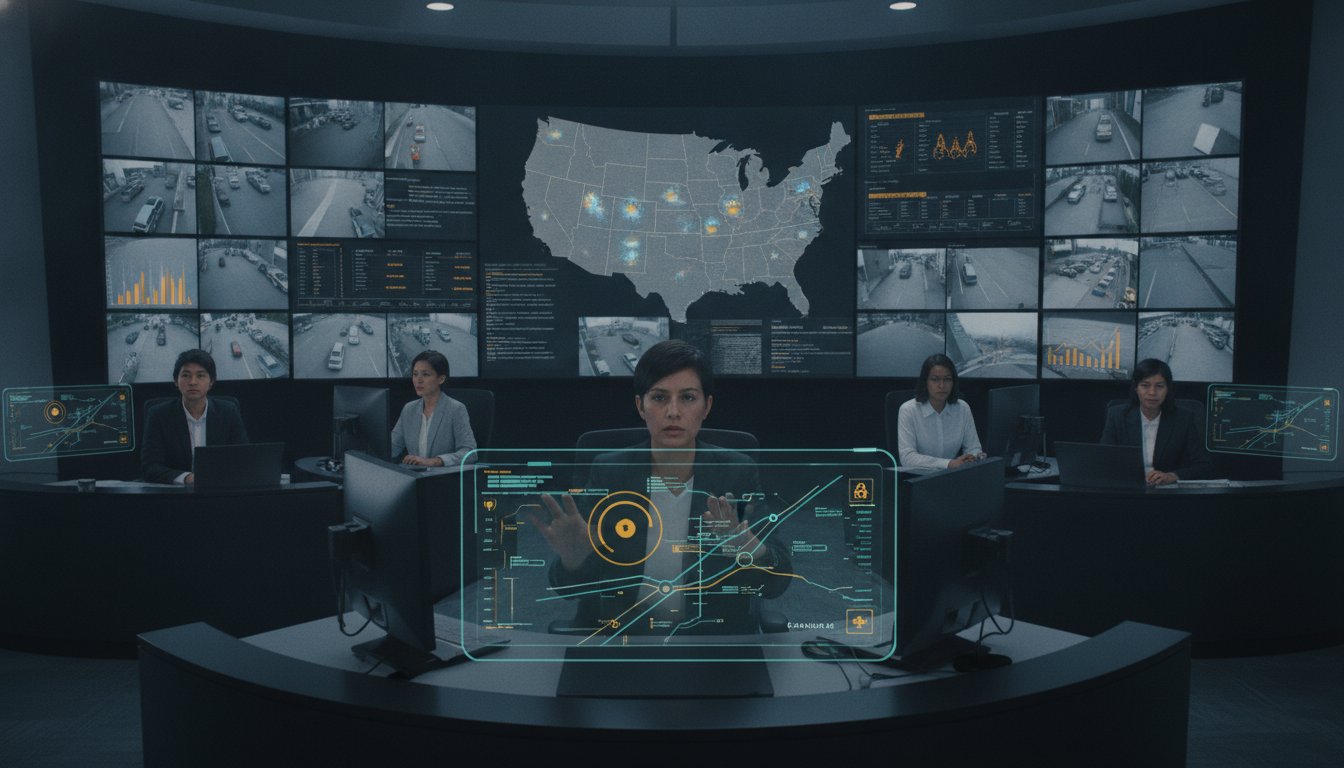
A massive video wall doesn’t guarantee safety; often, it just creates a more expensive way to miss a critical incident. As transportation management center technology becomes more complex, operators are frequently buried under a mountain of disconnected ITS feeds, camera streams, and telematics data. You’ve likely seen it happen: a minor stall escalates into a multi-car pileup because the right data point didn’t surface until it was too late. Managing multiple data feeds in a dispatch center shouldn’t feel like a game of chance where screen fatigue is the primary obstacle to situational awareness.
You understand that having more monitors hasn’t solved the problem of siloed intelligence or the difficulty of sharing real-time insights with field units. Most control rooms already have the screens. What they’re missing is the layer that decides what goes on them and escalates automatically when something needs attention. This article explores how a modern operational intelligence layer transforms fragmented streams into a proactive, unified operating picture. We’ll examine why partial, siloed solutions fall short without a central hub and how vis/ability automates incident detection to slash response times across your entire network.
Key Takeaways
- Identify how fragmented data streams and disconnected ITS feeds create operational blind spots that lead to missed incidents.
- Explore how modern transportation management center technology is evolving from passive monitoring toward proactive, event-driven situational awareness.
- Understand why an operational intelligence layer is the essential bridge between raw data on your screens and actionable human judgment.
- Learn to extend the command center’s reach by delivering real-time intelligence to mobile units and field agencies.
- Discover the steps to transition your facility from a reactive monitoring room into a unified, proactive operations hub.
The Complexity Crisis in Modern Transportation Management Centers
The current operational reality for highway and transit agencies is one of extreme data saturation. Every infrastructure project adds more sensors, high-definition cameras, and telematics streams to the network. While this growth in information is intended to improve safety, it often has the opposite effect. Operators find themselves managing more inputs than any human can reasonably process. This environment creates a complexity crisis where critical signals are lost in the noise of routine data.
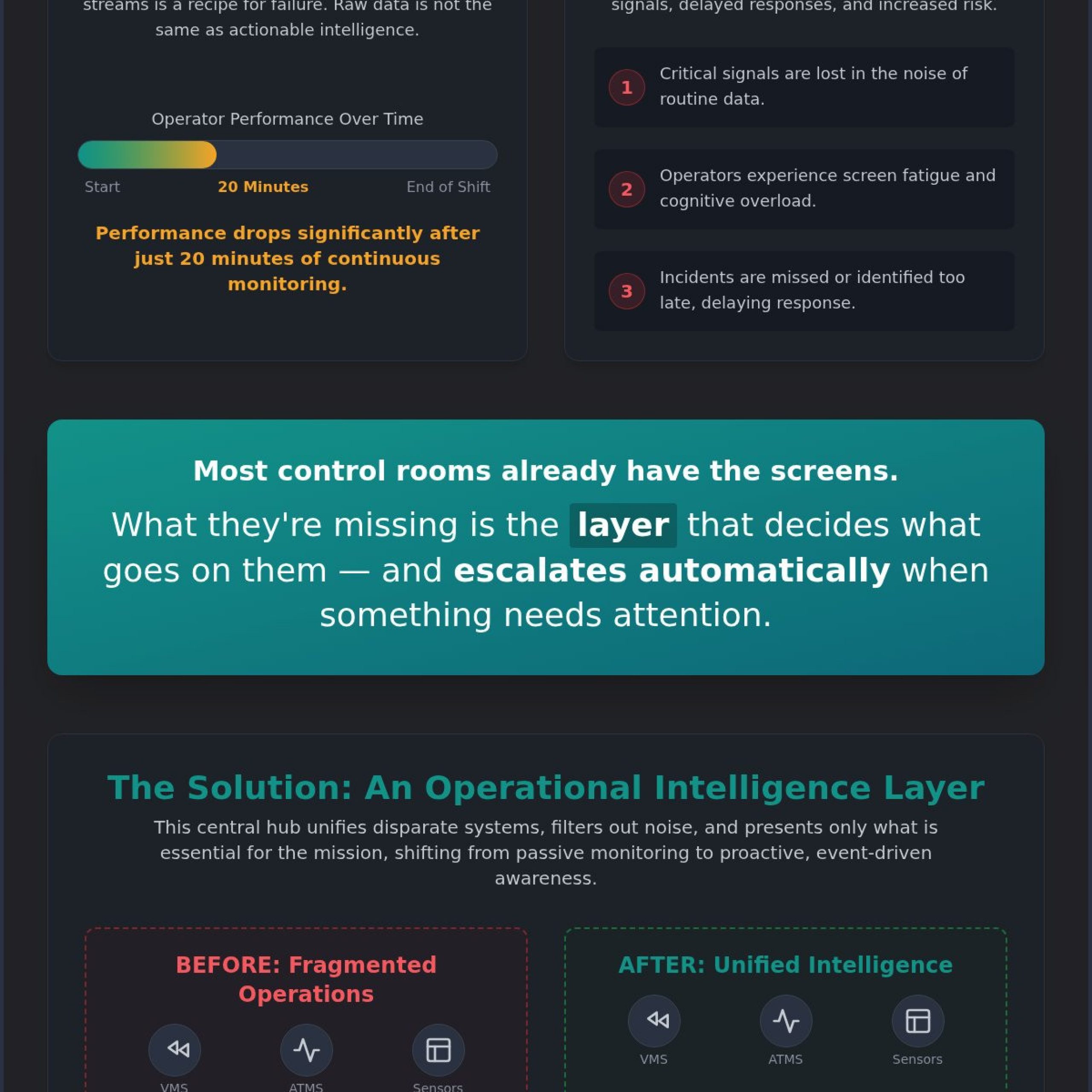
Relying on fragmented transportation management center technology leads to a reactive posture. Organizations often deploy specialized tools for specific tasks, such as Axon for digital evidence or video management. While these platforms provide vital data, they function as silos. They offer only a partial view of the operational landscape. Without a unifying orchestration layer, operators must manually toggle between systems to piece together what’s happening on the ground. This manual synthesis takes time that agencies don’t have during a major incident. Most control rooms already have the screens. What they’re missing is the layer that decides what goes on them, and escalates automatically when something needs attention.
The Failure of Traditional Monitoring Models
Passive monitoring, the practice of keeping dozens of camera feeds open on a video wall, is an obsolete strategy. Research into human factors shows that operator performance drops significantly after just twenty minutes of continuous monitoring. Expecting a team to catch a stalled vehicle or a debris hazard among a hundred live streams is a recipe for failure. The cognitive limits of human operators mean that raw data is not the same as actionable intelligence. In high-stress transit environments, the focus must shift from watching video to managing events through automated detection.
Siloed Systems and the Fragmented Operating Picture
Technical friction occurs when disparate software platforms cannot communicate. When an Advanced Traffic Management System (ATMS) operates independently from emergency response feeds, the result is a fragmented operating picture. This lack of integration delays multi-agency incident response and increases the risk of secondary crashes. Achieving true operational resilience requires a platform that pulls these threads together. For agencies looking to modernize, implementing robust transportation management solutions is the only way to ensure that field units and command centers see the same reality at the same time. By breaking down these silos, agencies can finally achieve a common operating picture that supports rapid, confident decision-making.
Defining Next-Generation TMC Technology: Beyond Simple Monitoring
Next-generation systems represent a fundamental shift in how agencies interact with their networks. Traditional setups rely on reactive monitoring, where operators wait for an incident to appear on a screen or a radio call to come through. This method is inherently flawed because it relies on human vigilance, which is a finite resource. Modern transportation management center technology moves beyond this limitation by prioritizing intelligence over simple visibility. It creates a proactive environment where data fusion informs every decision.
Most control rooms already have the screens. What they’re missing is the layer that decides what goes on them, and escalates automatically when something needs attention. This operational intelligence layer serves as the central hub. It filters out the noise of thousands of data points to present only what is essential for the current mission. By transitioning to this model, agencies can achieve a level of clarity that was previously impossible in high-density urban corridors.
The Role of Event-Driven Situational Awareness
Event-driven situational awareness is the new standard for high-stakes transit operations. Instead of operators hunting for anomalies across a grid of cameras, the technology flags deviations from the norm automatically. This approach, often called management by exception, ensures that personnel only intervene when the system detects a specific trigger, such as a sudden drop in vehicle speeds or a wrong-way driver alert. Event-driven visualization ensures that the most critical data finds the operator, rather than the operator hunting for the data. This shift reduces cognitive load and allows teams to focus on resolution rather than detection.
Achieving a Common Operating Picture (COP)
A true Common Operating Picture (COP) requires more than just a shared video feed. It demands the seamless integration of geospatial data, live telematics, and real-time infrastructure status. When these elements fuse into a single interface, everyone from the command center to the field unit sees the same reality. This level of technical integration is the cornerstone of the Virtual TMC concept, which allows for distributed collaboration across jurisdictional boundaries. To build this foundation, agencies must implement a platform that acts as the bedrock for all mission-critical decisions. You can explore how the vis/ability platform creates this unified environment to enhance operational readiness.
Why Video Walls Are Only Half the Equation
Many agencies prioritize physical infrastructure when upgrading their transportation management center technology. They invest millions in high-resolution displays and ergonomic consoles, assuming that more pixels equal better oversight. However, hardware-centric designs often lead to underutilized technology because they lack the underlying logic required to manage information flow. A video wall that merely displays fifty static camera feeds is digital wallpaper; it doesn’t provide intelligence. Most control rooms already have the screens. What they’re missing is the layer that decides what goes on them, and escalates automatically when something needs attention.
Traditional video wall controllers are designed to push pixels to a screen. They provide a surface for viewing but do nothing to help the operator understand the priority of the data. Modern operational intelligence layers change this dynamic by treating the video wall as a dynamic asset that responds to the environment. This shift moves the focus from hardware installation to operational outcomes, ensuring that the technology serves the mission rather than the other way around.
The Operational Intelligence Layer Defined
The vis/ability platform serves as the central hub into which all other tools flow. It acts as the brain of the command center. While some organizations use platforms like Axon for specific data needs, these tools only provide a partial solution. They lack a unifying orchestration layer to create a full common operating picture. By integrating these disparate systems into vis/ability, an agency makes its existing ITS and digital evidence tools more useful for the entire team. This layer ensures that data doesn’t just sit in a silo but actively contributes to the operational goals of the facility.
Automating the Escalation Workflow
Automated escalation reduces the critical time between incident detection and dispatch. In a traditional setup, an operator must manually change layouts or pull up relevant cameras when a sensor triggers. With vis/ability, specific triggers like a loop detector alert or a wrong-way driver sensor can change video wall layouts automatically. This immediate shift to a pre-configured incident mode provides the team with the exact visual context they need without manual intervention. Automated escalation preserves operator focus during crises by removing the administrative burden of managing screen real estate. This allows the team to focus entirely on coordinating response efforts and mitigating traffic impacts.
Extending Visibility: From the Command Center to the Field
Traditional command centers are often confined by their physical walls. In a high-stakes environment, intelligence must reach beyond the dispatcher’s desk to be truly effective. Modern transportation management center technology is no longer just about the central hub; it is about the entire ecosystem of response. Effective incident management requires that the same situational awareness present on the main video wall is available to first responders and regional partners in real time. Without this extension, the command center remains an island of information while field units operate in a vacuum.
Distributed collaboration is the key to regional resilience. Most control rooms already have the screens. What they’re missing is the layer that decides what goes on them, and escalates automatically when something needs attention. This logic must extend to huddle rooms, remote workstations, and mobile devices to ensure a seamless flow of intelligence. When every stakeholder sees the same data, the time spent on verbal clarification drops, allowing teams to focus on the mission at hand.
Mobile vis/ability and Field Integration
Sending high-bandwidth video to mobile devices in the field presents significant technical hurdles. Bandwidth fluctuations and a variety of hardware often lead to lag or failed streams in traditional systems. The vis/ability platform overcomes these challenges by optimizing data delivery for mobile environments. This ensures that field units receive clear, actionable visual intelligence even in areas with limited connectivity.
Field integration is a two-way street. Officers and road crews can contribute data back to the central common operating picture using their own mobile devices. Whether it’s a live stream from a smartphone at an accident scene or a telematics update from a service vehicle, this information enriches the central intelligence pool. You can see specific examples of these field-to-center workflows on our transportation solutions page. This bi-directional flow ensures that the command center has a ground-level view of every incident.
Cross-Agency Collaboration and Regional Resilience
Regional coordination often fails because agencies use different, incompatible software platforms. A unified operational intelligence layer allows various jurisdictions to see the same data simultaneously. This shared visibility is critical for maintaining operational continuity during large-scale disasters or multi-agency events. When state police, local DOTs, and emergency services share a unified operating picture, response times decrease and safety increases.
Security is the bedrock of this collaboration. Sharing sensitive data across agency boundaries requires strict protocols and encrypted channels. By using a secure, unified platform, agencies can collaborate without compromising data integrity or cybersecurity standards. This ensures that regional resilience is built on a foundation of trust and technical reliability. If you are ready to bridge the gap between your center and the field, you can request a demo to see these collaboration tools in action.
Implementing a Future-Proof TMC with Activu vis/ability
Modernizing transportation management center technology requires a fundamental shift in perspective. It isn’t about adding more equipment to an already crowded room. It’s about making sense of the data that already exists within your network. Many agencies find themselves trapped in a reactive cycle because their systems don’t communicate, leading to missed incidents and operator burnout. Breaking this cycle requires a clear roadmap toward digital maturity and operational readiness. Transitioning to a proactive hub ensures that your team stays ahead of the curve as traffic volumes and data complexity continue to rise.
Most control rooms already have the screens. What they’re missing is the layer that decides what goes on them, and escalates automatically when something needs attention. This operational intelligence layer serves as the bedrock of a modern command center. It unifies disparate tools and sensors into a single, cohesive interface. By prioritizing the flow of essential information, agencies can transform their facilities into high-performance environments where decisions are made with absolute certainty.
The Path to Proactive Operations
Moving from a reactive monitoring center to a proactive operations hub involves a methodical, three-step transition. This process ensures that technology serves the mission and empowers the personnel responsible for roadway safety.
- Step 1: Audit existing data silos. Identify where ITS, telematics, and video feeds remain disconnected. While organizations may use specialized tools like Axon for specific data needs, these platforms only provide a partial solution. They require a unifying layer to create a full common operating picture.
- Step 2: Define event-driven triggers. Use historical incident data to determine which anomalies require immediate escalation. This moves the center away from passive monitoring toward management by exception.
- Step 3: Deploy the operational intelligence layer. Implement vis/ability as the central hub. This platform unifies existing hardware and software, making every tool in the room more useful for the entire team.
Designing for Operational Excellence
Hardware-only builds often focus on the physical layout while ignoring the human-machine interface (HMI). Activu’s control room design services ensure that hardware and software work in harmony to reduce cognitive load. A software-defined control room offers a significantly higher long-term ROI than hardware-centric designs. It allows for modular updates and scales as new data sources, such as connected vehicle streams, become available. This approach ensures that your facility remains effective for years to come without requiring a total hardware overhaul every few years.
Operational readiness is an ongoing commitment to clarity and safety. If you’re ready to evaluate your current situational awareness gaps and move beyond the video wall, contact Activu to discuss your TMC modernization strategy. Our experts will help you design a system that bridges the gap between raw data and actionable human judgment.
Advancing Toward Operational Certainty
The future of transportation management center technology isn’t defined by the size of the displays, but by the intelligence that orchestrates them. Agencies must move away from passive monitoring models that rely on human vigilance alone. True operational readiness comes from a unified operating picture that automates incident detection and bridges the gap between the command center and field units. By implementing an event-driven situational awareness layer, you ensure that critical data finds the right person at the right time.
Activu vis/ability is the bedrock upon which major DOTs and transit authorities nationwide build their response strategies. It reduces time-to-decision through automated data orchestration and integrates seamlessly with your existing ITS tools. Most control rooms already have the screens; they simply need the layer that decides what goes on them and escalates when attention is required. Moving beyond the video wall allows your team to act with greater certainty and precision when the stakes are highest.
Ready to transform your operations? Request a personal demo of the vis/ability platform today to see how we help you achieve total situational awareness. Your path to a safer, more efficient network starts with clear, actionable intelligence.
Frequently Asked Questions
What is the most important technology for a modern Transportation Management Center?
The most critical transportation management center technology is the operational intelligence layer that unifies disparate data streams into a single operating picture. While individual tools like video management systems provide raw data, they lack the orchestration required for rapid decision-making. A platform like vis/ability acts as the central hub. It ensures that every operator and field unit sees the same essential information without manual intervention, leading to faster incident resolution.
How does an operational intelligence layer differ from a video wall controller?
A video wall controller is hardware designed to push pixels to a display, whereas an operational intelligence layer provides the logic for what appears on those screens. Most control rooms already have the screens. What they’re missing is the layer that decides what goes on them and escalates automatically when something needs attention. This software-defined approach moves beyond simple monitoring to provide event-driven situational awareness that guides human judgment.
Can modern TMC technology integrate with legacy ITS and camera systems?
Yes, modern platforms are specifically designed to integrate with legacy ITS, camera systems, and third-party software. vis/ability serves as a vendor-neutral hub that aggregates data from disparate sources, including older analog feeds and modern digital telematics. This integration eliminates data silos. It allows agencies to modernize their operations without a complete hardware overhaul, maximizing the value and lifespan of existing infrastructure investments.
How do event-driven alerts help reduce operator fatigue in control rooms?
Event-driven alerts reduce fatigue by shifting the operator’s role from passive monitoring to management by exception. Instead of watching hundreds of static camera feeds, the system only surfaces information when specific triggers occur. This ensures that personnel only engage when an anomaly is detected, such as a wrong-way driver or a sudden drop in speed. It preserves cognitive resources for critical decision-making during high-stress incidents where focus is paramount.
What are the benefits of extending TMC visibility to mobile devices?
Extending visibility to mobile devices ensures that field units and remote stakeholders have access to the same real-time intelligence as the command center. This bi-directional flow of data allows road crews to contribute live video back to the center while receiving updated incident layouts on their own devices. It bridges the gap between dispatch and response. This coordination leads to more accurate resource allocation and enhanced safety for responders.
How does a Common Operating Picture improve incident response times?
A Common Operating Picture improves response times by providing all stakeholders with a single, synchronized view of an incident. When everyone sees the same data simultaneously, the need for time-consuming verbal updates is significantly reduced. This clarity allows for immediate, confident action. It ensures that dispatchers and field units are working from the same facts, which is essential for mitigating secondary crashes in high-volume traffic corridors.
Is it possible to upgrade TMC technology without replacing existing video wall hardware?
It is absolutely possible to upgrade your operational capabilities without replacing your current displays. Most control rooms already have the screens. What they’re missing is the layer that decides what goes on them and escalates automatically when something needs attention. By deploying a software-defined transportation management center technology layer, you can transform your existing video wall into a dynamic, event-driven asset that responds to real-time network conditions.
How does vis/ability improve multi-agency collaboration during traffic emergencies?
vis/ability facilitates multi-agency collaboration by providing a secure, unified platform where different jurisdictions can share critical data during emergencies. During a large-scale event, state DOTs and local police can access a shared operating picture that integrates their unique data streams. This ensures that all agencies are operating with the same intelligence. It eliminates silos and fosters the regional resilience necessary to manage complex traffic emergencies with absolute precision.