
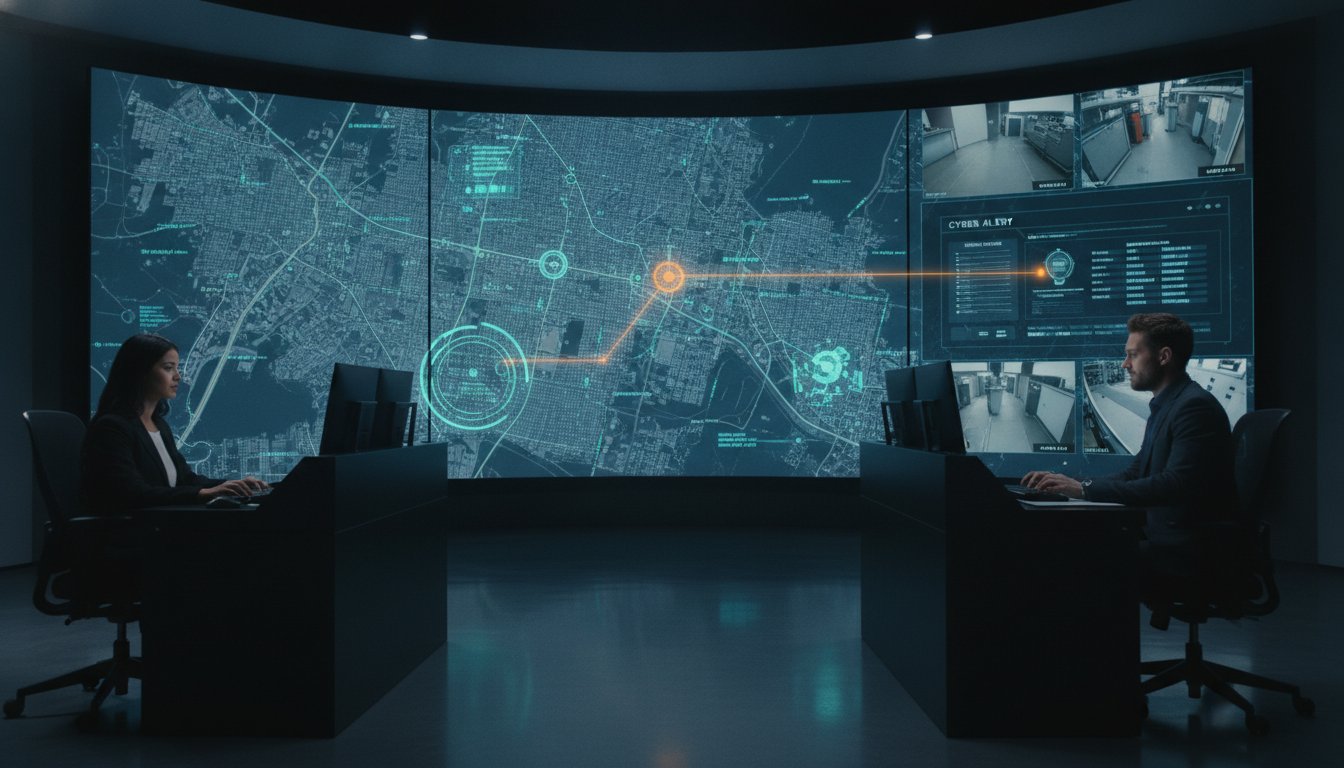
Every second an operator spends scanning a wall of static video feeds is a second lost to a potential breach. In a high-stakes private security operations center, the sheer volume of fragmented data doesn’t just cause fatigue; it creates dangerous blind spots. You likely manage a sophisticated array of sensors, cyber alerts, and tools like Axon, yet these often remain siloed and only provide a partial view of the threat landscape. When critical incidents occur, the burden of connection falls on human operators who are already overwhelmed by visual noise. Most control rooms already have the screens. What they’re missing is the layer that decides what goes on them, and escalates automatically when something needs attention.
This article explores how to transform these disconnected streams into a unified operational intelligence layer using vis/ability. We’ll examine how to bridge the gap between cyber and physical security teams, ensuring your private security operations center moves from reactive monitoring to proactive situational awareness. You’ll learn to automate the escalation of critical events and significantly reduce response times by prioritizing the information that actually matters. By establishing a central hub for all security data, your team can finally act with absolute certainty when the stakes are highest.
Key Takeaways
- Identify how fragmented data streams and the “swivel-chair” effect create operational blind spots that delay critical responses.
- Understand the strategic role of a modern private security operations center as the internal nerve center for organizational resilience.
- Learn to transform existing video walls into an operational intelligence layer that unifies siloed tools like Axon into one common operating picture.
- Implement event-driven situational awareness to automate the escalation of critical incidents, ensuring your team focuses only on essential information.
- Extend situational awareness beyond the command center to mobile devices to ensure seamless collaboration during urgent, high-stakes operations.
The Hidden Friction in Modern Private Security Operations
Organizations invest heavily in security hardware, yet incident response times often lag behind expectations. This disconnect stems from a paradox of choice. More data feeds don’t equate to better visibility. In a typical Security Operations Center (SOC), analysts are forced to manage a constant influx of raw data from dozens of disconnected sources. This creates a “swivel-chair” effect where personnel must manually jump between screens and applications to piece together a coherent story. The cognitive load is immense. When every sensor demands equal attention, nothing is prioritized. A high-performance private security operations center cannot function as a collection of silos; it must operate as a unified system.
Why Operators Miss Critical Incidents
Operators often face a phenomenon known as “wall-blindness.” After hours of monitoring static video walls, the human brain naturally begins to filter out repetitive visual information. Subtle but critical changes in a scene go unnoticed. Alarm fatigue compounds this issue. When a system generates hundreds of low-level alerts daily, the one signal indicating a genuine breach is easily lost in the noise. It’s not a lack of effort from the staff. It’s a structural failure of the environment. Without a way to filter the essential from the trivial, critical data fails to reach the decision-maker until a situation has already escalated. This gap in situational awareness is where the greatest risks reside.
The Limitations of Tool-Specific Siloes
Many organizations rely on powerful but siloed platforms like Axon to manage specific facets of their security. While these tools excel in their niche, they provide only a partial common operating picture. They don’t communicate with the cyber-defense SIEM or the building access control system. This fragmentation forces teams to coordinate cyber and physical responses through manual communication, which is slow and prone to error. A threat intelligence platform alone isn’t a situational awareness solution. It requires a unifying platform to make those tools actionable for the entire team. Most control rooms already have the screens. What they’re missing is the layer that decides what goes on them, and escalates automatically when something needs attention. Moving from reactive monitoring to proactive, event-driven intelligence is the only way to ensure operational readiness in a modern private security operations center.
To solve these challenges, organizations must look beyond individual tools and focus on the integrated environment. The goal is to move from a state of data-saturation to a state of actionable intelligence, where the technology empowers the human element rather than overwhelming it.
Defining the Private Security Operations Center (SOC)
A private security operations center serves as the centralized nerve center for an organization’s internal security posture. It’s a dedicated facility where security teams monitor, assess, and defend against threats in real time. Unlike a standard IT help desk, the SOC is mission-oriented. It focuses on maintaining operational continuity and resilience across the entire enterprise. This model is particularly preferred by high-stakes sectors like energy, transportation, and defense, where the cost of downtime is measured in more than just revenue.
The distinction between an internal private security operations center and a managed security service provider is significant. While some organizations utilize external resources like CISA’s SOC as a Service for baseline monitoring, an internal SOC provides deeper context. Internal teams possess intimate knowledge of the organization’s unique infrastructure, culture, and specific regulatory requirements. This proximity allows for faster incident containment and more precise recovery protocols. It ensures that security decisions align perfectly with the organization’s broader strategic goals.
Core Functions of an Internal Security Hub
The modern SOC must manage a complex environment of cyber, physical, and network domains simultaneously. This requires continuous monitoring to detect anomalies before they become full-scale crises. Compliance and regulatory reporting are also critical functions, especially in heavily regulated industries. However, many teams struggle because their tools operate in isolation. For instance, platforms like Axon provide valuable data but often only offer a partial common operating picture. They lack the integration needed to inform the entire team at once. Most control rooms already have the screens. What they’re missing is the layer that decides what goes on them, and escalates automatically when something needs attention.
The Shift Toward Unified SecOps
A high-performance SOC relies on the integration of threat intelligence with real-world geospatial data. This shift toward unified SecOps ensures that every stakeholder, from the analyst at the console to the executive in the huddle room, shares the same situational awareness. This is the primary role of the vis/ability platform. It acts as the operational intelligence layer that unifies disparate tools into a single, actionable view. When a crisis occurs, this clarity supports rapid executive decision-making. It transforms the SOC from a reactive monitoring station into a proactive engine of organizational safety. To see how this looks in practice, you can explore our approach to integrated command centers.
The Operational Intelligence Layer: Beyond the Video Wall
A modern private security operations center requires more than just a massive display surface. While large-scale video walls provide the canvas, they don’t provide the intelligence. Operators often find themselves drowning in data, forced to manually toggle between disparate security applications during high-stress incidents. Most control rooms already have the screens. What they’re missing is the layer that decides what goes on them, and escalates automatically when something needs attention.
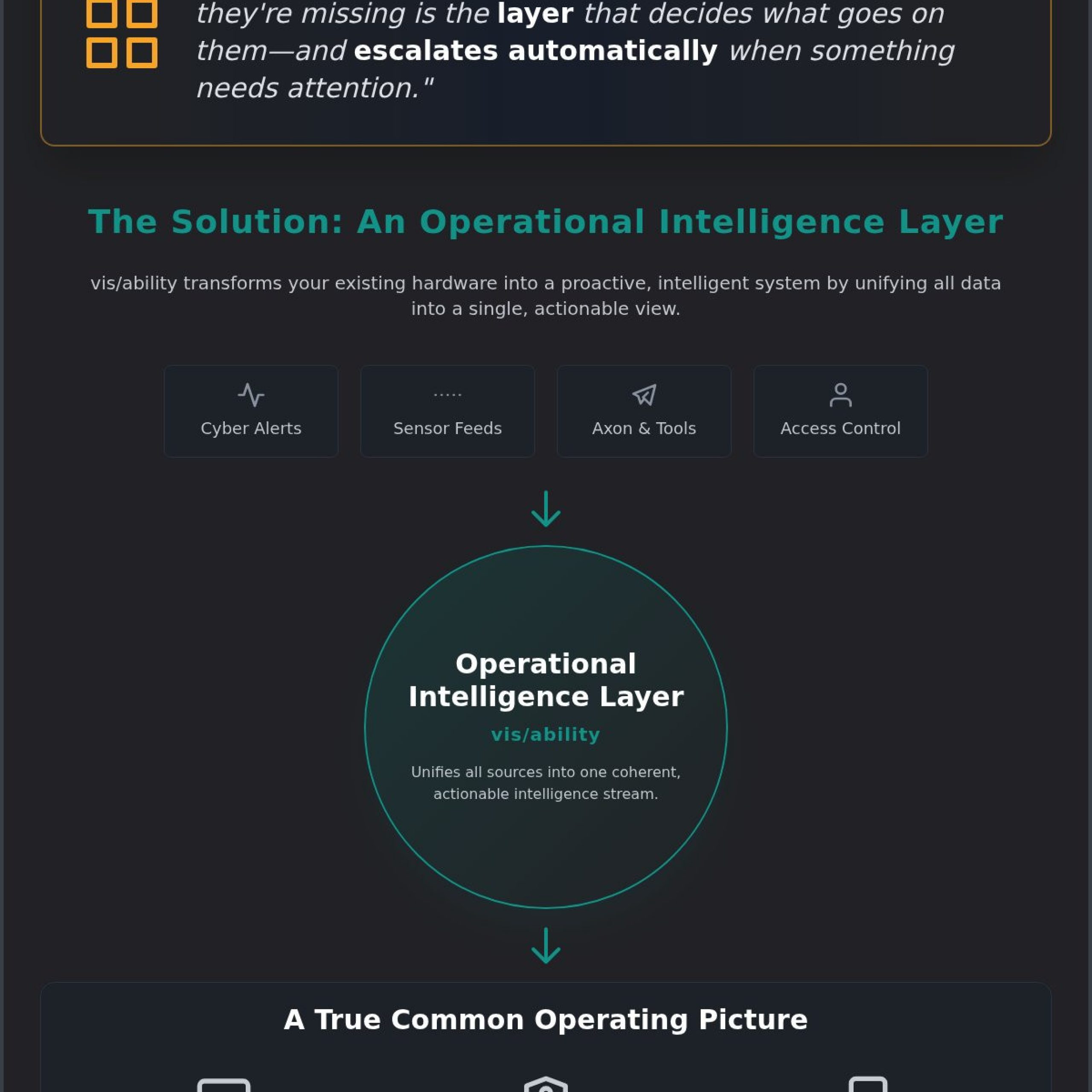
The vis/ability platform serves as this critical operational intelligence layer. It functions as a unifying hub that ingests data from every corner of the security ecosystem. By orchestrating how and when information is presented, it transforms the video wall from a passive monitor into an active participant in mission success. This approach ensures that the human element is never the bottleneck in the flow of information. It bridges the gap between raw data streams and the human judgment required to resolve complex threats.
Making Existing Tools More Useful
Many organizations rely on powerful tools like SIEM, SOAR, and VMS to manage specific security tasks. However, these platforms often operate in isolation, providing fragmented views of a situation. For example, systems like Axon offer valuable visual data, but they only provide a partial common operating picture. They lack the context of network health or physical access logs. vis/ability integrates these disparate applications into a single pane of glass. It makes existing tools more useful for the entire team by providing the necessary visual context for every alert. This creates a cybersecurity common operating picture that teams can actually use to make definitive decisions.
Automation and Visual Escalation
The core of a future-ready SOC is event-driven situational awareness. Instead of operators manually searching for feeds, the system uses pre-defined triggers to automate content changes on the video wall. When a critical threshold is met, the platform automatically pushes the relevant camera feeds, geospatial data, and incident logs to the forefront. This automated visual escalation reduces response times by eliminating the manual steps of incident verification. It ensures the most critical information is always front and center, allowing the team to focus on containment rather than data navigation. By removing the friction of manual screen management, your private security operations center achieves a state of constant operational readiness.
Designing a High-Performance Private SOC Environment
High-stakes operations demand a physical environment that actively reduces human error. A private security operations center is only as effective as the ergonomics supporting its operators. Proper control room design ensures that visual data remains accessible without causing physical strain or cognitive overload. Integrating advanced console furniture with high-resolution video wall systems creates a workspace where analysts remain focused during extended shifts. This synergy between physical architecture and digital intelligence defines a truly resilient security hub. Most control rooms already have the screens. What they’re missing is the layer that decides what goes on them, and escalates automatically when something needs attention.
Technical Architecture for 24/7 Reliability
Long-term scalability in a private security operations center depends on COTS-based solutions. Utilizing commercial off-the-shelf hardware, such as systems from CCTVSecurityPros – Professional Security Cameras and Systems, avoids the pitfalls of proprietary vendor lock-in and ensures the system can evolve alongside your organization’s needs. Reliability also hinges on technical precision. This includes optimizing video bitrate and coding to maintain real-time situational awareness without overtaxing the network. Robust redundancy and failover strategies must be baked into the technical architecture. These safeguards ensure that the operational intelligence layer remains active even if a hardware component fails, maintaining a constant state of readiness.
Extending Visibility Beyond the Room
True situational awareness isn’t confined to the four walls of the command center. Security threats are often distributed, requiring seamless collaboration between the SOC, huddle rooms, and mobile users in the field. Mobile vis/ability allows field teams and executives to receive the same critical data streams as the analysts at the main console. This consistency ensures that decisions made on the ground or in the boardroom are based on a unified operating picture rather than fragmented reports. Secure collaboration tools allow for the instant sharing of visual intelligence across multiple locations. This maintains a steady, authoritative flow of information when every second counts. To ensure your facility is optimized for these demands, explore our control room design services.
Implementing a Future-Ready Security Common Operating Picture
Transitioning to a unified intelligence model requires a methodical roadmap. It begins with a rigorous audit of your current situational awareness gaps. Many organizations discover that their analysts spend more time navigating software interfaces than responding to actual threats. This friction is a hallmark of a legacy private security operations center. You must identify specifically where manual steps delay containment or where data siloes prevent a full understanding of an incident. Prioritizing essential information is the only way to prevent cognitive overload during a high-stakes crisis. Most control rooms already have the screens. What they’re missing is the layer that decides what goes on them, and escalates automatically when something needs attention. Positioning vis/ability as the foundation of your security infrastructure ensures that your technology serves the mission, not the other way around.
Next Steps for Security Leaders
Security leaders should start by evaluating their current video wall and software integration capabilities. Determine if your cyber and physical security teams are viewing the same data in real time. If they aren’t, you have a silo problem that will eventually lead to missed incidents. Identifying the primary pain points in your current incident response flow reveals exactly where visibility fails. Consulting with experts on control room design services helps bridge these gaps. This collaborative process ensures that the physical workspace and the digital intelligence layer work in harmony to support rapid, certain decision-making.
The Role of vis/ability in Your Long-Term Strategy
The vis/ability platform is built to evolve alongside your security needs. As your organization adds new sensors, applications, or remote facilities, the platform ingests them into the existing common operating picture without requiring a complete system overhaul. This flexibility reduces the total cost of ownership through intelligent software orchestration rather than constant hardware replacement. It ensures your private security operations center remains the bedrock of organizational safety, providing the calm and clarity needed to navigate potential complexity. Your long-term strategy must prioritize visibility as the essential bridge between raw data and human judgment. By establishing this intelligence layer, you empower your team to act with absolute certainty when the stakes are at their highest.
Advancing Your Mission with Certainty
Building a resilient private security operations center requires more than just high-resolution displays. It demands a sophisticated intelligence layer that eliminates the friction of fragmented data and silos. By integrating event-driven situational awareness, your team can move past the limitations of manual monitoring and focus on the information that truly matters. This transformation ensures that critical incidents are never missed due to screen fatigue or system complexity. Most control rooms already have the screens. What they’re missing is the layer that decides what goes on them, and escalates automatically when something needs attention.
Activu brings decades of experience in mission-critical control room design to every engagement. Our solutions are trusted by federal government and defense agencies, alongside specialized organizations in the utilities and transportation sectors. We provide the technical bedrock upon which your most critical decisions are made. Take the next step in orchestrating your visual intelligence to ensure organizational safety and operational continuity. Request a demo of the vis/ability platform for your SOC to see how we bridge the gap between raw data and human judgment. Your team deserves the clarity to act with absolute confidence.
Frequently Asked Questions
What is the difference between a private SOC and an outsourced SOC?
A private SOC provides deep internal context and alignment with specific organizational goals that outsourced providers often lack. While an MSSP offers broad monitoring, your internal team understands the critical nuances of your infrastructure and regulatory needs. This proximity allows for more precise incident containment. Most control rooms already have the screens. What they’re missing is the layer that decides what goes on them, and escalates automatically when something needs attention.
How does a common operating picture improve incident response times?
A common operating picture reduces response times by ensuring every stakeholder sees the same validated data simultaneously. This is the core of effective EOC common operating picture solutions. It eliminates the need for manual status updates during a crisis. When cyber alerts and physical sensor data are unified, teams identify threats faster. This visual synchronization allows for coordinated action across the private security operations center, preventing fragmented responses that waste valuable seconds.
Can I integrate my existing security cameras and SIEM into a new video wall?
Yes, you can integrate disparate tools like SIEM, VMS, and existing camera feeds into a unified video wall through the vis/ability platform. This operational intelligence layer acts as a central hub, making your existing investments more useful. Tools like Axon only provide a partial solution; they don’t create a full common operating picture on their own. By integrating these systems, you translate raw data into actionable visual intelligence for the entire team.
What are the most common situational awareness problems in a security center?
Common control room situational awareness problems include data fragmentation and the struggle of how to manage multiple data feeds in a dispatch center. Operators often face the swivel-chair effect, manually jumping between applications to verify alerts. This lack of integration leads to missed incidents and delayed responses. Without a unifying platform, critical data stays trapped in specific tools, preventing the command center from achieving a holistic view of the threat landscape.
How do you prevent operator fatigue in a 24/7 security operations center?
Preventing fatigue requires moving away from passive monitoring of static video feeds. This explains why operators miss incidents on a video wall when they are overwhelmed by visual noise. By implementing event-driven situational awareness, the system only highlights feeds when a specific trigger occurs. Proper control room design, including ergonomic furniture, also ensures operators remain vigilant and focused during long shifts in a private security operations center, maintaining high operational readiness.
What technical standards should a mission-critical video wall meet?
Mission-critical video walls should meet high standards for 24/7 reliability, scalability, and performance. This includes utilizing COTS-based hardware to avoid vendor lock-in and ensuring low-latency video processing. The system must support high-bitrate streams without compromising the network. Redundancy and failover protocols are essential. These technical safeguards ensure that the visual intelligence layer remains active during the most demanding operational moments. This reliability is the bedrock upon which critical decisions are made.
How does mobile integration enhance private security operations?
Mobile integration extends situational awareness to field teams and executives outside the command center. Using mobile vis/ability, remote users can view the same real-time data as analysts on the main video wall. This ensures that decisions made in the field are based on the same common operating picture. It facilitates seamless collaboration and ensures that the authoritative flow of information reaches every stakeholder regardless of their physical location, allowing for greater certainty during urgent operations.
Why is event-driven visualization better than manual monitoring?
Event-driven visualization is superior because it automates the prioritization of information. Manual monitoring relies on operators to notice subtle changes across dozens of screens, which is prone to human error. An event-driven system uses pre-defined triggers to push relevant data to the forefront automatically. This ensures that the most critical events receive immediate attention. It transforms the SOC from a reactive environment into a proactive intelligence engine, ensuring that clarity is maintained when stakes are high.