

What if your most critical decision makers are forced to view a high-stakes emergency through a keyhole? Relying on traditional VPNs or basic RDP sessions often leaves remote operators blind to the full common operating picture, creating a dangerous lag in response times. You likely recognize the frustration of managing fragmented data feeds that don’t communicate, especially when a single missed incident can lead to operational failure. Modern remote access to control room systems must do more than just mirror a desktop. It has to transport the entire operational intelligence of the command center to the field without introducing new security vulnerabilities.
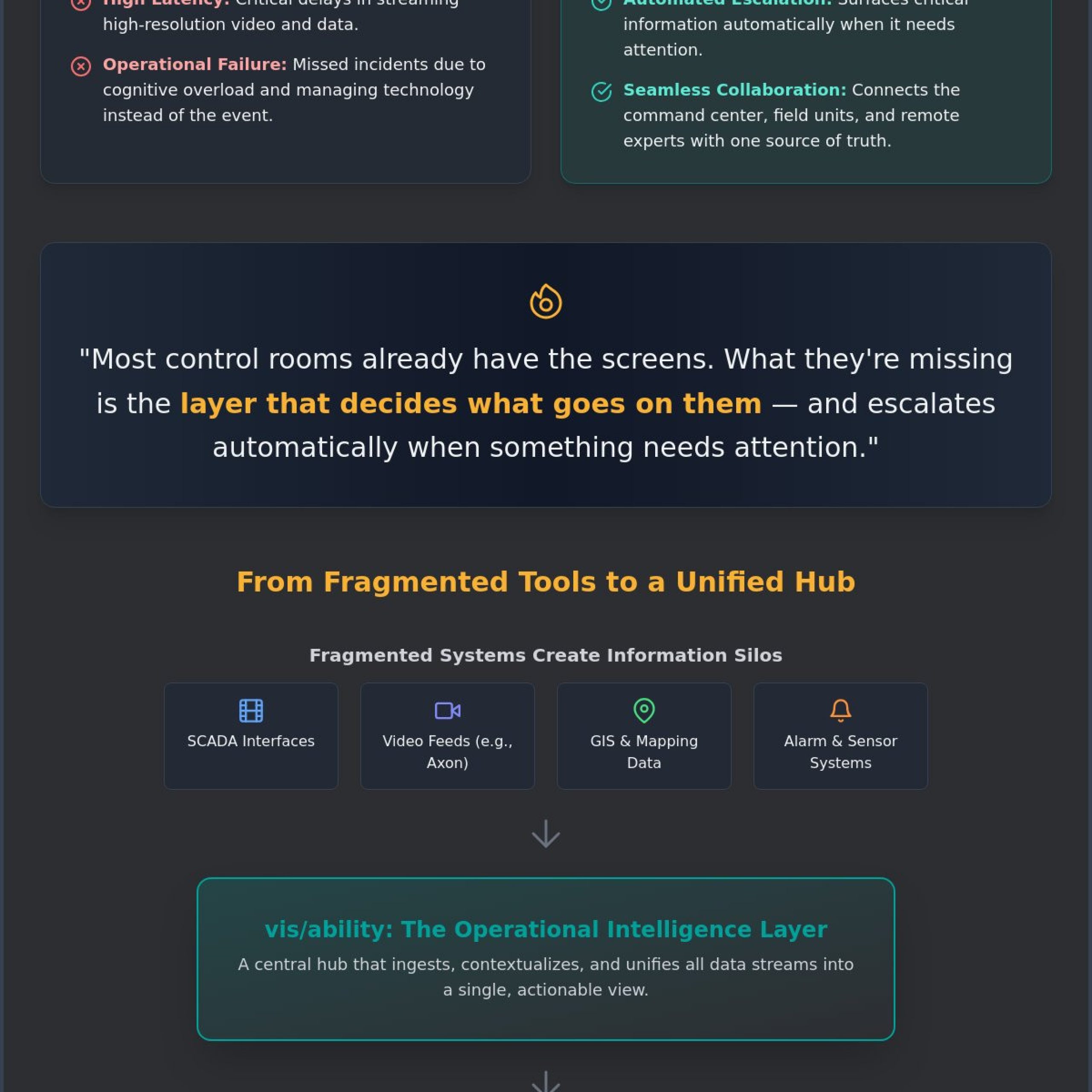
Most control rooms already have the screens. What they’re missing is the layer that decides what goes on them; it escalates automatically when something needs attention. This article demonstrates how to extend mission-critical situational awareness to any location while maintaining absolute technical reliability and compliance with standards like NERC CIP-012-2. You’ll learn how the vis/ability platform functions as a unified operational intelligence layer, integrating siloed tools into a single hub so your team maintains clarity and control whether they’re in the NOC or on a mobile device.
Key Takeaways
- Identify the critical limitations of traditional VPN and RDP solutions that hinder effective decision-making in high-stakes, distributed environments.
- Learn how an operational intelligence layer evolves remote access to control room systems into a proactive platform for real-time situational awareness.
- Navigate the latest regulatory requirements, including NERC CIP and CJIS, to secure mission-critical data across all remote endpoints.
- Discover how to extend the full common operating picture to mobile devices and huddle rooms to support seamless collaboration between the NOC and field units.
- Explore the implementation of vis/ability as a unified hub that integrates fragmented systems into a single, actionable view of operations.
The Evolution of Remote Access to Control Room Systems
Command centers were once defined by their physical walls and isolated networks. Today, the operational reality has shifted toward distributed hubs where decision makers are often miles away from the primary video wall. This transition requires a robust framework for remote access to control room systems, especially as regulations like NERC CIP-012-2, effective July 1, 2026, mandate stricter protections for real-time data exchanged between centers. Traditional remote monitoring and control (M&C) systems provided the technical foundation, but they didn’t account for the high-stakes urgency of modern mission-critical environments.
When an incident occurs, speed is the only metric that matters. Relying on a standard VPN or RDP session creates a dangerous bottleneck. These tools provide a pipe to the data, but they don’t provide the context needed to act. Operators often find themselves trapped in a state of tunnel vision, where they can see one specific application or server but lose the common operating picture that the physical control room provides. This gap between raw data connectivity and actionable intelligence is where most remote strategies fail.
The Limitations of Traditional Remote Desktop Protocol
RDP wasn’t intended to manage the complexities of a 24/7 operations center. It creates isolated information silos, forcing a remote user to toggle between multiple windows to piece together what’s happening. High-resolution video walls require significant bandwidth; streaming that data through a standard remote session often results in unacceptable latency. In a crisis, a three-second delay isn’t just an inconvenience; it’s a failure. Simply seeing a screen is not the same as understanding the operation.
Entering Through the Pain: Fragmented Data and Siloed Teams
Fragmented systems lead to slow decision-making. When remote teams rely on disparate tools like Axon for video or various SCADA interfaces, they’re only getting a partial view. These platforms are useful, but they lack a unifying layer to create a full common operating picture. Operators miss critical incidents because they’re managing the technology rather than the event. The cognitive load of juggling six different remote sessions simultaneously leads to fatigue and oversight.
Most control rooms already have the screens. What they’re missing is the layer that decides what goes on them, and escalates automatically when something needs attention. This is where the shift from simple connectivity to an operational intelligence layer becomes vital. By implementing the vis/ability platform, organizations move beyond basic screen sharing. They create a central hub where all data flows, ensuring that every team member, regardless of location, sees exactly what they need to see when the stakes are highest.
Moving Beyond RDP: The Operational Intelligence Layer
Modernizing remote access to control room systems requires a fundamental shift in perspective. Connectivity is a baseline requirement, but the true objective is visibility. An operational intelligence layer serves as the central nervous system for your command center. It acts as the unifying platform where disparate data streams converge into a single, cohesive view. Most control rooms already have the screens. What they’re missing is the layer that decides what goes on them, and escalates automatically when something needs attention. By implementing this layer, you ensure that the same mission-critical clarity found on your primary video wall is accessible from any location.
Traditional remote desktop protocols often fail because they focus on the device rather than the mission. They provide a window into a single computer, but they don’t provide a window into the operation. This creates a fragmented environment where remote users are perpetually one step behind the live event. The vis/ability platform functions as the bedrock for distributed teams, serving as a central hub into which all other tools flow. It transforms raw data into actionable intelligence, providing a steady hand for operators managing complex, high-stakes scenarios.
Integrating Fragmented Systems into a Unified View
Operators often struggle with partial solutions like Axon. While these platforms are useful for specific video evidence or live feeds, they only provide a fraction of the total picture. They remain isolated silos without a unifying layer to bridge the gap between video, geospatial data, and real-time SCADA analytics. By using vis/ability as your operational intelligence layer, you transform these individual tools into a collective asset for the entire team. This approach aligns with best practices for using remote capabilities, ensuring that access isn’t just secure but functionally superior to localized setups. This integration creates a true Common Operating Picture (COP) that remains consistent across the entire organization.
Event-Driven Awareness: Let the System Find the Incident
Reactive monitoring is a legacy approach that invites human error. When an operator is forced to stare at dozens of static feeds, fatigue is inevitable. Proactive, event-driven situational awareness changes the dynamic by allowing the system to monitor the data and bring the incident to the operator. Automated escalation ensures that remote users see the most critical information at the exact moment it matters. It filters out the digital noise, allowing your team to focus on resolution rather than detection. This reduces the cognitive load on your staff, ensuring they stay sharp when stakes are at their highest. You can explore how the vis/ability platform serves as the bedrock for these advanced remote operations.
Security and Compliance in Distributed Environments
Protecting the perimeter is no longer enough when the workforce is distributed across multiple locations. In mission-critical sectors like utilities and defense, remote access to control room systems introduces a complex web of regulatory requirements that standard IT tools cannot satisfy. Relying on off-the-shelf remote access software creates unacceptable risks. These generic tools often lack the forensic auditing, multi-factor authentication, and granular permissions needed to satisfy NERC CIP, CJIS, or FISMA standards. When an incident occurs, you need more than just a connection; you need a verifiable record of every data interaction.
Most control rooms already have the screens. What they’re missing is the layer that decides what goes on them, and escalates automatically when something needs attention. By moving beyond simple desktop mirroring, organizations can implement a secure operational intelligence layer that bridges the gap between strict security protocols and operational necessity. This approach ensures that situational awareness is maintained without compromising the integrity of the internal network. It provides a steady hand for security leaders who must balance the need for collaboration with the mandate for absolute data sovereignty.
Maintaining Compliance for Utilities and Energy
Adhering to NERC CIP requirements is a non-negotiable priority for power generation and transmission. With the enforcement of NERC CIP-003-9 in April 2026, governance over vendor electronic remote access has become even more stringent. Effective compliance requires comprehensive auditing and logging capabilities that track exactly who sees what and when. Securing the last mile of data transmission to a remote endpoint is a primary failure point for many organizations. The vis/ability platform addresses this by providing a controlled environment where data is visualized rather than transferred, significantly reducing the attack surface for remote access to control room systems.
The Cybersecurity Common Operating Picture
Extending Situational Awareness to Mobile and Huddle Rooms
Situational awareness shouldn’t be tethered to a physical workstation. In high-stakes operations, the point of decision frequently shifts from the primary command floor to huddle rooms, satellite offices, or the field. Effective remote access to control room systems must ensure that the common operating picture (COP) follows the leader, not the other way around. When a crisis breaks, the ability to maintain visual continuity across devices is the difference between a coordinated response and operational chaos. Decision-makers require the same high-fidelity data in a briefing room as they do when standing in front of a massive video wall.
Most control rooms already have the screens. What they’re missing is the layer that decides what goes on them, and escalates automatically when something needs attention. This operational intelligence layer bridges the gap between the static display and the dynamic needs of a mobile workforce. It ensures that critical data isn’t just available; it’s actively presented to the right person on the right device at the right moment. This proactive delivery of information eliminates the delay caused by manual data retrieval, allowing leaders to focus on strategic execution rather than technical navigation.
Mobile vis/ability: Intelligence in the Field
Field units often operate in an information vacuum, relying on voice radio or disjointed text updates while the command center has a wealth of visual data. Mobile vis/ability changes this by extending the COP to smartphones and tablets without compromising security. This two-way collaboration allows field technicians to stream live video back to the command center, providing dispatchers with ground-level context that sensors alone cannot capture. This level of integration is essential for improving public safety outcomes, as it empowers first responders with the same intelligence available to the NOC. It transforms the mobile device into a powerful extension of the control room network.
Collaboration Across Distributed Teams
Decision-making is rarely a solitary task. It requires huddle rooms and satellite offices to be in perfect sync with the main operations center. If these remote sites rely on separate, unmanaged feeds, they risk making decisions based on outdated or incomplete information. A unified platform ensures every team member sees a single version of the truth. Collaborative markup tools allow experts in different locations to highlight specific data points on a shared screen, significantly reducing the time to decision. This seamless handoff between environments preserves the integrity of the mission, ensuring that the transition from a desk to a huddle room never results in a loss of clarity. You can contact our team to learn how to implement these collaborative hubs in your organization.
Implementing vis/ability: A Unified Hub for Remote Operations
Designing a remote-ready control room requires more than just an internet connection. It demands a fundamental architectural shift from reactive, isolated silos to a proactive ecosystem of operational intelligence. When organizations attempt to manage remote access to control room systems using a patchwork of standalone tools, they inevitably encounter gaps in visibility and security. These fragmented setups force operators to manually bridge the data themselves, which leads to fatigue and delayed responses during high-stakes events. This lack of cohesion is often the primary reason why teams miss critical incidents despite having access to the necessary data feeds.
Most control rooms already have the screens. What they’re missing is the layer that decides what goes on them; it escalates automatically when something needs attention. By positioning vis/ability as the bedrock for mission-critical operations, you ensure that every remote endpoint functions as a high-fidelity extension of the command center. This platform serves as the unifying hub that makes every other tool in your stack more effective for the entire team, providing the technical reliability required when stakes are at their highest.
Why a Unified Platform is Non-Negotiable
Fragmented remote access tools carry hidden costs that extend far beyond licensing fees. They complicate IT management, increase the attack surface, and lengthen the training cycle for new operators who must learn multiple disparate interfaces. A unified platform like vis/ability simplifies these complexities by providing a consistent, authoritative interface across all devices. The long-term ROI is realized through event-driven situational awareness, where the system itself filters the noise. This allows your most skilled personnel to focus their cognitive energy on strategic resolution rather than navigating technical hurdles.
Take Control of Your Operational Picture
Auditing your current capabilities begins with assessing your “screens vs. intelligence” ratio. If your team has access to data but lacks the context to act immediately, the system isn’t fulfilling its mission. Integrating your existing toolset into a unified hub is the first step toward achieving total operational clarity. You don’t need to replace your entire infrastructure to gain these capabilities. Instead, you need the operational intelligence layer that brings it all together into a common operating picture. You can Contact Activu to begin designing a remote-ready environment that protects your assets and empowers your people to act with absolute certainty.
Securing the Future of Distributed Operations
Transitioning from basic connectivity to true operational intelligence is a strategic necessity for high-stakes environments. You’ve seen how legacy RDP sessions create dangerous information silos, while a unified hub ensures that every decision maker maintains a full common operating picture. Effective remote access to control room systems requires more than a secure pipe; it requires a platform that prioritizes critical data and automates escalation to reduce cognitive load during a crisis. Most control rooms already have the screens. What they’re missing is the layer that decides what goes on them; it escalates automatically when something needs attention.
Activu provides the bedrock for these operations, with NERC CIP and CJIS compliant architectures trusted by over 1,000 mission-critical installations worldwide. Our event-driven automation ensures your team stays focused on resolution rather than technical navigation. You can take the next step in modernizing your command center and extending situational awareness to the point of decision. Request a Demo of the vis/ability Platform to see how unified visibility transforms your remote capabilities. Empower your team with the clarity they need to act with absolute certainty when every second counts.
Frequently Asked Questions
What is the difference between RDP and a mission-critical remote access platform?
RDP provides a technical pipe to a single workstation, while a mission-critical platform delivers a unified operational intelligence layer. Standard remote desktop tools don’t provide the context needed for high-stakes decisions; they create information silos that force operators to toggle between disparate applications. In contrast, a purpose-built platform aggregates all relevant data into a single common operating picture. This ensures that remote access to control room systems provides the same level of situational awareness found on the primary video wall.
How do you ensure NERC CIP compliance with remote control room access?
You achieve compliance through architectures that enforce strict multi-factor authentication and comprehensive audit logging. Solutions must align with NERC CIP-012-2 requirements for protecting real-time operational data exchanged between centers. By visualizing data within a secure environment rather than transferring raw files to remote endpoints, you maintain a secure perimeter. This approach ensures that every interaction is tracked and verified to meet federal and industry-specific security standards.
Can remote access systems integrate with existing video walls?
You achieve seamless integration because the platform functions as an overlay to your existing infrastructure. Most control rooms already have the screens. What they’re missing is the layer that decides what goes on them; it escalates automatically when something needs attention. This software-driven approach allows you to sync the physical video wall with remote huddle rooms and mobile devices, ensuring a single version of the truth across the entire organization.
What happens to remote situational awareness during a network outage?
Redundant server architectures and edge processing capabilities maintain operational resilience. If the primary network link to a remote site fails, local failover protocols ensure that essential monitoring continues without interruption. Modern systems utilize low-bandwidth optimization to maintain visibility even during degraded network conditions. It’s vital for preventing the total loss of situational awareness that often occurs with standard, unmanaged remote connections during a critical infrastructure failure.
How does event-driven visualization reduce operator burnout for remote teams?
Event-driven visualization reduces burnout by shifting the team from reactive monitoring to proactive oversight. Instead of forcing operators to watch dozens of static feeds, the system monitors the data and highlights only the incidents that require human judgment. This proactive approach filters out digital noise and prevents operator fatigue. It allows personnel to remain focused on high-level strategy and resolution rather than becoming overwhelmed by a constant stream of non-critical alerts.
Is it possible to extend control room visibility to mobile devices securely?
Encrypted mobile vis/ability applications maintain security by providing controlled access to the common operating picture. These tools don’t just mirror a screen; they provide a tailored view of mission-critical data designed for smaller displays. Access is strictly managed through identity providers and secure gateways. This ensures that field units and first responders receive real-time intelligence without introducing new vulnerabilities to the core control room network.
How do you manage multiple data feeds for a remote dispatch center?
Managing multiple feeds requires a central hub that can ingest and synchronize data from SCADA, VMS, and geospatial sources. A remote dispatch center relies on this operational intelligence layer to harmonize fragmented systems into a cohesive view. This eliminates the need for operators to manage multiple remote sessions simultaneously. By unifying these feeds, the system provides a steady hand for dispatchers who must coordinate complex responses across wide geographic areas.
Why do operators often miss incidents when using standard remote access tools?
Operators miss incidents because standard tools often lead to tunnel vision. When using remote access to control room systems that lack automated escalation, an operator can only see what they are actively looking at. They don’t have the peripheral awareness provided by a physical video wall. Without a system that automatically brings critical events to the forefront, vital information remains hidden within a background tab or a secondary application window.