
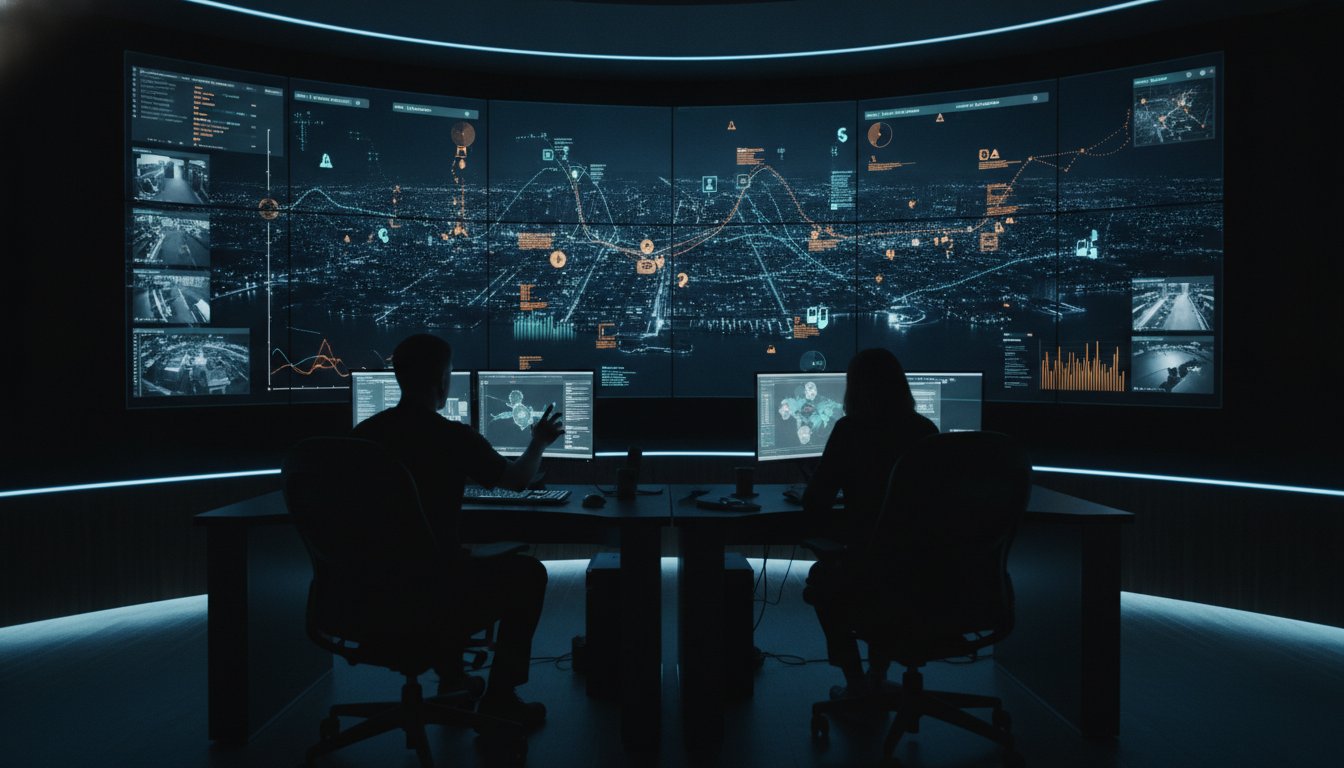
The Columbia Police Department reports that cases assisted by a real-time crime center have a 180% higher likelihood of leading to an arrest. Despite this clear potential, many agencies struggle with fragmented data streams from CAD, ALPR, and CCTV systems that operate in silos. Tools like Axon provide valuable data, yet they often offer only a partial solution that requires a unifying layer to create a full common operating picture. When critical information is buried in sub-menus or hidden across dozens of monitors, operator fatigue sets in and vital incidents go unnoticed. This lack of integration creates a dangerous gap between raw data and the decisive action required in a mission-critical environment.
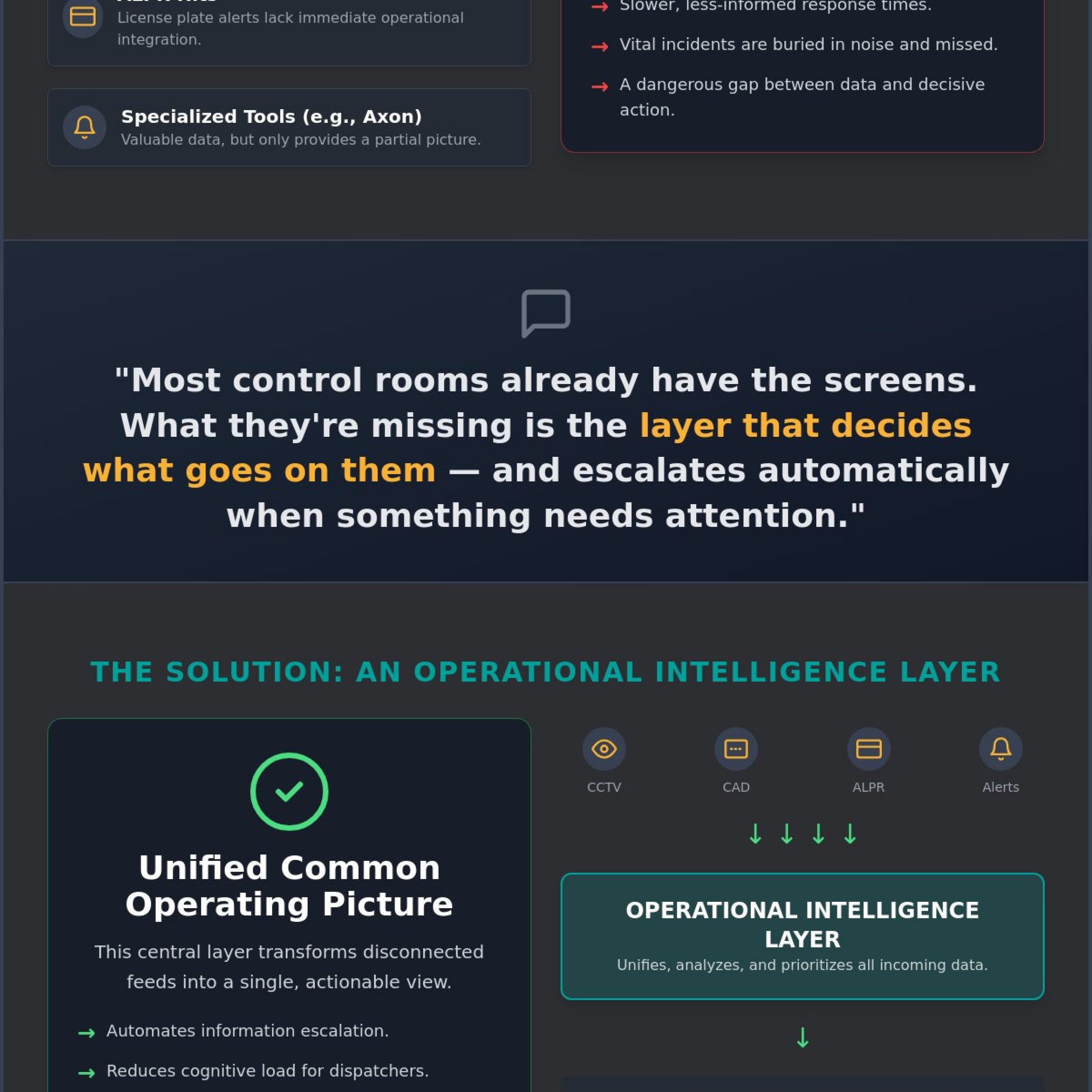
Most control rooms already have the screens. What they’re missing is the layer that decides what goes on them, and escalates automatically when something needs attention. By architecting an operational intelligence layer, you can transform these disconnected feeds into a unified common operating picture. This article explores how to optimize your real-time crime center to reduce cognitive load for dispatchers, accelerate response times, and provide the clarity needed when every second counts.
Key Takeaways
- Shift from reactive investigations to proactive interventions by leveraging real-time data integration for immediate situational awareness.
- Unify fragmented streams like CAD, ALPR, and CCTV into a real-time crime center to eliminate operational silos and prevent critical incidents from being missed.
- Implement an operational intelligence layer to automate information escalation, ensuring the most vital data is prioritized on your screens when attention is needed most.
- Integrate specialized tools into a single platform to create a cohesive common operating picture that extends from the command center to mobile devices in the field.
- Reduce cognitive load and operator fatigue by architecting a decision-support environment that focuses human judgment on the most urgent operational priorities.
The Paradigm Shift in Public Safety Operations
Modern policing has reached a critical inflection point. For decades, law enforcement relied on a reactive model where investigations began only after a crime occurred. Today, the speed of incidents requires a transition toward real-time proactive intervention. A Real-Time Crime Center (RTCC) serves as the strategic intelligence hub for this evolution. It’s not just a room with cameras; it’s the operational foundation for situational awareness that directly improves safety outcomes for both officers and the communities they serve.
The primary obstacle isn’t a lack of data. It’s the “Data Deluge.” Agencies have invested heavily in CCTV networks, Automated License Plate Recognition (ALPR), and gunshot detection. Yet, more sensors often lead to less clarity. When operators are flooded with thousands of data points, the essential information gets lost. True intelligence requires filtering the noise to find the signal. Finding that signal is what defines a high-functioning real-time crime center.
From Reactive Monitoring to Proactive Intervention
Traditional dispatch models struggle during high-velocity incidents. By the time a call is processed and units are sent, the scene has often changed. Real-time data prevents this escalation by providing immediate context. RTCC technology focuses on the moment of a pivotal decision. It provides the tactical advantage needed to intercept a suspect or de-escalate a situation before it turns fatal. This proactive posture transforms the agency from a responder into a guardian.
The Cost of Information Silos in Public Safety
Fragmented systems are a liability. When Computer-Aided Dispatch (CAD) doesn’t talk to video management systems, response times suffer. This creates a high risk for field units who walk into situations without full visibility. Command center operators face immense psychological pressure. Cognitive overload isn’t just a fatigue issue; it’s a safety failure. Adding more monitors to a wall doesn’t solve complexity. It just creates more space for critical details to go unnoticed.
Most control rooms already have the screens. What they’re missing is the layer that decides what goes on them, and escalates automatically when something needs attention. Without this operational intelligence layer, even the most advanced tools like Axon only provide a partial solution. They leave the burden of integration on the human operator, which limits the effectiveness of the entire unit. Success depends on a platform that unifies these streams into a single, actionable operating picture that empowers every member of the team.
Essential Components of a Modern RTCC Infrastructure
Building a modern real-time crime center requires more than just a collection of high-resolution displays. It demands a technical architecture capable of synthesizing massive volumes of data from varied sources. Core inputs like Computer-Aided Dispatch (CAD), Automated License Plate Recognition (ALPR), and expansive CCTV networks form the sensory nervous system of the operation. When these tools work in isolation, they create friction. When integrated, they provide the geospatial oversight necessary to track field units and incident locations with surgical precision.
Specialized applications like Axon and ShotSpotter offer critical data points, yet they often exist as standalone silos. While some organizations use these tools to gather specific evidence, they only provide a partial solution. Without a central hub to unify these inputs, analysts are forced to toggle between windows, wasting seconds that could be spent directing resources. This fragmentation is the primary barrier to achieving a true common operating picture.
Integrating Diverse Data Streams and Sensor Networks
Success in a 24/7 mission-critical environment relies on pulling raw data from disparate hardware vendors without latency. Technical reliability is the bedrock of public safety. Event-driven situational awareness serves as the filter for this data, stripping away the noise to highlight critical signals. This ensures that an ALPR hit or a gunshot detection alert doesn’t just sit in a log but triggers an immediate operational response across the entire network.
The Role of Video Wall Systems in Situational Awareness
A unified operating picture is the primary requirement for effective team collaboration. Most control rooms already have the screens. What they’re missing is the layer that decides what goes on them, and escalates automatically when something needs attention. High-performance Video Wall Systems must move beyond basic video feeds to become interactive, data-rich visualization platforms.
This visualization allows a supervisor to see the same intelligence as the analyst, ensuring everyone operates from a single version of the truth. When a major incident occurs, the system should automatically populate the wall with relevant cameras and maps. This level of automation reduces the cognitive burden on personnel, allowing them to focus on strategy rather than software navigation. Organizations looking to achieve this level of integration often start by evaluating their public safety technology stack to identify where the operational intelligence layer is missing.
Solving the Fragmentation Problem in Command Centers
Data fragmentation is the silent enemy of public safety operations. In many agencies, the real-time crime center operates as a collection of isolated workstations where analysts must manually bridge the gap between disparate software. When a dispatcher receives a call, they might check one system for vehicle history, another for live video, and a third for officer locations. This “swivel-chair” workflow creates friction. It delays response times and increases the likelihood that a critical detail, buried in a sub-menu or a background tab, will be missed entirely.
Most control rooms already have the screens. What they’re missing is the layer that decides what goes on them, and escalates automatically when something needs attention. While some organizations use specialized tools like Axon to manage digital evidence and certain camera feeds, these platforms often remain partial solutions. They lack the broad application integration required to ingest every relevant data point across a complex operation. Without a unifying operational intelligence layer, these tools stay siloed, forcing the human operator to act as the primary integration point during high-stress incidents.
Why Partial Solutions Create Operational Blind Spots
Relying on a single vendor’s ecosystem often limits situational awareness. If a tool cannot integrate third-party sensor data or regional CAD feeds seamlessly, it creates a blind spot. True operational intelligence requires a platform that acts as the bridge between raw data and human judgment. It must make all other tools useful for the entire team, whether they are sitting at a console or responding in the field. This ensures that no incident is missed simply because it occurred in a software silo.
Automating Information Escalation to Reduce Cognitive Load
Event-driven visualization changes the fundamental role of the operator. Instead of searching for data, the system surfaces critical information automatically based on predefined triggers. This automation allows personnel to focus on high-level decision-making rather than data entry. By implementing sophisticated Incident Management Software, an agency can ensure that the right information reaches the right person at the exact moment it is needed. This reduction in cognitive load is essential for maintaining clarity when stakes are at their highest.
- Eliminate manual data searching during active pursuits.
- Unify disparate software into a single common operating picture.
- Ensure automatic escalation of high-priority alerts to the video wall.
- Empower field units with the same intelligence available in the command center.
Architecting for High-Stakes Decision Support
Designing a real-time crime center requires a focus on the human element. While technology provides the data, the architecture must empower the personnel who make life-safety decisions. Research indicates that 96% of law enforcement agencies have implemented advanced technology into their operations as of 2026. However, simply owning the technology isn’t enough. A high-stakes environment demands a strategic layout that fosters collaboration and rapid information sharing. Without this structural foundation, even the most sophisticated intelligence tools can fail during the peak of a crisis.
Most control rooms already have the screens. What they’re missing is the layer that decides what goes on them, and escalates automatically when something needs attention. This operational intelligence layer acts as the bridge between raw digital feeds and human judgment. It ensures that when a critical incident occurs, the visualization environment adapts to the needs of the team, rather than forcing the team to adapt to the software.
Control Room Design for 24/7 Readiness
Operational efficiency is directly tied to the physical and digital environment. Reducing operator fatigue is a primary goal, as cognitive overload leads to missed signals. Professional Control Room Design Services ensure that every aspect of the center, from ergonomic seating to intuitive interface layouts, supports 24/7 readiness. A well-designed space allows analysts to maintain focus during long shifts and act with certainty when an emergency is triggered.
Cybersecurity is also a vital component of the visualization layer. As agencies integrate more third-party data, the command center must maintain a cybersecurity common operating picture. This ensures that the intelligence being viewed is secure and that the infrastructure itself remains resilient against digital threats. Protecting the integrity of the information is just as important as the information itself.
Mobile Visibility: Extending Intelligence to the Field
The common operating picture shouldn’t stop at the walls of the command center. Field officers need access to the same intelligence as the analysts back at headquarters. Mobile visibility ensures that distributed teams can collaborate in real-time, sharing maps, video feeds, and suspect descriptions instantly. This seamless flow of information improves officer safety by providing situational awareness before they even arrive on the scene. When everyone sees the same picture, the entire agency operates with greater speed and precision.
If you’re ready to modernize your agency’s response capabilities, discover how professional control room design can transform your operational readiness.
Implementing the vis/ability Operational Intelligence Layer
The vis/ability platform serves as the essential operational intelligence layer that bridges the gap between raw data and decisive action. In a real-time crime center, this platform acts as the central hub where CAD, ALPR, and CCTV feeds converge. By adopting a COTS-based approach, agencies ensure their infrastructure remains flexible and scalable. This methodology allows for the seamless integration of legacy systems alongside modern applications, preventing the technical debt often associated with proprietary hardware. It provides a stable foundation for agencies that need to move fast without losing technical reliability.
A unified visualization strategy also addresses the growing need for a cybersecurity common operating picture. As RTCCs become more interconnected, the visibility of the network’s health is just as critical as the visibility of the streets. vis/ability provides this oversight, ensuring that the visualization layer remains secure while providing analysts with the tools they need to protect the community. This dual focus on physical and digital security ensures that the command center remains operational when stakes are at their highest.
Most control rooms already have the screens. What they’re missing is the layer that decides what goes on them, and escalates automatically when something needs attention. Without this intelligence layer, even the most expensive video walls remain static displays rather than dynamic tools for intervention.
Creating a Unified Common Operating Picture
The vis/ability platform aggregates real-time data and video streams into a single, actionable interface. This focus on the human element within a digital context is what sets a modern RTCC apart from a traditional dispatch center. By prioritizing the most relevant data during a crisis, the system empowers individuals to act with greater certainty. Whether the team is in a command center, a huddle room, or using mobile devices, the intelligence remains consistent. You can find these capabilities within Public Safety Solutions that prioritize clarity over complexity, ensuring no detail is lost in the noise.
Future-Proofing Your RTCC with Event-Driven Intelligence
Future-proofing an RTCC requires a platform that evolves alongside new sensor technologies. Event-driven intelligence ensures that as an agency adds gunshot detection or drone telemetry, the system scales naturally. This capability makes vis/ability the bedrock for successful mission-critical operations. It moves the agency beyond the limitations of partial solutions, providing the comprehensive oversight required for modern public safety. For strategic decision-makers, implementing this intelligence layer is the final step in ensuring that their team is always prepared for the next pivotal decision. It’s time to move beyond reactive monitoring and embrace the clarity of true operational intelligence.
Elevating Your Operational Readiness
A high-functioning real-time crime center represents more than a collection of sensors; it’s the engine for proactive public safety. Achieving this requires a transition from reactive monitoring to an environment where intelligence is prioritized automatically. Most control rooms already have the screens. What they’re missing is the layer that decides what goes on them, and escalates automatically when something needs attention. This shift ensures your team stays focused on strategy rather than searching through disconnected data streams.
Activu provides over 40 years of mission-critical experience to help you bridge the gap between raw data and human judgment. Our vis/ability platform offers event-driven automation that integrates seamlessly with CAD, Axon, and your legacy applications. This unified approach empowers your operators to act with greater certainty and speed. By architecting for clarity, you build a foundation of safety that protects your officers and your community alike.
Modernize your command center today. Request a demo of the vis/ability platform to see how we can optimize your operational intelligence.
Frequently Asked Questions
What is the primary purpose of a Real-Time Crime Center?
The primary purpose of a real-time crime center is to provide law enforcement with immediate, actionable intelligence to enhance situational awareness during active incidents. By synthesizing data from multiple sources, it acts as a force multiplier that allows agencies to respond to crimes in progress with greater precision. This proactive approach focuses on de-escalation and officer safety by delivering context before units arrive on the scene.
How does an RTCC differ from a traditional 911 dispatch center?
A traditional dispatch center focuses on call processing and resource routing, while an RTCC provides a dedicated intelligence layer for those operations. Dispatchers manage the logistics of an incident, but RTCC analysts monitor live video feeds, ALPR hits, and historical data to provide tactical support. This differentiation allows dispatchers to focus on communication while the RTCC provides the visual and analytical context required for high-stakes decision-making.
What are the most critical data feeds for a modern RTCC?
Modern centers rely on a combination of Computer-Aided Dispatch (CAD), expansive CCTV networks, and Automated License Plate Recognition (ALPR). Integration of gunshot detection systems and Automatic Vehicle Location (AVL) data is also essential for geospatial oversight. Most control rooms already have the screens. What they’re missing is the layer that decides what goes on them, and escalates automatically when something needs attention.
Can an RTCC integrate with existing body-worn camera and ALPR systems?
Integration with existing body-worn cameras and ALPR systems is achieved through an operational intelligence layer. While specialized tools like Axon manage specific hardware ecosystems, they often only provide a partial solution. A unifying platform like vis/ability is required to ingest these disparate streams and present them within a single common operating picture, ensuring that data from different vendors is accessible to the entire team.
How does event-driven visualization reduce operator fatigue?
Event-driven visualization reduces operator fatigue by automating the delivery of critical information based on predefined triggers. Instead of manually monitoring dozens of screens, analysts only see data when an incident requires attention. This reduction in cognitive load prevents information from being buried in sub-menus and ensures that personnel remain focused on high-level decision-making rather than repetitive data searching.
What is the role of a Common Operating Picture (COP) in public safety?
A Common Operating Picture (COP) provides a single, unified view of an incident for every member of the agency. It ensures that supervisors, analysts, and field officers are looking at the same maps, video feeds, and data points simultaneously. This synchronization eliminates confusion and allows for a more coordinated response during complex or rapidly evolving public safety emergencies where seconds count.
How much space is required to build a functional RTCC?
The physical space required for a real-time crime center depends on the agency’s size and operational scope, ranging from small huddle rooms to large-scale command centers. Scalability is achieved through software integration rather than just physical square footage. Professional control room design services can optimize even limited spaces to ensure maximum visibility and ergonomic efficiency for 24/7 mission-critical operations.
To ensure the physical structure matches the technical sophistication of the center, many agencies rely on professional contractors like Swiss Build Ltd for high-quality commercial construction and facility upgrades.
Is it possible to extend RTCC data to officers in the field?
Extending intelligence to the field is a vital component of modern public safety. Mobile vis/ability allows officers on their devices to access the same real-time data and video streams available in the command center. This mobile situational awareness improves officer safety and ensures that the common operating picture remains consistent across all distributed teams during active pursuits or tactical operations.