
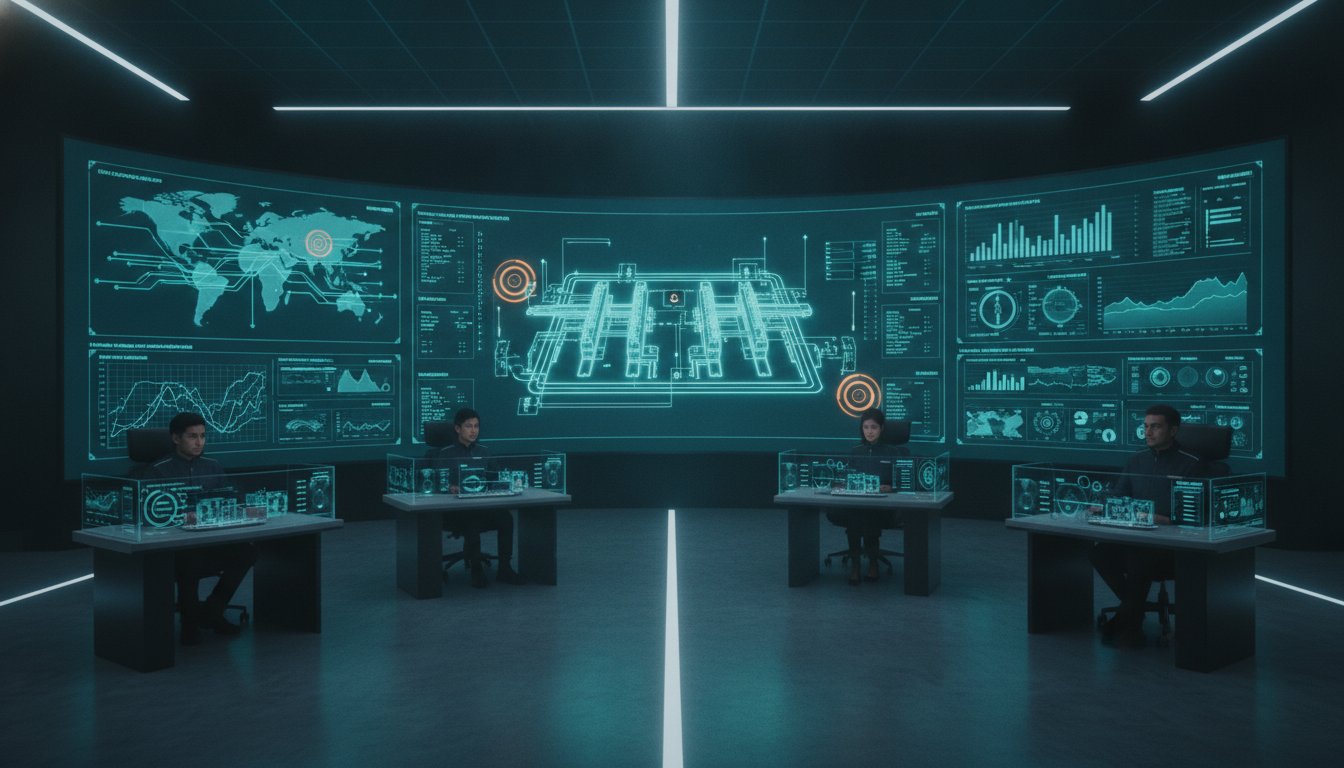
In a high-stakes environment where unplanned downtime costs an average of $260,000 per minute, your operators cannot afford to act as human integration points between disconnected monitors. When critical incidents occur, the difference between a minor adjustment and a total shutdown often depends on how quickly a team can synthesize siloed data. Most control rooms already have the screens. What they’re missing is the layer that decides what goes on them, and escalates automatically when something needs attention. Implementing modern manufacturing control room solutions is no longer about adding more hardware; it’s about deploying the intelligence required to make sense of the data you already have.
You likely recognize the fatigue of information overload and the operational risks created when teams must hunt for answers across fragmented systems. This guide demonstrates how to transform that chaos into a unified, event-driven operating picture that secures faster, more certain decision-making. We’ll examine the shift toward vis/ability as the centralized operational intelligence layer that reduces operator cognitive load and ensures seamless collaboration between the control room and field teams.
Key Takeaways
- Identify the operational risks of fragmented data and why siloed systems like SCADA and ERP prevent a unified common operating picture.
- Discover how modern manufacturing control room solutions prioritize an intelligent software layer to automate event-driven situational awareness.
- Recognize that effective situational awareness depends on a platform that prioritizes essential information and automates incident escalation.
- Reduce operator fatigue by presenting only high-priority data that requires immediate human judgment and certain action.
- Explore how a mobile operational intelligence platform connects the central control room with field teams to ensure seamless collaboration.
The Challenge of Modern Manufacturing Situational Awareness
Industry 4.0 has fundamentally changed the expectations for situational awareness. It isn’t enough to simply see that a machine is running. Operators must understand the implications of that data in real time. In a modern control room, this requires the synthesis of SCADA telemetry, ERP logistics, and facility security data. However, most facilities suffer from profound digital fragmentation. When these systems remain siloed, operators are forced to act as the primary integration point. This manual correlation creates a significant lag in response times, directly impacting the bottom line and increasing operational risk.
The traditional response to increased complexity has been to install more hardware. This approach assumes that more pixels lead to better decisions. In reality, adding monitors often compounds cognitive load. Operators find themselves scanning dozens of displays, searching for the one metric that matters amidst a sea of status-quo data. This lack of prioritization is why critical incidents go unnoticed until they cause physical damage or production halts. Strategic manufacturing control room solutions must move beyond the screen and address the underlying data architecture to ensure clarity during high-stakes events.
The Problem of Data Silos in Process Control
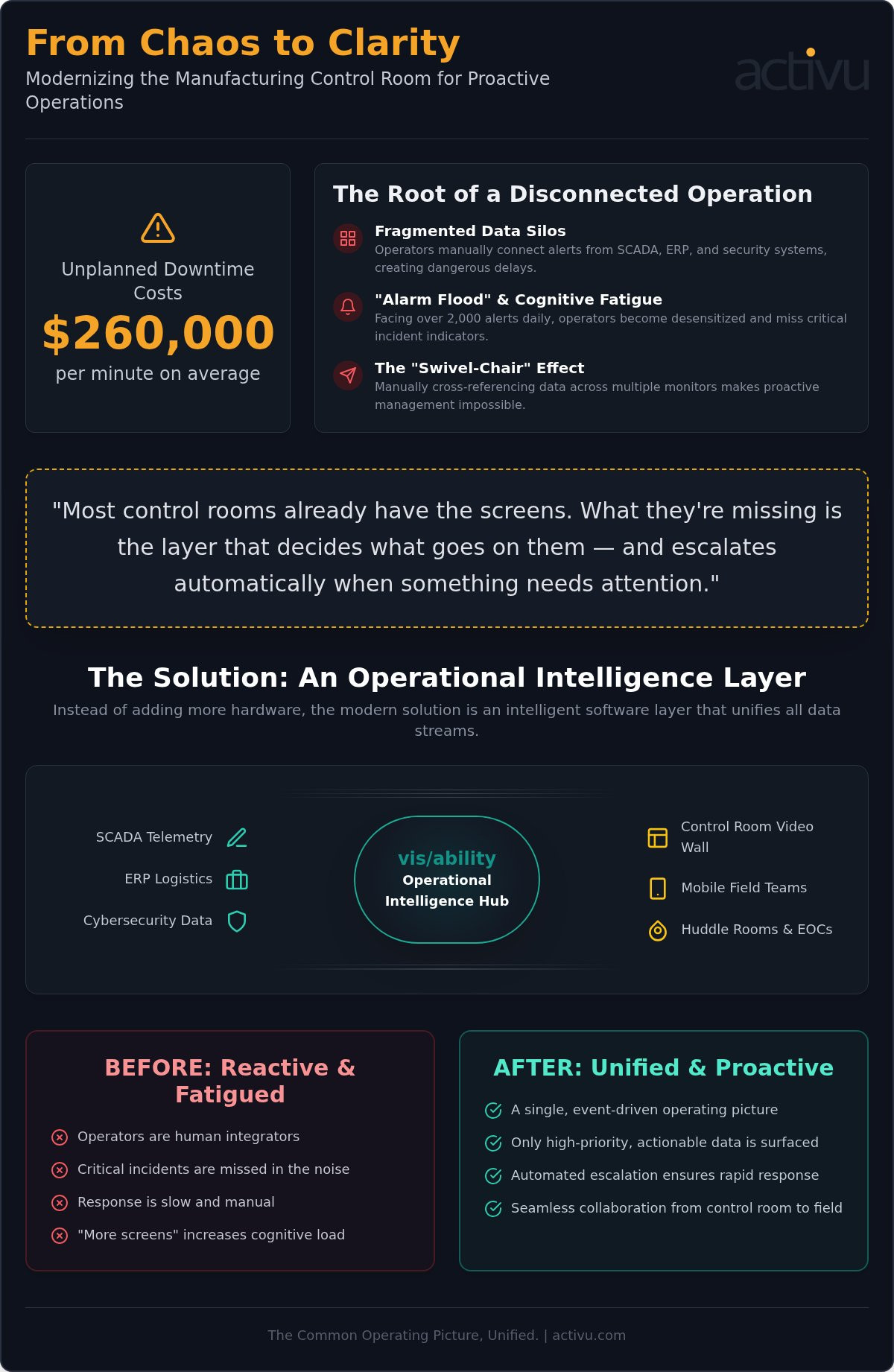
Disparate data streams prevent a unified view of plant health. Operators frequently experience the “swivel-chair” effect, where they must manually cross-reference an alert in the SCADA system with a log in the ERP or a visual in the CCTV feed. This fragmented workflow makes proactive management impossible. When information is siloed, the organization remains in a reactive state, only responding after a threshold is already crossed. With unplanned downtime costing an average of $260,000 per minute, these delays are unsustainable. Effective manufacturing control room solutions must bridge these gaps to create a cohesive environment for decision-makers.
Why Operators Miss Critical Manufacturing Incidents
Human attention is a finite resource. In a 24/7 environment, operators often face an “alarm flood,” managing over 2,000 alerts daily. When critical manufacturing incidents are buried under a mountain of low-priority noise, the brain naturally begins to filter out information. This cognitive fatigue is a primary reason why operators miss subtle indicators of impending failure. Without a system that filters information based on operational relevance, the most sophisticated video wall remains a liability. Success requires a shift from showing everything to showing only what requires immediate action and human judgment. For facilities where safety is paramount, integrating professional services from Vita Secure can help manage these risks by providing expert safety oversight during critical operations.
Most control rooms already have the screens. What they’re missing is the layer that decides what goes on them, and escalates automatically when something needs attention. While many organizations focus on the physical resolution or brightness of a video wall, the true value of modern manufacturing control room solutions lies in the software layer that orchestrates the data. This operational intelligence layer serves as the central hub where raw telemetry meets human judgment. It transforms a wall of static monitors into a dynamic environment that reacts to real-time production anomalies. By prioritizing essential information, the platform ensures that the transition from data to action is seamless and immediate.
The vis/ability platform provides this necessary foundation. It doesn’t replace your existing specialized tools; it makes them more effective for the entire team. By aggregating streams from across the enterprise, the platform ensures that the right people see the right information at exactly the right moment. This shift from hardware-centric design to intelligence-first strategy is what defines high-performing operations. When stakes are at their highest, the technology acts as the essential bridge between complex data and the human ability to act with certainty. To explore how custom AI agents can further enhance this intelligence-first strategy, you can learn more about Engineer Up.
Vis/ability as a Central Hub for Manufacturing Data
A true Common Operating Picture (COP) requires more than just a shared view. It requires the seamless integration of real-time video, SCADA feeds, and cybersecurity data into a single, accessible interface. vis/ability acts as the unifying platform where these disparate streams converge. For instance, while a SIEM or SOAR tool might detect a cybersecurity threat on the plant floor, these tools only provide a partial solution. vis/ability ensures that the alert is instantly visualized alongside the affected machine’s live CCTV feed and operational status. This level of application integration empowers the entire team to collaborate with a shared understanding of the operational reality.
Event-Driven Visualization: Filtering the Noise
The core of operational efficiency is the concept of management by exception. Rather than forcing operators to monitor thousands of steady-state data points, vis/ability uses event-driven situational awareness to filter the noise. When a specific threshold is triggered, the platform automatically escalates the relevant data and changes the video wall layout to focus on the incident. This automated escalation ensures that critical alerts are never buried under status-quo information. By presenting only the need-to-know data during a crisis, the system reduces cognitive load and accelerates the path to resolution. You can explore the vis/ability platform to see how this intelligence layer redefines manufacturing oversight.
Evaluating Manufacturing Control Room Solutions: Hardware vs. Strategy
Organizations often mistake physical infrastructure for operational capability. You might invest in ergonomic consoles or high-resolution displays, but these components are merely the stage upon which your data performs. Most control rooms already have the screens. What they’re missing is the layer that decides what goes on them, and escalates automatically when something needs attention. True continuity isn’t achieved through better desks; it’s achieved through a strategy that prioritizes the delivery of actionable intelligence over the mere display of raw data.
While ergonomic solutions from providers like ABB or Winsted address physical operator comfort, they don’t solve the problem of digital fragmentation. An operator sitting in a perfectly adjusted chair still faces the same cognitive exhaustion if they must manually correlate data across twelve different monitors. Strategic manufacturing control room solutions focus on the software layer first, ensuring the physical environment supports a streamlined, intelligent workflow that empowers individuals to act with greater certainty.
The Limitations of Hardware-Only Video Walls
High-resolution screens can still display useless or overwhelming data if they lack an intelligent management layer. Many legacy builds rely on proprietary hardware controllers that create significant maintenance challenges and lack the flexibility to scale. When you rely on Commercial Off-the-Shelf (COTS) hardware without an integration layer, you’re essentially building a static display system in a dynamic operational world. Software-defined visualization allows for a future-proof environment where layouts and data feeds adapt to the current threat level or production status without requiring a hardware overhaul.
Choosing a Unified Platform Over Point Solutions
Many organizations deploy specialized applications to manage specific segments of their operation. While these tools provide valuable data, they often operate in isolation, forcing operators to jump between interfaces to find the full story. The vis/ability platform fills these gaps by acting as the unifying platform where all specialized applications converge. It makes your existing tools more useful for the entire team by providing a single, event-driven interface. When evaluating the intelligence of your solution, consider whether it provides a true common operating picture or if it simply adds another screen to an already cluttered wall. You can explore how this integration works through our manufacturing control room solutions.
Optimizing Situational Awareness and Reducing Operator Fatigue
Operators in 24/7 manufacturing environments often face an impossible volume of data. Industry research indicates that personnel in these settings can be bombarded with over 2,000 alarms daily. This reality stands in stark contrast to industry recommendations that suggest operators should ideally manage only six alarms per hour to maintain peak performance. This “alarm flood” is a primary driver of cognitive exhaustion and missed incidents. Effective manufacturing control room solutions must solve this by acting as a sophisticated filter. Most control rooms already have the screens. What they’re missing is the layer that decides what goes on them, and escalates automatically when something needs attention. By presenting only need-to-know information, vis/ability ensures that human attention is reserved for the most critical decisions. This approach is vital for maintaining Operational Continuity: Ensuring Mission-Critical Resilience across the enterprise.
Human-Centric Design for 24/7 Manufacturing
Intuitive design isn’t a luxury; it’s an operational requirement. When interfaces are overly complex, the training burden for new operators becomes a significant bottleneck during high-stakes shifts. vis/ability provides a streamlined experience that offers steady reassurance through a reliable common operating picture. This clarity allows diverse roles, from plant managers to maintenance engineers, to collaborate without second-guessing the validity of the data. It shifts the focus from deciphering a cluttered system to acting on the intelligence it provides, ensuring that every individual understands their role in the current operational reality.
Automating the Escalation Process
The transition from reactive firefighting to proactive incident management depends on intelligent automation. The vis/ability platform identifies when critical manufacturing thresholds are reached and alerts only the necessary personnel. This precision prevents the entire team from being distracted by localized issues that don’t require their immediate attention. Automated SITREPs further enhance this by providing organizational transparency without the need for manual data entry during a crisis. These reports ensure that stakeholders receive timely, accurate updates, maintaining visibility as incidents evolve and resolve. You can contact our team to learn how these automated workflows can be integrated into your existing facility.
Implementing a Future-Ready Manufacturing Control Room
Integrating modern manufacturing control room solutions requires a shift from viewing the command center as a room full of monitors to viewing it as a strategic operational asset. The implementation process begins by mapping your specific data feeds and workflows to the intelligence platform. Most control rooms already have the screens. What they’re missing is the layer that decides what goes on them, and escalates automatically when something needs attention. By focusing on this operational intelligence layer first, you ensure that the physical build-out supports real-world decision-making rather than just providing a backdrop of static pixels. This strategic alignment turns raw data into a bedrock of technical reliability.
Professional Control Room Design Services play a vital role in this transition. These services ensure that the physical layout, lighting, and ergonomics complement the digital environment. This holistic approach prevents common pitfalls where high-end hardware fails to deliver results because it was not integrated with the operator’s daily reality. When the environment is designed around the purposeful flow of information, the command center becomes a trusted partner in maintaining uptime. It projects a persona of high intelligence and unwavering dependability, remaining focused and analytical when stakes are at their highest.
Extending Visibility Beyond the Control Room
Operational intelligence shouldn’t be confined to a single physical location. Mobile vis/ability extends critical insights to field supervisors and distributed leadership, ensuring that everyone operates from a single version of the truth. Whether a stakeholder is in a huddle room, at a remote site, or on a mobile device, they see the same event-driven operating picture as the central command team. This level of integration eliminates the communication lag that often occurs when field teams must wait for verbal updates. It provides a methodical and steady flow of information that mimics a well-oiled process. By making existing tools useful for the entire team, the platform ensures that visibility remains constant across the entire enterprise.
Next Steps for Operational Excellence
Achieving operational excellence starts with a pain-first assessment of your current visibility gaps. Identify where fragmented systems cause delays or where operators struggle with siloed data. Once these gaps are clear, you can begin the process of layering vis/ability over your existing tools to create a unified common operating picture. This logical progression leads the organization from a state of complexity to a state of clear, actionable intelligence. You can explore our Manufacturing & Process Control Solutions to see how this intelligence-first approach transforms production oversight. To see the platform in action, request a specialized demo tailored to your facility’s unique operational requirements.
Securing Operational Continuity through Intelligence
The evolution of the factory floor requires a fundamental shift in how organizations approach manufacturing control room solutions. Success no longer depends on the number of pixels in a room, but on the intelligence of the platform orchestrating the data. By implementing vis/ability as your operational intelligence layer, you transform fragmented streams from SCADA, VMS, and IT tools into a single, cohesive operating picture. This event-driven automation significantly reduces time-to-incident-awareness, ensuring that critical alerts never go unnoticed amidst an alarm flood.
Trusted by global leaders in manufacturing and utilities, the platform acts as the essential bridge between raw telemetry and decisive human action. Most control rooms already have the screens. What they’re missing is the layer that decides what goes on them, and escalates automatically when something needs attention. Transitioning to this unified model empowers your team to act with absolute certainty, even when stakes are at their highest.
Take the first step toward a more resilient, future-ready operation. Request a Demo of the vis/ability Platform to see how seamless integration and automated escalation can redefine your command center. You have the data; it’s time to turn it into actionable intelligence.
Frequently Asked Questions
What are the most common situational awareness problems in manufacturing control rooms?
Situational awareness problems often stem from fragmented data sources that require manual correlation. Operators struggle when SCADA telemetry, security video, and ERP data exist in separate silos. This fragmentation prevents a unified common operating picture, which is why many facilities seek modern manufacturing control room solutions. Without a cohesive view, the team lacks the context needed to understand how an isolated alert impacts the broader production line or facility safety.
How does an operational intelligence layer differ from a standard video wall controller?
A standard video wall controller merely manages pixels and layouts based on manual input. In contrast, an operational intelligence layer like vis/ability acts as a software hub that orchestrates information based on real-time events. Most control rooms already have the screens; what they’re missing is the layer that decides what goes on them, and escalates automatically when something needs attention. It transforms static monitors into a dynamic, responsive environment that mirrors a command operation.
Can vis/ability integrate with my existing SCADA and CCTV systems?
Yes, vis/ability is designed to aggregate disparate streams into a single interface. It integrates with existing SCADA systems, VMS platforms, and IT monitoring tools. By acting as a central hub, the platform makes these specialized tools more useful for the entire team. This integration ensures that when a SCADA threshold is reached, the relevant CCTV feed is instantly visualized for immediate verification. It provides the bedrock for certain action during a crisis.
How do manufacturing control room solutions reduce operator cognitive overload?
Advanced manufacturing control room solutions reduce cognitive load by applying event-driven filters to raw data. Rather than displaying every available stream, the system prioritizes essential information based on pre-defined operational thresholds. This management by exception approach ensures operators only interact with data that requires human judgment. By automating the reduction of background noise, the platform allows the team to remain focused on high-stakes decision-making and proactive incident management.
Why do operators often miss critical incidents despite having multiple video walls?
Operators miss incidents because more screens often lead to more noise rather than more clarity. Without an intelligence layer, a video wall is just a collection of static data that overwhelms the human brain’s ability to process information. When critical alerts are buried under status-quo telemetry, they become invisible. Operators require a system that automatically identifies anomalies and changes the display layout to highlight the most urgent threats, ensuring visibility when stakes are highest.
How can I manage multiple data feeds effectively in a dispatch or command center?
Effective management of multiple data feeds requires a unifying platform that can ingest and prioritize diverse streams. In a dispatch or command center, you must move away from manual swivel-chair integration. Implementing an event-driven situational awareness platform allows you to automate how feeds are presented. This ensures that the most relevant data from IT, security, and operations is always front and center during a pivotal decision, enabling faster and more certain results.
What is the benefit of extending control room visibility to mobile devices?
Mobile vis/ability extends the common operating picture beyond the physical walls of the control room. It keeps field supervisors and executives informed with the same real-time data seen by the command team. This connectivity eliminates communication delays and ensures a single version of the truth across the entire enterprise. Whether in a huddle room or on the plant floor, stakeholders can collaborate with greater certainty and act on actionable intelligence without being tied to a desk.
How does vis/ability improve cybersecurity visualization for manufacturing plants?
vis/ability improves cybersecurity visualization by correlating IT threat alerts with physical operational status. When a security tool detects a potential breach, the platform can instantly display the affected industrial control systems alongside live facility video. This integrated view provides the context needed to determine if a cyber event is impacting physical production. It turns abstract security data into a clear common operating picture, allowing teams to respond to threats with technical reliability and speed.