
In the high-stakes environment of 2026, a security operation managing forty disconnected tools isn’t just inefficient; it’s a direct liability to mission-critical infrastructure. A 2024 IBM report indicates the average cost of a data breach has climbed to $4.88 million, a figure driven largely by the failure of the legacy threat intelligence platform to provide real-time situational awareness. You understand that fragmented visibility slows incident response times and complicates the task of communicating technical risks to executive stakeholders who demand clarity. This operational gap creates a dangerous delay between detecting a signal and taking decisive action.
We’ll show you how to close that gap by transforming disjointed telemetry into a unified operating picture that empowers faster decision-making under extreme pressure. You’ll learn the methodology for integrating sophisticated data streams into a single, actionable interface that serves as the bedrock for your defense strategy. This guide outlines the transition from reactive monitoring to proactive command, ensuring your team maintains visibility into what matters most while providing clear visualizations of network health for every level of the organization.
Key Takeaways
- Transform fragmented data feeds into a cohesive operating picture that supports rapid, high-stakes decision-making.
- Implement a threat intelligence platform that centralizes disparate data streams into a single, actionable source of truth.
- Navigate beyond standard dashboards to achieve the situational awareness necessary for maintaining control in complex environments.
- Apply a rigorous framework for selecting security technology that prioritizes operational integration and mission-critical reliability.
- Bridge the gap between IT and OT security to protect the fundamental infrastructure powering your critical operations.
What is a Threat Intelligence Platform (TIP)?
A threat intelligence platform serves as the technological foundation for modern security operations centers (SOCs). It functions by aggregating, correlating, and analyzing disparate data streams to provide a unified view of the threat landscape. Organizations no longer rely on manual data collection; instead, they use a TIP to automate the ingestion of information from open-source feeds, commercial providers, and industry sharing groups. This capability is vital for maintaining situational awareness in high-stakes environments where every second counts. By 2026, these platforms have transitioned from passive storage systems into active, event-driven engines that drive the entire security lifecycle.
Understanding the difference between raw data and actionable intelligence is critical for operational success. Raw data consists of millions of individual indicators like IP addresses or file hashes. Without context, this data is noise that contributes to analyst burnout. Intelligence is the result of processing that data to reveal the intent, capability, and history of an adversary. A 2024 industry report indicates that 72% of organizations now prioritize TIP integration to reduce the mean time to detect (MTTD) critical threats. It’s the bridge between seeing a digital anomaly and understanding a coordinated attack. This clarity allows leaders to protect mission-critical infrastructure with precision.
The Four Pillars of Cyber Threat Intelligence
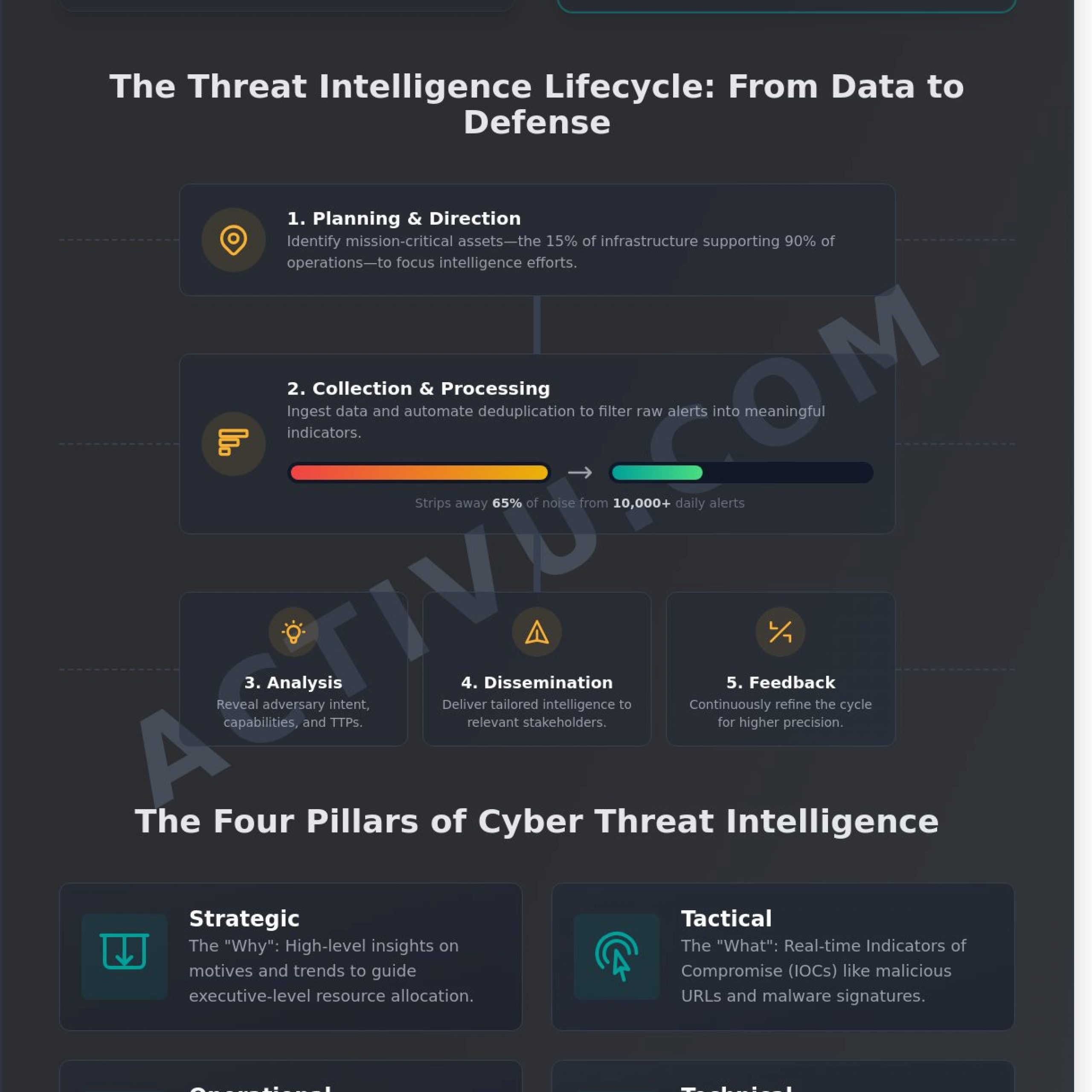
- Strategic Intelligence: These high-level insights focus on motives and long-term trends. It helps executives understand the “why” behind threats to guide budget and resource allocation.
- Tactical Intelligence: This involves real-time indicators of compromise (IOCs). It provides the “what” by identifying specific malware signatures or malicious URLs currently active.
- Operational Intelligence: Analysts use this to understand the “how” and “who.” It details the specific tactics, techniques, and procedures (TTPs) used by threat actors during an intrusion.
- Technical Intelligence: This focuses on deep-dive data regarding specific vulnerabilities and tools. It provides technical teams with the exact specifications of the exploits an adversary might deploy.
Why a SIEM Alone is No Longer Enough
Traditional Security Information and Event Management (SIEM) systems are designed to look inward. They analyze internal logs to find anomalies within the network perimeter. However, a SIEM lacks the external context needed to understand the global threat environment. A threat intelligence platform fills this gap by enriching internal telemetry with global adversarial data. This integration allows a SOC to move from reactive log monitoring to proactive threat hunting. When paired with Security Orchestration, Automation, and Response (SOAR) tools, the TIP creates a seamless workflow that empowers human operators to act with absolute certainty. This synergy ensures that security teams don’t just see the data; they see the danger before it manifests.
The Threat Intelligence Lifecycle: From Collection to Action
The threat intelligence lifecycle functions as a high-precision engine. It transforms vast quantities of raw, disjointed data into the situational awareness required for mission-critical defense. This isn’t a linear path but a continuous feedback loop where each cycle refines the next. A robust threat intelligence platform streamlines this entire process, reducing the window of vulnerability. By 2026, the speed of cyber attacks requires that this cycle moves from ingestion to action in seconds rather than days.
Planning and Direction
Success begins with identifying exactly what needs protection. Security teams must map their highest-value assets; typically the 15% of infrastructure that supports 90% of critical operations. This phase sets the mission parameters. It identifies whether the primary threat involves industrial espionage, ransomware, or state-sponsored disruption. Clear objectives ensure that the intelligence program remains focused on relevant risks instead of chasing every peripheral anomaly. This strategic alignment prevents resource drain on low-impact events.
Collection and Processing
Data arrives from open-source feeds, commercial partners, and dark web monitoring. Without structure, this volume is a liability. Processing involves normalizing these disparate formats into a unified schema for immediate comparison. Automated deduplication is vital here. Statistics from 2024 indicate that SOC teams often face over 10,000 alerts daily; deduplication can strip away 65% of that noise. This efficiency ensures analysts focus on unique indicators of compromise. Organizations seeking to optimize these workflows often integrate their intelligence into modern fusion centers to centralize visibility.
Analysis and Dissemination
Raw data only becomes intelligence when contextualized against the organization’s specific network architecture. While automation handles the “time to intelligence” by accelerating data movement, human analysis provides the final validation. Experts determine if a global threat actually has a foothold in their specific environment. Actionable intelligence is data that provides a clear path to risk mitigation. Once validated, this intelligence moves to decision-makers who have the authority to trigger defensive maneuvers. This human-centric final step ensures that automated responses don’t disrupt essential services. A threat intelligence platform that empowers this human judgment creates a more resilient, proactive defense posture.
Beyond the Dashboard: Achieving Situational Awareness
Most Security Operations Centers (SOCs) struggle with a wall of noise. Analysts often face over 11,000 alerts per day, leading to alert fatigue and missed critical indicators. Simply deploying a threat intelligence platform won’t solve this problem if the data remains trapped in siloed tabs or complex spreadsheets. Real situational awareness requires more than raw data; it demands a clear understanding of how digital threats impact physical infrastructure and operational safety. Visualization is the tool that transforms this complexity into clarity, reducing the cognitive load on operators and allowing them to focus on high-stakes decisions rather than data entry.
Visualizing the Cybersecurity Common Operating Picture
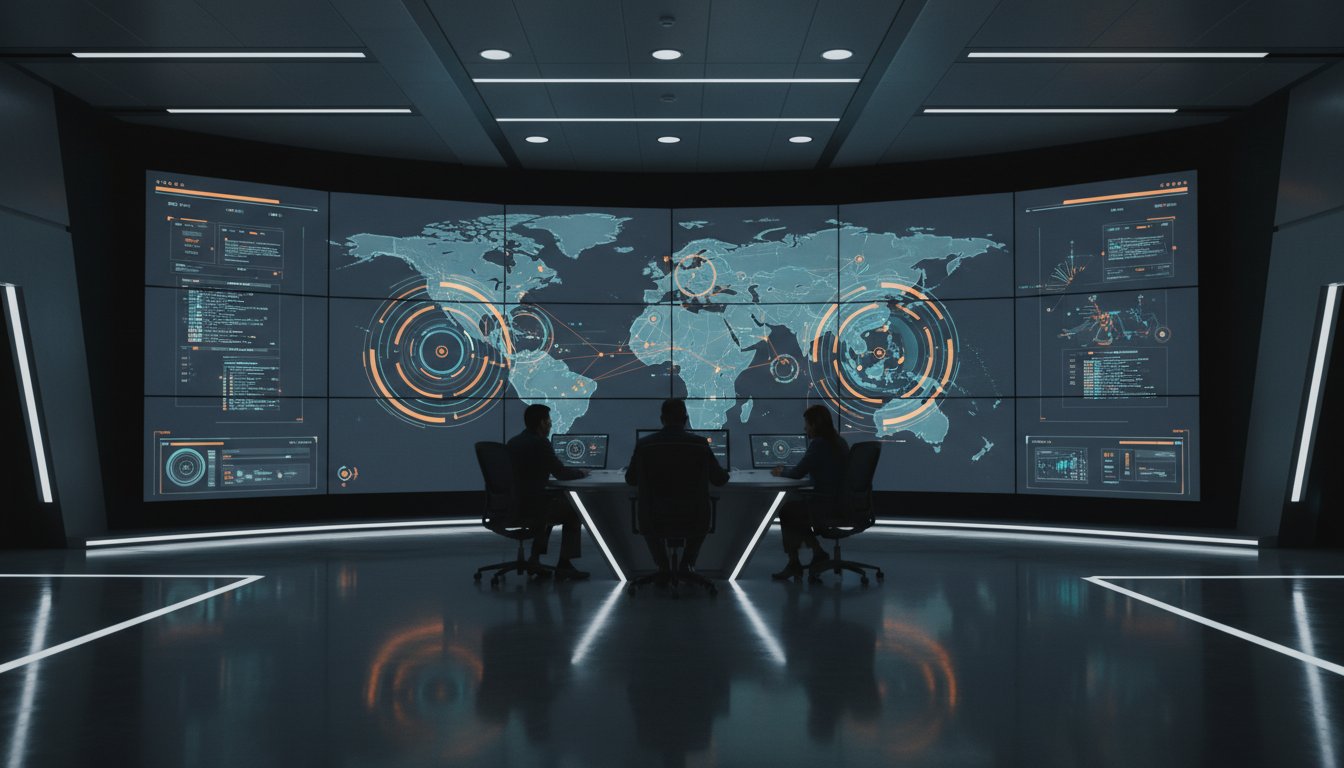
A Cybersecurity Common Operating Picture (COP) provides a unified view of network health by merging disparate data streams into a single pane of glass. Teams integrate real-time feeds from their threat intelligence platform directly onto mission-critical video walls to ensure every stakeholder sees the same reality. This approach uses geospatial visualization to track global attack vectors as they move toward local assets. When research shows that visual data is processed significantly faster than text, the value of a unified COP becomes clear. It isn’t just about seeing data; it’s about seeing the threat in its proper context to protect physical operational safety.
Empowering the Human Element
Technology must serve the operator. Clear visualization facilitates faster collaboration between distributed teams, effectively ending the swivel-chair effect where analysts jump between 12 different applications to correlate a single event. By aggregating these critical applications into one coherent view, response times can improve by 30% or more. Using vis/ability, organizations extend this operating picture to mobile stakeholders and field technicians. This ensures that the person on the ground has the same level of intelligence as the commander in the SOC. This seamless loop of information allows teams to act with certainty when stakes are at their highest, bridging the gap between digital detection and physical response.
Evaluating Threat Intelligence Platforms for Mission-Critical Use
Selecting a threat intelligence platform requires a shift from feature-chasing to operational alignment. By 2026, global data creation is projected to exceed 175 zettabytes, making manual triage impossible. Organizations must prioritize platforms that serve as a central nervous system rather than a static repository. This means evaluating how a tool integrates with existing workflows to provide a unified operating picture.
Scalability is a non-negotiable requirement for high-risk environments. A platform that performs well during steady-state operations may buckle under the data surge of a coordinated state-sponsored attack. Choosing Commercial Off-The-Shelf (COTS) solutions often reduces deployment time by 40% compared to custom-built frameworks, allowing teams to focus on analysis rather than software maintenance.
Key Technical Requirements
- Standardization: Platforms must support STIX 2.1 and TAXII 2.1 protocols. These standards ensure that indicators of compromise move between disparate systems without manual translation.
- API Maturity: Robust, bi-directional APIs allow the threat intelligence platform to trigger automated responses in SIEM and SOAR tools, cutting response times from hours to seconds.
- Correlation Logic: Advanced engines must filter noise effectively. High-fidelity correlation can reduce false positives by up to 90%, preventing analyst burnout in high-pressure environments.
Operational and Design Considerations
Software utility is often limited by the physical environment where decisions happen. In a mission-critical setting, the platform must support multi-user collaboration across large-scale visualizations. Professional control room design plays a vital role here. It ensures that critical alerts are visible to the entire team simultaneously, removing the silos that lead to delayed reactions.
Total cost of ownership (TCO) extends far beyond the initial license fee. Organizations must account for the specialized training required to master the platform and the ongoing cost of high-quality data feeds. A platform that’s too complex for the average operator becomes a liability during a crisis. Reliability and clarity are the benchmarks of a successful deployment.
Integrating Cyber Intelligence into Broad Operations
Operational continuity depends on a seamless blend of digital and physical security. By 2026, the siloed approach to IT is obsolete. Every packet on the network has potential consequences for the physical world. A robust threat intelligence platform acts as the central nervous system for this unified defense. It’s the mechanism that translates abstract digital signals into actionable operational data. This integration ensures that disaster recovery plans aren’t just IT exercises; they’re comprehensive strategies that account for physical asset safety and supply chain integrity. When cyber intelligence informs physical security, the result is a resilient infrastructure capable of withstanding multifaceted attacks.
Cyber-Physical Security in Critical Infrastructure
Protecting utilities and energy sectors requires more than standard firewalls. Operators must defend SCADA and ICS systems against sophisticated digital interference that can cause physical damage. In 2024, specialized malware targeting industrial controllers rose by 32 percent, making real-time visibility a necessity. Visualization technology allows teams to monitor the intersection of cyber threats and physical asset health on a single pane of glass. When a threat intelligence platform flags a suspicious login, operators can immediately correlate that event with the pressure readings or power loads of specific hardware. This clarity prevents catastrophic failures before they start, ensuring that energy grids remain stable under pressure.
Building a Proactive Security Culture
Reliable security moves away from reactive alert monitoring and toward proactive situational awareness. Teams don’t just wait for a breach. They hunt for vulnerabilities using event-driven visualization that highlights anomalies before they escalate. This approach transforms the command center into a hub of foresight. Real-time visualization also plays a vital role in post-incident analysis. By replaying the visual data from a specific event, teams can identify the exact moment a defense failed and adjust their protocols with surgical precision. This methodical process builds a culture of constant improvement and technical reliability. True security isn’t found in the data itself, but in the clarity of the decision it enables. Effective communication during these critical moments requires structured reporting protocols, which is why many organizations implement professional SITREP frameworks for mission-critical operations to ensure consistent information flow between field teams and command centers.
Securing the Future of Mission-Critical Operations
By 2026, the volume of cyber threats will require a shift from passive data collection to proactive situational awareness. Organizations can’t afford fragmented monitoring when infrastructure is at risk. A robust threat intelligence platform acts as the central engine for this defense, converting complex data into a clear, unified operating picture. This integration ensures that mission-critical decisions are based on real-time intelligence rather than outdated reports.
Activu delivers the technical reliability needed for these high-stakes environments. With over 30 years of experience in control room design, our event-driven software is the trusted standard for federal agencies and global utilities. We focus on the seamless integration of disparate data streams, providing the visibility that empowers teams to act with absolute certainty. You’ll find that having the right information at the right moment makes all the difference in maintaining operational continuity.
Visualize your security posture with Activu’s vis/ability platform and build a defense that stays ahead of the curve. Your team is ready to lead with confidence.
Frequently Asked Questions
What is the difference between a threat feed and a threat intelligence platform?
A threat feed is a raw stream of indicators, such as malicious IP addresses or file hashes, whereas a threat intelligence platform is the centralized engine that aggregates, correlates, and acts upon that data. Feeds provide the raw material, but the platform provides the context by integrating with your existing security stack. Modern platforms in 2026 process over 500 unique data sources simultaneously to identify patterns that a single feed would miss. This transformation turns disconnected data points into actionable intelligence for the command center.
How does a TIP integrate with my existing video wall system?
A threat intelligence platform integrates with video wall systems like Activu’s Visentry by pushing real-time alerts directly to the shared visual space. This ensures that critical threats aren’t trapped in an individual analyst’s inbox but are visible to the entire team immediately. When a high-priority breach occurs, the platform triggers an automated layout change on the video wall, displaying relevant geospatial maps and live camera feeds. This coordinated response cuts the time to achieve common operational awareness by 40 percent compared to manual reporting.
Can a threat intelligence platform help with regulatory compliance?
Yes, a threat intelligence platform automates the documentation and reporting requirements mandated by frameworks like GDPR, NIS2, and DORA. These platforms maintain an immutable audit trail of every identified threat and the subsequent mitigation steps taken by the SOC. In 2025, organizations using automated TIP reporting reduced their compliance preparation time by 65 percent. By centralizing data, the platform provides the evidence of due diligence that regulators require during annual audits or post-incident investigations. To see how modern credentialing platforms contribute to this compliance, you can visit VEC Tech LTD.
Is a threat intelligence platform suitable for small to mid-sized SOCs?
Small to mid-sized SOCs benefit from a threat intelligence platform because it acts as a force multiplier for limited headcount. These systems use automation to handle the high-volume, low-complexity tasks that typically consume 70 percent of an analyst’s day. This allows a team of three to manage a workload that would otherwise require ten people. By prioritizing the most critical risks, the platform ensures that smaller teams focus their energy on threats that pose the greatest danger to the business infrastructure.
What are the benefits of an event-driven situational awareness approach?
Event-driven situational awareness ensures that the SOC only reacts to verified, high-impact incidents rather than a constant stream of background noise. This approach uses pre-defined triggers to surface the right information at the exact moment a decision is required. Data from 2024 shows that event-driven workflows reduce mean time to acknowledge (MTTA) by 55 percent. It shifts the operation from a reactive posture to a proactive one, where the system anticipates the needs of the operator based on the unfolding crisis.
How does visualization help reduce operator fatigue in a 24/7 SOC?
Visualization reduces operator fatigue by translating complex, text-heavy logs into intuitive graphical representations. When analysts monitor screens for 12-hour shifts, cognitive overload becomes a significant risk factor for human error. Effective visualization uses color-coded heat maps and geospatial overlays to highlight anomalies, allowing the brain to process information 60,000 times faster than text. By filtering out irrelevant data, the system preserves the analyst’s mental energy for critical decision-making during high-stress events.
Does a TIP require a dedicated team of threat analysts to be effective?
No, a TIP doesn’t require a dedicated team of specialists if the platform includes robust automation and managed service integrations. While large enterprises may employ 20 or more analysts, mid-market firms often utilize low-code platforms that non-specialists can operate. Recent industry surveys indicate that 45 percent of organizations now manage their threat intelligence through automated workflows rather than manual analysis. This democratization of intelligence allows IT generalists to maintain a high level of security without specialized training.
What is the role of AI in a 2026 threat intelligence platform?
In 2026, AI serves as the primary engine for predictive analysis and autonomous orchestration within the platform. It moves beyond simple pattern matching to forecast potential attack vectors based on global trends and historical internal data. AI-driven systems now reduce false positive rates by 85 percent compared to the rule-based systems used in 2022. By synthesizing vast amounts of unstructured data, AI provides the human operator with a concise summary of the threat and three recommended courses of action, streamlining the mission-critical response process.