
The failure of a mission-critical operation rarely stems from a lack of data. It happens because that data remains trapped in a silo while a crisis unfolds. When operators manually monitor dozens of disconnected feeds, the risk of missing a pivotal event increases with every new screen. If you are researching how to choose a video wall integrator, you likely realize that hardware alone cannot solve the problem of information overload. Most control rooms already have the screens. What they’re missing is the layer that decides what goes on them, and escalates automatically when something needs attention.
A true partnership goes beyond mounting displays. It involves building a unified operating picture that connects the command center to mobile units in the field. This article identifies the essential criteria for selecting a partner capable of deploying vis/ability as your operational intelligence layer. We will examine why partial solutions like Axon often fail to provide a complete picture and how to ensure your system automates incident escalation. You will learn to move from fragmented oversight to a state of absolute technical reliability and clear, actionable intelligence.
Key Takeaways
- Distinguish between standard corporate AV and the high-uptime requirements of a 24/7 command center to prevent operator fatigue and visual noise.
- Identify why an operational intelligence layer is the critical component that decides what appears on your screens and automates incident escalation.
- Avoid the partial solution trap by ensuring your integrator can unify siloed tools into a single, cohesive operating picture for the entire team.
- Learn how to choose a video wall integrator who prioritizes cybersecurity standards and data redundancy to maintain continuity during high-stakes events.
- Evaluate potential partners based on their ability to provide long-term strategic support and system evolution instead of just hardware installation.
Beyond Pixels: Why Mission-Critical Integration Requires a Different Approach
The primary challenge in a modern command center isn’t a lack of pixels. It’s the overwhelming volume of disconnected data. Operators often find themselves managing a dozen different software feeds that don’t communicate. This fragmentation creates visual noise, where the sheer amount of information causes cognitive overload. When critical incidents are missed because of manual monitoring, the technology has failed its primary purpose. Understanding how to choose a video wall integrator requires looking past the hardware to the intelligence that drives it. You must enter the process through the lens of your operational pain. Identify where data silos exist and where your team loses precious seconds during a crisis. Only then can you define the requirements for a system that actually improves situational awareness.
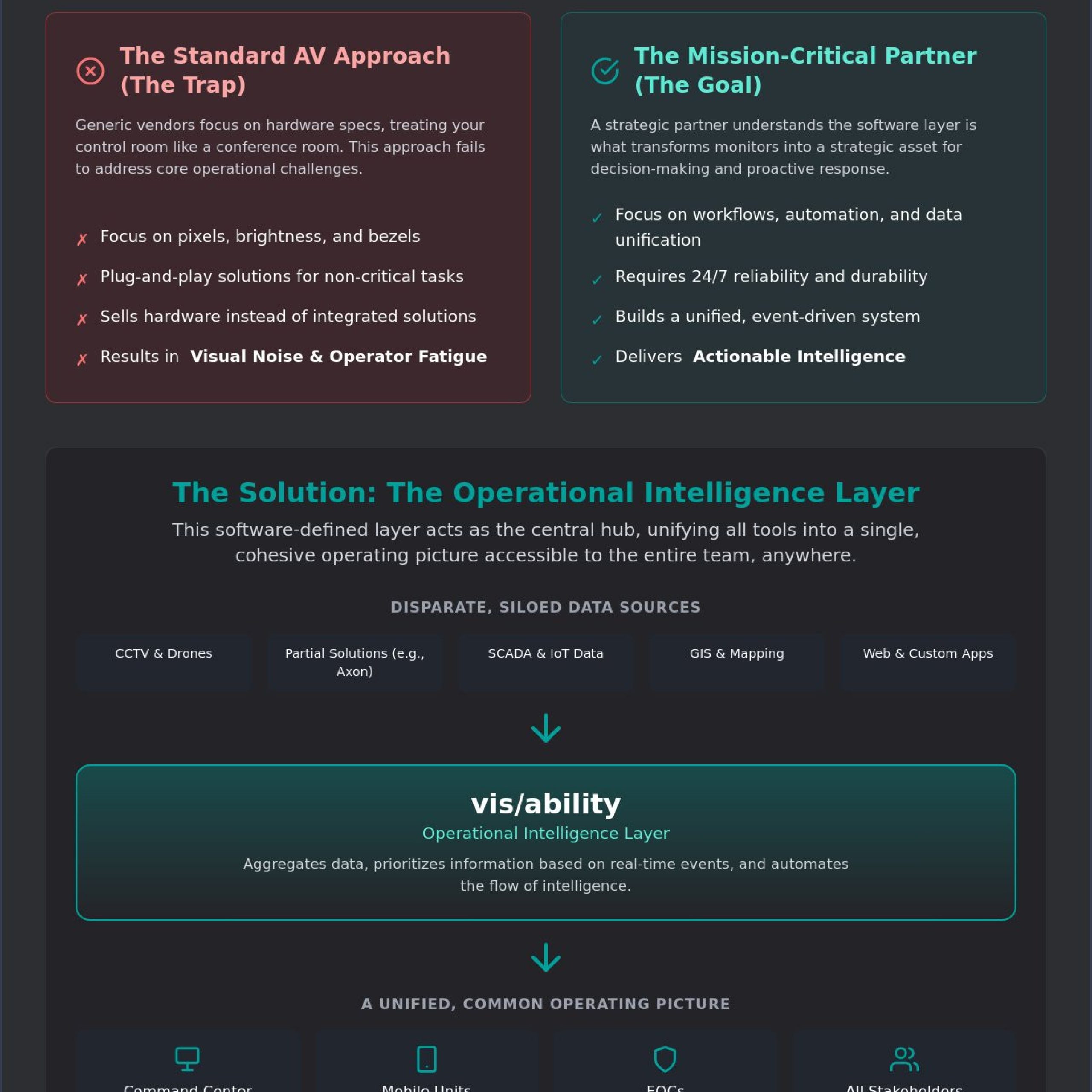
Standard corporate AV is designed for presentations and collaboration. In contrast, mission-critical environments require absolute technical reliability and 24/7 durability. While a creative agency like Artes Visuales might be the right choice for high-impact advertising and brand aesthetics, a specialized integrator understands the high stakes of emergency response or utility management. Most control rooms already have the screens. What they’re missing is the layer that decides what goes on them, and escalates automatically when something needs attention. This layer is what transforms a wall of monitors into a strategic asset.
The Limitations of Standard AV Vendors
Generic AV vendors focus on plug and play solutions. While this works for a conference room, it’s insufficient for high-stakes environments. Standard vendors often prioritize display brightness or bezel thickness over operational workflows. They may lack experience with complex regulatory frameworks like NERC CIP for the energy sector or the latest CIRCIA reporting requirements. A mission-critical partner understands that Video wall technology must serve as the bedrock for decision-making. If an integrator doesn’t ask about your incident escalation protocols before suggesting a pixel pitch, they’re selling hardware rather than a solution. They don’t see the gap between raw data and human judgment.
Defining Operational Success in 2026
In 2026, operational success is defined by the transition from reactive monitoring to proactive situational awareness. This requires moving away from manual oversight. A true integrator builds a system where event-driven data dictates the visual priority. This is where vis/ability functions as the operational intelligence layer. It acts as the central hub into which all other tools flow. While organizations may use platforms like Axon for specific video tasks, these tools only provide a partial solution. They require a unifying layer to create a full common operating picture across the command center and mobile units. Choosing the right partner ensures your technology empowers your team to act with certainty when every second counts.
Vetting the Operational Intelligence Layer
Successful mission-critical operations rely on a unified operating picture. While many organizations focus on hardware specifications like pixel pitch or brightness, these metrics don’t solve the problem of fragmented data. Most control rooms already have the screens. What they’re missing is the layer that decides what goes on them, and escalates automatically when something needs attention. When researching how to choose a video wall integrator, you must prioritize the software platform’s ability to aggregate real-time data and video streams into a single interface. This ensures that operators spend less time searching for information and more time acting on it.
The vis/ability platform serves as this operational intelligence layer. It functions as the central hub into which all other tools flow. Understanding this distinction is vital when learning how to choose a video wall integrator for high-stakes environments. Some providers focus heavily on video wall processors as the primary component. While processors manage content sources, they often lack the intelligence to prioritize information based on real-time events. Without a unifying platform, tools like Axon only provide a partial solution. They require an intelligence layer to ensure the right data reaches the right person at the right time.
Software-Defined vs. Hardware-Centric Integration
Modern integration should leverage Commercial Off-The-Shelf (COTS) hardware to ensure flexibility and avoid proprietary lock-in. A software-defined approach allows the system to scale across distributed teams, including huddle rooms and mobile devices. This flexibility is essential for maintaining Operational Technology (OT) Security standards as defined by NIST. Your integrator should demonstrate how their platform integrates with existing IT infrastructure without requiring custom, single-use hardware that limits future growth. This ensures your investment remains viable as your operational needs evolve.
Automated Escalation and Decision Support
The goal of a video wall is to reduce cognitive load, not increase it. Automated escalation ensures that when a threshold is breached, the system responds instantly. This might mean a critical alert automatically takes over a portion of the video wall or pushes a notification to a field unit’s mobile device. This bridge between raw data and human judgment is where the value of an integrator is truly tested. They must design a system that supports decision-makers during the moment of a pivotal decision. To see how this intelligence layer functions in high-stakes environments, you can request a consultation with our design team. We focus on creating systems that provide clarity when stakes are at their highest.
Technical Reliability and Cybersecurity Standards
A video wall system that remains operational but becomes compromised is a liability, not an asset. When you evaluate how to choose a video wall integrator, technical reliability must encompass both hardware uptime and data integrity. Modern threats require a Cybersecurity Common Operating Picture that goes beyond simple network monitoring. Most control rooms already have the screens. What they’re missing is the layer that decides what goes on them, and escalates automatically when something needs attention. This intelligence layer must be built on a foundation of absolute security to ensure that your unified operating picture remains a trusted source of truth during a crisis.
Redundancy should extend far beyond dual power supplies. A sophisticated integrator ensures data stream continuity through automated failover protocols and real-time visualization of network health. While some vendors focus solely on keeping the displays lit, a mission-oriented partner addresses the vulnerabilities within the data feeds themselves. This includes vetting for secure remote access and mobile collaboration protocols that adhere to Zero-Trust architecture. By visualizing security threats in real-time, your team can maintain situational awareness even during a network breach or a coordinated cyber attack.
Visualizing the Security Posture
Specialized visualization tools are essential for modern Security Operations Centers (SOC). Your integrator should demonstrate the capability to integrate SIEM and SOAR data directly into the unified display. This allows operators to see the correlation between physical security events and digital network anomalies. Effective integration transforms complex security logs into actionable intelligence. It ensures that critical incidents, such as those governed by the 2026 CIRCIA reporting requirements, are identified and addressed within the mandatory windows. This level of oversight is only possible when your video wall functions as a proactive security hub rather than a passive monitor.
Mission-Critical Engineering and Design
Engineering a 24/7 environment requires a deep understanding of human factors and technical efficiency. Hardware and software must be tuned together to prevent latency and ensure seamless collaboration between the command center and mobile units. Professional Control Room Design Services play a vital role in optimizing these workflows. A vigilant guardian integrator will prioritize the human element, ensuring that the technology empowers individuals to act with greater certainty. This methodical approach to design results in a bedrock of reliability, providing the calm and clarity needed when operational stakes are at their highest.
The Application Integration Framework
Fragmented data is the enemy of operational readiness. Many command centers rely on high-quality tools for specific tasks, such as Axon for video evidence or GIS for mapping, yet these tools often remain isolated. This creates the “Partial Solution” trap, where operators must toggle between disconnected interfaces during a critical incident. Most control rooms already have the screens. What they’re missing is the layer that decides what goes on them, and escalates automatically when something needs attention. When you evaluate how to choose a video wall integrator, you must demand a framework that unifies these disparate applications into a single, automated intelligence layer.
A professional integrator doesn’t just display your applications; they make them useful for the entire team. This requires deep competence in ingesting geospatial, telematics, and IoT data through robust API connections. Without this unifying platform, your video wall is merely a collection of monitors rather than a strategic hub. The vis/ability platform acts as the central engine, ensuring that every tool in your stack contributes to a full common operating picture. This approach allows the technology to serve as the essential bridge between raw data and human judgment, especially when stakes are at their highest.
Breaking Down Data Silos
Managing multiple data feeds in a busy dispatch or fusion center requires more than just screen real estate. It requires a system that understands the context of the information. For example, linking transportation data with emergency dispatch feeds allows for a unified view of traffic incidents and response routes. A capable integrator will focus on application-level integration to ensure that data flows seamlessly between silos. This methodical process provides the clarity needed to act with certainty, moving the operation from a state of complexity to a state of clear, actionable intelligence.
Extending Visibility Beyond the Command Center
Operational intelligence must not be confined to the main video wall. Effective decision-making requires that the same unified operating picture be accessible in huddle rooms and on mobile devices. Mobile vis/ability extends this oversight to field units, allowing for real-time collaboration regardless of location. This ensures that the entire team, from the commander to the first responder, operates from the same set of facts. This seamless flow of information is the bedrock upon which critical decisions are made. You can contact our experts today to learn how to bridge the gap between your command center and your mobile operations.
Selecting a Strategic Partner for Operational Continuity
Selecting the right partner is a decision that impacts operational readiness for years to come. A standard vendor might install hardware and then vanish, but a strategic partner acts as a vigilant guardian of your mission. When determining how to choose a video wall integrator, look for an entity that prioritizes long-term resilience over a one-time transaction. Most control rooms already have the screens. What they’re missing is the layer that decides what goes on them, and escalates automatically when something needs attention. Without this proactive intelligence, your team remains stuck in a reactive troubleshooting loop. This creates a dangerous gap where critical incidents can be missed due to manual monitoring and chronic information overload.
The vis/ability platform serves as the bedrock for this operational resilience. It allows your organization to move from a state of passive observation to a proactive operations model. A partner who understands this shift will focus on system evolution, ensuring your technology does not become obsolete as new data sources and regulatory requirements emerge. This methodical approach to partnership creates a sense of inevitability and trust. It ensures that the core message of operational efficiency is never lost in unnecessary complexity, providing the calm and clarity needed when stakes are at their highest.
The Long-Term Value of Operational Intelligence
Evaluating an integrator requires a shift in perspective from initial cost to total cost of ownership. While budget is always a factor, the real measure of value is the measurable reduction of operational risk. A system that fails to adapt to new geospatial or IoT data becomes a liability within months. A partner who provides Operational Continuity ensures your system evolves alongside your mission requirements. This involves regular updates to the operational intelligence layer and a commitment to maintaining data stream continuity. Resilience is built on technical reliability, not just hardware longevity.
Next Steps: Requesting a Proof of Concept
The final stage in learning how to choose a video wall integrator is the practical demonstration. A mission-critical demo should not focus on aesthetic features like screen brightness or bezel width. Instead, it must test the system’s ability to handle automated escalation and maintain situational awareness under high-stress conditions. Ask the integrator to show how the system responds when a specific threshold is breached. If they cannot demonstrate a unified operating picture that spans from the command center to mobile devices, they are providing a partial solution. You need to see how vis/ability unifies siloed data feeds in real-time to empower your team. Contact a Mission-Critical Expert to schedule a tailored assessment that focuses on your specific operational reality.
Achieving Operational Clarity Through Strategic Integration
Operational success in high-stakes environments depends on the seamless transition from raw data to actionable intelligence. You’ve seen that hardware is only a single component of a much larger mission. Most control rooms already have the screens. What they’re missing is the layer that decides what goes on them, and escalates automatically when something needs attention. When you evaluate how to choose a video wall integrator, prioritize a partner who understands the necessity of an operational intelligence layer that unifies silos and secures your data streams.
With over 40 years of experience in mission-critical environments, we provide the bedrock upon which critical decisions are made. Our patented event-driven situational awareness technology is trusted by Federal Defense, Utilities, and Public Safety agencies nationwide to ensure operational continuity. We move your operation beyond reactive monitoring toward a state of absolute technical reliability. Take the next step in securing your common operating picture by reaching out to our team of experts. Request a demo of the vis/ability platform to see how we unify your operations. We look forward to helping you act with greater certainty when stakes are at their highest.
Frequently Asked Questions
Why do operators miss critical incidents on a video wall?
Operators typically miss incidents because of cognitive overload and visual noise caused by manual monitoring. When a team is forced to watch dozens of disconnected feeds, fatigue sets in and vital details go unnoticed. Most control rooms already have the screens. What they’re missing is the layer that decides what goes on them, and escalates automatically when something needs attention. An automated intelligence layer ensures that only the most relevant data captures the operator’s focus during a crisis.
What is the difference between a video wall processor and an intelligence layer?
A video wall processor is hardware that manages inputs and layouts; an intelligence layer is software that understands data context. While a processor puts pixels on a screen, the vis/ability platform acts as the operational intelligence layer to automate visual priority. This distinction is crucial when evaluating how to choose a video wall integrator. Hardware alone cannot provide event-driven responses or the situational awareness required for high-stakes decision-making.
How do I manage multiple data feeds in a high-pressure dispatch center?
Managing multiple feeds requires a unifying platform that aggregates GIS, VMS, and IoT data into a single interface. Instead of forcing operators to toggle between disconnected applications, the system should use API integrations to create a unified operating picture. This approach reduces the risk of missed incidents by ensuring that data from various sources flows into a central hub that prioritizes essential information automatically when thresholds are breached. For commercial facilities requiring integrated security, Golden Audiovisual provides custom surveillance and smart lighting solutions that feed into these operational hubs.
What are the most common situational awareness problems in control rooms?
The most common problems include fragmented data silos, manual monitoring fatigue, and delayed communication between distributed teams. These issues often lead to critical incidents being overlooked during urgent operations. By implementing vis/ability as a central hub, organizations can replace these manual processes with automated incident escalation. This ensures that the entire team stays informed and remains focused on the most critical tasks as situations evolve in real-time.
How can I integrate cybersecurity data into my existing video wall?
Integration is achieved by feeding SIEM and SOAR logs into the operational intelligence layer to create a Cybersecurity Common Operating Picture. This allows your team to visualize network health alongside physical security feeds. When you determine how to choose a video wall integrator, ensure they can bridge the gap between digital threats and physical response. This integration is essential to maintain absolute technical reliability and clarity during a network breach or cyber attack.
Is a COTS solution better than proprietary hardware for mission-critical use?
Commercial Off-The-Shelf (COTS) solutions typically offer greater flexibility and lower total cost of ownership than proprietary systems. Using COTS hardware prevents vendor lock-in and allows for easier system evolution as technology advances. A mission-oriented integrator uses software to provide the intelligence. This ensures your system remains resilient and compatible with future data sources without requiring expensive, specialized hardware replacements that can limit your operational agility.
How does a common operating picture improve EOC response times?
A common operating picture improves response times by ensuring all decision-makers see the same real-time data simultaneously. This eliminates the need for verbal status updates and reduces the time spent reconciling conflicting information. When data flows into a unified platform, the EOC can act with greater certainty. The system escalates resources immediately when thresholds are breached rather than waiting for manual reports, resulting in a faster and more coordinated response.
Can I extend my command center visibility to mobile users in the field?
The vis/ability platform is designed to share the unified operating picture with mobile devices and remote huddle rooms. This ensures that field units have access to the same intelligence as the command center. While some organizations use partial solutions like Axon for field video, they require a unifying layer to be truly effective. This connection ensures that mobile users are fully integrated into the broader operational context for seamless collaboration.